Endometrial Ablation: How It Works, Recovery and Risks

Updated: 6 days ago
Written and medically reviewed by Dr. Baraa Alnahhal, MD · Last reviewed: October 2026 · How we review
Quick Answer
Endometrial ablation is a procedure that uses heat, cold or other energy to destroy the uterine lining and reduce heavy menstrual bleeding when medicines fail. It usually takes 3 to 10 minutes without general anesthesia, and most people resume normal activities within 48 hours. It is only for those who do not plan future pregnancy. [1]
What the research says
About 1 in 8 people need a hysterectomy within 5 years. A meta-analysis of 53 studies and 48,071 patients found hysterectomy rates rose from 4.3% at 1 year to 12.4% at 5 years after ablation, with no meaningful difference between device types (Oderkerk et al., Obstet Gynecol, 2023). [2]
Pregnancy after ablation carries serious risks. A systematic review of 274 reported pregnancies found that 85% of those from clinical studies ended in termination, miscarriage or ectopic pregnancy, and 80–90% of women had not used contraception (Kohn et al., BJOG, 2018). [3]
Younger age and painful periods raise the chance of failure. Across 56 studies of 157,830 women, being 35 or younger (OR 1.68), having a prior tubal ligation (OR 1.46) and having painful periods beforehand (OR 2.12) were linked to needing more surgery (Beelen et al., Obstet Gynecol, 2019). [4]
Key takeaways
Endometrial ablation destroys most of the uterine lining to make periods lighter or stop them.
It is for heavy bleeding that medicines have not controlled, in people who are finished having children.
The procedure takes minutes, and most people feel normal within two to three days.
Results build over two to three months.
Pregnancy is still possible afterward and can be dangerous, so reliable birth control is needed until menopause.
What is endometrial ablation?
Endometrial ablation is a treatment that destroys the endometrium, the tissue that lines the inside of the uterus, so that periods become lighter. [1]
Doctors use heat, cold or other forms of energy to do this. The goal is to treat heavy menstrual bleeding without removing the uterus. [1]
After the procedure, results vary. Some people stop bleeding completely, some bleed less, and a few see no change. [1]
What counts as a heavy period?
A heavy period is bleeding that lasts too long, soaks through products quickly or disrupts daily life. [1]
Sign of a heavy period | What it looks like |
Long duration | Bleeding lasts more than 7 days |
Frequent changes | Changing a pad or tampon every hour for several hours in a row |
Anemia symptoms | Tiredness and feeling cold from blood loss |
Daily disruption | Missing work, school or social plans because of bleeding |
Ongoing heavy bleeding can lead to iron deficiency anemia, which is one reason it deserves medical attention. [1]
Who is a good candidate for endometrial ablation?
The best candidates for endometrial ablation have heavy periods that medicines have not helped and are certain they do not want to become pregnant in the future. [1]
Your doctor will also want to rule out other causes of heavy bleeding first, such as cancer or thyroid disease. [1]

Who should not have endometrial ablation?
Endometrial ablation is usually not recommended for people who are past menopause, have uterine cancer, or cannot commit to birth control afterward. [1]
Reason | Why it matters |
Past menopause | Endometrial cancer risk rises after menopause, and ablation makes cancer cells harder to detect [1] |
No permanent birth control and unwilling to use contraception | Pregnancy after ablation is risky [1] |
Uterine infection | Infection needs treatment first [1] |
Uterine fibroids or endometrial hyperplasia | These conditions may need a different treatment [1] |
Ablation is not a cancer treatment [1] |
If ablation is not right for you, other options exist. Your doctor may discuss a hormonal IUD, uterine artery embolization or a hysterectomy, depending on the cause.
How do you prepare for endometrial ablation?
Preparing for endometrial ablation involves tests that confirm the procedure is safe and suitable for you. [1]
Before the procedure, your doctor may:
Do a pregnancy test. You cannot be pregnant during ablation. [1]
Remove an IUD, if you have one. [1]
Take a biopsy of the uterine lining to check for abnormal or cancerous cells. [1]
Review your medicines, especially blood thinners. [1]
Order imaging, such as a pelvic ultrasound or hysteroscopy, to look inside the uterus. [1]
Prescribe medicine to thin the lining, depending on the method used. [1]
You will also get instructions about eating, drinking and arranging a ride home. These vary by method. [1]
What happens during endometrial ablation?
During endometrial ablation, a thin wand-like device is passed through the vagina and cervix into the uterus, where it destroys part of the lining. [1]
It can be done in a doctor's office or a surgical center. You lie on an exam table in the same position as a pelvic exam. [1]
Your doctor may give you medicine about an hour beforehand to ease discomfort afterward. Depending on the method, the pelvic area may be numbed and you may receive sedation. [1]
What are the types of endometrial ablation?
The six types of endometrial ablation all destroy the uterine lining but use different energy sources: radiofrequency, microwave, heated balloon, heated fluid, cold and electricity. [1]

Method | How it works | Typical time |
Radiofrequency | A mesh-tipped instrument expands in the uterus and sends radiofrequency energy to the lining | 1–2 minutes |
Microwave | A small applicator releases microwave energy that heats the lining | 3–5 minutes |
Heated balloon | A balloon on a thin catheter fills with hot fluid and presses on the lining | 2–10 minutes |
Heated fluid (hydrothermal) | Hot water vapor is moved into the uterus through a thin, lighted scope | About 10 minutes |
Cold (cryoablation) | A cold-tipped tube forms tiny ice balls that freeze the lining | About 10 minutes |
Electricity (electrosurgery) | A scope fitted with a wire loop, roller ball or laser turns the lining into scar tissue | Least common; may need general anesthesia |
Source for table: [1]
Does endometrial ablation hurt, and are you put to sleep?
Most people are awake for endometrial ablation, because general anesthesia is usually not needed. [1]
You may feel some discomfort and light cramping during the procedure. Your care team will discuss pain relief options for during and after. [1]
How long does endometrial ablation take?
Endometrial ablation takes between 3 and 10 minutes for most methods. [1]
What is recovery like after endometrial ablation?
Recovery after endometrial ablation is usually quick, with most people back to their usual activities within 48 hours and feeling normal within two to three days. [1]
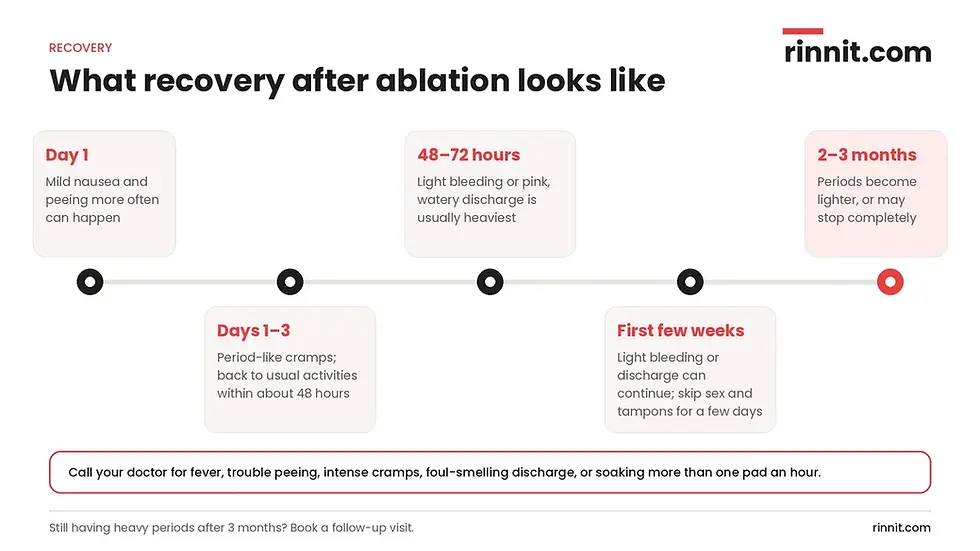
Timeframe | What is normal |
First day | Mild nausea and needing to pee more often |
Days 1–3 | Period-like cramps |
48–72 hours | Light bleeding or pink, watery discharge is usually at its heaviest |
First few weeks | Light bleeding or watery discharge may continue |
2–3 months | Periods become noticeably lighter, or stop |
Source for table: [1]
Your doctor will usually ask you to avoid sex and tampons for a few days. Keep all follow-up appointments, because full results can take several months to show. [1]
How does endometrial ablation affect your periods?
After endometrial ablation, most people have lighter periods, and some stop having periods altogether. [1]
Periods getting worse after ablation is not typical. Track how heavy and how regular your periods are over the following months and share this with your doctor. [1]
The procedure does not work for everyone. Over time, some people need further treatment, and about 12% have a hysterectomy within 5 years. [2]
Time after ablation | Share who had a hysterectomy |
1 year | 4.3% |
2 years | 8.0% |
3 years | 10.2% |
5 years | 12.4% |
10 years (2 studies) | 21.3% |
Source for table: [2]
Can you get pregnant after endometrial ablation?
Yes, pregnancy is still possible after endometrial ablation, but it is dangerous for both parent and baby. [1]
You keep ovulating, and some uterine lining remains. A pregnancy after ablation has a higher risk of miscarriage and serious complications. [1]
Research shows that continuing pregnancies after ablation have high rates of preterm birth, cesarean delivery and placenta that grows too deeply into the uterine wall. [3]
That is why reliable birth control is needed until menopause. Some people choose to have a tubal ligation at the same time as the ablation. [1]
What are the risks of endometrial ablation?
Endometrial ablation is considered safe, but like any procedure it carries some risks. [1]
Heavy bleeding
Allergic reaction
Infection
A puncture or burn of the uterus
Injury to nearby organs, such as the large intestine
Source: [1]
The benefits are meaningful for many people. Ablation can control heavy bleeding without daily medicine, and it carries less risk than removing the uterus. [1]
When should you call your doctor after endometrial ablation?
Call your doctor right away after endometrial ablation if you develop a fever, trouble peeing, intense cramping, foul-smelling vaginal discharge or heavy bleeding. [1]
Heavy bleeding means soaking more than one pad an hour for several hours. [1]
Book a follow-up visit if your periods are still heavy three months after the procedure. [1]
Conclusion
Endometrial ablation is a quick option for heavy periods that have not responded to medicine. It is done in minutes, recovery is short, and many people see lighter periods within two to three months.
It is not for everyone. It is best suited to people who are certain they are finished having children and willing to use birth control until menopause. Research also shows that some people need more treatment over time.
Heavy periods are common, but they are not something you have to live with. A clear conversation with your doctor about your bleeding, your plans and your options is the best next step.
Want to walk into your appointment prepared? Read our full guide to heavy menstrual bleeding, and explore more evidence-based women's health guides on rinnit.com.
FAQ
What is endometrial ablation used for?
Endometrial ablation is used to treat heavy menstrual bleeding when medicines have not helped. It destroys the uterine lining so periods become lighter or stop.
How long does endometrial ablation take?
Most endometrial ablation procedures take between 3 and 10 minutes, depending on the method. General anesthesia is usually not needed.
How long is recovery after endometrial ablation?
Most people return to their usual activities within 48 hours and feel like themselves within two to three days. Light bleeding or watery discharge can last a few weeks.
Will I still have periods after endometrial ablation?
Most people have lighter periods after endometrial ablation, and some stop having periods completely. It can take two to three months to see the full effect.
Can you get pregnant after endometrial ablation?
Yes, pregnancy is still possible after endometrial ablation, but it carries high risks of miscarriage and serious complications. Reliable birth control is needed until menopause.
Who should not have endometrial ablation?
Endometrial ablation is usually not recommended after menopause, with uterine cancer, with a uterine infection, or for people unwilling to use birth control afterward. Fibroids and endometrial hyperplasia may also rule it out.
What are the risks of endometrial ablation?
Risks of endometrial ablation include heavy bleeding, infection, an allergic reaction, a puncture or burn of the uterus, and injury to nearby organs such as the bowel.
When should I call my doctor after endometrial ablation?
Call your doctor if you have a fever, trouble peeing, intense cramping, foul-smelling discharge, or bleeding that soaks more than one pad an hour for several hours.
Is endometrial ablation the same as a hysterectomy?
No. Endometrial ablation destroys the lining of the uterus but leaves the uterus in place, while a hysterectomy removes the uterus. Ablation is less invasive and has a faster recovery.
Does endometrial ablation hurt?
You get anesthesia or numbing medicine, so the procedure itself should not be very painful. Cramping, like period cramps, is common for a day or two afterward and usually eases with pain relievers.
Further reading
On rinnit.com
External
Related Reading
Heavy Menstrual Bleeding (Menorrhagia): Symptoms, Causes, Diagnosis and Treatment explains causes of heavy periods and treatment options.
Hysterectomy (Surgical Removal of the Uterus) describes the types of uterus removal surgery and recovery.
Hysteroscopy: Procedure, Recovery, Risks and What to Expect explains how doctors look inside the uterus with a thin camera.
Uterine Artery Embolization: Effective Relief for Fibroids and Bleeding covers a nonsurgical treatment for fibroids and heavy bleeding.
References
Cleveland Clinic. Endometrial Ablation: Procedure, Side Effects & Recovery. Cleveland Clinic. Last updated January 7, 2025. https://my.clevelandclinic.org/health/treatments/21734-endometrial-ablation
Oderkerk TJ, Beelen P, Bukkems ALA, et al. Risk of hysterectomy after endometrial ablation: a systematic review and meta-analysis. Obstet Gynecol. 2023;142(1):51-60. PMID: 37290114. https://doi.org/10.1097/AOG.0000000000005223
Kohn JR, Shamshirsaz AA, Popek E, et al. Pregnancy after endometrial ablation: a systematic review. BJOG. 2018;125(1):43-53. PMID: 28952185. https://doi.org/10.1111/1471-0528.14854
Beelen P, Reinders IMA, Scheepers WFW, et al. Prognostic factors for the failure of endometrial ablation: a systematic review and meta-analysis. Obstet Gynecol. 2019;134(6):1269-1281. PMID: 31764738. https://doi.org/10.1097/AOG.0000000000003556
U.S. Food and Drug Administration. Endometrial Ablation for Heavy Menstrual Bleeding. FDA. Content current as of October 25, 2021. https://www.fda.gov/medical-devices/surgery-devices/endometrial-ablation-heavy-menstrual-bleeding
Medical disclaimer
This article is for general education only and does not replace advice, diagnosis or treatment from a qualified healthcare professional. Always talk with your doctor about your symptoms and treatment options. If you have severe bleeding, fever or intense pain after a procedure, seek medical care promptly.



Comments