Distal Splenorenal Shunt (DSRS): What It Is, How the Surgery Works, Recovery and Risks

Updated: 6 days ago
Written and medically reviewed by Dr. Baraa Alnahhal, MD · Last reviewed: October 2026 · How we review
Quick Answer: What is a distal splenorenal shunt?
Distal splenorenal shunt (DSRS) is a surgery that lowers pressure in the portal vein by detaching the spleen's vein and joining it to the left kidney vein, while blood keeps reaching the liver. It controls bleeding varices and other portal hypertension complications but does not cure the condition, so regular follow-up care is needed. [1]
What the research says
DSRS and TIPS control bleeding about equally, but TIPS needs far more repeat procedures. In a randomized trial of 140 people with Child-Pugh class A or B cirrhosis followed for 2–8 years, rebleeding was 5.5% after DSRS versus 10.5% after TIPS, and 5-year survival was 62% versus 61% (neither difference significant). Shunt blockage, narrowing and repeat procedures occurred in 11% after DSRS versus 82% after TIPS. (Henderson et al., Gastroenterology, 2006)
Shunts sharply reduce repeat bleeding compared with endoscopic treatment, with a trade-off in brain function. A review of 27 randomized trials (1,828 people) found shunts lowered rebleeding (risk ratio 0.40) with no clear effect on overall death (risk ratio 0.99), but raised acute hepatic encephalopathy (risk ratio 1.60). Shunt dysfunction was 7% after DSRS versus 47.1% after TIPS. The evidence certainty was rated very low. (Simonetti et al., Cochrane Database Syst Rev, 2020)
DSRS works in people with well-compensated cirrhosis, including after a failed TIPS. Among 119 patients treated over 20 years, recurrent variceal bleeding occurred in 5.4%, encephalopathy in 11.7%, 30-day mortality was 6.4% and 1-year survival was 85.9%. 13.5% later had a liver transplant without extra complications. (Elwood et al., Arch Surg, 2006)
Key takeaways
A distal splenorenal shunt reroutes blood from the spleen's vein into the left kidney vein to relieve portal vein pressure.
Doctors use it to prevent or control bleeding from swollen veins (varices) in the stomach or esophagus.
The operation takes about four hours under general anesthesia, followed by roughly 7–10 days in the hospital.
The risk of bleeding again is highest in the first month after surgery.
DSRS manages portal hypertension; it does not cure it, so regular lab tests and check-ups continue after surgery.
Distal splenorenal shunt at a glance
Feature | What to expect |
What it is | Surgery that creates a new path for blood flow (a shunt) using an existing vein |
Main goal | Ease portal vein pressure and prevent or control bleeding varices |
Veins involved | Splenic vein (from the spleen) joined to the left renal vein (from the kidney) |
Anesthesia | General — you are asleep and feel no pain |
Operation time | About 4 hours |
Hospital stay | About 7–10 days |
Shunt check | Angiogram within a week after surgery |
Highest-risk period | First month after surgery (risk of bleeding again) |
Cure? | No — it manages symptoms; follow-up care continues |
What is a distal splenorenal shunt?
A distal splenorenal shunt is an operation that eases high pressure in the portal vein, the large vein that carries blood from your digestive system to your liver. [1]
Surgeons use DSRS to control bleeding and other complications of portal hypertension. It cannot cure portal hypertension, but it often helps manage its symptoms. [1]
After DSRS, you will usually need regular testing and follow-up visits so your care team can check how you are doing. [1]
What is portal hypertension and why does it need treatment?
Portal hypertension is high blood pressure in the portal vein that develops when the vein becomes narrowed or blocked, most often because of liver damage such as cirrhosis. [1][3]
The high pressure forces blood out of the portal vein and into large new blood vessels called varices. These form in the stomach or esophagus. [1]
As pressure builds, varices swell and their thin walls weaken. They may:
Leak fluid into the belly, causing discomfort.
Burst and bleed — a medical emergency. [1]
How does a distal splenorenal shunt work?
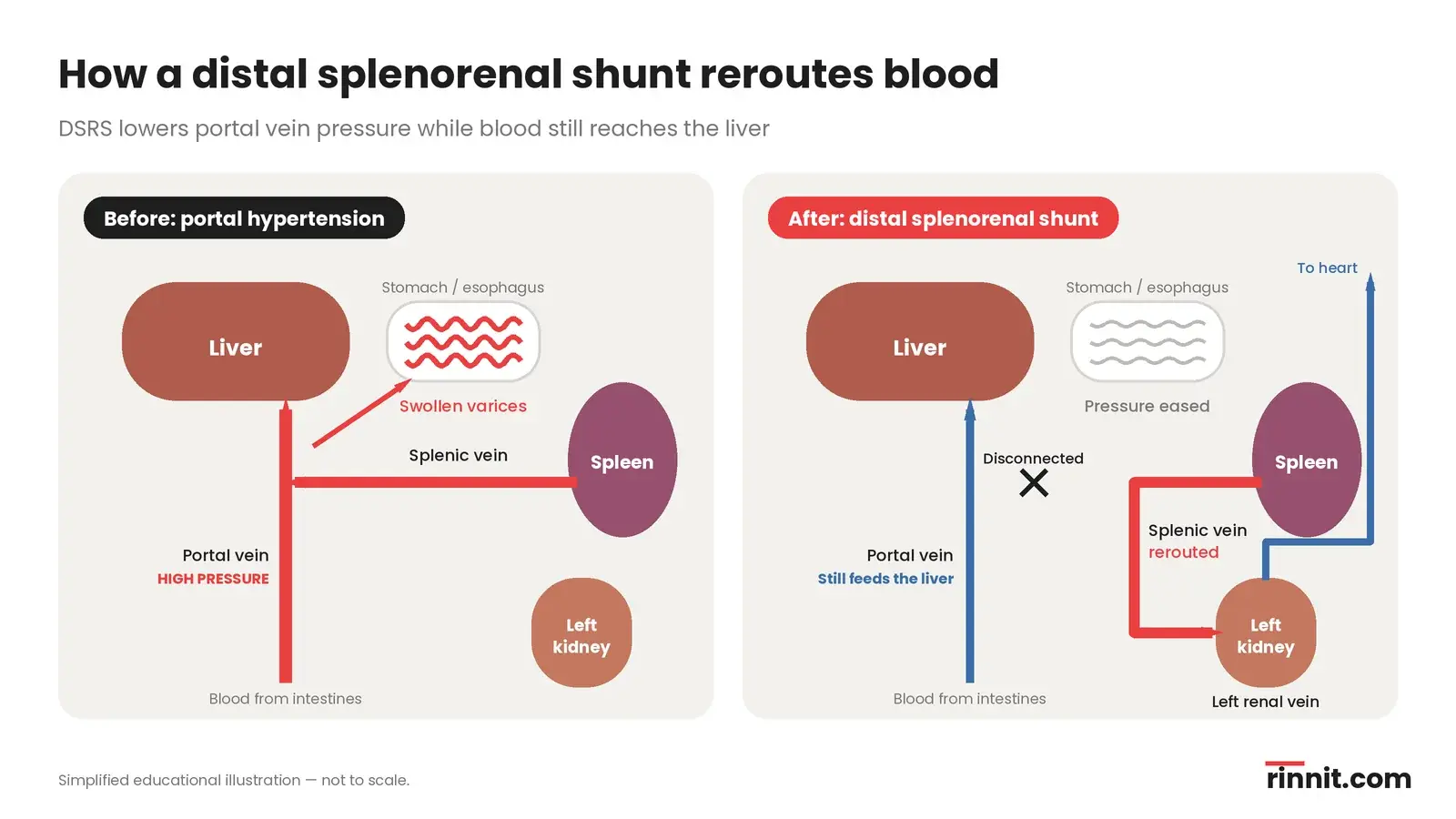
A distal splenorenal shunt works by moving blood flow away from the portal vein, which relieves pressure and eases swelling while blood continues flowing to the liver. [1]
During the operation, the surgeon:
Disconnects the splenic vein (the vein from your spleen) from the portal vein.
Attaches the splenic vein to the left renal vein (the vein from your left kidney).
This creates a new path that lets blood flow freely and takes pressure off the swollen veins. [1]
Who needs a distal splenorenal shunt?
People who need a distal splenorenal shunt usually have tests showing enlarged or bleeding veins in the stomach or esophagus caused by portal hypertension. [1]
Portal hypertension can also cause:
Complication | What it means |
Fluid buildup in the belly | |
Edema | Swelling in the legs and feet |
Blood in vomit or stool | Signs of bleeding in the digestive tract |
Gastrointestinal bleeding | Bleeding anywhere along the digestive tract |
An enlarged, overactive spleen | |
Hypoxemia | Low blood oxygen |
Kidney failure | Kidneys stop filtering waste well |
Mild cognitive impairment | Problems with memory or thinking |
Your healthcare provider weighs these findings when deciding whether DSRS is the right option for you. [1]
How is a distal splenorenal shunt different from TIPS and other shunts?
A distal splenorenal shunt differs from TIPS mainly in how the new path for blood is made: DSRS is open surgery that uses an existing vein, while TIPS is a minimally invasive, catheter-based procedure. [1][4]
TIPS (transjugular intrahepatic portosystemic shunt) connects the portal vein directly to the hepatic vein, which carries blood from the liver to the heart. Overall, TIPS is more common than DSRS. [1][4]
Shunt type | How it works | Key point |
Distal splenorenal shunt (DSRS) | Surgery joins the splenic vein to the left renal vein | Keeps blood flowing to the liver; spleen stays in place |
TIPS | Catheter places a channel between the portal vein and hepatic vein | Minimally invasive; more common overall |
Proximal splenorenal shunt | Surgical splenorenal shunt | Surgeons may need to remove the spleen (splenectomy) |
Spontaneous splenorenal shunt (SSRS) | Forms naturally in advanced liver disease | Blood reverses its flow when it cannot pass through the liver |
In head-to-head research, DSRS and TIPS controlled bleeding about equally, but TIPS needed repeat procedures far more often (11% versus 82%). [5]

How do you prepare for a distal splenorenal shunt?
Preparing for a distal splenorenal shunt starts with a review of your medical history, a physical exam and tests that check your overall health, your liver function and how severe the portal hypertension is. [1]
Tests may include:
Blood tests
Liver function tests
Chest X-ray
Electrocardiogram (EKG)
Angiogram (an X-ray of blood vessels)
Upper endoscopy
Your care team will also tell you:
Which medicines to stop.
What to bring to the hospital.
When to stop eating and drinking. [1]
Write down your questions before your visit so you feel comfortable and ready.
What happens during distal splenorenal shunt surgery?
Distal splenorenal shunt surgery typically takes about four hours and is done under general anesthesia, so you are asleep and feel no pain. [1]
The surgical team then:
Separates the vein attached to your spleen from your portal vein.
Attaches that vein to the vein of your left kidney. [1]
What happens after distal splenorenal shunt surgery?
After distal splenorenal shunt surgery, most people recover in the hospital for about a week to 10 days. [1]
While you are in the hospital, your care team:
Places a temporary catheter in your bladder to drain urine.
Passes a nasogastric (NG) tube through your nose into your stomach for 24 hours to remove gas and fluids.
Inserts an IV line in your neck to give medicines and fluids.
Sets you up with a pain pump that you control. [1]
Within a week of surgery, you have an angiogram to confirm the shunt is working. You start solid food and drinks once you are able to eat. Before you go home, a dietitian meets with you and may recommend a low-sodium, low-fat diet. [1]

What are the risks of a distal splenorenal shunt?
The main risk of a distal splenorenal shunt is bleeding again, and this risk is highest in the first month after surgery. Overall, DSRS is generally considered a safe and effective procedure. [1]
Your team works with you to manage this risk and keep you safe. [1]
Research also shows that shunts, including DSRS, can raise the chance of hepatic encephalopathy — confusion caused by toxins the liver normally clears. In one long-term series, 11.7% of patients developed encephalopathy after DSRS. [2][6]
How do you recover after a distal splenorenal shunt?
Recovering after a distal splenorenal shunt means following your provider's and dietitian's advice, keeping every follow-up appointment and having regular lab tests to check how well your liver is working. [1]
Ask your provider when you can return to your usual routine and physical activity. Your provider works with you over time to keep you stable and healthy. [1]
When should you call a doctor after a distal splenorenal shunt?
After a distal splenorenal shunt, contact your healthcare provider or call your local emergency number right away if you notice: [1]
Coughing
Difficulty breathing
Fainting
Fever
Chest pain
Sweating more than usual
Vomiting blood or passing blood in your stool can be a sign of bleeding and needs emergency care. [1]
Conclusion
A distal splenorenal shunt gives people with portal hypertension a lasting way to lower pressure in the portal vein and control dangerous bleeding from varices, while keeping blood flowing to the liver. It is a major operation with a hospital stay of about 7–10 days and a higher risk of bleeding in the first month, and it works best alongside regular follow-up care.
If you or someone you care for has been told you have varices or portal hypertension, use this guide to prepare your questions for your liver specialist or surgeon.
Keep learning: Explore our guides on portal hypertension and the portal vein, esophageal varices and the TIPS procedure — and save or share this page to bring to your next appointment.
FAQ
What is a distal splenorenal shunt used for?
A distal splenorenal shunt is used to prevent or control bleeding from swollen veins in the stomach or esophagus caused by portal hypertension. It also helps ease other complications of high portal vein pressure.
Does a distal splenorenal shunt cure portal hypertension?
No. A distal splenorenal shunt does not cure portal hypertension, but it often helps manage its symptoms. Regular tests and follow-up care continue after surgery.
How long does distal splenorenal shunt surgery take?
Distal splenorenal shunt surgery typically takes about four hours. It is done under general anesthesia, so you are asleep and feel no pain.
How long is the hospital stay after DSRS?
Most people stay in the hospital for about a week to 10 days after DSRS. An angiogram within the first week checks that the shunt is working.
Is DSRS better than TIPS?
DSRS and TIPS controlled bleeding about equally in a randomized trial of 140 people, with similar 5-year survival. TIPS needed repeat procedures much more often, so the choice depends on your condition and the expertise available.
What is the biggest risk after a distal splenorenal shunt?
The biggest risk after a distal splenorenal shunt is bleeding again, which is highest in the first month after surgery. Your care team monitors you closely during this time.
What diet is recommended after DSRS?
A dietitian meets with you before you leave the hospital and may recommend a low-sodium, low-fat diet. Follow your dietitian's and provider's advice as you recover.
When should I seek emergency care after DSRS?
Contact your healthcare provider or emergency services right away if you have coughing, difficulty breathing, fainting, fever, chest pain or sweating more than usual after DSRS.
Will I still need a liver transplant after a distal splenorenal shunt?
Possibly. DSRS controls bleeding from portal hypertension but does not treat the underlying liver disease, so some people still need a transplant later. Your liver team will keep checking whether one may be needed.
How is the shunt checked after surgery?
Your care team may use imaging tests, such as a Doppler ultrasound, to make sure the shunt stays open and blood flows the right way. Keep all your follow-up appointments.
Related Reading
Portal Hypertension: Complete Guide to Symptoms, Causes, Diagnosis, and Treatment explains what causes high pressure in the portal vein and how it is treated.
Esophageal Varices: Symptoms, Causes, and Treatment explains why swollen esophagus veins bleed and how they are treated.
TIPS Procedure: Transjugular Intrahepatic Portosystemic Shunt explains the TIPS procedure, a nonsurgical shunt for portal hypertension.
Hepatic Encephalopathy: Symptoms, Causes, and Treatment Explained describes the confusion caused by liver disease and how it is treated.
References
Cleveland Clinic. Distal Splenorenal Shunt: What It Is, Procedure & Complications. Cleveland Clinic. Last updated October 16, 2023. https://my.clevelandclinic.org/health/treatments/4950-distal-splenorenal-shunt
Elwood DR, Pomposelli JJ, Pomfret EA, et al. Distal splenorenal shunt: preferred treatment for recurrent variceal hemorrhage in the patient with well-compensated cirrhosis. Arch Surg. 2006;141(4):385-388. PMID: 16618897. https://doi.org/10.1001/archsurg.141.4.385
Merck Manual. Portal Hypertension. Merck Manual Consumer Version. Last updated March 2026. https://www.merckmanuals.com/home/liver-and-gallbladder-disorders/manifestations-of-liver-disease/portal-hypertension
American Liver Foundation. Transjugular Intrahepatic Portosystemic Shunt (TIPS). American Liver Foundation. Last updated August 17, 2023. https://liverfoundation.org/liver-diseases/treatment/transjugular-intrahepatic-portosystemic-shunt-tips/
Henderson JM, Boyer TD, Kutner MH, et al. Distal splenorenal shunt versus transjugular intrahepatic portal systematic shunt for variceal bleeding: a randomized trial. Gastroenterology. 2006;130(6):1643-1651. PMID: 16697728. https://doi.org/10.1053/j.gastro.2006.02.008
Simonetti RG, Perricone G, Robbins HL, et al. Portosystemic shunts versus endoscopic intervention with or without medical treatment for prevention of rebleeding in people with cirrhosis. Cochrane Database Syst Rev. 2020;10(10):CD000553. PMID: 33089892. https://doi.org/10.1002/14651858.CD000553.pub3
Medical disclaimer
This article is for educational purposes only and is not a substitute for professional medical advice, diagnosis or treatment. Always talk to your doctor or another qualified healthcare provider about your health, and seek emergency care right away for symptoms such as vomiting blood, fainting, chest pain or difficulty breathing.



Comments