Splenectomy: Procedure, Recovery, and Long-Term Care

Updated: 3 days ago
Medically reviewed by Dr. Baraa Alnahhal, MD · Last reviewed: October 2026
A splenectomy is the surgical removal of the spleen, a fist-sized organ in the upper left abdomen that filters blood and fights infection [1]. While the body can function normally without a spleen as the liver and bone marrow assume its duties, patients face a lifelong increased risk of serious infections [1] [3]. The procedure is typically performed laparoscopically with a 2–3 day hospital stay, though open surgery may be required for emergencies or significantly enlarged organs [1].
Quick Answer
A splenectomy is a major surgical procedure to remove the spleen, often because of trauma, blood disorders or certain cancers [1]. Most elective cases use minimally invasive laparoscopic techniques, with discharge within a few days and return to normal activity over several weeks. Because the spleen is key to immunity, strict vaccination and infection prevention are required afterward.
What the research says
Infection risk after splenectomy depends on why the spleen was removed. In a single-center review of 106 splenectomy patients, the infection rate within 5 years was 42% after removal for non-traumatic reasons (disease, or together with a distal pancreatectomy) compared with 14.0% after trauma (p = 0.0040) (Camejo et al., Langenbeck's Archives of Surgery, 2022 [2]).
The risk of overwhelming infection is lifelong. A systematic review of splenic autotransplantation (18 studies) describes a lifelong risk of overwhelming sepsis after splenectomy from encapsulated bacteria, most commonly Streptococcus pneumoniae, and notes it has not been confirmed that autotransplantation gives meaningful protection against overwhelming post-splenectomy infection (Surendran et al., ANZ Journal of Surgery, 2020 [3]).
When is a splenectomy needed?
A splenectomy is rarely the first line of treatment unless a medical emergency occurs. Healthcare providers typically exhaust nonsurgical options before recommending the procedure [1]. The most common reasons for removal include traumatic injury and chronic blood conditions that do not respond to medication.
Condition Category | Specific Indications |
Trauma | Ruptured spleen causing life-threatening internal bleeding from abdominal impact. |
Blood Disorders | ITP, polycythemia vera, thalassemia, sickle cell anemia, and hemolytic anemia. |
Cancers | Hodgkin and non-Hodgkin lymphoma, chronic lymphocytic leukemia, and hairy cell leukemia. |
Organ Issues | Enlarged spleen (splenomegaly), overactive spleen (hypersplenism), or splenic abscesses. |
Benign Growths | Large noncancerous cysts or tumors that interfere with surrounding organ function. |

What happens during a splenectomy?
Surgeons typically utilize one of two primary methods to remove the spleen: laparoscopy or open surgery. The choice depends on the size of the spleen, the patient's overall health, and whether the surgery is an elective or emergency procedure. Both methods are performed under general anesthesia, ensuring the patient is asleep and pain-free throughout the operation [1].
Laparoscopic Splenectomy
In the majority of elective cases, surgeons prefer a laparoscopic approach due to its minimally invasive nature. This technique involves inflating the abdomen with carbon dioxide gas to create a workspace, followed by the insertion of a laparoscope—a thin rod with a camera—through small incisions [1]. Tiny surgical instruments are then used to detach and remove the organ, resulting in smaller scars and a faster overall recovery period.
Open Splenectomy
Open surgery involves a single, larger incision across the abdomen. This approach is generally reserved for emergency situations where rapid access is needed to control bleeding, or when the spleen has become so enlarged that it cannot be safely removed through small laparoscopic ports [1]. If complications arise during a laparoscopic attempt, the surgeon may convert to an open procedure to ensure patient safety [1].

What are recovery and long-term health like after a splenectomy?
The recovery timeline varies based on the surgical method used. Patients undergoing laparoscopic surgery are typically discharged within two to three days, while open surgery patients may require five to seven days of hospital monitoring [1]. The primary focus after surgery is the prevention of infection, as the body's natural defenses are permanently altered.
Infection Prevention Protocols
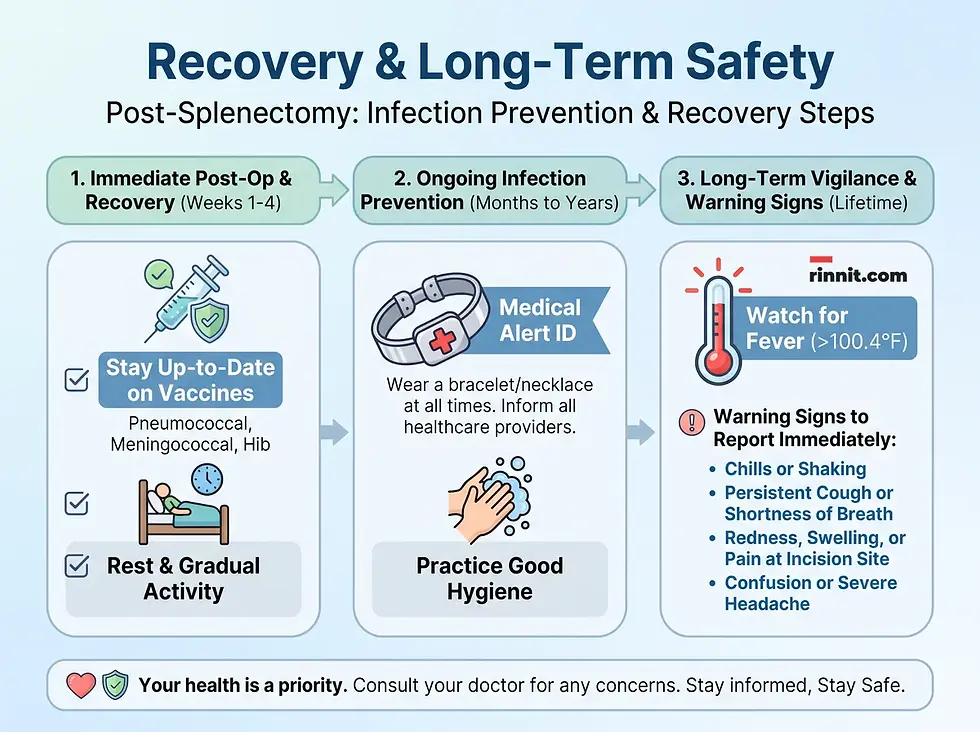
Without a spleen, the body is more vulnerable to certain bacterial and viral infections. Patients must maintain a rigorous vaccination schedule, often starting several weeks before an elective surgery [1]. In some cases, particularly for children under five or immunocompromised individuals, daily antibiotics may be prescribed to provide a constant layer of protection against life-threatening pathogens [1].
Warning Signs and OPSI
Overwhelming post-splenectomy infection (OPSI) is a rare but extremely serious complication [1]. Patients are advised to carry a medical alert card or wear a bracelet to inform emergency responders of their condition [1]. Immediate medical attention is required if any signs of infection develop, as these can progress rapidly without a functioning spleen.
Symptom | Action Required |
Fever (100.4°F / 38°C) | Contact healthcare provider or visit ER immediately. |
Chills or Shaking | Seek urgent medical evaluation. |
Vomiting or Severe Nausea | Monitor closely and report to a doctor. |
Redness at Incision | Check for signs of localized infection or drainage. |
Uncontrolled Pain | Consult the surgical team for pain management adjustment. |
Conclusion
A splenectomy is a life-saving intervention for many patients facing trauma or chronic illness. While the removal of the spleen necessitates lifelong vigilance regarding infection, most individuals return to a full and active lifestyle with a normal life expectancy [1]. By following vaccination protocols, maintaining open communication with healthcare providers, and recognizing early warning signs, patients can successfully navigate the challenges of living without a spleen.
Next step: If you have been scheduled for this procedure, ensure your immunizations are current and discuss a long-term infection management plan with your surgical team.
Frequently Asked Questions
Can I live a normal life without a spleen?
Yes, you can live a normal, healthy life with a standard lifespan after your spleen is removed. Other organs, primarily the liver and bone marrow, take over the spleen's functions of filtering blood and fighting infection. However, you will need to take lifelong precautions to prevent serious infections.
What is the most common reason for a splenectomy?
The most common reasons for spleen removal are traumatic injury causing a ruptured spleen and the treatment of various blood disorders. When a spleen ruptures, it can cause life-threatening internal bleeding, making immediate surgical removal necessary to save the patient's life.
How long does it take to recover from spleen surgery?
Recovery depends on the surgical method. Laparoscopic patients usually stay in the hospital for two to three days, while open surgery requires five to seven days. Most people can return to their normal daily activities within a few weeks, though complete internal healing may take longer.
Why do I need vaccines before or after a splenectomy?
Because the spleen plays a major role in your immune system, its removal makes you more susceptible to certain infections. Vaccines help your body build defenses against these specific bacteria and viruses before the organ is gone or shortly after to compensate for the loss.
Is a splenectomy considered a major surgery?
Yes, a splenectomy is considered a major surgery because it involves the removal of a significant internal organ. It is only recommended when it is a medical emergency or when other nonsurgical treatments for blood disorders or cancers have failed to produce results.
What are the risks of living without a spleen?
The primary risk is an increased susceptibility to infections, including a rare but life-threatening condition called overwhelming post-splenectomy infection (OPSI). Other risks include a higher vulnerability to certain travel-related illnesses like malaria and complications from tick-borne diseases like babesiosis.
Will I need to take antibiotics for the rest of my life?
Not everyone needs daily antibiotics. Lifelong daily antibiotics are typically reserved for high-risk groups, such as children under five years old or individuals with weakened immune systems. However, all patients are usually given emergency antibiotics to take at the first sign of an infection.
How does a laparoscopic splenectomy differ from open surgery?
Laparoscopic surgery is minimally invasive, using several small incisions and a camera to guide the surgeon, leading to faster recovery and smaller scars. Open surgery uses one large incision and is typically reserved for emergencies or when the spleen is too large for laparoscopy.
What precautions should I take when traveling without a spleen?
When traveling, you should be aware of the increased risk of certain infections, particularly malaria and babesiosis. It is important to discuss your travel plans with a healthcare provider to ensure you have the necessary preventive medications and up-to-date vaccinations for your destination.
What should I do if I develop a fever after my splenectomy?
If you develop a fever of 100.4°F (38°C) or higher, you must seek medical attention immediately. Because you lack a spleen, a simple infection can turn into a life-threatening emergency very quickly. Always inform medical staff that you have had a splenectomy.
How do I prepare for a splenectomy?
Because living without a spleen raises infection risk, vaccinations often start several weeks before an elective splenectomy. Make sure your immunizations are current and discuss a long-term infection management plan with your surgical team [1].
What anesthesia is used for a splenectomy?
Both laparoscopic and open splenectomy are performed under general anesthesia, so you are asleep and pain-free during the operation [1].
Related Reading
References
Cleveland Clinic. Splenectomy. Cleveland Clinic. Last updated January 11, 2024. https://my.clevelandclinic.org/health/procedures/14614-splenectomy
Camejo L, Nandeesha N, Phan K, et al. Infectious outcomes after splenectomy for trauma, splenectomy for disease and splenectomy with distal pancreatectomy. Langenbeck's Archives of Surgery. 2022;407(4):1685-1691. PMID 35075620. https://doi.org/10.1007/s00423-022-02446-3
Surendran A, Smith M, Houli N, et al. Splenic autotransplantation: a systematic review. ANZ Journal of Surgery. 2020;90(4):460-466. PMID 31576640. https://doi.org/10.1111/ans.15383
Medical disclaimer
The information provided in this article is for educational purposes only and should not be used as a substitute for professional medical advice, diagnosis, or treatment. Always seek the advice of your physician or other qualified health provider with any questions you may have regarding a medical condition.



Comments