TIPS Procedure: Transjugular Intrahepatic Portosystemic Shunt

Updated: 3 days ago
Medically reviewed by Dr. Baraa Alnahhal, MD | Last reviewed: October 7, 2026
Quick Answer
A TIPS procedure (transjugular intrahepatic portosystemic shunt) places a small metal stent inside the liver to connect the portal vein to a hepatic vein [1], rerouting blood around high-pressure areas caused by liver scarring. It is mainly used for complications such as ascites and bleeding varices [1]. An interventional radiologist performs it through the neck, typically in one to two hours [1].
What the research says
Early TIPS improves survival in high-risk variceal bleeding. An individual patient data meta-analysis of 8 studies (1,389 high-risk patients with cirrhosis and acute variceal bleeding) found that placing a TIPS within 72 hours of admission lowered the risk of death compared with drugs plus endoscopy (hazard ratio 0.43, 95% CI 0.32–0.60) (Nicoară-Farcău et al., Hepatology, 2024) [2].
Early TIPS lowered rebleeding without a significant rise in hepatic encephalopathy. A meta-analysis of 3 randomized trials and 6 observational studies (2,878 participants) found that early TIPS reduced all-cause death (RR 0.64, 95% CI 0.52–0.79) and rebleeding (RR 0.40, 95% CI 0.23–0.71), with no significant increase in hepatic encephalopathy (RR 1.13, 95% CI 0.92–1.38); the survival benefit appeared in high-risk patients but not low-risk ones (Zhou et al., European Radiology, 2021) [3].
The procedure usually succeeds, and serious procedure-related complications are uncommon. In a single-center study of 948 patients who received covered-stent TIPS, 95.1% of procedures were technically successful, major procedure-related complications occurred in 3.2% of patients (30 patients), and 0.84% of patients died from them (Yin et al., Frontiers in Medicine, 2022) [4].
What is the TIPS procedure?
The Transjugular Intrahepatic Portosystemic Shunt, commonly referred to as the TIPS procedure, is a critical intervention for people with severe complications from liver disease. When the liver becomes heavily scarred or diseased, blood flow through the portal vein slows or is blocked, leading to a condition known as portal hypertension [1]. The extra pressure pushes blood into smaller, weaker veins, which can burst and bleed [1] or leak fluid into the abdomen and chest. For a deeper look at the condition itself, see our complete guide to portal hypertension.
The main goal of a TIPS procedure is to create an artificial channel within the liver that lets blood flow more freely. By connecting the high-pressure portal vein to a lower-pressure hepatic vein, the procedure reroutes blood and lowers the overall pressure [1]. This relief helps prevent life-threatening internal bleeding and manage chronic fluid accumulation [1].
When is a TIPS procedure needed, and how do you prepare?
A TIPS procedure is typically considered for people with portal hypertension from severe liver disease [1], including those who have not responded well to other treatments. It can help with several specific conditions [1].
Medical Indications for TIPS
Condition | Description |
Ascites | Chronic fluid buildup in the abdominal cavity. |
Budd-Chiari Syndrome | A condition that affects the hepatic veins, so blood backs up into the liver and spleen. |
Hepatic Hydrothorax | Water buildup in the chest cavity due to cirrhosis. |
Hepatopulmonary Syndrome | Severe liver disease affects blood vessels in the lungs, causing low oxygen levels. |
Swollen Veins (Varices) | Enlarged veins in the esophagus or stomach that are at risk of bleeding. |
Hepatorenal Syndrome | Kidney failure that severe liver disease may cause. |
Preoperative Preparation
Preparing for a TIPS procedure involves several tests to help keep you safe. Healthcare providers typically order liver and kidney function tests, as well as a blood test to check how long it takes your blood to clot [1]. Imaging, such as a CT scan [1], may also be done to map the liver's anatomy.
Your radiologist may tell you to stop eating or drinking at least eight hours before the procedure [1]. Tell them about all the medications you take, including over-the-counter medications and herbal supplements [1]. Also report any allergies, especially to latex or anesthesia [1]. Plan to stay in the hospital overnight for one or more days after the procedure [1].
What happens during the TIPS procedure?
The TIPS procedure is a minimally invasive intervention usually performed by an interventional radiologist. It uses imaging technology to guide the stent into place without large abdominal incisions. You will receive either general anesthesia, so you are asleep, or sedation, so you are semi-awake and very drowsy but should not feel pain [1].
Procedural Steps
Once you are lying on the procedure table and have received anesthesia, your radiologist will [1]:
Make a tiny cut in your neck and place a catheter, a thin flexible tube, into your right internal jugular vein.
Move the catheter down into a hepatic vein on the right side of your liver.
Use ultrasound to locate your portal vein.
Place a metal stent that reaches from your portal vein to your hepatic vein.
Check that the stent is diverting blood from your portal vein to your hepatic vein.
Remove the catheter.
The entire process typically takes one to two hours [1]. Your team will then move you to a recovery room and check on you as you wake up from anesthesia [1].

What are recovery and long-term care like after a TIPS procedure?
Recovery from a TIPS procedure is gradual and needs careful monitoring in the hospital and at home. While you are still in the hospital, your care team will watch for side effects such as bleeding or infection, and your radiologist may do follow-up imaging to confirm the stent works [1]. The procedure itself is relatively quick, but its full effect on conditions like ascites can take weeks or months to show [1].
Post-Operative Milestones
Milestone | Expected Timeline and Care |
Hospital Observation | Most people stay 1–2 days for monitoring of bleeding or infection [1]. |
Strenuous Activity | Avoid lifting more than 10 pounds, and take it easy, for at least 10 days [1]. |
Hydration | Drink at least 8 glasses of water daily to help your body clear ascites fluid [1], unless your care team gives you different fluid instructions. |
Follow-up Imaging | Periodic scans to confirm the stent remains open and working. |
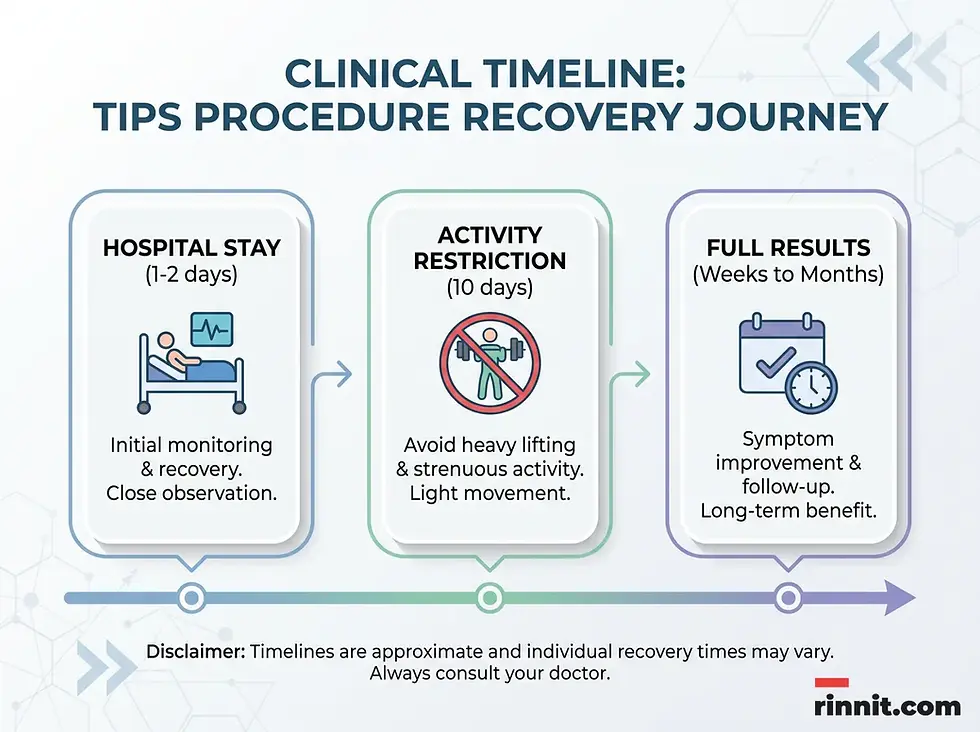
Rest well during the first part of recovery. A TIPS procedure addresses the complications of portal hypertension, but it does not treat the underlying liver disease [1]. Ongoing management of the primary condition remains a critical part of your long-term care, and your provider can explain how the procedure may affect your outlook.
What are the outcomes and potential complications of a TIPS procedure?
Research shows that most TIPS procedures are technically successful. For example, a single-center study of 948 patients reported a technical success rate of 95.1% [4]. As with any complex intervention, there are risks to weigh.
Benefits
The main benefit of the TIPS procedure is that it relieves pressure on the veins in your liver [1]. This can stop internal bleeding and fluid backup [1], and it can make chronic fluid buildup easier to manage, which may improve comfort and mobility.

Possible Complications
TIPS may cause the following complications [1]:
Hepatic encephalopathy: Because the shunt lets blood bypass part of the liver's filtering system, toxins can build up in the blood and affect brain function. This is one of the most significant risks.
Hemobilia: Bleeding from or into the liver ducts.
Hemoperitoneum: Bleeding into the peritoneal cavity, the space that contains abdominal and pelvic organs.
Liver failure: The procedure may affect the liver's ability to meet the body's needs, which happens in people with advanced liver disease.
Organ failure: Changes in blood flow can affect how one or more organs work.
Contact your healthcare provider or go to the emergency room if you have severe confusion, drowsiness, or involuntary movements such as facial twitches. These are symptoms of hepatic encephalopathy, a life-threatening complication [1].
Conclusion
The TIPS procedure is an effective intervention for managing the life-threatening complications of portal hypertension. By creating a functional bypass within the liver, it can help control bleeding and fluid accumulation for people with advanced liver disease. It carries real risks, particularly hepatic encephalopathy, so the decision should be made with your care team.
Next Steps
If you or a loved one has complications from liver disease, such as persistent fluid buildup or internal bleeding, talk with a hepatologist or an interventional radiologist. They can run the necessary evaluations to determine whether a TIPS procedure is the right path. Discussing the specific benefits and risks in the context of your overall health will help you make an informed decision.
Frequently Asked Questions
What does TIPS stand for?
TIPS stands for transjugular intrahepatic portosystemic shunt.
Is the TIPS procedure a major surgery?
The TIPS procedure is minimally invasive, using a small cut in the neck and imaging guidance, but it is complex and requires specialized care and monitoring.
How long does the procedure take?
A TIPS procedure typically lasts one to two hours, followed by a period of observation in a recovery room.
Will I be awake during the procedure?
You will receive either general anesthesia, so you are asleep, or sedation, so you are semi-awake and very drowsy but should not feel pain. Your anesthesiologist will discuss which type you will have.
How long is the hospital stay?
Most people stay in the hospital for one to two days so the care team can watch for bleeding or infection.
What is the success rate of the TIPS procedure?
In a single-center study of 948 patients who received covered-stent TIPS, 95.1% of procedures were technically successful.
Does the TIPS procedure cure liver disease?
No. It treats the complications of portal hypertension but does not treat the underlying liver disease.
What is the most serious risk of TIPS?
Hepatic encephalopathy, in which toxins build up in the blood and affect the brain, is one of the most significant risks. Liver failure can also occur in people with very advanced liver disease.
How long does it take to see results?
The shunt starts lowering pressure in the portal vein once it is in place, but fluid buildup such as ascites can take weeks or months to go away.
Can the stent become blocked?
Yes. Stents can narrow or block over time, which is why follow-up imaging is important.
Are there activity restrictions after the procedure?
Yes. Take it easy for at least 10 days, and do not lift anything that weighs more than 10 pounds during that time.
Why do I need to drink so much water after the procedure?
Cleveland Clinic advises drinking at least eight glasses of water a day to help your body get rid of fluid buildup from ascites. Ask your care team for fluid instructions that fit your situation.
Who performs the TIPS procedure?
A radiologist, typically an interventional radiologist, performs it.
What symptoms should I watch for at home?
Contact your healthcare provider or go to the emergency room if you have severe confusion, drowsiness, or involuntary movements such as facial twitches. These are symptoms of hepatic encephalopathy, a life-threatening complication.
Is the TIPS procedure permanent?
The stent is designed to be permanent, although it may need maintenance or revision if it becomes narrow.
How do I prepare for the TIPS procedure?
Before TIPS you have blood tests of liver function, kidney function and clotting time, plus imaging such as a CT scan [1]. You may be told to stop eating and drinking at least eight hours beforehand, and you should tell the radiologist about every medication you take, including over-the-counter drugs and herbal supplements, as well as any allergies, including latex, and any past reaction to anesthesia [1]. An anesthesiologist will discuss whether you will have general anesthesia or sedation, and you should plan for an overnight hospital stay or longer [1].
Sources
Cleveland Clinic. TIPS Procedure (Transjugular Intrahepatic Portosystemic Shunt). Cleveland Clinic. Last updated July 27, 2025. https://my.clevelandclinic.org/health/procedures/tips-procedure
Nicoară-Farcău O, Han G, Rudler M, et al. Pre-emptive TIPS in high-risk acute variceal bleeding. An updated and revised individual patient data meta-analysis. Hepatology. 2024;79(3):624-635. PMID 37782566. https://doi.org/10.1097/HEP.0000000000000613
Zhou GP, Jiang YZ, Sun LY, et al. Early transjugular intrahepatic portosystemic shunt for acute variceal bleeding: a systematic review and meta-analysis. Eur Radiol. 2021;31(7):5390-5399. PMID 33409783. https://doi.org/10.1007/s00330-020-07525-x
Yin X, Gu L, Zhang M, et al. Covered TIPS procedure-related major complications: incidence, management and outcome from a single center. Front Med (Lausanne). 2022;9:834106. PMID 35602500. https://doi.org/10.3389/fmed.2022.834106
Related Reading
Medical disclaimer
This information is for educational purposes only and does not constitute medical advice. Always consult a healthcare professional for diagnosis and treatment.



Comments