Catheter Ablation: How It Works, Success Rates, Risks and Recovery

Updated: 6 days ago
Written and medically reviewed by Dr. Baraa Alnahhal, MD · Last reviewed: October 2026 · How we review
Quick Answer: What is catheter ablation?
Catheter ablation is a minimally invasive heart procedure that treats abnormal heart rhythms by threading thin tubes through a blood vessel to the heart and using heat, cold or pulsed energy to create tiny scars that block faulty electrical signals. It usually takes two to four hours, and people often go home the same day or the next. [1]
What the research says
Pulsed field ablation works as well as heat or cold ablation for paroxysmal AFib. In a randomized trial of 607 people with drug-resistant paroxysmal atrial fibrillation, 73.3% treated with pulsed field ablation and 71.3% treated with conventional heat or cold ablation stayed free of the primary failure events at 1 year; serious procedure-related events were 2.1% vs 1.5%. (Reddy et al., N Engl J Med, 2023)
Ablation cuts AFib recurrence compared with rhythm drugs. In a trial of 2,204 people with atrial fibrillation followed for a median of about 4 years, AFib came back in 49.9% of the ablation group vs 69.5% of the drug group. The combined rate of death, disabling stroke, serious bleeding or cardiac arrest was 8.0% vs 9.2%, a difference that was not statistically significant. (Packer et al., JAMA, 2019)
In people with AFib and heart failure, ablation lowered death and hospital stays. Among 363 people with AFib and a weak heart pump (ejection fraction 35% or less), death or hospitalization for worsening heart failure occurred in 28.5% after ablation vs 44.6% with medical therapy over a median of 37.8 months; death from any cause was 13.4% vs 25.0%. (Marrouche et al., N Engl J Med, 2018)
Key takeaways
Catheter ablation fixes the "short circuit" behind many fast heart rhythms by scarring a tiny area of heart tissue.
It is done through a blood vessel, usually in the groin, so the chest is never opened.
Success is highest for supraventricular tachycardia (90%–95%) and lower for AFib, atrial tachycardia and ventricular tachycardia (60%–80%).
Recovery from the procedure takes hours, but the heart can take up to three months to heal fully.
Most people return to desk work in five to seven days and avoid heavy lifting for at least a week.

How does catheter ablation work?
Catheter ablation works by creating small, controlled scars in the exact spot where an abnormal heart rhythm starts. These scars block the faulty electrical impulses so they can no longer trigger an arrhythmia. [1]
A heart rhythm specialist guides thin, flexible tubes called catheters through a blood vessel and into the heart. Once there, the catheter delivers energy to the problem tissue.
The scars are placed carefully so they affect only the tissue involved in the faulty rhythm. They do not cause lasting pain in the heart or harm how the heart pumps.
What types of energy are used in cardiac ablation?
Cardiac ablation uses one of three types of energy to create the scars: heat, cold or short bursts of electrical energy. [1]
Ablation type | Energy used | What sets it apart |
Radiofrequency ablation | Heat | The long-established method; involves some X-ray radiation exposure |
Cryoablation | Extreme cold | Freezes the target tissue to form the scar |
Pulsed field ablation | Very short, high-voltage electrical bursts | Targets heart muscle with little effect on nearby nerves or the esophagus |
What conditions does catheter ablation treat?
Catheter ablation treats most types of fast heart rhythms. It is often a first-line option for rhythms that cause symptoms or threaten life, and it is commonly offered when medicines don't control the rhythm or cause side effects. [1] [5]
Condition | What happens in the heart | Why it matters |
Upper chambers (atria) beat irregularly and ineffectively | Pooled blood can form clots that travel and cause a stroke | |
Upper chambers beat too fast in a regular circuit | Carries a similar clot and stroke risk | |
Supraventricular tachycardia (SVT), such as AVNRT | Sudden episodes of very fast heartbeats, up to 300 beats per minute | Repeated or long episodes can damage the heart over time |
A fast rhythm starting from one spot in the atria | Can cause palpitations and fatigue | |
Lower chambers (ventricles) beat too rapidly | Potentially dangerous; can lead to cardiac arrest |
Can catheter ablation help after a cardiac arrest?
Catheter ablation can help people at high risk of sudden cardiac arrest when the cause isn't obvious. The specialist first runs an electrophysiology study, using special catheters to record the heart's rhythm from the inside and find which abnormal rhythm caused the arrest. If an abnormal rhythm is found, it can be ablated in the same session. [1]
How do you prepare for catheter ablation?
Preparing for catheter ablation mainly involves adjusting medicines, fasting and arranging a ride home. Your care team will give you exact instructions. [1]
Blood thinners: You may be asked to pause medicines such as apixaban, rivaroxaban or warfarin. Stop them only as directed.
Fasting: You'll usually stop eating and drinking for several hours, often from midnight before the procedure.
Ride home: Arrange for someone to drive you home from the hospital.
Clothing: Wear comfortable clothes and leave jewelry and valuables at home.
IV line: A small intravenous line is placed in your arm for medicines, including sedation or anesthesia.
What happens during catheter ablation?
During catheter ablation, you receive sedation or sometimes general anesthesia, so you stay relaxed even if you're awake. The procedure follows seven main steps: [1]
The care team shaves, cleans and numbs the skin over a blood vessel, usually in the groin (sometimes the arm, leg or neck).
A small tube called a sheath is placed into the vein or artery to create an access point.
Electrode catheters are threaded through the sheath and up to the heart, guided by X-ray imaging.
The specialist maps the heart's electrical activity to find the exact problem tissue.
The catheter delivers energy to that tissue to block the irregular rhythm.
The catheters and sheath are removed.
Special plugs or stitches are applied to stop bleeding at the access site.
How long does catheter ablation take?
Catheter ablation usually takes two to four hours, and it can take longer. The exact time varies from person to person, depending on the rhythm being treated.
Is catheter ablation major surgery?
Catheter ablation is not major surgery. It is done through the blood vessels, the chest is not opened, and the only opening is the small puncture where the catheter enters the vessel.
Is catheter ablation painful?
Catheter ablation usually causes only mild, short-lived discomfort, and many people feel little or nothing. Afterward, the puncture site may be sore and bruised, but it is very small and tends to heal quickly.
How successful is catheter ablation?
Catheter ablation success depends on the type of abnormal rhythm being treated. Rates are highest for supraventricular tachycardia and lower for more complex rhythms. [1]
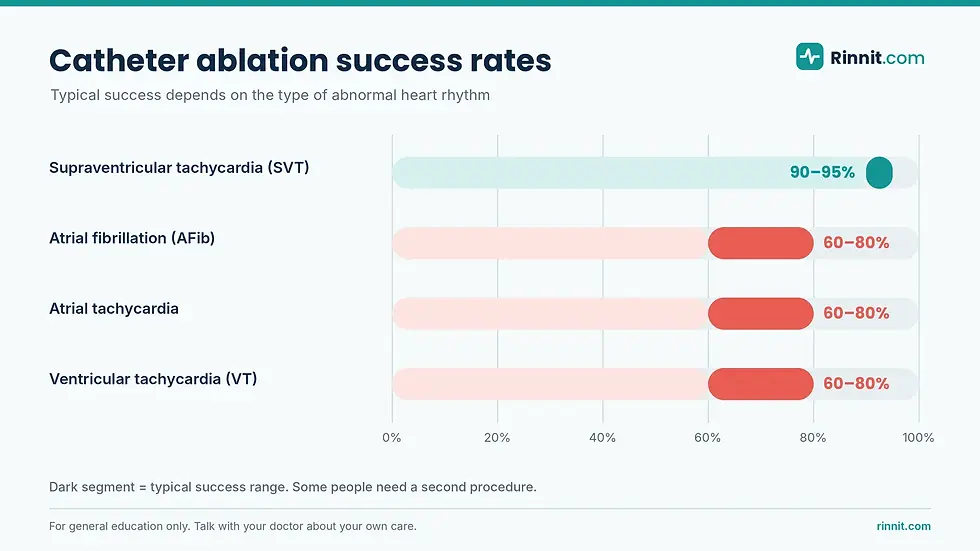
Heart rhythm | Typical success rate |
Supraventricular tachycardia (SVT) | 90%–95% |
Atrial fibrillation (AFib) | 60%–80% |
Atrial tachycardia | 60%–80% |
Ventricular tachycardia (VT) | 60%–80% |
When the procedure works, the effect isn't always immediate. Symptoms may continue for several weeks before improving, and some people need a second ablation later.
What are the benefits of catheter ablation?
The main benefit of catheter ablation is restoring a normal heart rhythm when medicines fail or cause unwanted side effects. In some cases, the procedure can be lifesaving. [1]
Because it is minimally invasive, it usually doesn't require a long hospital stay. Pulsed field ablation adds a safety advantage by focusing on the abnormal heart muscle while sparing nearby tissue such as nerves and the esophagus.
What are the risks of catheter ablation?
Catheter ablation risks are low, and complications are rare, especially at hospitals that perform many ablations. Large national data show that hospitals doing fewer ablations had a higher risk of complications. [6]
Possible risks include: [1]
Blood clots
Damage to a blood vessel from the sheath or catheter
Damage to heart tissue or heart valves
Infection or bleeding
Stroke
Needing a permanent pacemaker (newer options include a leadless pacemaker)
Catheter ablation usually involves some radiation exposure from X-ray guidance, whatever type of energy is used. If you're pregnant, ask your doctor whether the procedure can safely wait until after delivery.
What is the recovery time after catheter ablation?
Recovery from catheter ablation itself takes only a few hours, but the full effect of the ablation can take several weeks to appear. The heart tissue keeps healing for about three months. [1]

Time after ablation | What to expect |
First 6–8 hours | Monitoring in a recovery room by a nurse; you may go home that day or stay overnight |
First week | No heavy lifting (over 10 pounds / about 4.5 kg) and no strenuous exercise |
5–7 days | Most people with non-physical jobs feel ready to return to work |
First 3 months | Some irregular rhythms are normal while the heart tissue heals |
Up to 1 year | Follow-up visits; a repeat procedure may be needed if symptoms return |
Your doctor may prescribe a blood thinner, such as apixaban, to help prevent blood clots. You may take it for several months or longer, depending on your medical history.
Ask your doctor when it's safe to drive and return to physical activity.
When should you call a doctor after catheter ablation?
Call your doctor after catheter ablation if you notice bleeding or swelling at the puncture site, chest pain, dizziness, nausea, leg numbness, or a racing heartbeat with severe symptoms. [1]
Bleeding, a lump, swelling or pain at the puncture site
Chest pain
Dizziness or lightheadedness
Nausea or vomiting
Numbness, pain or tingling in your leg (if the groin was used)
A racing heartbeat with severe symptoms, such as dizziness, shortness of breath or chest pain, or one lasting three hours or more
Get emergency care right away if you notice face drooping or arm weakness. These are signs of a stroke. After AFib ablation, also get emergency care for fever, chest pain or painful swallowing in the first weeks, or for vomiting blood, which can signal a rare but serious injury to the food pipe.
Conclusion
Catheter ablation is a proven, minimally invasive way to correct many fast heart rhythms without open surgery. It works best for SVT, works well for many people with AFib, flutter and VT, and carries a low risk of complications, especially at experienced centers.
Recovery is quick in daily terms, but patience matters: the heart can take up to three months to settle fully. Knowing what to expect at each stage can make the experience far less stressful.
Living with an abnormal heart rhythm? Bring your questions to a heart rhythm specialist, and keep learning with our plain-language guides to atrial fibrillation, left atrial appendage closure and heart arrhythmias.
Frequently asked questions
Is catheter ablation the same as cardiac ablation?
Yes. Catheter ablation and cardiac ablation are two names for the same procedure, which uses catheters inside the heart to treat abnormal rhythms.
Are you awake during a heart ablation?
You usually receive sedation, which keeps you relaxed even if you're awake. Some people receive general anesthesia instead.
How long do you stay in the hospital after ablation?
Most people stay six to eight hours after the procedure. Depending on your condition, you may go home the same day or stay overnight.
Can AFib come back after ablation?
Yes. Irregular rhythms are common during the first three months while the heart heals. If symptoms return after that, a repeat ablation may be considered.
When can I exercise after catheter ablation?
Avoid strenuous exercise and lifting more than 10 pounds for at least a week. Ask your doctor before returning to full activity.
Will I need blood thinners after ablation?
Many people take a blood thinner, such as apixaban, for several months or longer to lower the risk of clots. The length depends on your medical history.
Does catheter ablation leave a scar on the skin?
Only a tiny puncture mark at the entry site, usually in the groin. It may bruise but should heal quickly.
How long does catheter ablation take?
Catheter ablation usually takes two to four hours and sometimes longer. The time depends on the rhythm being treated.
Is catheter ablation painful?
Most people feel only mild, short-lived discomfort, and many feel little or nothing. The spot where the catheter went in may be sore and bruised for a few days.
How successful is catheter ablation?
Success depends on the rhythm. It works best for supraventricular tachycardia, at about 90% to 95%, and less often for AFib, atrial tachycardia and ventricular tachycardia, at about 60% to 80%.
Helpful external resources
Related Reading
Pulmonary Vein Isolation (PVI): Ablation for Atrial Fibrillation explains pulmonary vein isolation.
Chemical Cardioversion: Medicines, Procedure and Risks explains chemical cardioversion.
Maze Procedure for AFib: How It Works, Success Rate and Recovery explains the maze procedure for AFib.
Cardioversion: Procedure, Types, Risks and Recovery explains how cardioversion resets an abnormal heart rhythm.
Electrophysiology (EP) Study: Why It's Done, What Happens and Recovery explains the catheter test that maps the heart's electrical system to diagnose arrhythmias.
References
Cleveland Clinic. Cardiac (Heart) Ablation: Procedure Details & Recovery. Cleveland Clinic. Last updated November 7, 2025. https://my.clevelandclinic.org/health/treatments/16851-catheter-ablation
Reddy VY, Gerstenfeld EP, Natale A, et al. Pulsed Field or Conventional Thermal Ablation for Paroxysmal Atrial Fibrillation. N Engl J Med. 2023;389(18):1660-1671. PMID: 37634148. https://doi.org/10.1056/NEJMoa2307291
Packer DL, Mark DB, Robb RA, et al. Effect of Catheter Ablation vs Antiarrhythmic Drug Therapy on Mortality, Stroke, Bleeding, and Cardiac Arrest Among Patients With Atrial Fibrillation: The CABANA Randomized Clinical Trial. JAMA. 2019;321(13):1261-1274. PMID: 30874766. https://doi.org/10.1001/jama.2019.0693
Marrouche NF, Brachmann J, Andresen D, et al. Catheter Ablation for Atrial Fibrillation with Heart Failure. N Engl J Med. 2018;378(5):417-427. PMID: 29385358. https://doi.org/10.1056/NEJMoa1707855
American Heart Association. Ablation for Arrhythmias. Heart.org. Last reviewed October 24, 2024. https://www.heart.org/en/health-topics/arrhythmia/prevention--treatment-of-arrhythmia/ablation-for-arrhythmias
Hosseini SM, Rozen G, Saleh A, et al. Catheter Ablation for Cardiac Arrhythmias: Utilization and In-Hospital Complications, 2000 to 2013. JACC Clin Electrophysiol. 2017;3(11):1240-1248. PMID: 29759619. https://doi.org/10.1016/j.jacep.2017.05.005
Medical disclaimer
This article is for general education only and does not replace advice from your doctor. Always talk with a qualified healthcare professional about your symptoms and treatment options. If you think you're having a medical emergency, call your local emergency number right away.



Comments