Cardioversion: Procedure, Types, Risks and Recovery

Updated: 2 days ago
Written and medically reviewed by Dr. Baraa Alnahhal, MD · Last reviewed: November 2026 · How we review
Quick Answer
Cardioversion is a treatment that resets an abnormal heart rhythm to normal. Electrical cardioversion uses a brief, controlled shock through pads on the chest and back under sedation; chemical cardioversion uses medicine. It's most often used for atrial fibrillation and atrial flutter. The visit takes about four to six hours, and most people go home the same day.
What the research says
Many AFib episodes stop on their own: in a trial of people with new atrial fibrillation in the emergency department, waiting and watching restored normal rhythm in 91% by 4 weeks versus 94% with early cardioversion, and 69% of the waiting group converted on their own within 48 hours (Pluymaekers NAHA et al., New England Journal of Medicine, 2019) [2]
Pad placement doesn't change success: in 12 trials with 2,046 patients, placing pads front-to-back or front-to-side gave similar success for electrical cardioversion of atrial fibrillation (Virk SA et al., Heart, Lung and Circulation, 2022) [3]
Key takeaways
Cardioversion resets an abnormal heart rhythm.
Electrical cardioversion uses a brief shock while you're asleep; chemical cardioversion uses medicine.
It's most often used for atrial fibrillation and atrial flutter.
Most people go home the same day.
Don't drive for 24 hours afterward.
What is cardioversion?
Your heart's electrical system controls each heartbeat. In some arrhythmias, the signals become fast or chaotic. Cardioversion interrupts the abnormal rhythm so the heart's natural pacemaker can take over again. It differs from defibrillation, which uses a stronger shock in a cardiac arrest. Sources: [1]
Why it's done

Symptoms include a pounding heart, shortness of breath, dizziness and fatigue.
Atrial fibrillation, the most common reason.
Atrial flutter.
Atrial tachycardia.
Ventricular tachycardia or ventricular fibrillation, where it can be lifesaving. Sources: [1]
It can ease symptoms such as a pounding or fluttering heart, shortness of breath, chest discomfort, dizziness and extreme tiredness. Leaving some rhythms untreated can raise the risk of stroke or heart attack. Sources: [1]
Types of cardioversion

Your provider chooses the best approach for your rhythm.
Type | How it works | Timing |
Electrical | A brief shock through pads or paddles on your chest and back | Works within minutes |
Chemical | Medicine by mouth or IV | Minutes, hours or days; in the hospital or at home |
Sources: [1]
How to prepare
Arrange for an adult to drive you home.
Ask how to take blood thinners, diabetes medicines or insulin.
Don't eat, drink or chew anything, including gum, after midnight.
Don't wear lotion, powder or deodorant on your chest and back, and leave jewelry at home.
Bring a list of your medicines.
You may have a transesophageal echocardiogram (TEE) first to check for blood clots. Sources: [1]
What happens during electrical cardioversion
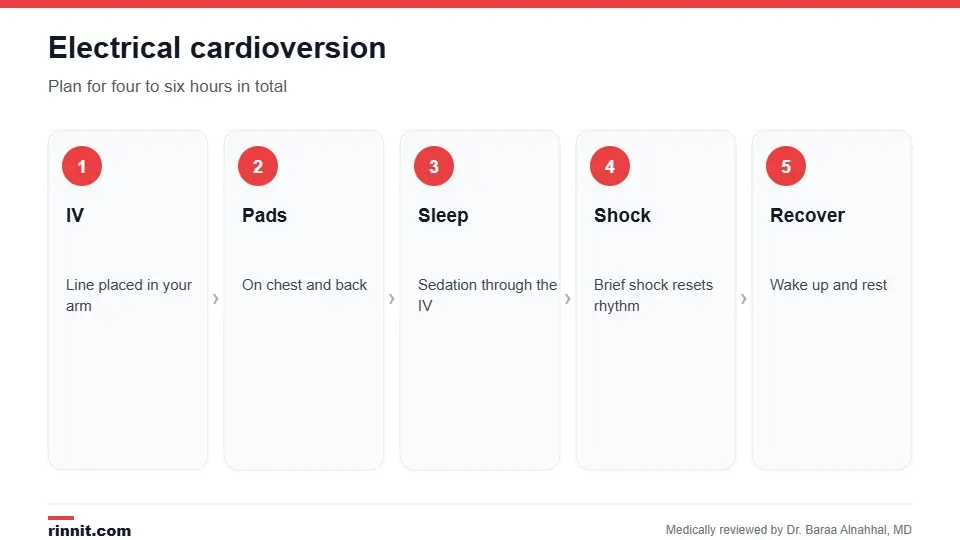
The shock takes a few minutes; plan for four to six hours in total.
An IV is placed, and EKG patches and shock pads go on your chest and sometimes your back.
Medicine through the IV puts you to sleep.
A brief shock is delivered through the pads; more than one may be needed.
Your heart rhythm, oxygen and blood pressure are watched closely.
You wake up in a few minutes and rest in recovery. Sources: [1]
The shock isn't painful because you're asleep. Sources: [1]
Risks
Risk | Notes |
Skin irritation or burns from pads | Usually mild and temporary |
Bruising at the IV | Mild |
Blood clot causing a stroke | Rare; blood thinners and a TEE lower the risk |
Worsening rhythm | Uncommon |
Allergic reaction to medicine | Rare |
Sources: [1]
Recovery
You may feel drowsy as the sedation wears off.
Your chest may be tender for a few days; hydrocortisone cream may help.
Most people go home the same day.
Don't drive for 24 hours.
You may need medicines to keep a normal rhythm or prevent clots. Sources: [1]
Results
Cardioversion often restores a normal rhythm, eases symptoms and can help your heart work better. It's one part of care that also includes medicines, heart-healthy habits and follow-up visits. Some rhythms return over time. Sources: [1, 2, 3]
When to call your provider
Your symptoms come back.
Symptoms are severe or don't go away.
Call 911 for chest pain, fainting or stroke symptoms. Sources: [1]
Conclusion
Cardioversion is a quick, safe way to reset an abnormal heart rhythm, usually with a same-day visit. Following your medicine plan afterward helps keep your rhythm normal.
Keep learning: read about atrial fibrillation and catheter ablation.
Frequently asked questions
What is cardioversion?
A treatment that resets an abnormal heart rhythm to normal.
Does cardioversion hurt?
No. You're asleep during the shock; your chest may be sore afterward.
What does cardioversion treat?
Mostly atrial fibrillation and atrial flutter.
How long does it take?
A few minutes for the shock; about four to six hours in total.
What's the difference between electrical and chemical cardioversion?
Electrical uses a shock; chemical uses medicine.
Can I go home the same day?
Usually, yes.
When can I drive?
After 24 hours.
What is a TEE?
An ultrasound through the throat to check the heart for clots before cardioversion.
What are the risks?
Skin irritation and, rarely, a stroke from a blood clot.
Will my abnormal rhythm come back?
It can; medicines and follow-up help prevent it.
Related Reading
Chemical Cardioversion: Medicines, Procedure and Risks explains chemical cardioversion.
Atrial Fibrillation (AFib): Symptoms, Causes & Treatment Guide the most common reason for cardioversion.
Heart Arrhythmia: Symptoms, Types, Causes, Diagnosis & Treatment — Complete Guide abnormal heart rhythms explained.
Defibrillation: How an Electrical Shock Restarts a Normal Heart Rhythm a stronger shock used in cardiac arrest.
Catheter Ablation: How It Works, Success Rates, Risks and Recovery a procedure to prevent AFib from returning.
Persistent Atrial Fibrillation: Understanding Long-Term Arrhythmia long-lasting atrial fibrillation.
References
Cleveland Clinic. Cardioversion: Procedure, Treatment & Recovery. Cleveland Clinic. Last updated April 28, 2022. https://my.clevelandclinic.org/health/treatments/16952-electrical-cardioversion
Pluymaekers NAHA, Dudink EAMP, Luermans JGLM, et al. Early or delayed cardioversion in recent-onset atrial fibrillation. New England Journal of Medicine. 2019;380(16):1499-1508. PMID 30883054. https://doi.org/10.1056/NEJMoa1900353
Virk SA, Rubenis I, Brieger D, et al. Anteroposterior versus anterolateral electrode position for direct current cardioversion of atrial fibrillation: a meta-analysis of randomised controlled trials. Heart, Lung and Circulation. 2022;31(12):1640-1648. PMID 36163316. https://doi.org/10.1016/j.hlc.2022.08.016
Medical disclaimer
This article is for general education only and does not replace advice from a qualified healthcare professional. Talk to your doctor about your own diagnosis and treatment, and seek emergency care right away for severe or sudden symptoms.



Comments