Defibrillation: How an Electrical Shock Restarts a Normal Heart Rhythm

Updated: 6 days ago
Written and medically reviewed by Dr. Baraa Alnahhal, MD · Last reviewed: October 2026 · How we review
Quick Answer: What is defibrillation?
Defibrillation is an emergency treatment that uses a controlled electrical shock to stop a life-threatening rhythm in the heart's lower chambers, such as ventricular fibrillation or pulseless ventricular tachycardia, so a normal beat can return. It works best when given within the first 10 minutes. If someone collapses, call emergency services, start CPR and use an AED. [1][2]
What the research says
Every minute of delay lowers survival. In 6,789 in-hospital cardiac arrests caused by ventricular fibrillation or pulseless ventricular tachycardia at 369 hospitals, shocks delayed beyond 2 minutes (30.1% of cases) were linked to survival to discharge of 22.2%, compared with 39.3% when the shock was not delayed. (Chan et al., N Engl J Med, 2008 [7]
Bystander AED use is linked to better survival. A systematic review of 44 observational studies and 3 randomized trials pooled the 6 higher-quality observational studies and found that bystander AED use was associated with higher survival to hospital discharge (odds ratio 1.73) and better neurological recovery (odds ratio 2.12). (Holmberg et al., Resuscitation, 2017 [8]
Defibrillation strongly predicts a returning pulse. A meta-analysis of 49 studies and 63,378 out-of-hospital cardiac arrest patients in China found that return of spontaneous circulation was far more likely in people who received defibrillation (odds ratio 8.52). (Zhou et al., Eur J Med Res, 2023 [9]
Key takeaways
Defibrillation treats two deadly rhythms: ventricular fibrillation and ventricular tachycardia without a pulse. [1]
Speed is everything — a shock can save a life when given within the first 10 minutes of ventricular fibrillation. [1]
Anyone can use an AED; it analyzes the rhythm and gives spoken instructions. [1][3]
People at high risk may wear a vest-style defibrillator or have an ICD implanted. [1][3]
Recovery after cardiac arrest can take months or years and often needs rehabilitation. [1][6]
What is defibrillation?
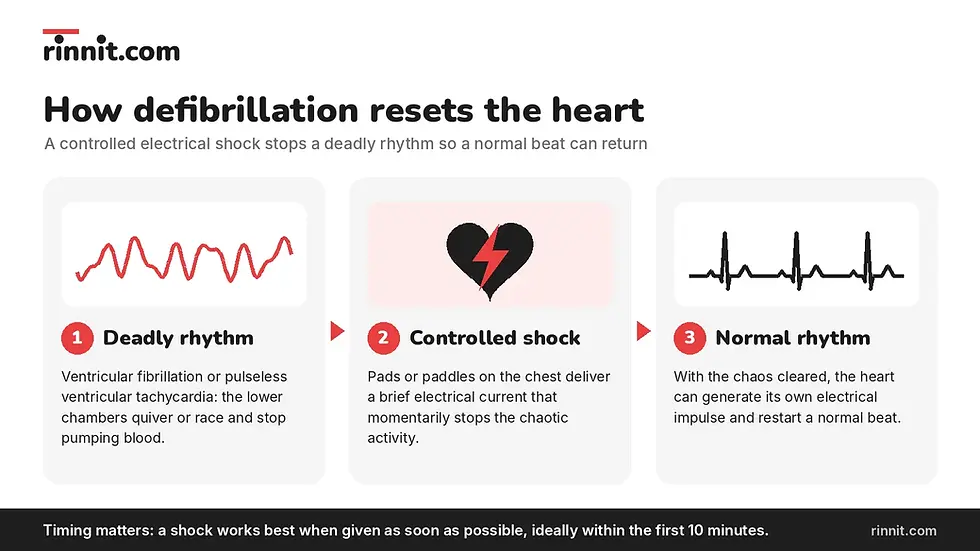
Defibrillation is the use of an electrical current to help the heart return to a normal rhythm when a potentially fatal arrhythmia (abnormal heart rhythm) starts in the lower chambers, called the ventricles. [1]
The shock briefly stops the heart muscle's chaotic activity. That pause lets the heart generate its own electrical impulse and restart a normal rhythm — in essence, defibrillation restarts the heart. [1]
It is closely related to electrical cardioversion, which also uses a controlled shock to reset the heart's rhythm. Defibrillation is most effective when the shock is delivered as soon as possible after the dangerous rhythm begins. [1][2]
Which heart rhythms need defibrillation?
Defibrillation is used for two life-threatening rhythms that start in the ventricles: ventricular fibrillation and ventricular tachycardia without a pulse. [1] Ventricular fibrillation is the most common cause of sudden cardiac arrest. [1][4]
Rhythm | What happens in the heart | Does it need a shock? |
The heart muscle quivers instead of pumping blood | Yes — the main reason for defibrillation | |
The heart beats so fast that no pulse can be felt | Yes | |
Other rhythms | The ventricles are not in fibrillation or pulseless tachycardia | No — a shock can trigger ventricular fibrillation and cardiac arrest |
Both rhythms belong to the wider group of ventricular arrhythmias. For a broader overview of rhythm problems, see our heart arrhythmia guide.
What types of defibrillators are there?
Defibrillators come in four main forms: automated external defibrillators (AEDs), hospital devices with paddles or pads, wearable defibrillators and implantable defibrillators. [1][3]
Type | Where it is used | Who operates it | Key feature |
AED | Airports and other public places | Any bystander | Analyzes the rhythm, charges itself and gives spoken instructions |
Paddles or sticky pads | Hospitals and emergency care | Healthcare providers | Pads or paddles are placed on the chest and the shock is triggered by button |
Worn daily under clothing | Works automatically | Skin sensors detect an abnormal rhythm and deliver a shock | |
Inside the body | Works automatically | Watches for arrhythmias and delivers the right amount of shock |
An ICD keeps the heart beating much like a pacemaker, but it can also deliver a shock when a fatal rhythm is detected. [1] Defibrillation can still be performed on someone who already has a pacemaker or an ICD. [1]

Who needs a personal defibrillator?
People at high risk of a potentially fatal heart rhythm need a defibrillator with them at all times; others can be helped by an AED or a hospital team. [1]
These people may use a vest-like wearable cardioverter defibrillator, worn under clothing so the sensors touch the skin, or an implanted ICD. [1][3] Shocks from personal defibrillators can range from painless to a sensation like being kicked in the chest. [1]
How common is defibrillation?
Cardiac arrest is common: in the United States alone, more than 184,000 people outside hospitals and about 200,000 people in hospitals have a cardiac arrest each year and may receive defibrillation. [1]
What happens before defibrillation?
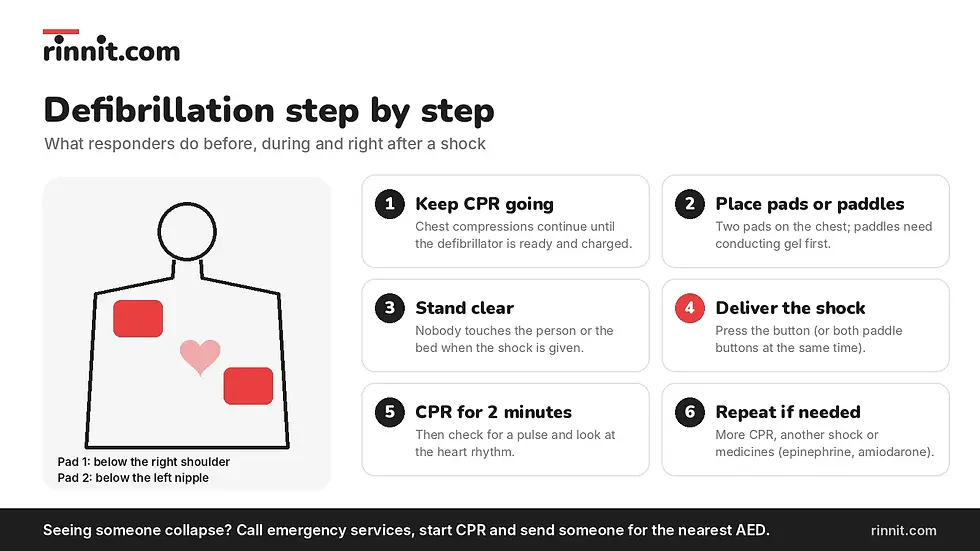
Before defibrillation, a first responder or healthcare provider keeps doing CPR until the defibrillator is ready and charged. [1][5]
Just before the shock, they make sure no one is touching the person or the bed. [1] An AED found in a public place examines the heart's rhythm on its own to decide whether a shock is needed, then charges itself and gives spoken instructions. [1]
What happens during defibrillation?
During defibrillation, two paddles or sticky pads attached to the defibrillator are placed on the chest and a button releases the electrical charge. [1]
Pad placement: one pad goes below the right shoulder and the other below the left nipple. [1]
Burn prevention: sticky pads contain conducting material; paddles need conducting material applied to the chest first. [1]
Delivering the shock: with pads, the provider presses one button on the defibrillator; with paddles, they press the button on each paddle at the same time. [1]
What happens after defibrillation?
After a shock, the care team restarts CPR for two minutes, then checks for a pulse and looks at the heart rhythm. [1][5]
Step after the shock | Why it is done |
CPR for 2 minutes | Keeps blood moving while the heart recovers |
Pulse and rhythm check | Shows whether a normal rhythm has returned |
More CPR and another shock | Used if the dangerous rhythm continues |
Medicines (epinephrine or amiodarone) | Given if defibrillation has not worked |
Careful temperature control at 32–37.5 °C (89.6–99.5 °F), preventing fever | For people still unresponsive after circulation returns |
Cardiac catheterization | May follow once the person is stable |
What are the benefits of defibrillation?
The main benefit of defibrillation is survival: it can save a person's life when given within the first 10 minutes of ventricular fibrillation. [1] Defibrillation gives a person a real chance to survive sudden cardiac arrest, and CPR helps bridge the gap until a defibrillator arrives. [1][5]
What are the risks of defibrillation?
The main risk of defibrillation is shocking the wrong rhythm: a shock given to someone who does not have ventricular fibrillation or pulseless ventricular tachycardia may cause ventricular fibrillation and cardiac arrest. [1]
An AED analyzes the rhythm first to decide whether a shock is needed. [1] Defibrillation also does not guarantee survival — cardiac arrest is still fatal for many people. [1]
What does recovery after defibrillation look like?
Recovery after cardiac arrest and defibrillation is a long-term process that takes months or years for many survivors. [1][6]
Recovery issue | What survivors may face |
Ongoing impairment | Up to 40% of survivors cannot return to work or normal daily activities when they leave the hospital |
Fatigue | Common and often long-lasting |
Rib fracture | May need time to heal after CPR |
Seizures or trouble walking | Can appear during recovery |
Rehabilitation | Occupational, physical and/or speech therapy may be needed |
People who survive ventricular fibrillation are very likely to have it again, so doctors treat the underlying cause and may recommend an ICD. [1][4] Anyone with an ICD needs regular checkups to make sure it is working, and the battery usually needs replacing after about five years. [1]
When should you call for help or see a doctor?
Call emergency services right away if you see someone collapse, start CPR and ask someone to bring the nearest AED. [1][5]
If you have had defibrillation or live with an ICD:
Keep taking the medicines your doctor prescribed. [1]
Attend regular visits so your ICD can be checked. [1]
Stick with physical and other therapies — progress takes time and patience. [1]
Defibrillation at a glance
Question | Short answer |
What it does | Stops a deadly ventricular rhythm so a normal beat can return |
Rhythms treated | Ventricular fibrillation and pulseless ventricular tachycardia |
Best timing | As soon as possible — ideally within the first 10 minutes |
Devices | AED, hospital paddles or pads, wearable defibrillator, ICD |
Main risk | Shocking a non-shockable rhythm can trigger ventricular fibrillation |
Recovery | Months to years; therapy often needed |
Conclusion
Defibrillation gives people in sudden cardiac arrest a chance to survive — but only if it comes fast. A controlled shock stops ventricular fibrillation or pulseless ventricular tachycardia so the heart can restart a normal rhythm, while CPR keeps blood flowing until the shock arrives. For people at high risk, wearable and implantable defibrillators keep that protection close at all times. Survival is the first step; recovery often takes months of therapy and follow-up.
Know what to do before it happens. Learn where the AEDs are in your workplace and community, take a CPR class, and read our guides on sudden cardiac arrest, ventricular fibrillation and life with an ICD to understand the full picture.
FAQ
What is defibrillation used for?
Defibrillation is used to stop ventricular fibrillation and pulseless ventricular tachycardia, two rhythms that can cause sudden cardiac arrest. The shock lets the heart restart a normal rhythm.
Can anyone use an AED?
Yes. An AED analyzes the heart rhythm on its own, decides whether a shock is needed, charges itself and gives spoken instructions, so a bystander can use it while waiting for help.
How soon does defibrillation need to happen?
Defibrillation works best as soon as possible after the dangerous rhythm starts. It can save a life when given within the first 10 minutes of ventricular fibrillation, and CPR should continue until the device is ready.
Where are defibrillator pads placed?
One pad goes below the right shoulder and the other below the left nipple. Sticky pads contain conducting material; paddles need conducting material applied to the chest first.
Can you defibrillate someone who has a pacemaker or ICD?
Yes. Defibrillation can be performed even if the person already has a pacemaker or an implantable cardioverter defibrillator (ICD).
Is defibrillation painful?
Shocks from personal defibrillators, such as an ICD or wearable device, can range from painless to feeling like a kick in the chest.
What are the risks of defibrillation?
Shocking someone who does not have ventricular fibrillation or pulseless ventricular tachycardia may cause ventricular fibrillation and cardiac arrest. Defibrillation also does not guarantee survival.
How long is recovery after defibrillation?
Recovery after cardiac arrest and defibrillation often takes months or years. Up to 40% of survivors have some impairment at discharge, and many need physical, occupational or speech therapy.
What is the difference between defibrillation and cardioversion?
Defibrillation is an emergency shock for a heart that has stopped pumping because of a deadly rhythm. Cardioversion is usually a planned, timed shock to fix a fast but not immediately deadly rhythm, such as atrial fibrillation.
Should I start CPR before the AED arrives?
Yes. Call 911 and start hands-only CPR right away by pushing hard and fast in the center of the chest. Keep going until the AED is ready and tells you to stop.
Related Reading
Cardioversion: Procedure, Types, Risks and Recovery explains how cardioversion resets an abnormal heart rhythm.
CPR: How to Perform It, Steps and When to Use It explains how to perform CPR in an emergency.
References
Cleveland Clinic. What is Defibrillation Used For? Cleveland Clinic. Last updated May 10, 2022. https://my.clevelandclinic.org/health/treatments/23021-defibrillation
Goyal A, Chhabra L, Singh B, et al. Defibrillation. StatPearls. Last updated March 23, 2025. https://www.ncbi.nlm.nih.gov/books/NBK499899/
National Heart, Lung, and Blood Institute. Defibrillators. NHLBI Health Topics. Last updated June 6, 2023. https://www.nhlbi.nih.gov/health-topics/defibrillators
Mitchell LB. Ventricular Fibrillation. Merck Manual Consumer Version. Last updated September 2026. https://www.merckmanuals.com/home/heart-and-blood-vessel-disorders/abnormal-heart-rhythms/ventricular-fibrillation
Schlesinger SA. Cardiopulmonary Resuscitation (CPR) in Adults. Merck Manual Professional Version. Last updated September 2026. https://www.merckmanuals.com/professional/critical-care-medicine/cardiac-arrest-and-cpr/cardiopulmonary-resuscitation-cpr-in-adults
Sawyer KN, Camp-Rogers TR, Kotini-Shah P, et al. Sudden Cardiac Arrest Survivorship: A Scientific Statement From the American Heart Association. Circulation. 2020;141(12):e654-e685. PMID 32078390. https://doi.org/10.1161/CIR.0000000000000747
Chan PS, Krumholz HM, Nichol G, et al. Delayed time to defibrillation after in-hospital cardiac arrest. N Engl J Med. 2008;358(1):9-17. PMID 18172170. https://doi.org/10.1056/NEJMoa0706467
Holmberg MJ, Vognsen M, Andersen MS, et al. Bystander automated external defibrillator use and clinical outcomes after out-of-hospital cardiac arrest: A systematic review and meta-analysis. Resuscitation. 2017;120:77-87. PMID 28888810. https://doi.org/10.1016/j.resuscitation.2017.09.003
Zhou G, Wang Y, Sun Z, et al. Survival outcome among patients with out-of-hospital cardiac arrest who received cardiopulmonary resuscitation in China: a systematic review and meta-analysis. Eur J Med Res. 2023;28(1):8. PMID 36600249. https://doi.org/10.1186/s40001-022-00955-x
Disclaimer
This article is for general educational purposes only and does not replace professional medical advice, diagnosis or treatment. If you think someone is having a medical emergency, call your local emergency number immediately.



Comments