CPR: How to Perform It, Steps and When to Use It

Updated: 2 days ago
Written and medically reviewed by Dr. Baraa Alnahhal, MD · Last reviewed: November 2026 · How we review
Quick Answer
CPR (cardiopulmonary resuscitation) is an emergency procedure for cardiac arrest, when the heart suddenly stops pumping blood. Start it if someone is unresponsive and not breathing normally. Call 911, send someone for an AED, then push hard and fast in the center of the chest: at least 2 inches deep and 100 to 120 times a minute.
What the research says
Bystander CPR saves lives: across 79 studies of 142,740 people who had cardiac arrest outside the hospital, only 7.6% survived to go home, but survival was higher when a bystander gave CPR, which happened in just 32% of cases (Sasson C et al., Circ Cardiovasc Qual Outcomes, 2010) [2]
Hands-only CPR works for adults: in 3 trials of dispatcher-guided bystander CPR, compression-only CPR led to slightly better survival than standard CPR with breaths (14% vs 12%) (Hüpfl M et al., Lancet, 2010) [3]
Key takeaways
CPR keeps blood flowing to the brain when the heart stops.
Start CPR if someone is unresponsive and not breathing normally.
Push hard and fast: at least 2 inches deep, 100 to 120 times a minute.
Hands-only CPR works well for adults.
Use an AED as soon as one arrives.
What is CPR?
In sudden cardiac arrest, the heart stops pumping, and the brain can be damaged within minutes without oxygen. CPR doesn't restart the heart, but it moves blood until a defibrillator can shock the heart back into rhythm. Most cardiac arrests outside the hospital happen at home, so anyone can save a life by learning CPR. This guide follows the 2025 American Heart Association guidelines. Sources: [1]
When to do CPR
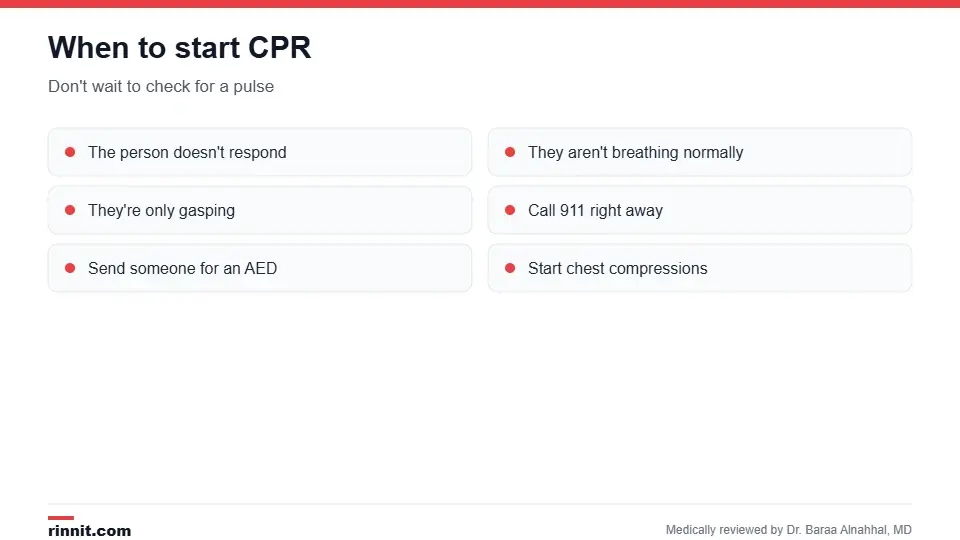
Don't wait to check for a pulse.
The person doesn't respond when you tap them and shout.
They aren't breathing, or they're only gasping.
Don't check for a pulse; start compressions right away. Sources: [1]
Types of CPR
Type | What it involves | Who should do it |
Hands-only CPR | Chest compressions only | Anyone; no training needed |
CPR with breaths | 30 compressions, then 2 rescue breaths | People trained in CPR; best for children and babies |
Both work well for adults in the first few minutes. Breaths help more if CPR goes on longer, and they're especially important for children and babies. Sources: [1, 3]
How to do CPR on an adult
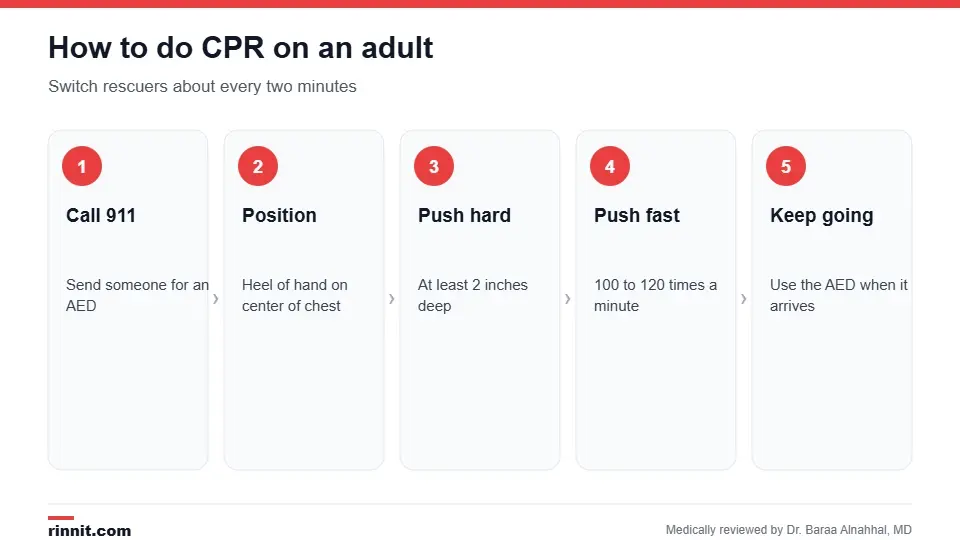
Switch rescuers about every two minutes.
Call 911, or put your phone on speaker if you're alone, and send someone for an AED.
Lay the person on their back on a firm, flat surface and kneel beside them.
Put the heel of one hand on the center of the chest and your other hand on top, fingers laced.
Keep your elbows locked and shoulders over your hands.
Push straight down at least 2 inches (5 cm) but no more than 2.4 inches (6 cm), letting the chest rise fully between pushes.
Push 100 to 120 times a minute, about the beat of "Stayin' Alive."
If trained, give 2 breaths after every 30 compressions.
Keep going until the person breathes normally, an AED is ready or responders take over. Sources: [1]
If you can, switch with another rescuer about every two minutes so compressions stay strong. Don't do a blind finger sweep of the mouth; only remove an object if you saw the person choking and it's clearly visible. Sources: [1]
CPR for children and babies
Age | Compression depth | Technique |
Children (1 to 8 years) | About 2 inches (5 cm) | One or two hands |
Babies (1 to 12 months) | About 1.5 inches (4 cm) | Two thumbs with hands circling the chest, or the heel of one hand |
CPR with breaths is best for children and babies, but hands-only CPR is better than nothing if you aren't trained. Sources: [1]
Using an AED

Anyone can use an AED, even without training.
An automated external defibrillator (AED) checks the heart's rhythm and gives a shock if needed. AEDs are found in many public places and give spoken instructions, so you can use one without training. Use it as soon as it arrives. Learn more about defibrillator types. Sources: [1]
Risks
Strong compressions can break ribs or injure organs in the chest. These injuries are far less serious than the risk of not doing CPR. Sources: [1]
After CPR
Emergency responders take over and bring the person to the hospital, where providers look for the cause, such as a heart attack, and check for organ damage from low oxygen. Anyone revived with CPR needs to be checked right away, even if they seem fine. Sources: [1]
How to learn CPR
The American Red Cross and the American Heart Association offer CPR classes, and many are short. Learning CPR prepares you to act fast for family, friends or strangers. See our first aid essentials guide for more lifesaving skills. Sources: [1]
Conclusion
CPR can keep someone alive until help arrives, and starting it right away makes the biggest difference. Call 911, push hard and fast in the center of the chest and use an AED as soon as you can.
Keep learning: read about sudden cardiac arrest and the recovery position.
Frequently asked questions
What does CPR stand for?
Cardiopulmonary resuscitation.
When should I do CPR?
When someone is unresponsive and isn't breathing normally.
How deep should chest compressions be?
At least 2 inches (5 cm) but no more than 2.4 inches (6 cm) for adults.
How fast should I push?
100 to 120 times a minute, about the beat of "Stayin' Alive."
Do I need to give rescue breaths?
Not for adults if you aren't trained; hands-only CPR works well.
What is the compression-to-breath ratio?
30 compressions, then 2 breaths.
Should I check for a pulse?
No. Start compressions right away.
Can I use an AED without training?
Yes. It gives spoken instructions.
Can CPR break ribs?
Yes, but that's far less serious than not doing CPR.
How long should I keep going?
Until the person breathes normally, an AED is ready or responders take over.
Related Reading
Heimlich Maneuver: How to Help Someone Who Is Choking explains how to help someone who is choking.
Sudden Cardiac Arrest: Symptoms, Causes, Diagnosis, and Treatment Explained the emergency that needs CPR.
Defibrillation: How an Electrical Shock Restarts a Normal Heart Rhythm how a shock restarts the heart's rhythm.
First Aid Essentials: Life-Saving Skills and Techniques basic lifesaving first aid skills.
What Is Choking? Signs, Causes, First Aid and Prevention how to help someone who is choking.
Heart Attack Symptoms and Treatment: A Complete Guide a common cause of cardiac arrest.
References
Cleveland Clinic. CPR: How To Perform It and What It Stands For. Cleveland Clinic. Last updated February 18, 2026. https://my.clevelandclinic.org/health/treatments/17680-cardiopulmonary-resuscitation-cpr
Sasson C, Rogers MA, Dahl J, et al. Predictors of survival from out-of-hospital cardiac arrest: a systematic review and meta-analysis. Circ Cardiovasc Qual Outcomes. 2010;3(1):63-81. PMID 20123673. https://doi.org/10.1161/CIRCOUTCOMES.109.889576
Hüpfl M, Selig HF, Nagele P. Chest-compression-only versus standard cardiopulmonary resuscitation: a meta-analysis. Lancet. 2010;376(9752):1552-1557. PMID 20951422. https://doi.org/10.1016/S0140-6736(10)61454-7
Medical disclaimer
This article is for general education only and does not replace advice from a qualified healthcare professional. Talk to your doctor about your own diagnosis and treatment, and seek emergency care right away for severe or sudden symptoms.



Comments