What Is Choking? Signs, Causes, First Aid and Prevention

Updated: 3 days ago
Medically reviewed by Dr. Baraa Alnahhal, MD · Last reviewed: October 2026
Quick Answer: What is choking?
Choking is when an object gets stuck in the airway so a person can't breathe normally. [1] If they can cough with sound, let them cough. [1] [2] If they can't speak, breathe or cough, call 911 and give up to five back blows then five abdominal thrusts, repeating until it clears. [1] [2] Start CPR if the person becomes unconscious. [1] [2]
Key takeaways
Choking (foreign body airway obstruction) means something is stuck in your airway, blocking normal breathing. [1] [9] [11]
It most commonly happens while eating, when food lodges in the windpipe (trachea) or voice box (larynx). [1] [9]
Partial choking means you can still breathe a bit; complete choking means you can't breathe, talk or cough — a medical emergency. [1]
After four minutes without oxygen, there's a risk of brain injury and possibly death. [1] [3]
If someone is coughing with sound, don't attempt first aid — encourage them to cough and stay with them. [1] [2] [6]
First aid for adults and children (over age 1): up to five back blows, then up to five abdominal thrusts (Heimlich maneuver), repeated. [1] [2] [6]
First aid for infants (under 1): five back slaps, then five chest thrusts, repeated. [1] [4]
If the person becomes unconscious, begin CPR if you're able. [1] [2] [6]
Food — candy, grapes, gum, hot dog rings, marshmallows, meat, nuts, popcorn — causes most episodes; coins, balloons and small toy parts threaten young children. [1] [3] [11]
Back blows and abdominal thrusts are lifesaving but can injure the chest and internal organs, so see a provider afterward. [1] [6]
Prevent choking by chewing thoroughly, taking smaller bites, not talking or laughing while eating, and sitting upright. [1]
What the research says
Chewing, swallowing and dental problems are central choking risk factors. In a series of 138 people (ages 1 to 88) admitted to an emergency department in Rome after a choking event, 67% had choked on fish bones, 9% on meat bones and 3% on artichokes, and the authors name neurological disorders, dysphagia and dental issues (few or no teeth, unstable or unsuitable prostheses) as three of the most common general risk factors. This was a single-center series and the foods reflect local diet, so the food mix will differ elsewhere (Saccomanno et al., Eur J Transl Myol, 2023). [8]
Suction (airway-clearance) devices may help as a backup, but the evidence is thin. In a retrospective evaluation of 27 adult choking emergencies in UK care homes (victims aged 45 to 101, mean 79.8 years), staff reported that the DeChoker device removed the obstruction in 26 of 27 cases, and 21 of 27 victims (78%) did not need to go to Accident and Emergency. The data were self-reported by care-home staff with no comparison group, and the authors describe the device as an adjunct to current guideline procedures while noting limited evidence on its safety and effectiveness (Bhanderi & Palmer Hill, Front Public Health, 2020). [7]
The evidence behind first-aid manoeuvres is weaker than most people assume. A 2024 narrative review of first aid for children who are choking found that guidelines worldwide diverge and are generally grounded in low-quality evidence, mainly case studies, and that studies since 2015 used highly varied methods and often left out details such as body position. The authors call for updated, evidence-based recommendations; this is a call for better research, not a reason to delay first aid (Bieliński et al., Medicina (Kaunas), 2024). [10]
What Is Choking?

Choking (also called "foreign body airway obstruction") is when something gets stuck in your airway. This prevents you from breathing normally. [1] [11] Choking most commonly occurs while eating. Food can easily get lodged in your windpipe (trachea) or voice box (larynx), especially if you're laughing, talking or eating quickly. [1] Certain medical conditions also raise your risk for choking. Young kids might choke on anything from food to small toys or coins. [1] Choking can quickly turn into a medical emergency. Call 911 or call emergency services (and do first aid if you're able) if someone has signs of severe choking — they can't cough, speak or breathe — and/or if they lose consciousness. [1]
Types of Choking
Type | What Happens | What It Means |
Complete (severe) airway obstruction | The object fully blocks the airway; air and oxygen can't reach the lungs | A medical emergency requiring immediate first aid — after four minutes without oxygen, there's a risk of brain injury and possibly death |
Partial (mild) airway obstruction | The object only partly blocks the airway; you feel something "go down the wrong pipe" and cough intensely until it comes out | Still serious because the object could shift and fully block the airway, but usually you can cough up the object without help |
Partial choking is what happens to most of us from time to time. It's still serious because the object could shift and fully block the airway, but usually you can cough up the object without anyone stepping in to help. [1]
Symptoms and Causes
Symptoms of Choking
Most people who are choking will cough (noisily or silently), grab at their neck and look scared. But the signs can sometimes be subtle, especially in babies or kids. The signs also depend on whether the airway is partly or fully blocked.
Partial Choking Symptoms
Someone who's partially choking can still take in a little air. So, they may cough a lot — probably loudly, sound hoarse when they try to talk (but words can still come out), and turn reddish or darker in color. [1] Stay with them, encourage them to cough and be ready for first aid if needed.
Complete Choking Symptoms
Someone whose airway is completely blocked may be unable to speak, clutch or point to their neck, develop blue skin, nails or lips (cyanosis), have a weak or silent cough, make a high-pitched noise (stridor), nod when asked "Are you choking?", pass out (lose consciousness), or seem surprised, panicked or confused. [1] [2] Blue skin tone (signaling a lack of oxygen) is obvious in people who have light skin. But you may not notice a change in people with darker skin — check their gums, the inner sides of their lips and their fingernails instead. [1] [5]

Symptom Group | Signs to Watch For |
Partial choking | Coughing a lot (probably loudly); hoarse voice when talking but words still come out; face turning reddish or darker in color |
Complete choking | Unable to speak; clutching or pointing to the neck; blue skin, nails or lips (check gums, inner lips and fingernails in darker skin); weak or silent cough; high-pitched noise (stridor); nodding "yes" when asked if they're choking; passing out; looking surprised, panicked or confused |
What Is the Main Cause of Choking?
Food causes most episodes of choking. [1] You can choke on any food that's large enough to get stuck in your airway, especially if you don't chew it fully. Common culprits include candy (especially hard candy), grapes, gum, hot dogs sliced into rings, marshmallows, meat, nuts and popcorn. [1] Besides food, other objects that can cause choking — especially in children — include balloons, beads, button batteries, coins, and small toys or toy parts. [1] [3]
Object Type | Where It Gets Stuck | Typical Obstruction |
Larger objects (big chunks of food, coins) | Above the vocal cords | Usually a complete obstruction |
Small, thin or sharp objects (like fish bones) | Between or below the vocal cords | Usually a partial obstruction |
Risk Factors
Not chewing your food well enough is a major risk factor for choking. [1] [8] There are many reasons why you might not chew thoroughly — and many of these are out of your control. You might have loose or missing teeth, wear dentures (which can make it hard to tell if your food is chewed well), have TMJ dysfunction (which limits how well you can chew), or eat quickly because you don't have time to spare. [1] Eating in bed with your head lowered can also raise your risk. You also may be more likely to choke if you have a medical condition that causes trouble swallowing (dysphagia). Examples include Alzheimer's disease, Parkinson's disease, myasthenia gravis and multiple sclerosis. [1]
Complications of Choking
Choking limits how much oxygen reaches your brain (cerebral hypoxia). This can quickly lead to cerebral anoxia, which means no oxygen can reach your brain. Dangerous arrhythmias, brain injury and death can result. [1]
Diagnosis and Tests
Choking isn't diagnosed with tests — it's recognized by its signs and symptoms in the moment. If someone shows signs of a completely blocked airway, call emergency services and do first aid if you're trained. Every second matters. Providers respond based on whether the obstruction appears partial (person can cough with sound) or complete (person cannot speak, breathe or cough effectively).
Management and Treatment
What Should You Do If Someone Is Choking?
If someone around you starts choking, try to stay calm. Staying calm can help you make the best and safest decisions. If you're trained in first aid, be prepared to use it if necessary. Three general principles guide your response: First, assess the situation. If someone is coughing (with sound), don't attempt first aid — it's likely they can cough up the object on their own, and trying to intervene might make matters worse. [1] Instead, watch and see what happens, encourage the person to cough, and don't leave them alone until you know they're OK. Second, don't automatically try to remove the object. You might think you need to reach into the person's mouth, but only do this if you can clearly see the object. If so, make a hooking motion with your index finger to grab the object and pull it out. Don't sweep your fingers around their mouth — this might push the object farther down. [1] [2] [6] Third, know when to call for emergency help. If the person shows signs of complete choking, you or someone else should call 911 or your local emergency services number, and immediately begin first aid appropriate to the person's age. [1]
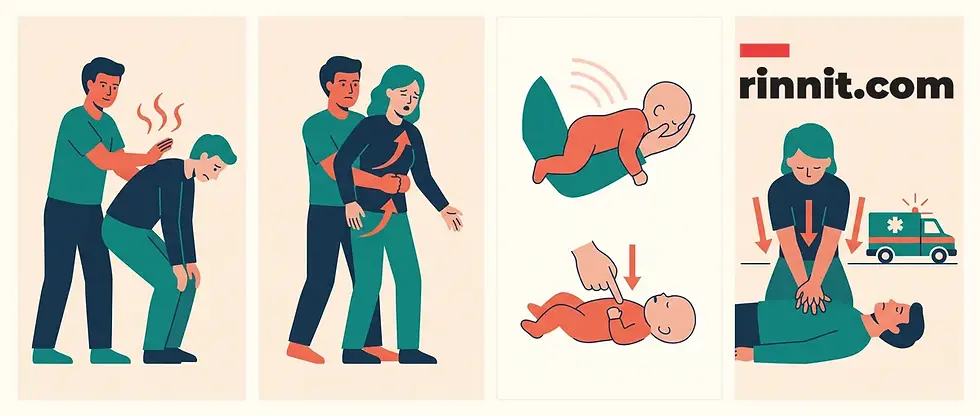
Choking First Aid for Adults and Children (Over Age 1)
If an adult or child (over age 1) shows signs of complete choking, tell someone else to call emergency services. If no one else is around, call yourself, but put the phone on speaker and don't delay first aid. Follow these steps:
Stand to the side and a bit behind the person. Kneel if it's a small child.
Lean the person slightly forward.
Use your nondominant hand to gently support the person's chest (if you're right-handed, use your left hand for support).
Use the heel of your dominant hand to strike the area between their shoulder blades — this is called a back blow or back slap. Do up to five of these, pausing between each one to see if the object has come out. [1] [2] [6]
If five back blows aren't enough, do up to five abdominal thrusts — also called the Heimlich maneuver. [6] Make a fist with one hand and clasp your other hand around it, place your hands between the person's belly button and ribcage, and push inward and upward. Don't attempt this unless you're trained. [1]
If the person is still choking, repeat this sequence of five back blows and five abdominal thrusts until the object comes out or medical help arrives. If the person is pregnant or too large to wrap your arms around, give chest thrusts instead of abdominal thrusts. [1] [2] [6]
If the person goes unconscious at any point before help arrives, begin CPR if you're able. [1] [2] [6]
Choking First Aid for Infants (Babies Under 1 Year)
If an infant shows signs of complete choking, have someone call 911 and begin first aid:
Turn the infant over so they're lying face-down across your nondominant arm.
Use your nondominant hand to support the infant's head and neck.
Do five back slaps using the heel of your dominant hand on the area between the infant's shoulder blades. [1] [4] Use firm pressure, but use your best judgment to avoid being too forceful.
Turn the infant over so they're face up.
Do five chest thrusts using two fingers in the center of the chest, just below the nipple line, to press down on the infant's breastbone (sternum). Each thrust should push the chest down about 1½ inches (about 4 cm). [1] Avoid pressing on the sternum's lower tip.
Repeat this same sequence — five back slaps and then five chest thrusts — until the object comes out or medical help arrives. [1] [4]
If the infant goes unconscious, begin CPR if you're able. [1] [4]
Hospital Treatments for Choking
Usually, first aid is enough to manage choking. But some people need extra treatments at a hospital. This might involve a procedure (like laryngoscopy) to remove the object that's stuck, support for breathing, and treatment for any complications that arise. [1]
Outlook / Prognosis
When Should I See a Healthcare Provider?
See a provider if you had a serious choking episode that required first aid. Back blows and abdominal thrusts are lifesaving, but they can also cause complications, including damage to organs and bones in your torso (trunk). [1] [6] A provider will check for signs of complications and make sure you get any needed treatments. Along similar lines, seek medical care for your child if they received first aid for choking. This is important even if your child seems fine — they may not know something is wrong or be able to tell you if something hurts. See a provider after a partial choking episode if you feel like there's something stuck in your throat, have trouble swallowing, or keep coughing. [1]
When Should I Go to the ER?
Seek emergency care for yourself or anyone around you who's severely choking — meaning they can't speak, breathe or cough effectively to dislodge the object stuck in their airway. [1] Every second matters and could make the difference between life and death.
What Questions Should I Ask My Healthcare Provider?
Healthcare providers are your best source of information about ways to prevent choking or respond when it happens. If you have a child or are planning a family, talk to a provider about pediatric first aid training — they can recommend a program and make sure you get the resources you need. The more confident you feel in your ability to respond to a medical emergency, the less anxious you'll feel in the moment. Specific questions you may want to ask include:
Should I do first aid training? If so, what courses do you recommend?
Do I have any risk factors for choking?
How can I lower my risk of choking?
Are there any reasons why I shouldn't receive abdominal thrusts (the Heimlich maneuver)?
What should I do if I choke when alone?
If you have a loved one at risk for choking, ask their healthcare provider what you can do to help them stay safe. Be sure to get your loved one's thoughts and preferences, too. You may want to do first-aid training regularly, or arrange for someone to always be with them when they're eating. Having a plan in place can give you both some peace of mind.
Prevention
How Can I Prevent Choking?
Prevention Habit | Why It Helps |
Cut your food into smaller pieces and take smaller bites | Reduces the size of food that could lodge in the airway |
Don't talk or laugh while chewing | Keeps food moving toward the esophagus, not the airway |
Pay attention when you chew, and chew thoroughly | Fully chewed food is far less likely to get stuck |
Make sure dental prostheses (implants, dentures, crowns) fit and work well | Poorly fitting prostheses make it hard to tell if food is chewed well |
Try to slow down when you eat | Rushed eating leads to bigger bites and poor chewing |
Avoid eating while lying down; if in bed, sit up at a 90-degree angle | Gravity helps keep food moving in the right direction |
There's a lot you can do to prevent choking in your child, too. For example, cut their food into small pieces and teach your child to spit out anything that doesn't belong in their food — like bones, gristle or pits. [1]
Living With
Choking is scary to experience and maybe even scarier to witness. But learning how to prevent choking and what to do if it happens can help your whole family stay safe. Even something as simple as reminding yourself to slow down and chew your food all the way can greatly lower your risk. Share choking resources with your loved ones and encourage them to take first aid classes — sometimes, just a small reminder can make a big difference.
Conclusion
Choking — also called foreign body airway obstruction — happens when something gets stuck in your airway so you can't breathe normally, most often when food lodges in the windpipe or voice box during meals. Partial choking still allows a little air through and usually resolves with coughing, but complete choking is a true emergency: the person can't speak, breathe or cough, and after about four minutes without oxygen, brain injury and death become real risks. The right response depends on age — back blows and abdominal thrusts (the Heimlich maneuver) for adults and children over 1, and back slaps with chest thrusts for infants under 1 — repeated until the object comes out or help arrives, with CPR if the person loses consciousness. Simple habits like cutting food small, chewing thoroughly, not talking while eating, and keeping coins, balloons and small toy parts away from young children prevent most episodes. Because first aid can itself cause injuries, always follow up with a healthcare provider after a choking emergency. Sharing this knowledge widely matters — which is why Rinnit's infographic templates can help you turn life-saving first aid steps into clear, printable visuals for your family, classroom or workplace.
Frequently Asked Questions
What is choking?
Choking is when something gets stuck in your airway, preventing you from breathing normally.
What is the medical term for choking?
It's called "foreign body airway obstruction."
Where do objects usually get stuck when you choke?
Food usually lodges in the windpipe (trachea) or the voice box (larynx).
When does choking most commonly happen?
Most commonly while eating, especially if you're laughing, talking or eating quickly.
What is the difference between partial and complete choking?
Partial choking means something only partly blocks the airway and you can still breathe a bit; complete choking means you can't breathe, talk or cough at all.
Is partial choking dangerous?
Yes — it's still serious because the object could shift and fully block the airway.
How long can you go without oxygen when choking?
After about four minutes without oxygen, there's a risk of brain injury and possibly death.
What does someone do when they're partially choking?
They may cough a lot (probably loudly), sound hoarse when talking, or turn reddish or darker in color.
Should you help someone who's coughing with sound?
No — if someone is coughing with sound, don't attempt first aid. Encourage them to cough, stay with them, and don't leave them alone until you know they're OK.
Why shouldn't you interfere when someone can cough?
Trying to intervene might make matters worse — they can likely cough up the object on their own.
What are the signs of complete choking?
Inability to speak, clutching or pointing to the neck, blue skin/nails/lips, weak or silent cough, a high-pitched noise, nodding when asked if they're choking, passing out, or looking surprised, panicked or confused.
What is cyanosis?
Blue skin, nails or lips caused by a lack of oxygen.
Why is cyanosis hard to spot in darker skin?
Blue skin tone is obvious in light skin but harder to notice in darker skin — check the gums, inner sides of the lips and the fingernails instead.
What is stridor?
A high-pitched noise made when the airway is severely narrowed or blocked.
What does someone look like when they can't speak while choking?
They often clutch or point to their neck and may nod "yes" when asked if they're choking.
Can choking cause someone to pass out?
Yes — losing consciousness is one of the signs of complete choking.
What food causes most choking episodes?
Food in general causes most episodes, especially hard candy, grapes, gum, hot dogs sliced into rings, marshmallows, meat, nuts and popcorn.
Why are hot dogs sliced into rings a choking hazard?
A hot dog round matches the shape and size of a child's airway, making it easy to lodge completely.
What non-food objects cause choking in children?
Balloons, beads, button batteries, coins, and small toys or toy parts.
Where do large objects get stuck in the airway?
Larger objects like big food chunks or coins usually get stuck above the vocal cords, typically causing complete obstruction.
Where do small thin objects get stuck?
Small, thin or sharp objects like fish bones usually get stuck between or below the vocal cords, causing partial obstruction.
Why is not chewing well a major choking risk?
Unchewed food is large enough to lodge in the airway — not chewing thoroughly is one of the biggest risk factors.
Do dentures increase choking risk?
Yes — dentures can make it hard to tell whether food is chewed well enough.
Can missing teeth increase choking risk?
Yes — loose or missing teeth make thorough chewing difficult.
Does TMJ dysfunction raise choking risk?
Yes — TMJ dysfunction limits how well you can chew.
Does eating in bed raise choking risk?
Yes — eating in bed with your head lowered can raise your risk; if in bed, sit up at a 90-degree angle.
Which medical conditions raise choking risk?
Conditions that cause trouble swallowing (dysphagia), such as Alzheimer's disease, Parkinson's disease, myasthenia gravis and multiple sclerosis.
What is dysphagia?
A medical condition that causes trouble swallowing.
What happens to the brain when you choke?
Choking limits oxygen reaching the brain (cerebral hypoxia), which can quickly progress to cerebral anoxia (no oxygen reaching the brain).
What are the complications of oxygen loss during choking?
Dangerous arrhythmias, brain injury and death.
What should you do if someone starts choking around you?
Stay calm, assess whether they can cough with sound, call 911 if signs show complete choking, and use age-appropriate first aid if trained.
Should you reach into a choking person's mouth?
Only if you can clearly see the object — use a hooking motion with your index finger to pull it out. Never sweep your fingers blindly, as this might push the object farther down.
How do you perform back blows on an adult?
Stand to the side and slightly behind the person, lean them slightly forward, support their chest with your nondominant hand, and strike between the shoulder blades with the heel of your dominant hand — up to five times, pausing between each.
What is the Heimlich maneuver?
Abdominal thrusts: make a fist with one hand, clasp it with the other, place your hands between the person's belly button and ribcage, and push inward and upward. Don't attempt it unless you're trained.
What is the full sequence for an adult choking victim?
Up to five back blows, then up to five abdominal thrusts, repeated until the object comes out or medical help arrives.
What if the person goes unconscious during first aid?
Begin CPR if you're able, while emergency help is on the way.
How do you perform first aid on a choking infant under 1?
Lay the infant face-down across your nondominant arm with their head and neck supported, give five firm back slaps between the shoulder blades, turn them face up, give five chest thrusts (using two fingers to press the breastbone down about 1½ inches), and repeat the sequence.
How deep should chest thrusts be on an infant?
The chest should go down about 1½ inches (about 4 cm) per thrust, and avoid pressing on the sternum's lower tip.
Can a choking device replace first aid?
No — healthcare providers still recommend traditional first aid (back blows and abdominal thrusts) as the tried-and-true response. More research is needed on when suction devices are most effective.
What is a choking device?
A tool like a sink plunger that creates a tight seal around the mouth and uses suction to dislodge a stuck object. Examples include DeChoker and LifeVac brand devices.
When might a choking device be useful?
As a backup if all else fails and paramedics haven't arrived, for people who could be injured by abdominal thrusts (such as those with frailty), or for pregnant people or body shapes that make traditional first aid harder.
Should I buy a choking device?
Talk to a healthcare provider before investing in one — get their opinion on whether to buy it and when to use it.
What hospital treatments exist for choking?
Usually first aid is enough, but hospitals may perform a procedure like laryngoscopy to remove the stuck object, provide breathing support, and treat complications.
Why should I see a provider after a choking episode that needed first aid?
Back blows and abdominal thrusts are lifesaving but can cause complications, including damage to organs and bones in the torso — a provider should check for these.
Should a child see a provider after choking first aid even if they seem fine?
Yes — children may not know something is wrong or be able to tell you if something hurts.
When should I see a provider after partial choking?
If you feel like something is stuck in your throat, have trouble swallowing, or keep coughing.
When should I go to the ER for choking?
If anyone is severely choking — unable to speak, breathe or cough effectively to dislodge the object. Every second matters.
What should I do if I choke when alone?
Ask your healthcare provider what to do if you choke when alone — this is one of the recommended questions to discuss.
How can I prevent choking while eating?
Cut food into smaller pieces, take smaller bites, don't talk or laugh while chewing, chew thoroughly, slow down, make sure dentures fit well, and avoid eating while lying down.
How do I prevent choking in children?
Cut their food into small pieces and teach them to spit out anything that doesn't belong in their food, like bones, gristle or pits.
Is my baby choking or gagging?
In general, gagging is noisy and generally harmless (loud coughing noises, sticking the tongue out, vomiting), while choking is mostly quiet and dangerous (silent cough, high-pitched whistling/stridor, turning bluish).
Why do babies gag?
Gagging is a normal reflex that keeps a baby from choking while they learn to chew and swallow foods of different textures.
Should I take first aid training?
Ask your healthcare provider — they can recommend courses, and the more confident you feel responding to an emergency, the less anxious you'll feel in the moment.
Should someone watch over a loved one at risk of choking?
You might arrange for someone to always be with them when they're eating — having a plan in place gives you both peace of mind.
Related Reading
Heimlich Maneuver: How to Help Someone Who Is Choking explains how to help someone who is choking.
CPR: How to Perform It, Steps and When to Use It explains how to perform CPR in an emergency.
Learn more in our guide to Cricothyrotomy: The Emergency Neck Airway, How It's Done, Risks and Recovery.
References
Cleveland Clinic. Choking. Cleveland Clinic Health Library. Last updated March 28, 2025. https://my.clevelandclinic.org/health/diseases/choking
American Red Cross. Adult/Child Choking. American Red Cross. Accessed October 30, 2026. https://www.redcross.org/take-a-class/resources/learn-first-aid/adult-child-choking
American Academy of Pediatrics. Choking Prevention for Babies & Children: What Every Parent Needs to Know. HealthyChildren.org. Last updated February 27, 2026. https://www.healthychildren.org/English/health-issues/injuries-emergencies/Pages/Choking-Prevention.aspx
National Safety Council (U.S.). Choking Prevention and Rescue Tips. National Safety Council. Accessed October 30, 2026. https://www.nsc.org/community-safety/safety-topics/choking
National Health Service (U.K.). Choking and gagging on food. NHS Best Start in Life. Accessed October 30, 2026. https://www.nhs.uk/best-start-in-life/baby/weaning/safe-weaning/choking-and-gagging-on-food/
Resuscitation Council UK. First Aid Guidelines (2025 Resuscitation Guidelines). Resuscitation Council UK. Published October 27, 2025. https://www.resus.org.uk/professional-library/2025-resuscitation-guidelines/first-aid-guidelines
Bhanderi BG, Palmer Hill S. Evaluation of DeChoker, an Airway Clearance Device (ACD) Used in Adult Choking Emergencies Within the Adult Care Home Sector: A Mixed Methods Case Study. Front Public Health. 2020;8:541885. PMID: 33425826. https://doi.org/10.3389/fpubh.2020.541885
Saccomanno S, Saran S, Coceani Paskay L, et al. Risk factors and prevention of choking. Eur J Transl Myol. 2023;33(4):11471. PMID: 37905785. https://doi.org/10.4081/ejtm.2023.11471
Simpson E. How to manage a choking adult. Nurs Stand. 2016;31(3):42-46. PMID: 27745052. https://doi.org/10.7748/ns.2016.e10542
Bieliński JR, Huntley R, Dunne CL, et al. Do We Actually Help Choking Children? The Quality of Evidence on the Effectiveness and Safety of First Aid Rescue Manoeuvres: A Narrative Review. Medicina (Kaunas). 2024;60(11):1827. PMID: 39597012. https://doi.org/10.3390/medicina60111827
Duckett SA, Bartman M, Roten RA. Choking. In: StatPearls. Treasure Island (FL): StatPearls Publishing; 2022. PMID: 29763116. https://www.ncbi.nlm.nih.gov/books/NBK499941/
Medical disclaimer
This article is for general informational purposes only and is not a substitute for professional medical advice, diagnosis, or treatment. In a choking emergency, call 911 or your local emergency services immediately. Always consult a qualified healthcare provider with questions about a medical condition, and seek certified first aid training before performing emergency techniques.



Comments