Cricothyrotomy: The Emergency Neck Airway, How It's Done, Risks and Recovery

Updated: 3 days ago
Written and medically reviewed by Dr. Baraa Alnahhal, MD · Last reviewed: November 2026 · How we review
Quick Answer: What is a cricothyrotomy?
A cricothyrotomy is an emergency procedure that opens an airway through the front of the neck. A provider cuts through the cricothyroid membrane and places a breathing tube into the windpipe. It's used only when a breathing tube can't be placed through the mouth or nose. It's usually changed to a tracheostomy within 1 to 3 days. [1]
What the research says
The scalpel method succeeds far more often than the needle method in the field. A meta-analysis of prehospital studies found surgical (scalpel) cricothyrotomy succeeded in 90.5% of cases vs. 65.8% for needle cricothyrotomy, across 21 studies and 512 patients. (Hubble et al., Prehospital Emergency Care, 2010) [2]
Scalpel and puncture techniques work about equally, but the scalpel is faster. A 2023 meta-analysis of 32 studies found similar overall success (82.6% scalpel vs. 82.2% puncture) and similar complication rates, but the scalpel technique took less time. The authors rated the evidence as low certainty. (Duan et al., Anaesthesia Critical Care & Pain Medicine, 2023) [3]
Emergency surgical airways carry real but manageable risk. A review of 1,011 emergency surgical airways (961 tracheostomies and 50 cricothyrotomies) in people with head and neck conditions found a pooled complication rate of 16.8% and an airway-related death rate of 0.2%. Complications were more likely when the procedure was done outside an operating room. (Wu et al., International Journal of Oral and Maxillofacial Surgery, 2026) [4]
Key takeaways
A cricothyrotomy is a last-resort, life-saving airway done through the front of the neck. [1]
It's used when a person can't be oxygenated and a breathing tube can't be placed through the mouth or nose. [1]
Emergency physicians, trauma surgeons and paramedics perform it. [1]
It's faster and needs less equipment than a tracheostomy, but it's temporary. [1]
Complications are common, so it's usually replaced with a tracheostomy within 24 to 72 hours. [1]
What is a cricothyrotomy?
A cricothyrotomy (also called a cricothyroidotomy) is a procedure to create an opening in the airway through the neck. The provider goes through the cricothyroid membrane, a thin band of tissue between two cartilages in the voice box (larynx): the thyroid cartilage (Adam's apple) above and the cricoid cartilage below. A tube placed through this opening lets air and oxygen reach the lungs. [1]
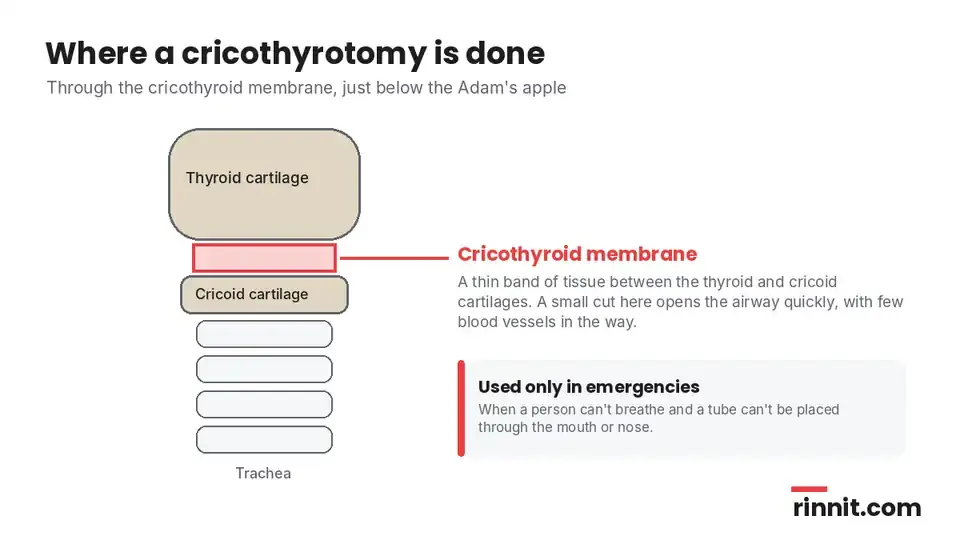
The cricothyroid membrane sits just below the Adam's apple.
It's an emergency procedure and is rare. Providers usually try other ways of securing the airway first, such as rapid sequence intubation. [1]
When is a cricothyrotomy needed?
A cricothyrotomy is done when a person can't get enough oxygen and other airway methods have failed or aren't possible. Reasons include: [1]
Severe injury to the face or neck
Heavy bleeding into the mouth or airway
Vomiting that blocks the view of the airway
Swelling that makes it impossible to place a breathing tube through the mouth or nose
Swelling of the throat and airway can happen with conditions such as epiglottitis, anaphylaxis and angioedema. Most of these are treated without a cricothyrotomy, but it can be needed when the airway closes and can't be opened any other way.
Cricothyrotomy is generally done in people about 10 years and older. Providers use other airway methods for younger children. [1]
Who performs a cricothyrotomy?
It may be performed by: [1]
Emergency medicine physicians
Trauma surgeons
Paramedics and other trained emergency responders
Is consent needed?
Providers ask for consent whenever possible. In a life-threatening emergency, they may perform a cricothyrotomy without consent to save the person's life. [1]
What happens during a cricothyrotomy?
The provider follows these steps: [1]
Find the membrane. They feel the neck to locate the cricothyroid membrane below the thyroid cartilage.
Make a small cut. They make a short vertical incision through the skin.
Open the membrane. They cut through the cricothyroid membrane into the airway.
Insert the tube. They place a breathing tube into the trachea.
Confirm placement. They check that the tube is in the right place and air reaches the lungs.
Secure the tube. They fix the tube so it doesn't move.

With practice, the whole procedure can take about one minute.
With practice, a provider can complete a cricothyrotomy in about one minute. [1]
Cricothyrotomy vs. tracheostomy
Both procedures create an airway through the neck, but they're used differently. [1]
Feature | Cricothyrotomy | Tracheostomy |
Purpose | Emergency rescue airway | Planned or longer-term airway |
Location | Cricothyroid membrane | Lower down, through the trachea |
Speed | About 1 minute with practice | Takes longer |
Equipment | Less equipment | More equipment |
Duration | Temporary | Weeks to permanent |
Sources: [1]
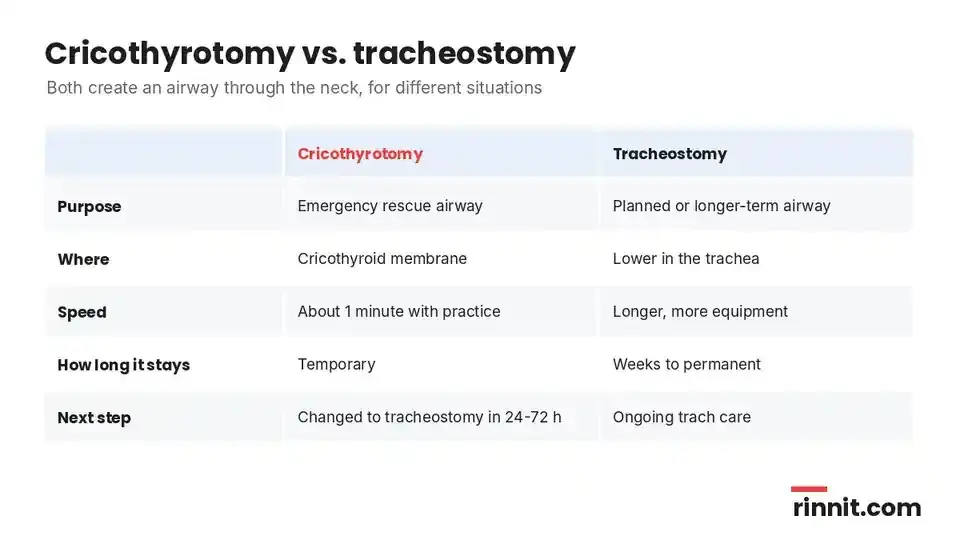
A cricothyrotomy is a short-term bridge; a tracheostomy is the longer-term airway.
People who need a breathing opening for longer get a tracheostomy, which needs regular care such as tracheostomy suctioning. [1]
What are the advantages?
Compared with a tracheostomy, a cricothyrotomy: [1]
Is faster to perform
Needs less equipment
Can be done outside the hospital by trained responders
What are the risks of a cricothyrotomy?
Complications are common. A 2025 review found they can affect up to 5 in 10 people. [1]
Timing | Possible complications |
During or right after | Bleeding, injury to nearby structures, incorrect tube placement, low oxygen |
Later | Scarring and narrowing of the airway, voice changes, trouble swallowing |
Sources: [1]
These risks are weighed against the alternative, since a cricothyrotomy is done only when a person can't breathe and can't be oxygenated another way. [1]
What happens after a cricothyrotomy?
The care team closely monitors: [1]
Oxygen level
Blood pressure
Heart rate
A cricothyrotomy is a temporary airway. It's usually converted to a tracheostomy within 24 to 72 hours. [1]
What is recovery like?
Recovery varies widely. It depends mainly on the emergency that made the cricothyrotomy necessary, such as cardiac arrest or severe trauma, and on any complications. [1]
Conclusion
A cricothyrotomy is a rare, last-resort procedure that can save a life when a person can't breathe and a breathing tube can't be placed through the mouth or nose. It's quick and needs little equipment, but it carries a high complication rate and is usually replaced with a tracheostomy within a few days. [1]
If you or a loved one had a cricothyrotomy, ask the care team about follow-up for voice, swallowing or breathing changes after the airway is converted or removed.
Keep learning: Read our guides to choking and epiglottitis. For more on emergency airway access, see MedlinePlus: Emergency airway puncture.
FAQ
What is a cricothyrotomy?
A cricothyrotomy is an emergency procedure that opens the airway through a small cut in the cricothyroid membrane at the front of the neck.
When is a cricothyrotomy done?
It's done when a person can't get enough oxygen and a breathing tube can't be placed through the mouth or nose.
Where is the cut made for a cricothyrotomy?
The cut is made through the cricothyroid membrane, just below the Adam's apple (thyroid cartilage) and above the cricoid cartilage.
Who can perform a cricothyrotomy?
Emergency physicians, trauma surgeons and trained paramedics or emergency responders can perform it.
How long does a cricothyrotomy take?
With practice, it can be done in about one minute.
Is a cricothyrotomy the same as a tracheostomy?
No. A cricothyrotomy is a quick, temporary emergency airway. A tracheostomy is placed lower in the trachea and is used for longer-term breathing support.
Is a cricothyrotomy permanent?
No. It's usually changed to a tracheostomy within 24 to 72 hours.
What are the risks of a cricothyrotomy?
Risks include bleeding, injury, incorrect tube placement and low oxygen, and later scarring, voice changes and trouble swallowing.
Can a cricothyrotomy be done on children?
It's generally done in people about 10 years and older. Providers use other airway methods for younger children.
Is consent needed for a cricothyrotomy?
Providers ask for consent when possible, but they may perform it without consent in a life-threatening emergency.
Related Reading
Learn more in our guide to Epiglottitis: Symptoms, Causes, and Treatment.
Learn more in our guide to Anaphylaxis: Symptoms, Triggers, and Why Epinephrine Is the Only Emergency Treatment.
Learn more in our guide to What Is Choking? Signs, Causes, First Aid and Prevention.
Learn more in our guide to Hives and Angioedema: Symptoms, Causes, Treatment & Complete Guide.
References
Cleveland Clinic. Cricothyrotomy: Purpose, Procedure, Risks & Recovery. Cleveland Clinic. Last updated March 27, 2026. https://my.clevelandclinic.org/health/procedures/cricothyrotomy
Hubble MW, Wilfong DA, Brown LH, et al. A meta-analysis of prehospital airway control techniques part II: alternative airway devices and cricothyrotomy success rates. Prehosp Emerg Care. 2010;14(4):515-530. PMID 20809690. https://doi.org/10.3109/10903127.2010.497903
Duan Q, Yang D, Gao H, et al. Scalpel cricothyrotomy versus punctured cricothyrotomy in the context of the CICO crisis. A systematic review and Meta-analysis. Anaesth Crit Care Pain Med. 2023;42(4):101211. PMID 36871625. https://doi.org/10.1016/j.accpm.2023.101211
Wu S, Li KY, Su YX, et al. Emergent surgical airway for patients with head and neck conditions: a systematic review and meta-analysis. Int J Oral Maxillofac Surg. 2026;55(4):408-416. PMID 41339154. https://doi.org/10.1016/j.ijom.2025.11.010
Medical disclaimer
This article is for general education only and does not replace advice from a qualified healthcare professional. Talk to your doctor about your own diagnosis and treatment, and seek emergency care right away for severe or sudden symptoms.



Comments