Epiglottitis: Symptoms, Causes, and Treatment

Updated: 3 days ago
Medically reviewed by Dr. Baraa Alnahhal, MD · Last reviewed: October 2026

Quick answer
Epiglottitis is swelling of the epiglottis, the cartilage lid that covers the windpipe, which can block airflow and become life-threatening. Symptoms include fever, sore throat, a high-pitched breathing sound called stridor, drooling and a muffled voice. Medical teams first open and protect the airway, then give IV antibiotics. There is no home care for this condition. [1] [2]
What the research says
According to PubMed:
Vaccination has lowered how often adults need airway intervention. A meta-analysis of 30 studies with 10,148 adults found airway intervention fell from 18.8% before to 10.9% after the Haemophilus influenzae vaccine was introduced (P = 0.01); stridor (RR 7.15), an epiglottic abscess (RR 2.45), and diabetes (RR 2.15) were linked to needing airway intervention. (Sideris et al., DOI).
Children with non-infectious epiglottitis need more intensive care than adults. A systematic review of 57 cases (23 children, 34 adults) found children were intubated far more often (82.6% versus 20.6%) and admitted to intensive care more often (56.5% versus 17.6%); stridor (56.5% versus 14.7%) and drooling (56.5% versus 26.5%) were also more common in children. (Safia et al., DOI).
Study details are from PubMed abstracts.
What is epiglottitis?
Epiglottitis happens when the epiglottis, a small cartilage lid that covers the windpipe, swells. The swelling blocks the flow of air into the lungs. Because the airway itself is at risk, epiglottitis can be deadly, and the condition always needs quick care to prevent deadly complications.
The throat includes the esophagus, trachea, larynx, tonsils and epiglottis. The epiglottis sits just above the larynx as a small, movable lid that normally prevents food and drink from entering the windpipe. When it swells shut, breathing becomes the problem before anything else.
Many factors can cause the epiglottis to swell, including infections, burns from hot liquids and injuries to the throat.
Epiglottitis can happen at any age. Once, mainly children got it, and the most common cause in children was infection with Haemophilus influenzae type b (Hib) bacteria. The same bacterium also causes pneumonia, meningitis and blood infections. Routine Hib vaccination for infants has made epiglottitis rare in children, and it is now more common in adults.
How fast it develops
Children | Adults | |
Speed of onset | Within hours | Over days |
Fever | Yes | Possible |
Sore throat | Yes | Yes |
Stridor (high-pitched sound when breathing in) | Yes | Yes |
Difficult, painful swallowing | Yes | Yes |
Drooling | Yes | Possible |
Acting anxious and irritable | Yes | Not typical |
Muffled or hoarse voice | Not typical | Yes |
Sitting up or leaning forward to ease breathing | Yes | Not typical |
Warning signs and symptoms
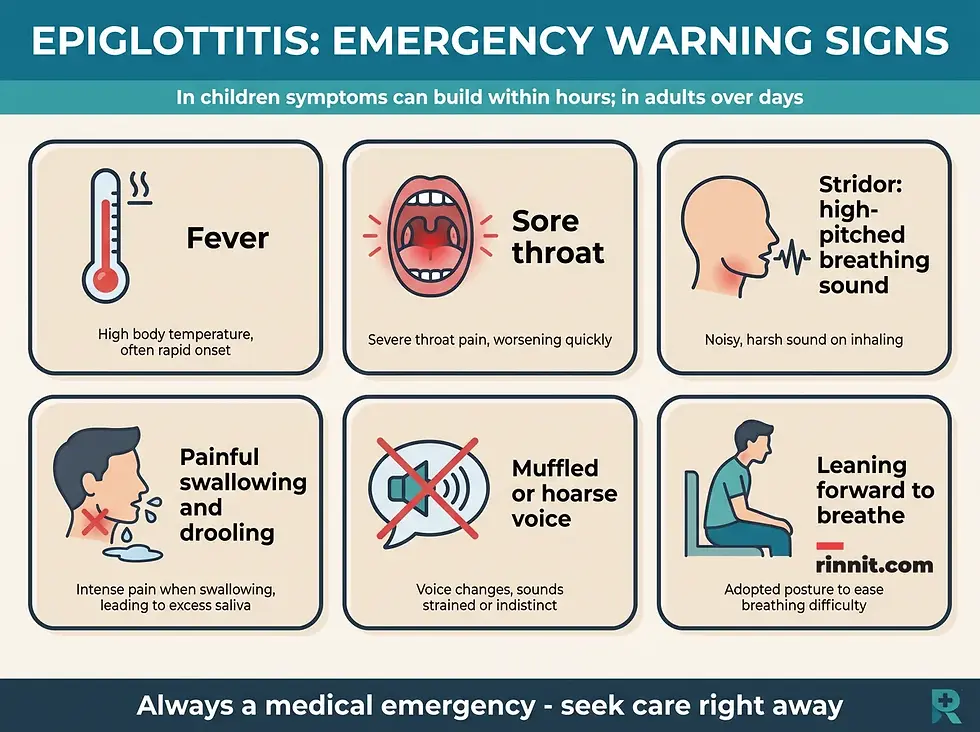
Symptoms in children
Children can develop symptoms of epiglottitis within hours. Signs can include fever, sore throat, an unusual high-pitched sound when breathing in known as stridor, difficult and painful swallowing, drooling, acting anxious and irritable, and sitting up or leaning forward to ease breathing.
Symptoms in adults
Adults might get symptoms over days rather than hours. Symptoms might include sore throat, fever, a muffled or hoarse voice, stridor, difficulty breathing, difficulty swallowing and drooling.
When to seek emergency care
Epiglottitis is a medical emergency. If you or someone you know suddenly has trouble breathing and swallowing, call your local emergency number or go to the nearest hospital emergency department. Try to keep the person quiet and upright, because this position can make it easier to breathe.
Causes and risk factors
An infection or injury causes epiglottitis.
Infection
In the past, a common cause of swelling and inflammation of the epiglottis and surrounding tissues was infection with Hib bacteria. Hib is responsible for other conditions, the most common being meningitis. Hib is now much less common in developed countries where children get Hib vaccines.
Hib spreads when an infected person coughs or sneezes droplets into the air. It is possible to have Hib in the nose and throat without becoming sick, but spreading it to others is still possible.
In adults, other bacteria and viruses also can cause the epiglottis to swell. These include Streptococcus pneumoniae (pneumococcus), which can cause meningitis, pneumonia, ear infection and blood infection; Streptococcus A, B and C, a group of bacteria that can cause diseases from strep throat to blood infection; and Staphylococcus aureus, which causes skin infections and other diseases including pneumonia and toxic shock syndrome.
Injury
Rarely, physical injury, such as a blow to the throat, can cause epiglottitis. So can burns from drinking very hot liquids and breathing in smoke from a fire. Symptoms like those of epiglottitis can also come from swallowing a chemical that burns the throat, swallowing an object, smoking drugs such as crack cocaine, and smoking electronic cigarettes.
Who is at higher risk
Some factors increase the risk of getting epiglottitis. Having a weakened immune system, weakened by illness or medicines, makes bacterial infections that may cause epiglottitis more likely. Not being fully vaccinated, or skipping vaccinations or not getting them on time, can leave a child open to Hib and increase the risk of epiglottitis.
Complications
Epiglottitis can cause many complications, and two stand out. The first is breathing failure: swelling of the epiglottis can completely block the airway, leading to breathing or respiratory failure, a life-threatening condition in which the level of oxygen in the blood drops very low. The second is a spreading infection: sometimes the bacteria that cause epiglottitis cause infections in other parts of the body, including pneumonia, meningitis or a bloodstream infection.
How epiglottitis is diagnosed
First, the medical team ensures that the airway is open and that enough oxygen is getting through. The team monitors breathing and blood oxygen levels, and oxygen levels that drop too low might need breathing aid. After breathing is stable, tests can include the following.
Test | What it involves |
Throat exam | A provider uses a flexible fiber-optic lighted tube through the nose to look at the throat, often with numbing medicine on the nose; this might be done in an operating room in case the airway becomes blocked [2] |
Chest or neck X-ray | Not needed for diagnosis, but may show a thumbprint sign in the neck, which points to an enlarged epiglottis [2] |
Throat culture | Once breathing is stable, a swab of the epiglottis is checked for Hib [2] |
Blood tests | Blood cultures check for bacteremia, an infection of the blood that often is present with epiglottitis [2] |
Treatment: airway first, then infection

Helping a person breathe is the first step in treating epiglottitis. Then treatment focuses on the infection.
Helping with breathing
Making sure a person is breathing well might mean wearing an oxygen mask, which sends oxygen to the lungs. It can also mean having a breathing tube placed into the windpipe through the nose or mouth, known as intubation; the tube stays in place until the swelling in the throat goes down, which can take many days. In rare cases a health care provider creates an emergency airway by putting a needle into an area of cartilage in the windpipe, also known as the trachea, to get air into the lungs quickly. This procedure is called a needle cricothyroidotomy.
Treating the infection
Antibiotics given through a vein treat epiglottitis. Because the infection needs quick treatment, a provider might prescribe a broad-spectrum drug right away rather than waiting for results of the blood and tissue cultures. The first medicine may be changed later to a more targeted antibiotic, depending on what is causing the epiglottitis.
Prevention and protection
Getting the Hib vaccine prevents epiglottitis caused by Hib. In the United States, children usually receive the vaccine in three or four doses: at 2 months, at 4 months, at 6 months if the child is getting the four-dose vaccine, and at 12 to 15 months. [3]
Because children older than 5 and adults are less likely to develop Hib infection, they are not usually given the vaccine. But CDC guidance recommends the vaccine for older children and adults whose immune systems are weak because of sickle cell disease, HIV/AIDS, spleen removal, chemotherapy, or medicine to prevent rejection of organ or bone marrow transplants. [3]
Possible vaccine side effects include an allergic reaction, which is rare but requires swift medical attention if it causes difficulty breathing, wheezing, hives, weakness, a rapid heartbeat or dizziness within minutes or hours after the shot, and mild effects such as redness, warmth, swelling or pain at the injection site, and a fever.
The Hib vaccine is not foolproof. Some vaccinated children have had epiglottitis, and other germs can cause epiglottitis too. Commonsense precautions help: do not share personal items, wash hands frequently, and use an alcohol-based hand sanitizer if soap and water are not available.
Conclusion and next steps
Epiglottitis shows how fast a small structure can create a big problem. The epiglottis is only a small cartilage lid, but when it swells it can close off the windpipe entirely, which is why the condition is always treated as an emergency, for children and adults alike. The good news is that routine Hib vaccination has made this condition rare in children, and that modern emergency care works quickly: secure the airway, then clear the infection.
Next steps: If you or a loved one develops rapid throat swelling, a high-pitched breathing sound, drooling or trouble swallowing, do not wait and do not watch it. Call your local emergency number or go to the nearest emergency department immediately.
Frequently asked questions
Is epiglottitis a medical emergency?
Yes. Epiglottitis is always a medical emergency because the swollen epiglottis can completely block the airway. Call your local emergency number or go to the nearest emergency department right away, and keep the person quiet and upright while help is on the way. [1]
Can epiglottitis kill you?
Epiglottitis can be deadly if the swollen epiglottis blocks airflow into the lungs, causing breathing failure in which blood oxygen drops very low. Quick emergency care that secures the airway prevents this outcome. [1]
Who gets epiglottitis?
Epiglottitis can happen at any age. It was once mainly a disease of children, most often caused by Hib bacteria, but routine infant Hib vaccination has made it rare in children, and it is now more common in adults. [1]
What causes the epiglottis to swell?
Infection is the most common cause: historically Hib bacteria, and today in adults other bacteria such as pneumococcus, Streptococcus A/B/C and Staphylococcus aureus, plus some viruses. Rarely, injury causes it, including a blow to the throat, burns from very hot liquids, fire smoke, swallowed chemicals or objects, and smoking drugs or electronic cigarettes. [1]
How is epiglottitis treated?
Treatment happens in two stages. First the airway is secured with an oxygen mask, a breathing tube placed through the nose or mouth (intubation), or, rarely, an emergency needle airway. Then antibiotics are given through a vein, starting with a broad-spectrum drug and switching to a targeted antibiotic once test results identify the cause. [2]
This article is for general education and is not a substitute for professional medical advice, diagnosis, or treatment. Always consult a qualified healthcare professional about your individual situation.
Related Reading
Learn more in our guide to Cricothyrotomy: The Emergency Neck Airway, How It's Done, Risks and Recovery.
References
Mayo Clinic Staff. Epiglottitis: Symptoms and causes. Mayo Clinic. Accessed October 14, 2026. https://www.mayoclinic.org/diseases-conditions/epiglottitis/symptoms-causes/syc-20372227
Mayo Clinic Staff. Epiglottitis: Diagnosis and treatment. Mayo Clinic. Accessed October 14, 2026. https://www.mayoclinic.org/diseases-conditions/epiglottitis/diagnosis-treatment/drc-20372231
Centers for Disease Control and Prevention. Hib Vaccination. CDC. Accessed October 14, 2026. https://www.cdc.gov/hi-disease/vaccines/index.html
Sideris A, Holmes TR, Cumming B, et al. A systematic review and meta-analysis of predictors of airway intervention in adult epiglottitis. Laryngoscope. 2020;130(2):465-473. PMID 31173373. https://doi.org/10.1002/lary.28076
Safia A, Abd Elhadi U, Shehadeh R, et al. Does patients' age predict their clinical outcomes following non-infectious epiglottitis? A systematic review. PLoS One. 2025;20(2):e0318648. PMID 39928631. https://doi.org/10.1371/journal.pone.0318648



Comments