Anoxia: Causes, Symptoms, and the Minutes That Matter

Updated: 2 days ago
Medically reviewed by Dr. Baraa Alnahhal, MD · Last reviewed: September 2026
TL;DR
Anoxia is a medical emergency in which part or all of the body receives little or no oxygen. It is a severe worsening of hypoxia (low oxygen), and it most often follows events like cardiac arrest, drowning, choking, or carbon monoxide poisoning. Brain damage can begin within 3 to 5 minutes of oxygen deprivation, and permanent damage becomes far more likely after 6 to 10 minutes. Treatment depends on the cause but always begins with the ABCs — Airway, Breathing, Circulation — and immediate CPR can double or triple the chance of survival. Outcomes range from full recovery to permanent disability, depending mainly on what caused the event and how long oxygen was cut off.
Quick Answer
What is anoxia? Anoxia is a life-threatening emergency where the body's tissues receive little or no oxygen, typically because breathing stops, blood circulation fails, or blood can no longer carry oxygen. The brain is the most vulnerable organ: damage can begin within 3 to 5 minutes, and outcomes improve dramatically when bystanders start CPR immediately — immediate CPR can double or triple survival chances. Recovery depends on the underlying cause and how quickly oxygen supply is restored.
What Exactly Is Anoxia?
Anoxia is the most extreme form of oxygen deprivation. The word comes from ancient Greek roots meaning "without oxygen," and it describes a situation in which tissues receive little or no oxygen at all [1].
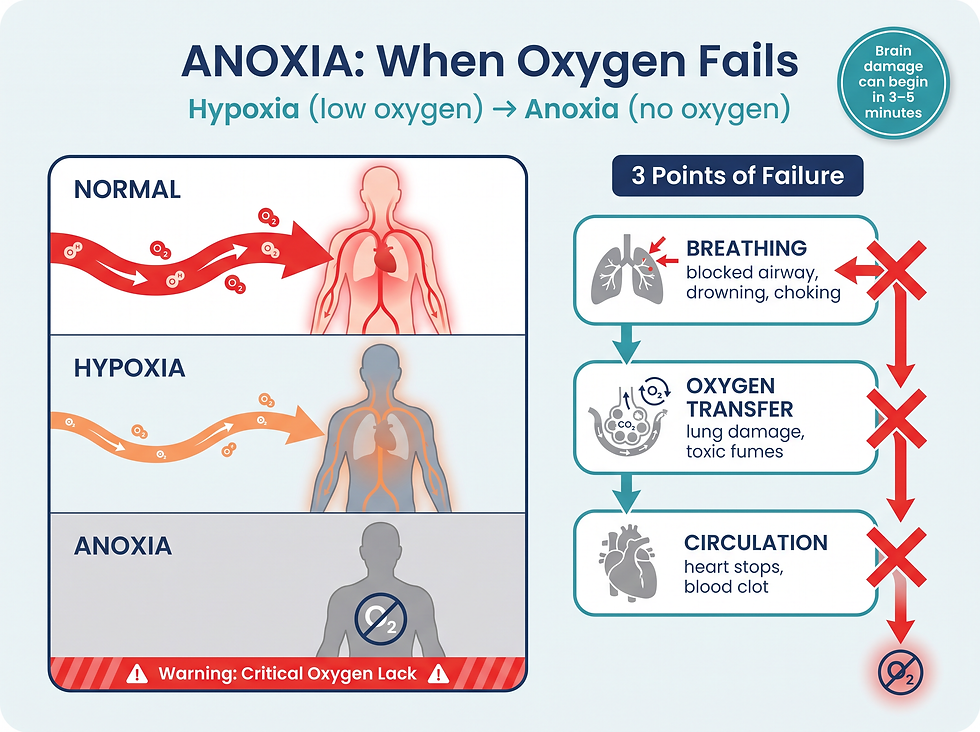
It sits at the severe end of an oxygen-deprivation spectrum. Hypoxia means low oxygen levels. When hypoxia keeps worsening and oxygen supply keeps dropping, it crosses into anoxia [1].
The distinction matters because different organs tolerate oxygen loss differently. The brain has an extremely high oxygen demand, which is why brain anoxia can cause permanent damage or death in just a few minutes without prompt treatment [1].
Anoxia vs. hypoxia vs. hypoxemia: Anoxia means little or no oxygen in body tissues; hypoxia means low oxygen in tissues; hypoxemia specifically means low oxygen in the blood. Hypoxemia is often the step that leads to tissue-level anoxia [1].
How Does Anoxia Happen?
Every case of anoxia traces back to one of three points of failure in the body's oxygen supply chain: breathing, oxygen transfer, or circulation [1].
If you physically cannot breathe, or something blocks the airway, no oxygen enters the lungs. If oxygen in the lungs fails to pass into the blood, blood oxygen falls (hypoxemia), which then produces anoxia in the tissues. And if the heart stops beating or circulation is blocked, oxygen-rich blood never reaches the organs at all [1].
When cells receive insufficient oxygen, the result is ischemia — restricted blood flow and oxygen delivery. The longer ischemia lasts, the worse the damage. In the brain especially, that damage can become severe and permanent within minutes [1].
What events actually cause anoxia?
Event category | Examples | How it causes anoxia |
Breathing disruption (asphyxiation) | Drowning, choking, paralysis, anaphylaxis | Airway blocked or breathing physically impossible [1] |
Circulation blocked internally | Pulmonary embolism | Blood cannot circulate, especially through the lungs [1] |
Oxygen transfer interference | Inhalation burns, toxic fumes | Lung damage prevents oxygen from entering the blood [1] |
Heart stops or weakens | Heart attack, arrhythmias, drug overdose, cardiogenic shock | No circulation to carry oxygen [1] |
Severe altitude sickness | Above 11,000 feet (3,352 meters) | Less oxygen available in the air [1] |
Severe blood loss | Major hemorrhage | Not enough blood to carry oxygen [1] |
Toxic effects | Carbon monoxide poisoning | Blood cannot bind oxygen even when breathing normally [1] |
Most of these events occur suddenly and without warning, which is why awareness of the causes — rather than blame or prevention pressure — is the most useful knowledge most readers can take away.

What Are the Symptoms of Anoxia?
People with anoxia are unconscious and unresponsive — they cannot be woken up. Around that core symptom, additional signs often appear [1]:
Symptom | What it looks like |
Unconsciousness | Cannot be roused by voice, touch, or pain |
Cyanosis | Bluish tint to skin, lips, or nail beds [1] |
Slow pulse or no pulse | Heart rate drops dangerously or stops entirely [1] |
Seizures | Sudden uncontrolled electrical activity in the brain [1] |
Muscle twitching (myoclonus) | Rapid involuntary muscle jerks [1] |
Because anoxia itself presents as unresponsiveness, the visible clues are usually the event that preceded it — a collapse, a choking episode, a submersion — plus the signs above. After someone survives an anoxic event, longer-term symptoms can reflect brain injury: memory and thinking problems, speech or swallowing difficulty, movement and coordination changes, vision problems, mood or personality changes, fatigue, and spasticity or tremors [4].
The severity of brain injury is commonly described in three levels. Mild injury may cause temporary confusion, headaches, and difficulty concentrating, and many people recover well. Moderate injury produces ongoing memory, attention, speech, or coordination problems that often need structured rehabilitation. Severe injury can cause coma or disorders of consciousness, frequently with long-term disability [4].
How quickly does the brain get damaged?
The timeline is the single most important fact in this article, because it defines why every second counts [1] [4]:
Time without oxygen | What typically happens |
Seconds | Loss of consciousness can occur [4] |
3–5 minutes | Brain damage can begin [1] |
~4 minutes | Brain cells may begin to die [4] |
6–10 minutes | Permanent brain damage or brain death becomes much more likely [1] |
After brain death | Life support can keep the body alive temporarily, but death will occur without it [1] |
How Is Anoxia Diagnosed?
Anoxia is diagnosed through a combination of a physical exam and tests, usually in an emergency setting [1]:
Test | What it measures |
Pulse oximeter | Blood oxygen level via a sensor on the finger [1] |
Arterial blood gas (ABG) | Precise oxygen and carbon dioxide levels in blood [1] |
Pulmonary (lung) function tests | How well the lungs are working [1] |
CT scan or VQ scan | Imaging for lung injury or blood clots [1] |
Brain MRI | Assessing lingering damage after the event [1] |
In comatose survivors, clinicians also use neurologic exams, EEG monitoring, and — in some cases — specialized indicators to estimate the odds of recovery, such as pupillary and corneal reflexes at specific time points after resuscitation [3].
How Is Anoxia Treated?
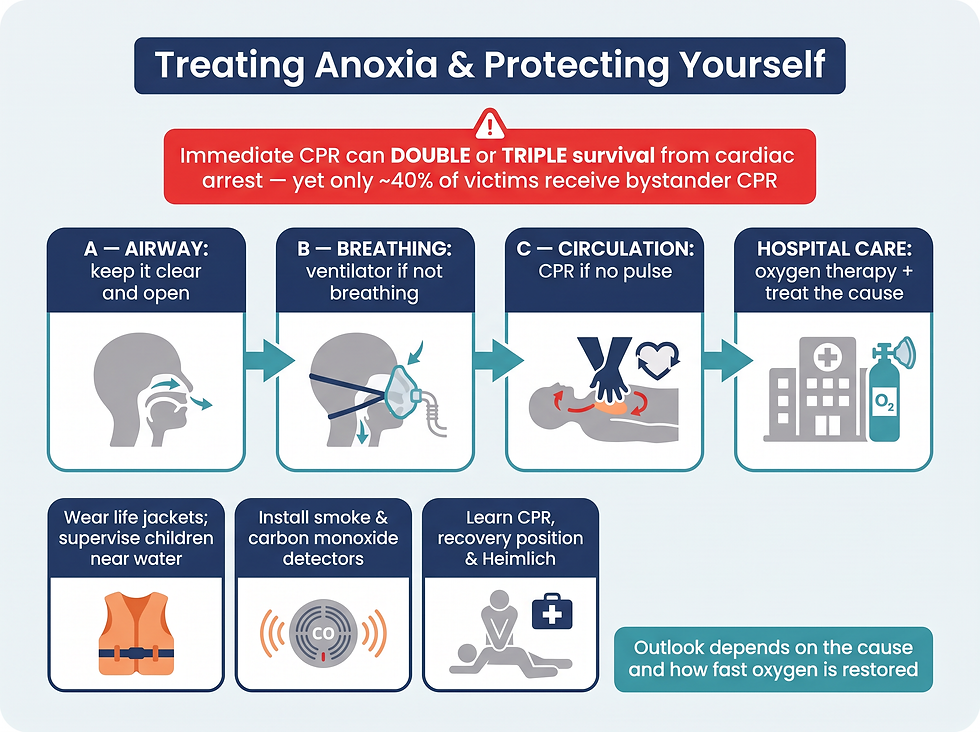
Treatment begins at the moment of the event, and the first steps follow the ABCs — Airway, Breathing, Circulation [1]:
Step | Action |
A — Airway | The airway must be clear and open [1] |
B — Breathing | If the person is not breathing, mechanical ventilation breathes for them [1] |
C — Circulation | If there is no pulse, CPR restores blood flow immediately [1] |
Beyond the ABCs, oxygen therapy — delivering higher oxygen concentrations than regular air — is a common part of treating anoxia and conditions that could cause it [1]. Further treatment targets the underlying cause: dissolving or removing a clot, treating a heart attack or arrhythmia, reversing an overdose, or removing a carbon monoxide source.
Because people with anoxia are unconscious, healthcare decisions fall to someone empowered to make those choices — usually a loved one or a person named in an advance directive. This is one of the quiet reasons advance directives matter so much [1].
Why bystander CPR is the most important treatment of all
Anoxia frequently begins outside a hospital, where professional help is minutes away. Immediate bystander CPR can double or triple the chance of survival after an out-of-hospital cardiac arrest [2]. Yet only about 40% of people who experience an out-of-hospital cardiac arrest receive bystander CPR before professionals arrive [2].
That gap is the difference between life and death for tens of thousands of Americans every year. Cardiac arrest alone causes roughly 450,000 cases annually in the U.S. and claims about 436,000 American lives in a single year — more deaths than colorectal cancer, breast cancer, prostate cancer, influenza, pneumonia, auto accidents, HIV, firearms, and house fires combined [2] [3]. Survival to hospital discharge for out-of-hospital arrests remains around 9 to 10% [2] [5].
What Is the Outlook for Anoxia?
The outlook depends mainly on two factors: what caused it and how long it lasted. When the cause is reversible and anoxia is brief, recovery is possible. The longer it lasts, the worse the chances [1].
Outcomes in the comatose survivors of cardiac arrest — the most common anoxic scenario — span the full range: full recovery, permanent unconsciousness, or death [3]. A useful research benchmark: in one study of post-anoxic coma, 27% of patients regained consciousness within 28 days, while roughly 9% remained in a coma or minimally conscious state [6].
For people who do recover from severe events, rehabilitation plays a central role. Structured neurological rehabilitation can help people with moderate injuries regain memory, speech, movement, and independence [4]. Full recovery from severe anoxic injury is rare, but many people with mild injuries make a full or partial recovery [4].
Can Anoxia Be Prevented?
Anoxia is not 100% preventable. Most cases begin with sudden medical events. But several practical steps reduce the risk of the situations that lead to anoxia [1]:
Prevention step | What it protects against |
Wear life jackets around water | Drowning, a major anoxia trigger [1] |
Supervise children around water | Unsupervised submersion [1] |
Install and maintain smoke and carbon monoxide detectors | CO poisoning and smoke inhalation [1] |
Manage heart disease, arrhythmias, and clotting disorders | Cardiac arrest and pulmonary embolism [1] |
Learn the recovery position, CPR, and the Heimlich maneuver | Being able to act in the first minutes [1] |
Learning these skills is the closest thing to a vaccine against anoxia's worst outcomes — because the first minutes of treatment happen in the hands of whoever is nearby.
When Should You Go to the Emergency Room?
Any condition that stops someone's heart or breathing is a medical emergency. Call 911 (or your local emergency number) immediately — do not drive the person yourself, and do not wait to see if they improve. When in doubt, act quickly, because it could save a life [1].
Key Takeaways
Anoxia is a life-threatening emergency in which body tissues receive little or no oxygen, and the brain pays the highest price. The most actionable facts to remember: unconsciousness with no pulse or breathing means call 911 and start CPR now — immediate bystander CPR doubles or triples survival chances; brain damage can begin within 3 to 5 minutes; and recovery depends mainly on the cause and how fast oxygen flow is restored. While most cases follow sudden medical events that cannot be fully prevented, practical safeguards — water supervision, carbon monoxide detectors, heart health, and first-aid skills — meaningfully reduce risk.
Call to action: If you have not done so recently, take a CPR and first-aid course, make sure your home has working smoke and carbon monoxide detectors, and talk with your family about advance directives. If you have questions about your own risk for a heart condition or clotting disorder, schedule a conversation with your healthcare provider.
Frequently Asked Questions
1. Is anoxia the same as hypoxia?
No. Hypoxia means low oxygen levels in the body's tissues, while anoxia is the severe end of the spectrum — little or no oxygen at all. Anoxia is what happens when hypoxia keeps getting worse [1].
2. How long can the brain survive without oxygen?
Brain damage can begin after just 3 to 5 minutes without oxygen, and permanent damage or brain death becomes much more likely after 6 to 10 minutes. Brain cells may begin to die after about 4 minutes [1] [4].
3. What are the signs that someone has anoxia?
The person is unconscious and cannot be woken up. Additional signs include bluish skin (cyanosis), a very slow or absent pulse, seizures, and muscle twitching [1].
4. Can you recover from an anoxic brain injury?
Recovery is possible and depends mainly on the cause and duration. Mild cases often recover fully or nearly fully, while severe injuries can cause lasting disability, and full recovery from severe anoxic injury is rare [1] [4].
5. What causes anoxia most often?
In adults, the most common trigger is cardiac arrest, which affects roughly 450,000 Americans each year. Other causes include drowning, choking, pulmonary embolism, carbon monoxide poisoning, severe bleeding, drug overdose, and toxic fume inhalation [1] [2] [3].
6. What should you do if someone collapses and is not breathing?
Call 911 immediately, then start CPR — immediate bystander CPR can double or triple the chance of survival. Continue until emergency responders take over [1] [2].
7. Can anoxia be prevented?
Not entirely, because most cases begin with sudden medical events. But risk-reduction steps help: life jackets and water supervision, working smoke and carbon monoxide detectors, managing heart conditions, and knowing CPR and the Heimlich maneuver [1].
8. What happens in the hospital after someone survives anoxia?
Care focuses on restoring oxygen (oxygen therapy, ventilation if needed), treating the underlying cause, and monitoring the brain with imaging such as CT or MRI. Because the patient is unconscious, a loved one or advance directive typically guides healthcare decisions [1].
References
Anoxia — medically reviewed, last updated 03/30/2026. https://my.clevelandclinic.org/health/diseases/anoxia
CPR Facts & Stats — American Heart Association, 2023 Heart Disease and Stroke Statistics. https://cpr.heart.org/en/resources/cpr-facts-and-stats
Prognosis of Anoxic-Ischemic Encephalopathy — Palliative Care Network of Wisconsin, Fast Fact #234, March 2019. https://www.mypcnow.org/fast-fact/prognosis-of-anoxic-ischemic-encephalopathy/
Anoxic and Hypoxic Brain Injuries — Shepherd Center. https://shepherd.org/treatment/conditions/brain-injury/types/anoxic-hypoxic/
CPR Facts and Statistics — American Red Cross, updated October 2024. https://www.redcross.org/take-a-class/resources/articles/cpr-facts-and-statistics
What Is the Life Expectancy After an Anoxic Brain Injury? — Traumatic Brain Injury Law (citing post-anoxic coma recovery study, March 2025). https://www.tbmlawyers.com/blog/life-expectancy-after-anoxic-brain-injury
Hypoxic Brain Injury — Lacerte M, et al. StatPearls, NCBI Bookshelf, updated 01/27/2023. https://www.ncbi.nlm.nih.gov/books/NBK537310/
Anoxic Encephalopathy — Messina Z, et al. StatPearls, NCBI Bookshelf, updated 01/28/2023. https://www.ncbi.nlm.nih.gov/books/NBK539833/
Read More From Our Health Library
Health information, not medical advice. This article is for general education and is not a substitute for professional diagnosis or treatment. Always consult a qualified healthcare provider about your own health, and seek emergency care for urgent symptoms.
Comments