Heimlich Maneuver: How to Help Someone Who Is Choking

Updated: 2 days ago
Written and medically reviewed by Dr. Baraa Alnahhal, MD · Last reviewed: November 2026 · How we review
Quick Answer
The Heimlich maneuver (abdominal thrusts) is first aid for choking in adults and children over 1 year, used when someone can't breathe, speak or cough. Alternate five back blows with five hard abdominal thrusts until the object comes out. If the person becomes unconscious, call 911 and start CPR. For babies under 1, use back blows and chest thrusts.
What the research says
Fast bystander help saves lives: a review of 69 publications found back blows, abdominal thrusts and chest thrusts all relieve choking, and early removal of the blockage by bystanders was linked to about 6 times higher odds of surviving with good brain function (Couper K et al., Resuscitation, 2020) [2]
Clearing the airway before paramedics arrive matters most: in 709 choking cases in Alberta, 42.4% died when the blockage wasn't cleared before paramedics arrived compared with 0.4% when it was (Dunne CL et al., Resuscitation, 2024) [3]
Key takeaways
The Heimlich maneuver uses abdominal thrusts to clear a blocked airway.
Use it only if the person can't breathe, speak or cough.
Alternate five back blows with five quick inward and upward thrusts above the belly button.
For babies under 1, use back blows and chest thrusts instead.
If the person becomes unconscious, call 911 and start CPR.
What is the Heimlich maneuver?
Dr. Henry Heimlich introduced abdominal thrusts in 1974. The quick upward push forces air out of the lungs, which can pop a stuck object out of the windpipe. Anyone can learn it, and knowing the steps can save a life. Sources: [1]
When to use it

If they can cough or talk, encourage coughing instead.
The person can't speak, breathe or cough.
They clutch their throat, the universal sign of choking.
Ask, "Are you choking?" If they nod and can't speak, act right away. Sources: [1]
If the person can talk, cough or breathe, don't do the Heimlich. Encourage them to keep coughing. Sources: [1]
How to do the Heimlich maneuver on an adult
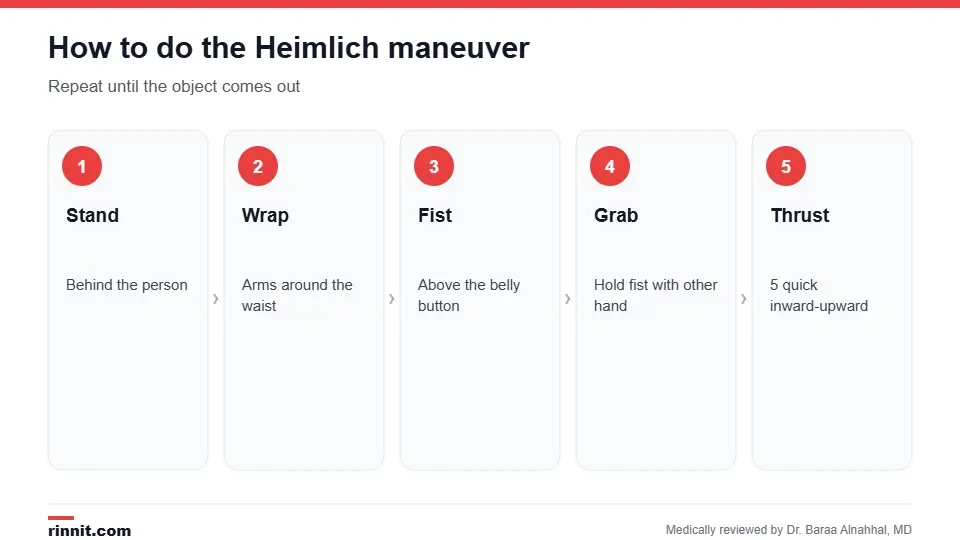
Repeat until the object comes out or the person becomes unconscious.
Stand behind the person and wrap your arms around their waist.
Make a fist and place the thumb side just below the ribcage, about two inches above the belly button.
Grab your fist with your other hand.
Give five firm back blows between the shoulder blades, then five quick, hard thrusts inward and upward, and keep alternating.
Repeat until the object comes out or the person becomes unconscious. Sources: [1]
If the person becomes unconscious, lower them to the ground, call 911 and start CPR. Sources: [1]
Special situations

Use CPR if anyone becomes unconscious.
Person | What to do |
Adults and older children | Back blows alternated with abdominal thrusts |
Children under 5 or under 45 pounds | Kneel behind the child and use gentler thrusts |
Babies 12 months or younger | Back blows and chest thrusts, not abdominal thrusts |
Pregnant people or people with obesity | Thrusts on the breastbone (chest thrusts) |
Yourself | Thrust your fist inward and upward, or push your belly against a chair back or table edge |
Sources: [1]
How to help a choking baby
Lay the baby face down along your forearm or thigh, with the head lower than the body.
Give five firm back blows between the shoulder blades with the heel of your hand.
Check the mouth for the object.
If it's still stuck, turn the baby face up and give five chest thrusts, pressing about ½ to 1½ inches into the breastbone.
Repeat until the object comes out. Call 911 and start CPR if the baby becomes unresponsive. Sources: [1]
Risks
The Heimlich maneuver is quick and lifesaving when done correctly. Thrusts can sometimes cause broken ribs or injuries to the stomach or intestines, especially if done incorrectly or many times. Because choking can be fatal, the benefits far outweigh these risks. Anyone who received abdominal thrusts should be checked by a provider. Sources: [1, 2]
Conclusion
The Heimlich maneuver is a simple skill that can save someone's life in minutes. Learn the steps for adults, children and babies, and take a first aid or CPR class to practice.
Keep learning: read about CPR and first aid essentials.
Frequently asked questions
What is the Heimlich maneuver?
Quick abdominal thrusts that push a stuck object out of the airway.
When should I do the Heimlich maneuver?
When someone can't breathe, speak or cough.
Where do I put my hands?
Your fist goes just above the belly button, below the ribcage.
How many thrusts should I give?
Five back blows, then five quick thrusts, repeated until the object comes out.
Can I do the Heimlich on a baby?
No. Use back blows and chest thrusts for babies under 1.
What if the person is pregnant?
Give chest thrusts on the breastbone instead.
Can I do the Heimlich on myself?
Yes, with your fist or by pushing against a chair or table edge.
What if the person passes out?
Call 911 and start CPR.
Can the Heimlich cause injury?
Sometimes broken ribs or abdominal injuries, so get checked afterward.
What if they can still cough?
Encourage them to keep coughing.
Related Reading
What Is Choking? Signs, Causes, First Aid and Prevention what happens when the airway is blocked.
CPR: How to Perform It, Steps and When to Use It what to do if a choking person becomes unconscious.
First Aid Essentials: Life-Saving Skills and Techniques basic lifesaving first aid skills.
The Recovery Position: A Life-Saving First Aid Technique how to position someone who is unconscious but breathing.
Essential Shock First Aid: Immediate Actions and Lifesaving Steps first aid for another emergency.
References
Cleveland Clinic. Heimlich Maneuver. Cleveland Clinic. Last updated February 13, 2024. https://my.clevelandclinic.org/health/treatments/21675-heimlich-maneuver
Couper K, Abu Hassan A, Ohri V, et al. Removal of foreign body airway obstruction: a systematic review of interventions. Resuscitation. 2020;156:174-181. PMID 32949674. https://doi.org/10.1016/j.resuscitation.2020.09.007
Dunne CL, Cirone J, Blanchard IE, et al. Evaluation of basic life support interventions for foreign body airway obstructions: a population-based cohort study. Resuscitation. 2024;201:110258. PMID 38825222. https://doi.org/10.1016/j.resuscitation.2024.110258
Medical disclaimer
This article is for general education only and does not replace advice from a qualified healthcare professional. Talk to your doctor about your own diagnosis and treatment, and seek emergency care right away for severe or sudden symptoms.



Comments