Maze Procedure for AFib: How It Works, Success Rate and Recovery

Updated: 2 days ago
Written and medically reviewed by Dr. Baraa Alnahhal, MD · Last reviewed: November 2026 · How we review
Quick Answer
The maze procedure is heart surgery for atrial fibrillation (AFib) in which the surgeon creates a pattern of scar tissue in both upper heart chambers that blocks the abnormal electrical signals causing AFib. It's used when medicines or catheter ablation haven't worked. Success rates are 80% to 90%, and recovery takes about three to six weeks.
What the research says
Adding ablation during valve surgery doubled AFib-free rates: in a trial of 260 people with persistent AFib having mitral valve surgery, adding surgical ablation left 63.2% free of AFib at 6 and 12 months versus 29.4% without it, though more people needed a pacemaker (Gillinov AM et al., New England Journal of Medicine, 2015) [2]
Closing the left atrial appendage lowered stroke risk: in the LAAOS III trial of 4,770 people with AFib having heart surgery, closing the left atrial appendage cut stroke or blood clots to 4.8% versus 7.0% over about 3.8 years (Whitlock RP et al., New England Journal of Medicine, 2021) [3]
Key takeaways
The maze procedure blocks the abnormal signals that cause AFib.
It creates a maze of scar tissue in both atria.
The left atrial appendage is usually removed or closed.
Success rates are 80% to 90%.
Recovery takes about three to six weeks.
What is the maze procedure?
The maze pattern has one entrance, one exit, one pathway and several dead ends, which traps stray signals. The current version, the Cox-maze IV procedure, is the gold standard surgery for atrial fibrillation. Sources: [1]
Why it's done
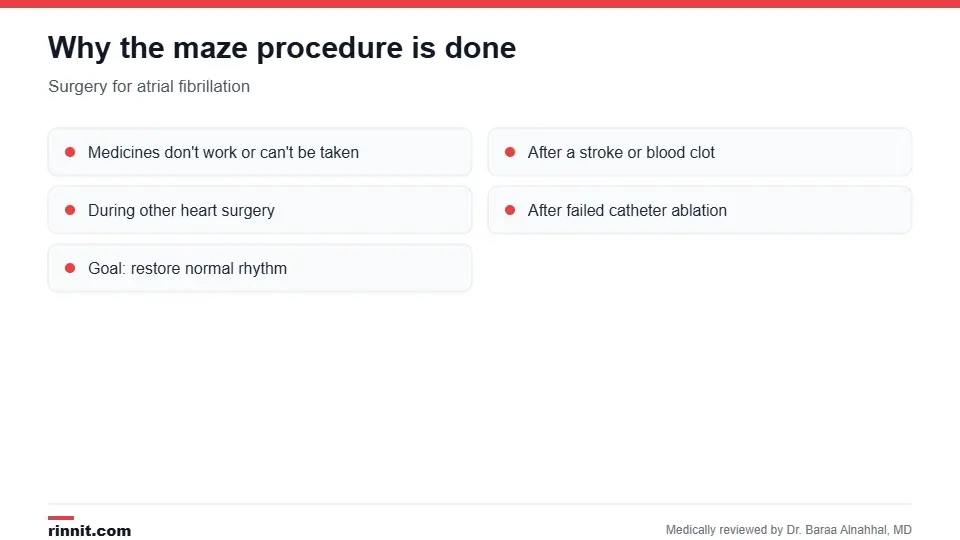
The goals are to restore rhythm, control heart rate and lower stroke risk.
Medicines don't work or you can't take them.
You've had a blood clot, such as a stroke.
You're having other heart surgery, such as bypass or valve surgery.
Catheter ablation didn't work. Sources: [1]
AFib doubles the risk of death, raises stroke risk five to seven times and may cause heart failure. Sources: [1]
Surgical approaches
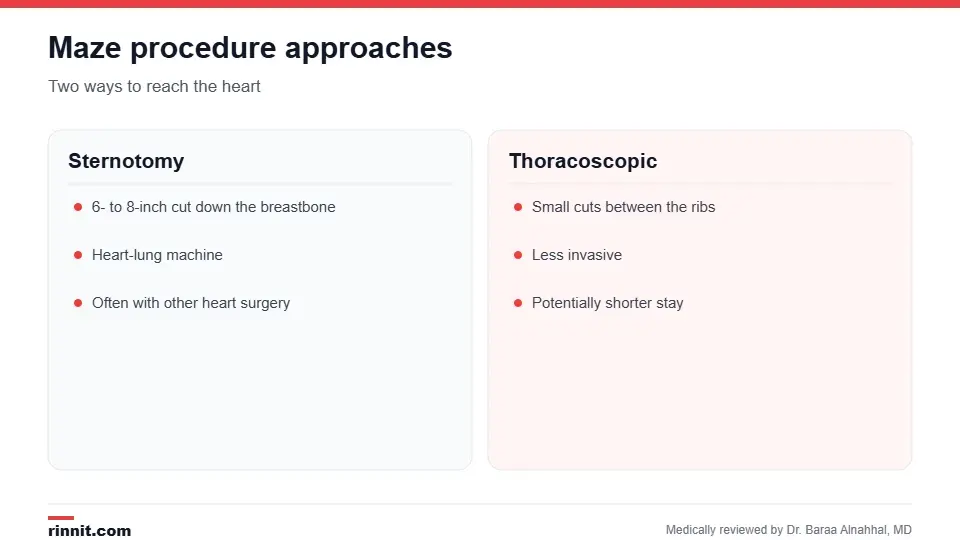
Pulmonary vein isolation is a more limited option.
Approach | How it's done |
Sternotomy | A 6- to 8-inch cut down the breastbone, with a heart-lung machine |
Thoracoscopic | Small cuts between the ribs; potentially fewer complications and a shorter stay |
A true maze treats both atria. Pulmonary vein isolation is a more limited option. Sources: [1]
How to prepare
You'll have an echocardiogram and chest CT.
You may have abdominal and pelvic CT for a less invasive approach.
You'll get instructions on eating, drinking and medicines.
You'll meet your anesthesiologist, cardiologist and surgeon. Sources: [1]
What happens during surgery
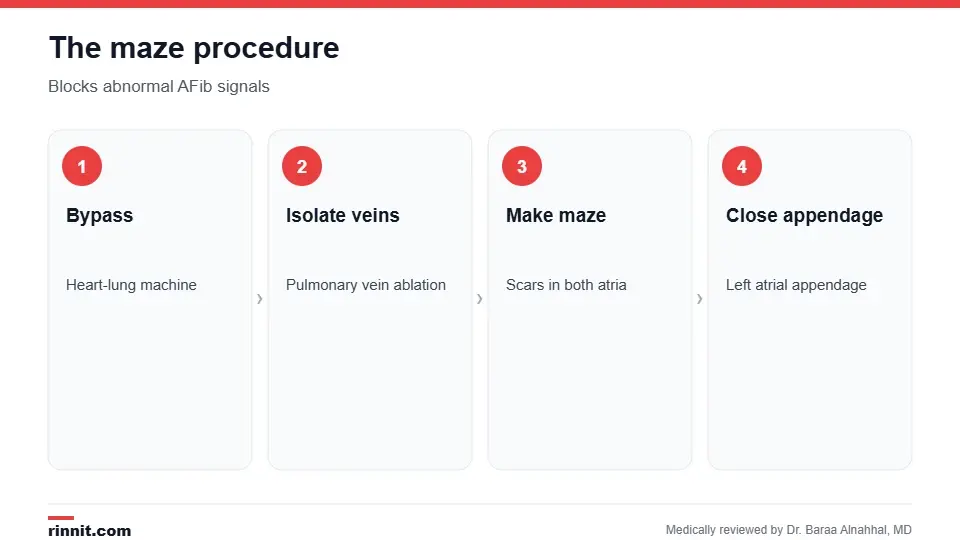
It adds about 15 to 30 minutes when done with other heart surgery.
For a sternotomy, you're connected to a heart-lung machine.
The pulmonary veins are isolated with ablation.
A maze pattern of scars is made in the right and left atria.
The left atrial appendage is removed or closed with stitches, staples or a device. Sources: [1]
When done with another heart surgery, it adds about 15 to 30 minutes. Sources: [1]
Risks
About 30% to 50% of people have skipped beats or short AFib episodes in the first three months, which usually go away.
About 6% need a pacemaker.
Some people need catheter ablation later. Sources: [1, 2]
Recovery
You'll spend one or two days in the ICU, then a few more days in a regular room.
After less invasive surgery, most leave about four days after surgery; others stay about a week.
You'll take blood thinners for at least three months, plus rhythm medicines and diuretics.
Normal activities return in about three to six weeks.
You'll have EKGs at three, six and 12 months, then yearly. Sources: [1]
Outlook
The maze procedure is successful in 80% to 90% of people. It can give long-term AFib relief, fewer clots and lower stroke risk. Sources: [1, 3]
When to call your provider
Contact your cardiologist if your AFib symptoms come back after surgery. Sources: [1]
Conclusion
The maze procedure can restore a normal heart rhythm when other AFib treatments haven't worked. Follow-up heart rhythm checks help confirm it's working over time.
Keep learning: read about atrial fibrillation and left atrial appendage closure.
Frequently asked questions
What is the maze procedure?
Heart surgery that creates scar tissue to block the signals causing AFib.
Why is it called maze?
The scar pattern works like a maze; it isn't an acronym.
Who needs the maze procedure?
People whose AFib isn't controlled by medicines or catheter ablation.
Is it open-heart surgery?
It can be, or it can be done through small cuts between the ribs.
How successful is it?
Success rates are 80% to 90%.
Will my AFib come back?
Short episodes are common in the first three months and usually go away.
Will I need a pacemaker?
About 6% of people do.
How long is the hospital stay?
About four days to a week.
How long is recovery?
About three to six weeks.
Will I take blood thinners?
Yes, for at least three months.
Related Reading
Atrial Fibrillation (AFib): Symptoms, Causes & Treatment Guide the condition this surgery treats.
Left Atrial Appendage Closure: Procedure, Benefits, Risks and Recovery closing the main source of clots.
Catheter Ablation: How It Works, Success Rates, Risks and Recovery a less invasive AFib treatment.
PVI Ablation Explained: A Minimally Invasive Solution for Atrial Fibrillation a more limited ablation.
Convergent Procedure: A Hybrid Approach to Persistent Atrial Fibrillation a hybrid AFib treatment.
References
Cleveland Clinic. Maze Procedure for Atrial Fibrillation (AFib). Cleveland Clinic. Last updated April 6, 2022. https://my.clevelandclinic.org/health/treatments/17086-heart-surgery-for-atrial-fibrillation-maze
Gillinov AM, Gelijns AC, Parides MK, et al. Surgical ablation of atrial fibrillation during mitral-valve surgery. N Engl J Med. 2015;372(15):1399-1409. PMID 25853744. https://doi.org/10.1056/NEJMoa1500528
Whitlock RP, Belley-Cote EP, Paparella D, et al. Left atrial appendage occlusion during cardiac surgery to prevent stroke. N Engl J Med. 2021;384(22):2081-2091. PMID 33999547. https://doi.org/10.1056/NEJMoa2101897
Medical disclaimer
This article is for general education only and does not replace advice from a qualified healthcare professional. Talk to your doctor about your own diagnosis and treatment, and seek emergency care right away for severe or sudden symptoms.



Comments