Pulmonary Vein Isolation (PVI): Ablation for Atrial Fibrillation

Updated: 2 days ago
Written and medically reviewed by Dr. Baraa Alnahhal, MD · Last reviewed: November 2026 · How we review
Quick Answer
Pulmonary vein isolation (PVI) is a minimally invasive ablation that treats atrial fibrillation by creating tiny scars around the pulmonary veins with heat or cold, blocking the faulty electrical signals that trigger it. It's best when Afib continues despite medicine. It takes four to six hours, and serious complications are rare, around 1% or less.
What the research says
Cold and heat ablation worked equally well: in the FIRE AND ICE trial of 762 people with paroxysmal Afib, 1-year treatment failure was 34.6% with cryoballoon ablation versus 35.9% with radiofrequency ablation, with similar safety (Kuck KH et al., New England Journal of Medicine, 2016) [2]
Early ablation slowed Afib from getting worse: in the EARLY-AF trial of 303 people with untreated paroxysmal Afib, persistent Afib developed in 1.9% after first-line cryoablation versus 7.4% with drugs over 3 years, and hospital stays were 5.2% versus 16.8% (Andrade JG et al., New England Journal of Medicine, 2023) [3]
Ablation kept Afib away better than rhythm drugs: a meta-analysis of 12 randomized trials with 2,393 people with paroxysmal Afib found recurrence at 1 year was 27.4% after catheter ablation versus 56.3% with antiarrhythmic drugs, with similar complication rates (Parlavecchio A et al., International Journal of Cardiology Heart & Vasculature, 2023) [4]
Ablation also worked as a first treatment: in 6 randomized trials of 1,120 people with previously untreated Afib, first-line ablation cut the risk of Afib coming back by 46% compared with drugs (Ullah W et al., American Journal of Cardiology, 2024) [5]
Key takeaways
PVI creates tiny scars around the pulmonary veins to stop Afib signals.
It uses heat or cold delivered by catheter.
It's for Afib that medicine doesn't control.
Most people go home the next morning.
Many get lasting relief, but some need a repeat procedure.
What is pulmonary vein isolation?
The pulmonary veins carry blood from the lungs to the heart and are a common source of atrial fibrillation signals. PVI is a type of catheter ablation. Sources: [1]
Who it's for
Untreated Afib raises stroke risk.
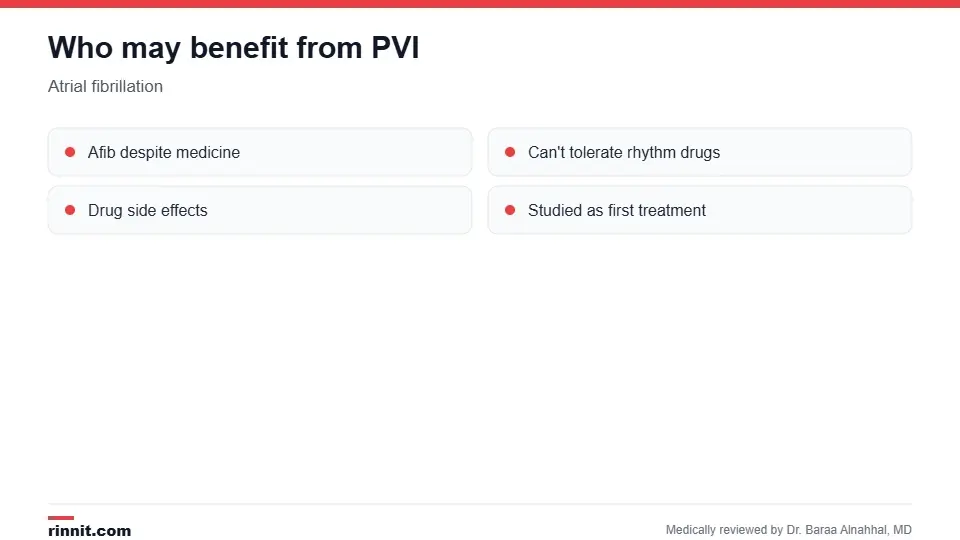
Afib symptoms despite medicine.
Can't tolerate or had complications from rhythm drugs.
As a first treatment for some people, such as those with untreated paroxysmal Afib. Sources: [1, 3]
Your evaluation may include an EKG, echocardiogram or Holter monitor. Sources: [1]
Radiofrequency vs. cryoablation
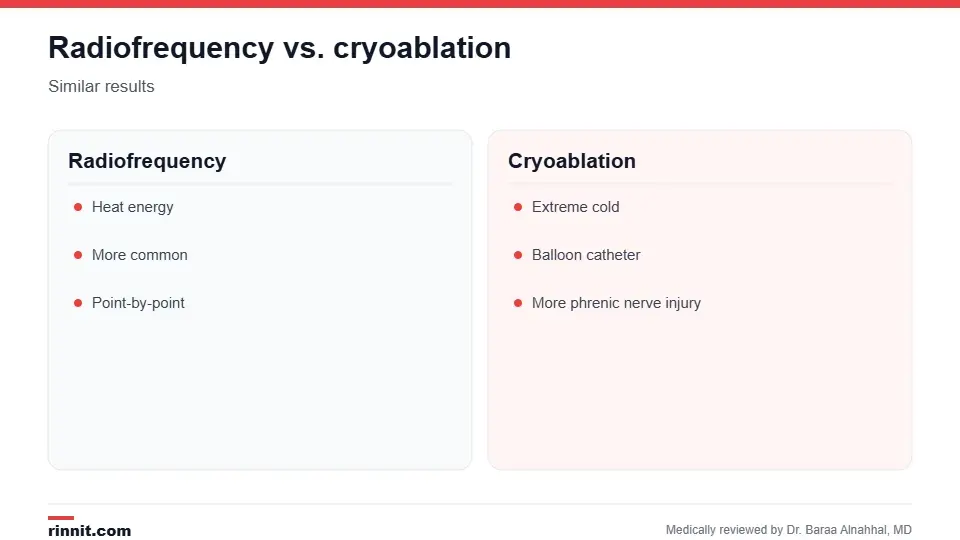
Your electrophysiologist chooses the method.
Feature | Radiofrequency | Cryoablation |
Energy | Heat | Extreme cold |
How common | More common | Common |
Results | Similar | Similar |
Notable risk | — | More phrenic nerve injury |
Learn about radiofrequency ablation and cryoablation. Sources: [1, 2]
What happens during the procedure

It takes about four to six hours.
You get general anesthesia or local numbing.
Two catheters go in through veins in your groin or neck.
They're guided to the heart's left atrium.
One catheter finds faulty signals; the other delivers heat or cold.
The catheters are removed and the sites are closed. Sources: [1]
You'll rest in bed for four to eight hours, with overnight heart monitoring. Sources: [1]
Risks
Risk | Approximate rate |
Heart puncture | 1% |
Pulmonary vein damage | 1% |
Stroke | 0.5% |
Esophagus damage | 0.25% |
Other | Contrast allergy, incision infection, phrenic nerve injury |
PVI is generally safe and low risk. Sources: [1]
Recovery
Expect soreness, tiredness or chest discomfort for about 48 hours.
Resume daily activities after that; strenuous exercise in a few weeks.
Afib may continue for up to 10 weeks while scars form.
You'll take rhythm and blood-thinning medicines for a few months.
Follow-up visits are at three to four months and one year. Sources: [1]
Outlook
Many people get lasting symptom relief, though some need more than one procedure. PVI reduces Afib but doesn't cure it, so you may still need blood thinners and ongoing monitoring. Sources: [1, 2, 3]
When to call your provider
Chest pain.
Shortness of breath.
Nausea and vomiting.
Pain or trouble swallowing.
Dizziness or fainting. Sources: [1]
Conclusion
Pulmonary vein isolation can quiet the signals that cause Afib and help many people feel better without daily rhythm drugs. Follow-up care keeps your heart and stroke risk in check.
Keep learning: read about atrial fibrillation and catheter ablation.
Frequently asked questions
What is pulmonary vein isolation?
An ablation that blocks faulty Afib signals from the pulmonary veins.
Is it surgery?
No. It's a minimally invasive catheter procedure.
Heat or cold, which is better?
Studies show similar results.
How long does it take?
About four to six hours.
Will I stay overnight?
Usually one night.
When can I exercise?
Strenuous exercise after a few weeks.
Will my Afib stop right away?
It may continue for up to 10 weeks while scars form.
Will I still need blood thinners?
Often, yes.
Can it be repeated?
Yes, some people need more than one.
Is PVI a cure?
It reduces Afib but doesn't cure it.
Related Reading
Atrial Fibrillation (AFib): Symptoms, Causes & Treatment Guide the condition PVI treats.
Catheter Ablation: How It Works, Success Rates, Risks and Recovery catheter ablation.
Pulmonary Veins: Anatomy, Function, Variations and Care the veins PVI targets.
Pulsed Field Ablation: The Next Generation of Cardiac Care a newer ablation method.
References
Cleveland Clinic. Pulmonary Vein Isolation (PVI) Ablation. Cleveland Clinic. Last updated August 29, 2022. https://my.clevelandclinic.org/health/treatments/17401-pulmonary-vein-isolation-ablation
Kuck KH, Brugada J, Fürnkranz A, et al. Cryoballoon or radiofrequency ablation for paroxysmal atrial fibrillation. New England Journal of Medicine. 2016;374(23):2235-2245. PMID 27042964. https://doi.org/10.1056/NEJMoa1602014
Andrade JG, Deyell MW, Macle L, et al. Progression of atrial fibrillation after cryoablation or drug therapy. New England Journal of Medicine. 2023;388(2):105-116. PMID 36342178. https://doi.org/10.1056/NEJMoa2212540
Parlavecchio A, Vetta G, Coluccia G, et al. Catheter ablation in patients with paroxysmal atrial fibrillation and absence of structural heart disease: a meta-analysis of randomized trials. International Journal of Cardiology Heart & Vasculature. 2023;49:101292. PMID 38020055. https://doi.org/10.1016/j.ijcha.2023.101292
Ullah W, Johnson D, Nair AS, et al. Ablation versus antiarrhythmic drugs as first-line therapy for treatment-naive atrial fibrillation: a systematic review and meta-analysis. American Journal of Cardiology. 2024;213:63-68. PMID 38040282. https://doi.org/10.1016/j.amjcard.2023.11.052
Medical disclaimer
This article is for general education only and does not replace advice from a qualified healthcare professional. Talk to your doctor about your own diagnosis and treatment, and seek emergency care right away for severe or sudden symptoms.



Comments