AVNRT: The "Traffic Circle" Heart Rhythm That Makes Your Heart Suddenly Race — and How to Stop It

Updated: 20 hours ago
Medically reviewed by Dr. Baraa Alnahhal, MD. Last reviewed October 13, 2026. This content is for educational purposes and is not medical advice.
Quick Answer
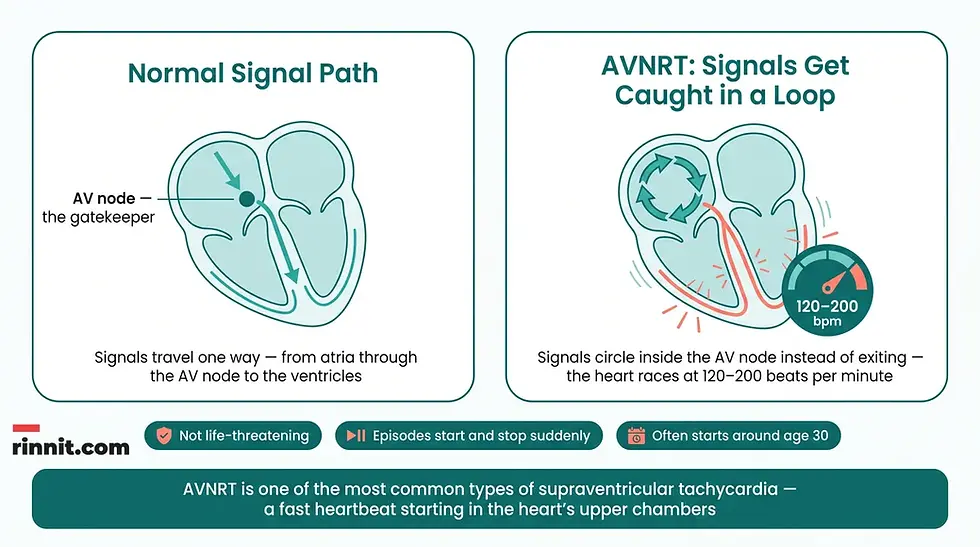
AVNRT is a common abnormal heartbeat in which electrical signals circle inside the heart's AV node, making the heart suddenly race at 120 to 200 beats per minute [1]. Episodes can last seconds to hours, though it is not life-threatening [1]. Vagal maneuvers, IV adenosine or cardioversion stop episodes [1] [5], and catheter ablation can often cure it [1] [5].
What the research says
A modified Valsalva maneuver stops supraventricular tachycardia more often than the standard one. In the REVERT randomized trial of 433 adults with supraventricular tachycardia in emergency departments, 43% (93 of 214) of those who did a modified Valsalva maneuver (strain, then lying back with the legs raised) returned to normal rhythm within a minute, compared with 17% (37 of 214) with the standard maneuver (adjusted odds ratio 3.7, 95% CI 2.3-5.8), with no serious adverse events. As noted below, vagal maneuvers should only be done at home if your provider recommends them and teaches you how (Appelboam et al., The Lancet, 2015) [6].
Catheter ablation has a high success rate and is recommended first-line for recurrent episodes. A clinical review of the common types of paroxysmal supraventricular tachycardia, which include AVNRT, reports that vagal maneuvers are first-line for stable patients and synchronized cardioversion for unstable ones, with beta blockers and/or calcium channel blockers used acutely or for long-term suppression. It recommends catheter ablation as the first-line method for long-term management of recurrent, symptomatic paroxysmal SVT and a low threshold for referral to a cardiologist for an electrophysiologic study (Nasir et al., American Family Physician, 2023) [4].
AVNRT is about twice as common in women, yet ablation works equally well in both sexes. A review of the literature found a twofold women-to-men predominance, and no significant gender-related differences in the acute success rate, long-term success rate, or recurrence after catheter ablation, although the time from symptom onset to ablation was significantly longer in women (Etaee et al., J Cardiovasc Electrophysiol, 2021) [7].
Catheter ablation of AVNRT has very high success and a low complication rate. In a meta-analysis of 13 studies (679 adults) comparing magnetic-navigation with conventional catheter ablation, acute success was 98% in both groups, long-term freedom from arrhythmia was 97% versus 96%, and the overall complication rate was 2.7% versus 1.0% (Shurrab et al., Expert Rev Cardiovasc Ther, 2013) [8].
Pooled trials confirm the modified Valsalva maneuver works far more often than the standard one. In a meta-analysis of 5 randomized trials with 1,181 participants with supraventricular tachycardia, the modified Valsalva maneuver had a higher success rate for returning to sinus rhythm (odds ratio 4.36, 95% CI 3.30–5.76), with no significant difference in adverse events (risk ratio 1.48, 95% CI 0.91–2.42) (Lodewyckx & Bergs, Eur J Emerg Med, 2021) [9].
What is AVNRT?
Atrioventricular nodal reentrant tachycardia (AVNRT) is a type of abnormal heartbeat, called an arrhythmia. During an episode, your heart suddenly starts beating very fast, typically over 120 beats per minute [1]. AVNRT is one of the most common types of supraventricular tachycardia (SVT) [1] [5], the name for fast heartbeats that begin in the heart's upper chambers.
The name itself explains what's happening. Here's what each part means:
Word part | What it means |
Atrioventricular | "Atrio" refers to the atrium (the top heart chamber) and "ventricular" refers to the ventricle (the bottom chamber). It's often shortened to "AV." |
Nodal | A "node" is a small area of tissue in your heart that controls electrical signals. "Atrioventricular nodal" refers to the AV node near the center of your heart. |
Reentrant | Normally, electrical signals follow a set path through your heart. With AVNRT, they reenter a circular path in your AV node, causing a fast heartbeat. |
Tachycardia | The medical term for a fast heart rate. There are many types; AVNRT is just one example. |
AVNRT can affect people at any age, but it often starts around age 30 [1]. It's more common in females than in males [1] [5], and it can occur in young, otherwise healthy adults [1].
Why does the heart race so fast?
Your AV node has a reputation for being the "gatekeeper" between your upper heart chambers (atria) and lower heart chambers (ventricles). It makes sure electrical signals get from your atria to your ventricles along a precise path.
With AVNRT, electrical signals get caught up in your AV node. Instead of heading toward your ventricles, they go around in circles in the node [1]. Picture cars going around and around in a traffic circle instead of exiting to a street. Normally, signals should "exit" the node and travel toward your ventricles. When they don't, your heart starts beating very fast.
What does an AVNRT episode feel like?
AVNRT can make you uncomfortably aware of your heartbeat. The most common symptom is heart palpitations [1]. Episodes happen suddenly and stop suddenly [1] [5]. They can last just a few seconds or as long as several hours [1] [5].
Symptom | What you might experience |
Heart palpitations | The most common symptom: an uncomfortable awareness of your heartbeat |
Racing heart | A feeling like your heart is racing |
Dizziness | Feeling lightheaded during an episode |
Neck discomfort | Palpitations or discomfort in your neck |
Shortness of breath | Feeling winded or unable to catch your breath |
More frequent urination | Producing more pee than usual (polyuria) |
If you're wearing a heart rate monitor, you might see your heart rate jump to between 120 and 200 beats per minute during an episode [1]. That's well above the normal adult resting heart rate of 60 to 100 bpm [1]. It's also possible for AVNRT to push the heart rate above 200 bpm, though this is more likely in younger people [1].

What causes AVNRT, and what triggers an episode?
Like other arrhythmias, AVNRT occurs when there's abnormal electrical activity in your heart. In this case, the problem relates to your AV node, where signals loop in circles instead of exiting toward the ventricles [1].
It's not always clear what triggers an episode. Sometimes it happens on its own for no known reason [1]. Possible triggers include alcohol, caffeine, and physical activity [1].
Trigger | How it may contribute |
Alcohol | Episodes may follow drinking |
Caffeine | Episodes may follow caffeine intake |
Physical activity | Episodes may follow exercise |
No known reason | Episodes sometimes start on their own for no clear reason |
What are the types of AVNRT?
Healthcare providers classify AVNRT into types based on which pathways electrical signals take inside the AV node. Importantly, you can't tell which type you have based on your symptoms. A diagnostic electrophysiology study (EPS) is needed to see the difference [1].
Type | How common | What's happening |
Typical AVNRT (slow/fast) | About 85 to 90 out of every 100 people | The signal follows a slow pathway, then a fast one, in the AV node |
Atypical AVNRT (fast/slow) | Much less common | The signal follows a fast pathway, then a slow one |
Atypical AVNRT (slow/slow) | Much less common | The signal follows two slow pathways |
How is AVNRT diagnosed?
Healthcare providers diagnose AVNRT with a physical exam and a discussion of your symptoms, sometimes followed by one or more tests [1] [4]. They may also run one or more of these tests:
Test | What it checks |
Electrocardiogram (ECG/EKG) | Your heart's electrical activity |
Holter monitor | Documents the arrhythmia if it doesn't occur during your EKG |
Electrophysiologic study | Detailed insights about your heart's electrical activity |
Echocardiogram (echo) | Your heart's structure and function |
Blood tests | Conditions that might be affecting your heart |
How is AVNRT treated?
Treatment aims to manage your symptoms and improve how you feel from day to day. Unlike some other arrhythmias, AVNRT isn't life-threatening [1]. But episodes of a very fast heart rate can feel scary or disrupt your life, which is why treatment matters.
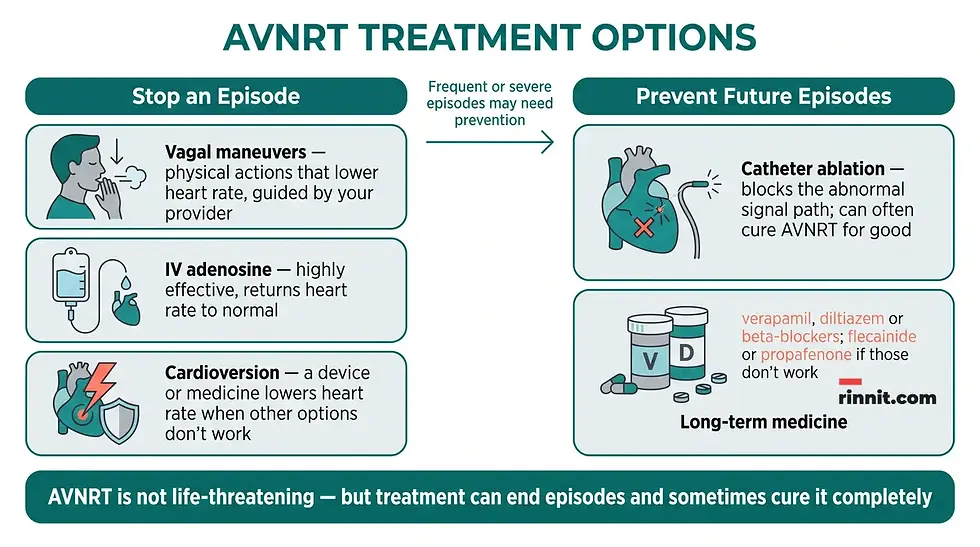
Your healthcare provider will talk to you about your options and help you decide what's best for your unique needs. Certain treatments stop an episode in its tracks. Others prevent episodes by helping your heart's electrical system work as it should.
Treatments that stop an episode
Treatment | How it works |
Vagal maneuvers | Physical actions that lower your heart rate, performed with a provider's help in a clinical setting; only do them at home if your provider recommends and teaches you how |
Medicines | Adenosine given through an IV, which is highly effective at returning your heart rate to normal; other options include certain beta-blockers and calcium channel blockers |
Cardioversion | A device or medicine used to safely lower your heart rate, typically when other treatments don't work or aren't an option |
Treatments that prevent future episodes
If you have frequent or severe AVNRT episodes, your provider may recommend treatments that keep your heart's electrical signals from taking the abnormal, circular route through your AV node [1]:
Treatment | How it works |
Catheter ablation | Blocks abnormal electrical signals in your AV node to help your heart beat normally. It can often cure AVNRT so you have no more episodes |
Long-term medicine | Verapamil, diltiazem, or beta-blockers; if those don't work, flecainide or propafenone may be prescribed |
What's the long-term outlook?
AVNRT can cause uncomfortable symptoms, but it doesn't pose a serious threat to your health [1]. Your provider will help you understand your options for stopping episodes and, if needed, preventing future ones.
Possible complications include worsening of existing heart disease and sudden cardiac arrest [10].
If you rarely have episodes and your symptoms are mild, your provider may recommend waiting to try treatments like cardioversion or long-term medicine. It's possible you might eventually stop having any episodes even without these treatments [1].
What's the difference between AVNRT and AVRT?
AVNRT and AVRT differ in where the abnormal electrical activity occurs: AVNRT involves the AV node, while AVRT involves an extra (accessory) pathway [1] [5]. The "N," which stands for "nodal," is important in AVNRT. It refers to the location of the abnormal electrical activity: your AV node.
AVRT is different. The problem is an extra (accessory) pathway that sends electrical signals from your atria to your ventricles. In other words, your heart has an additional wire that's not supposed to be there, and it causes a fast, abnormal rhythm. AVRT is a feature of Wolff-Parkinson-White syndrome [1].
Condition | Where the problem is | Key detail |
AVNRT | Inside the AV node: signals circle around | "Nodal" means the AV node itself is the source |
AVRT | An extra pathway from atria to ventricles | A feature of Wolff-Parkinson-White syndrome |
Conclusion: you can break the loop
AVNRT can make both your heart and your thoughts race. While your heart beats faster in your chest, all sorts of worries come to mind, and it can be hard to tell if a fast heartbeat is harmless or something that needs medical attention.
The reassuring news is that AVNRT doesn't pose a serious threat to your health [1], and it's highly treatable. A single IV injection of adenosine can return your heart rate to normal [1]. Catheter ablation can often cure the condition entirely [1] [5]. And for people with mild, rare episodes, watchful waiting is a valid option, since some people eventually stop having episodes on their own [1].
When in doubt, listen to your body. If something feels out of the ordinary for you, call a healthcare provider, whether or not you have an AVNRT diagnosis. Your provider can identify the cause and make sure you get the care you need.
Your next step: If your heartbeat suddenly races for no reason, or if diagnosed episodes start changing or worsening, contact your healthcare provider for an evaluation. Explore Rinnit.com's library of heart health guides for clear, easy-to-understand answers on arrhythmias, palpitations, and more.
Frequently Asked Questions
What does AVNRT stand for? AVNRT stands for atrioventricular nodal reentrant tachycardia. It means electrical signals are circling (reentering) inside the AV node, the small area of tissue near the center of your heart that normally passes signals from the upper chambers to the lower chambers, and causing a fast heartbeat.
Is AVNRT dangerous? AVNRT isn't life-threatening. It doesn't pose a serious threat to your health. However, the episodes of a very fast heart rate can feel scary and disrupt your daily life, which is why treatment is worthwhile.
How fast does the heart beat during an AVNRT episode? Typically 120 to 200 beats per minute, well above the normal adult resting rate of 60 to 100 bpm. Rates above 200 bpm are possible and more likely in younger people.
How long does an AVNRT episode last? Episodes come and go suddenly. One episode might last just a few seconds or as long as several hours.
Who gets AVNRT? Anyone at any age can get AVNRT. It often starts around age 30, is more common in females than in males, and can occur in young, otherwise healthy adults.
What causes an AVNRT episode? The cause is abnormal electrical activity in the heart: signals get caught in a circular path in the AV node. Possible triggers include alcohol, caffeine, and physical activity, but episodes sometimes happen on their own for no known reason.
What are the symptoms of AVNRT? The most common symptom is heart palpitations. Others include a racing-heart feeling, dizziness, palpitations or discomfort in the neck, shortness of breath, and producing more pee than usual (polyuria).
How is AVNRT diagnosed? Providers use a physical exam and discussion of your symptoms, plus tests such as an ECG/EKG, Holter monitor, electrophysiologic study, echocardiogram, and blood tests.
What are the types of AVNRT? Typical AVNRT (slow/fast) is the most common, affecting about 85 to 90 out of every 100 people with the condition. Atypical AVNRT has two subtypes, fast/slow and slow/slow, and is much less common. You can't tell the type from symptoms; a diagnostic electrophysiology study shows the difference.
How do you stop an AVNRT episode? Vagal maneuvers (physical actions done with a provider's guidance), an IV medicine called adenosine that's highly effective at returning the heart rate to normal, other medicines like certain beta-blockers and calcium channel blockers, or cardioversion if other treatments don't work.
Can AVNRT be cured? Catheter ablation can often cure AVNRT. The procedure blocks the abnormal electrical signals in your AV node so your heart beats normally and episodes stop for good.
What medicines prevent AVNRT episodes? Providers typically prescribe verapamil, diltiazem, or beta-blockers for long-term prevention. If those don't work, flecainide or propafenone may be prescribed.
What's the difference between AVNRT and AVRT? AVNRT starts inside the AV node itself. AVRT involves an extra (accessory) pathway from the atria to the ventricles, an additional "wire" that's not supposed to be there, and is a feature of Wolff-Parkinson-White syndrome.
Can you have AVNRT without treatment? Yes. If you rarely have episodes and your symptoms are mild, your provider may recommend waiting before trying treatments like cardioversion or long-term medicine. Some people eventually stop having episodes even without treatment.
When should I call my healthcare provider? Call your provider right away if your symptoms change or get worse, if you have questions about your treatment plan, or if you experience side effects from your medicines. If a fast heartbeat feels out of the ordinary for you, call a healthcare provider either way.
Related Reading
What Is Supraventricular Tachycardia (SVT)? Symptoms, Causes, Tests, and Treatments Explained - The broader family of rhythms AVNRT belongs to.
Heart Palpitations: Causes, Symptoms & Treatment Guide - Harmless fluttering versus a sign to call your doctor.
References
Cleveland Clinic. Atrioventricular Nodal Reentrant Tachycardia (AVNRT). Cleveland Clinic. Updated July 17, 2025. https://my.clevelandclinic.org/health/diseases/22923-avnrt
Marzlin KM. Atrioventricular Nodal Reentrant Tachycardia. AACN Adv Crit Care. 2017;28(1):84-88. PMID 28254859. https://doi.org/10.4037/aacnacc2017887
Marzlin KM, et al. Atrioventricular Reentrant Tachycardia. AACN Adv Crit Care. 2017;28(2):223-228. PMID 28592483. https://doi.org/10.4037/aacnacc2017151
Nasir M, et al. Common Types of Supraventricular Tachycardia: Diagnosis and Management. Am Fam Physician. 2023;107(6):631-641. PMID 37327167. https://pubmed.ncbi.nlm.nih.gov/37327167/
Mitchell LB. Reentrant (Paroxysmal) Supraventricular Tachycardias (PSVT). Merck Manual Professional Version. Updated September 2024. https://www.merckmanuals.com/professional/cardiovascular-disorders/specific-cardiac-arrhythmias/reentrant-paroxysmal-supraventricular-tachycardias-psvt
Appelboam A, et al. Postural modification to the standard Valsalva manoeuvre for emergency treatment of supraventricular tachycardias (REVERT): a randomised controlled trial. Lancet. 2015;386(10005):1747-53. PMID 26314489. https://doi.org/10.1016/S0140-6736(15)61485-4
Etaee F, Elayi CS, Catanzarro J, et al. Gender associated disparities in atrioventricular nodal reentrant tachycardia: a review article. J Cardiovasc Electrophysiol. 2021;32(6):1772-1777. PMID 33969588. https://doi.org/10.1111/jce.15078
Shurrab M, Danon A, Crystal A, et al. Remote magnetic navigation for catheter ablation of atrioventricular nodal reentrant tachycardia: a systematic review and meta-analysis. Expert Rev Cardiovasc Ther. 2013;11(7):829-836. PMID 23895026. https://doi.org/10.1586/14779072.2013.811968
Lodewyckx E, Bergs J. Effectiveness of the modified Valsalva manoeuvre in adults with supraventricular tachycardia: a systematic review and meta-analysis. Eur J Emerg Med. 2021;28(6):432-439. PMID 34406136. https://doi.org/10.1097/MEJ.0000000000000862
Mayo Clinic Staff. Atrioventricular nodal reentry tachycardia (AVNRT) — Symptoms and causes. Mayo Clinic. October 5, 2024. https://www.mayoclinic.org/diseases-conditions/avnrt/symptoms-causes/syc-20573830
Medical Disclaimer
This article is for general informational purposes only and is not a substitute for professional medical advice, diagnosis, or treatment. Always seek the advice of your physician or other qualified health provider with any questions you may have regarding a medical condition. Never disregard professional medical advice or delay seeking it because of something you have read here.



Comments