Bursa Injection: What It Treats, How It's Done and What Recovery Looks Like

Updated: 6 days ago
Written and medically reviewed by Dr. Baraa Alnahhal, MD · Last reviewed: October 31, 2026 · How we review
Quick Answer: What is a bursa injection?
A bursa injection is a steroid shot, usually combined with a numbing medicine, placed into an inflamed bursa to ease bursitis pain and swelling in joints such as the hip, shoulder, elbow or knee. It often takes less than 10 minutes at a provider's office, starts working within a few days and can relieve symptoms for months. [1]
What the research says
Steroid shots into the shoulder bursa cut pain by about 3 points on a 10-point scale. A meta-analysis of 23 studies (739 patients) with shoulder impingement found an average pain drop of 3.00 points after subacromial injection, with lower doses (2.85 points) working about as well as higher doses (3.06 points) (Qin et al., Am J Phys Med Rehabil, 2026).
For outer hip pain, a steroid shot gives a small short-term benefit, and exercise stays central. A systematic review of randomized trials in gluteal tendinopathy found a small short-term pain effect for corticosteroid injection (SMD 0.51), while exercise plus education had a medium effect on pain (SMD 0.95) and function (SMD 0.91) (Bremer et al., Clin Rehabil, 2025).
Ultrasound guidance may give faster early relief for shoulder pain. In a meta-analysis of 13 studies (656 patients) with shoulder pain, ultrasound-guided steroid shots gave better pain scores at 1 week and better arm-raising (abduction) at 6 weeks than landmark-guided shots, with no difference in other outcomes (Zhang et al., J Clin Ultrasound, 2025).
Key takeaways
A bursa injection combines a steroid (such as triamcinolone) with a local anesthetic.
It treats bursitis of the hip, shoulder, elbow, buttock/hamstring area and knee.
The procedure often takes less than 10 minutes, and you go home soon after.
Numbing relief lasts a couple of hours; the steroid takes a few days to work.
Relief can last several months or up to about one year.
Most people need to wait at least three months between injections.
Steroid shots can raise blood pressure and blood sugar for one to two days.
Bursa injection at a glance
Question | Short answer |
What is injected? | A steroid (for example, triamcinolone) plus a local anesthetic |
Where is it done? | At a healthcare provider's office |
How long does it take? | Often less than 10 minutes |
Is imaging used? | Ultrasound may guide shots to the hip, knee or shoulder |
When does it start working? | Numbing: right away for a couple of hours. Steroid: within a few days |
How long does relief last? | Several months, up to about one year |
How often can it be repeated? | Usually no sooner than every three months |
Main short-term side effects | Discomfort, bruising or swelling for a day or two |
What is a bursa injection?
A bursa injection is a shot that delivers anti-inflammatory steroid medicine directly into an irritated bursa to reduce swelling and pain from bursitis. [1]
The shot typically contains a steroid such as triamcinolone. Steroids are anti-inflammatory medicines that calm swelling and pain.
The steroid is mixed with an anesthetic (numbing medicine). This mix does two jobs:
It helps the medicine spread over a larger area.
It gives some pain relief right away, while you wait for the steroid to start working.
Bursa injections can also help joint pain caused by arthritis and other inflammatory conditions. [1]
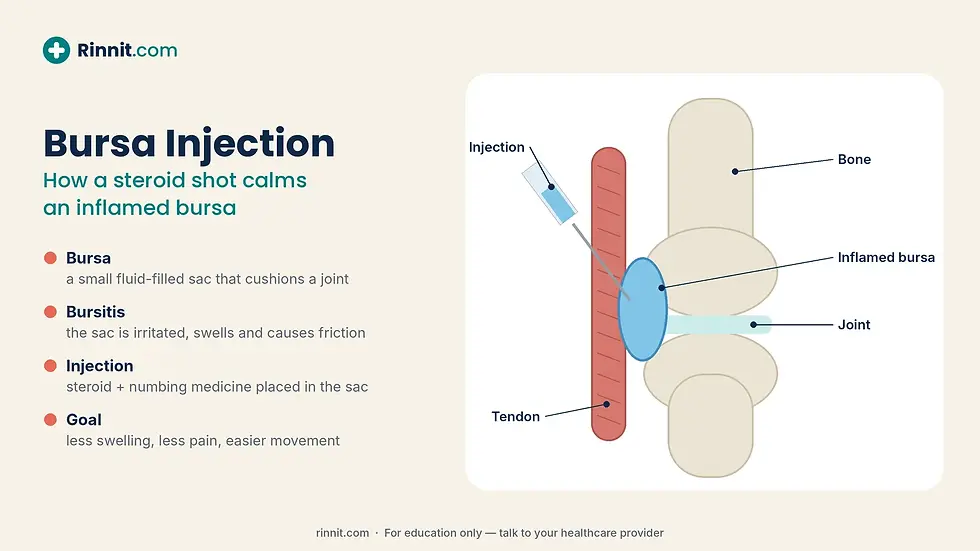
How a bursa injection reaches the inflamed sac that sits between a tendon and the bone. Image: Rinnit.com
Why does bursitis need a bursa injection?
Bursitis needs a bursa injection when the swollen, fluid-filled bursa keeps causing pain, and a steroid shot is used to bring that swelling down. [1]
Bursae (pronounced bur-SEE) are small, fluid-filled sacs that cushion your joints. They let tendons, muscles and bones glide past each other without friction.
Here is how bursitis develops, step by step:
Irritation. Repetitive use, accidents or injuries irritate a bursa.
Fluid builds up. Over time, extra fluid collects inside the sac.
Less space. The swollen bursa leaves less room for the joint and nearby tissues to move.
Friction and pain. Movement now rubs and hurts.
Which types of bursitis can a bursa injection treat?
A bursa injection can treat bursitis in any of the body's 160 bursae, but it is most often used in joints that do a lot of repetitive work. [1]
Type of bursitis | Where it hurts | Learn more |
Hip (trochanteric) bursitis | Outer side of the hip | |
Shoulder (subacromial) bursitis | Top and outer shoulder | |
Elbow (olecranon) bursitis | Tip of the elbow | — |
Hamstring or buttock bursitis | Sitting bone / back of the upper thigh | |
Knee bursitis (most often pre-patellar) | Front of the kneecap |
Bursitis can also affect other areas, such as the inner knee (pes anserine bursitis) or the heel.
What happens during a bursa injection?
A bursa injection is a quick office procedure, often finished in less than 10 minutes, and you usually go home soon after. [1]
For some sites, such as the hip, knee or shoulder, your provider may use ultrasound to guide the needle.
During the injection, your provider will:
Check which procedure you need and the exact location.
Clean the skin over the injection site.
Numb the skin with a local anesthetic.
Insert a thin needle through the skin into the inflamed bursa.
Inject the medicine into the bursa.
You may feel some pressure or discomfort during the shot. If more than one bursa is treated, your provider repeats these steps with a new, sterile needle for each injection.

The five steps of a bursa injection, usually done in under 10 minutes. Image: Rinnit.com
What are the side effects of a bursa injection?
Bursa injections are generally a safe treatment for bursitis pain, and most side effects are mild and short-lived. [1]
The type of side effect can depend on where the shot is given.
Side effect | What to know |
Discomfort, bruising or swelling in the joint | Common; usually lasts a day or two |
Headache | Possible after the shot |
Mild fever | Possible; fever with redness or discharge at the site can be a sign of infection — call your provider |
Skin dimpling or color change | Possible at the injection site |
Infection | A slight risk with any injection |
Who needs extra care after a bursa injection?
People with diabetes or high blood pressure need extra care after a bursa injection because steroid shots can raise blood sugar and blood pressure for one to two days. [1]
If you have diabetes: make a plan with your care team before the shot. Some people need extra medicine for a short time.
If you have high blood pressure: you may need to check your readings more closely for a few days.
What is recovery like after a bursa injection?
Recovery after a bursa injection is usually quick: the numbing medicine eases pain for a couple of hours, and the steroid starts reducing swelling within a few days. [1]
Follow your provider's advice. Common aftercare steps include:
Aftercare step | How long |
Avoid activity that stresses the treated area | At least 24 hours |
Put an ice pack wrapped in a towel on the area | As needed for comfort |
Take over-the-counter pain relievers or NSAIDs | As advised, for pain and swelling |
Avoid baths, pools or soaking the area | 2 days (showers are fine after that) |
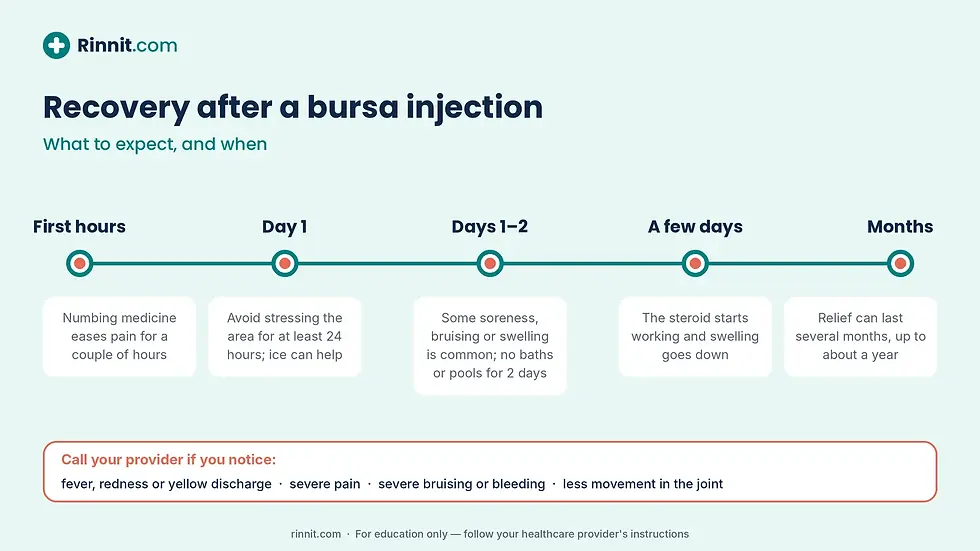
What recovery usually looks like after a bursa injection, from the first hours to the months that follow. Image: Rinnit.com
How long does a bursa injection last?
A bursa injection can reduce pain and inflammation for several months and sometimes up to one year, depending on the joint treated. [1]
Some people get lasting relief from a single injection.
If you keep doing the activities that irritate the joint, symptoms may return sooner.
How often can you get a bursa injection?
Most people need to wait at least three months between bursa injections, because too many shots can damage the bursa, joint and connective tissue. [1]
How often you can have one depends on:
The area being treated
Your symptoms
The dose of medicine used
When should you call a doctor after a bursa injection?
Call your healthcare provider after a bursa injection if you notice signs of infection, severe pain, heavy bruising or bleeding, or reduced movement in the treated joint. [1]
Warning sign | What it may look like |
Signs of infection | Fever, redness or yellow discharge at the injection site |
Severe pain | Severe pain in the treated area |
Severe bruising or bleeding | Heavy bruising or bleeding at the site |
Less movement | The treated joint becomes harder to move |
How can you keep bursitis from coming back after a bursa injection?
You can lower the chance of bursitis returning after a bursa injection by following your provider's plan, which often pairs the shot with rehabilitation and activity changes. [1]
Your provider may suggest:
Limiting activities that irritate the joint
Wearing a supportive brace or sling for a while
Stretching and strengthening exercises, often through physical therapy
In several joints, the inflammation also involves a nearby tendon, because tendons sit close to the bursa. If symptoms come back after the injection, talk with your provider. If injections have not worked, other treatments or surgery may be recommended.
Conclusion
A bursa injection is a fast, generally safe way to calm bursitis pain and swelling. Most people feel numbing relief right away, steroid relief within a few days, and benefits that can last for months. The shot works best as part of a bigger plan that includes rest from irritating activities, exercise and follow-up with your provider.
Next step: If bursitis is limiting your day, ask your healthcare provider whether a bursa injection is right for you. Then keep learning with our guides to knee bursitis, ischial bursitis and physical therapy.
Frequently asked questions
Does a bursa injection hurt?
Your skin is numbed first, so most people feel only some pressure or discomfort during the shot. Mild soreness, bruising or swelling can follow for a day or two.
How fast does a bursa injection work?
The numbing medicine can ease pain for a couple of hours right away. The steroid usually takes a few days to reduce swelling and pain.
How long will a bursa injection last?
Relief often lasts several months and can last up to about one year. Some people get lasting relief from one shot.
How many bursa injections can I have?
Most people need to wait at least three months between injections, because frequent shots can damage the bursa, joint and connective tissue.
Can I shower or swim after a bursa injection?
You can shower, but avoid baths, pools or soaking the area for two days after the injection.
What should I know about a bursa injection if I have diabetes?
Steroid shots can raise blood sugar for one to two days. Make a plan with your care team before the injection; some people need extra medicine for a short time.
What if the bursa injection doesn't work?
Talk with your provider. They may suggest rehabilitation, other treatments or, in some cases, surgery.
Is a bursa injection the same as a cortisone shot?
Yes, it is a type of cortisone shot. It combines a steroid with a numbing medicine and places it directly into the irritated bursa.
Will ultrasound be used to guide my bursa injection?
Sometimes. Your provider may use ultrasound to guide the needle for shots into the hip, knee or shoulder.
Can pain get worse after a bursa injection?
Some people have a short-term increase in pain for a day or two before the steroid starts to work. Call your provider if pain is severe, keeps getting worse, or comes with redness, warmth or fever.
External resources
Related Reading
Cortisone Shots (Steroid Injections): How They Work, Side Effects, and What to Expect explains how cortisone shots ease inflammation and their possible side effects.
Knee Bursitis: Symptoms, Causes, Diagnosis, and Treatment Guide covers knee bursitis symptoms, causes and treatment options.
Ischial Bursitis: Understanding Sit Bone Pain and Recovery explains sit-bone pain from ischial bursitis and how it heals.
Heel Bursitis: Understanding Causes, Symptoms, and Recovery describes heel bursitis causes, symptoms and recovery steps.
References
Cleveland Clinic. Bursa Injection: Steroid Injection for Joint Pain. Cleveland Clinic. Last updated July 21, 2021. https://my.clevelandclinic.org/health/treatments/21663-bursa-injection
Qin Y, Kim HH, Gao D, et al. Corticosteroid Dose and Efficacy in Shoulder Impingement Syndrome: A Systematic Review and Meta-Analysis. American Journal of Physical Medicine & Rehabilitation. 2026. Epub ahead of print August 11, 2026. PMID: 42576185. https://doi.org/10.1097/PHM.0000000000003122
Bremer T, Nicklen P, Fearon A, Morrissey D. The efficacy of gluteal tendinopathy treatments: A systematic review. Clinical Rehabilitation. 2025;39(5):600-617. PMID: 40223303. https://doi.org/10.1177/02692155251327298
Zhang Y, Hu M, Wei J, et al. Ultrasound- Versus Landmark-Guided Corticosteroid Injections in Patients With Shoulder Pain: A Meta-Analysis and Systematic Review. Journal of Clinical Ultrasound. 2025;53(3):525-534. PMID: 39441207. https://doi.org/10.1002/jcu.23871
Medical disclaimer
This article is for general educational purposes and is not a substitute for professional medical advice, diagnosis or treatment. Always seek the advice of your doctor or another qualified health provider with any questions about a medical condition or treatment.



Comments