Pes Anserine Bursitis: Understanding Medial Knee Pain

Updated: 2 days ago
Medically reviewed by Dr. Baraa Alnahhal, MD · Last reviewed: October 2026
Pes anserine bursitis is inflammation of a fluid-filled sac on the inner side of the knee. It often results from overuse or repetitive stress and causes pain and tenderness below the joint line [1]. It is common in athletes and in people with risk factors such as overweight or knee osteoarthritis, and most cases heal within about six to eight weeks with nonsurgical care such as rest, physical therapy, and anti-inflammatory medication [1].
Quick Answer: What is pes anserine bursitis?
Pes anserine bursitis is irritation and swelling of the bursa between the shin bone and three tendons on the inner knee. It causes inner knee pain, about 2 to 3 inches below the joint, that worsens with activity, stairs or standing up. Treatment includes rest, cold packs, medicine and physical therapy, and most people heal in six to eight weeks. [1]
What the research says
Three injection options all helped, and two lasted longer than corticosteroid. In a randomized multicenter trial of 72 participants (mean age 61.5 years), ultrasound-guided injections into the bursa of a corticosteroid, oxygen-ozone, or 20% dextrose (prolotherapy) all improved pain and knee function scores. Corticosteroid and oxygen-ozone were better at 1 week, while oxygen-ozone and prolotherapy were better at 8 weeks, so the authors concluded that their effects last longer than corticosteroid (Babaei-Ghazani et al., Am J Phys Med Rehabil, 2024).
Knee alignment and osteoarthritis were linked to pes anserine problems. In a retrospective study of 168 patients with knee osteoarthritis (mean age 73.8 years, 78% female), 162 had a bow-legged (varus) alignment and 39 had pes anserine tendinitis, all within the varus group. The authors reported a significant link between knee varus and bursitis at this site, but the cross-sectional design means causality cannot be established (Liang et al., Ann Med, 2025).
Kinesiology taping may ease symptoms, but evidence for add-on therapies is limited. A review of physical therapy modalities reported that kinesiology taping improves symptoms in people with this type of knee bursitis, plantar fascia pain, and low back pain. It cautions that most such modalities are not supported by high-quality evidence and should be used as adjuncts to active exercise rather than replacements for it (Beutler, FP Essent, 2018).
Research summaries are based on article abstracts retrieved from PubMed.
What is the anatomy of the pes anserinus?
The term “pes anserinus” is Latin for “goose's foot.” It describes the footprint-like shape formed where three tendons, the sartorius, gracilis, and semitendinosus, converge and attach to the medial (inner) side of the shin bone. The pes anserinus bursa is a thin, fluid-filled sac positioned between these tendons and the bone [1].
In a healthy knee, the bursa acts as a cushion and lubricant that lets tendons and muscles glide smoothly along the bone. When the bursa becomes irritated, it produces too much fluid and swells, which causes knee pain and tenderness [1].

What are the symptoms and warning signs of pes anserine bursitis?
The pain usually develops gradually rather than suddenly. Where the pain is and what triggers it helps tell this bursitis apart from other knee problems [1].
Symptom Type | Clinical Presentation |
Primary pain | Pain and tenderness on the inside of the knee, roughly 2 to 3 inches below the joint line. |
Activity triggers | More discomfort when kneeling, climbing stairs, walking up and down stairs, or standing up from a chair. |
Relief factors | Pain typically improves with enough rest. |
Physical signs | Swelling and tenderness to the touch on the inner knee. |
What causes pes anserine bursitis, and who is at risk?
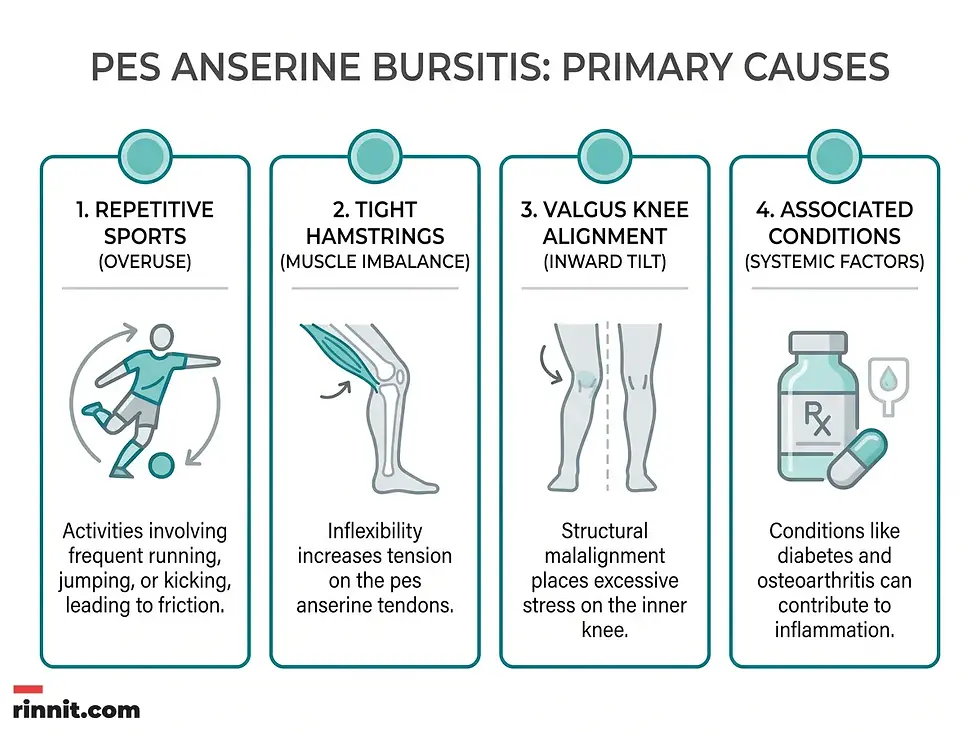
Bursitis most often occurs because of overuse or stress on the bursa [1]. Common causes include:
Repetitive stress: sports with repeated knee movements, such as soccer or tennis, and overuse of the knee.
Mechanical factors: tight hamstring muscles or abnormal knee alignment (valgus).
Training errors: poor technique, such as not stretching properly before a workout.
Prior injury: an existing injury to the medial collateral ligament (MCL).
The condition is most common among athletes. It also predominantly affects females and people between the ages of 40 and 60, and people with diabetes, knee osteoarthritis, or overweight or obesity [1]. One study of patients with knee osteoarthritis also linked varus (bow-legged) alignment to pes anserine problems [3].
How is pes anserine bursitis diagnosed?
Pes anserine bursitis is diagnosed by reviewing your medical history and performing a physical examination of the knee. Because it can have the same symptoms as a stress fracture, a knee X-ray may be needed to rule out a broken bone. Ultrasound or magnetic resonance imaging (MRI) may be used to see the soft tissues and determine the extent of the injury [1].
How is pes anserine bursitis managed, and what is recovery like?
Most people recover with nonsurgical care. Most heal in about six to eight weeks, and severe cases may take longer. You will likely recover faster if you rest and get proper treatment [1].
Conservative Treatment Options
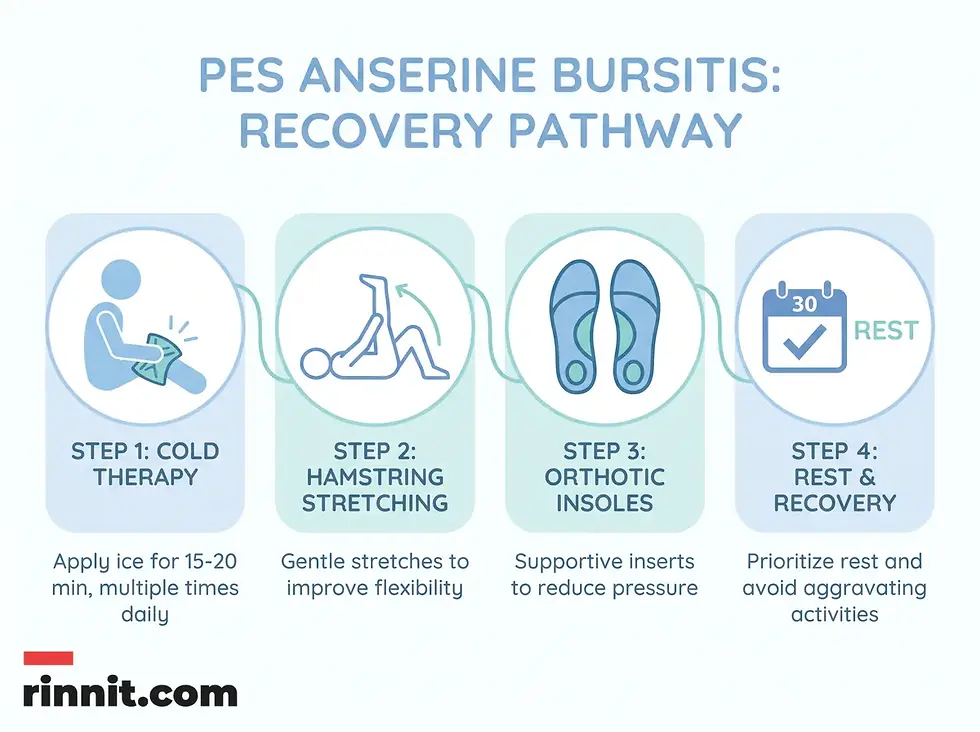
Rest: take a break from activities that cause flare-ups and ask your provider when you can return to your routine.
Cold packs: applying ice to the area three to four times daily can help reduce inflammation.
Medication: nonsteroidal anti-inflammatory drugs (NSAIDs), such as naproxen and ibuprofen, can help relieve inflammation, swelling and pain.
Physical therapy: ultrasound treatments or stretching exercises help you regain strength and range of motion.
Orthotics: if abnormal knee alignment is part of the problem, wedge insoles can help keep the leg in the right position.
Kinesiology tape: can ease pain symptoms, so ask your provider about proper technique [4].
In rare cases, a provider may inject a steroid into the bursa, or use platelet-rich plasma (PRP) from a sample of your blood to promote healing [1]. A randomized trial of bursa injections found that several injection types can help [2]. Surgery to remove the bursa is rare and is reserved for severe cases [1].
How can pes anserine bursitis be prevented, and when can you return to activity?
To lower your risk of a recurrence, ask your healthcare provider for exercises that stretch and strengthen the muscles of your knees, thighs, and abdomen. If you have overweight or obesity, reaching and maintaining a healthy weight can take pressure off the bursae [1]. You can usually return to work right after treatment if you have a desk job, but a physically demanding job may require a few weeks off [1].
Conclusion
Pes anserine bursitis can be painful and disrupt daily life, but it responds well to early diagnosis and nonsurgical care. By identifying the triggers and addressing mechanical problems such as tight hamstrings, most people recover without long-term limits [1]. If you have persistent inner knee pain, see a healthcare provider.
When should you see a doctor about pes anserine bursitis?
Schedule a visit any time you develop persistent knee pain. If you do not get relief after a few months of at-home treatment, or you start to feel worse, follow up with your provider, who may recommend other treatment options [1].
Frequently Asked Questions
Why is it called "pes anserine"?
The name comes from the Latin words for "goose's foot." It refers to the way the sartorius, gracilis, and semitendinosus tendons come together and attach to the shin bone in a shape that looks like a goose's footprint [1].
How can I tell if my knee pain is bursitis or a ligament tear?
Bursitis at the pes anserinus causes pain on the inside of the knee, 2 to 3 inches below the knee joint, that usually develops gradually. Ligament tears more often follow a specific injury. Because bursitis can mimic a stress fracture, a healthcare provider's exam, and sometimes imaging, is needed to confirm the cause [1].
Can I continue to exercise with pes anserine bursitis?
Take a break from activities that lead to flare-ups and ask your healthcare provider when you can return to your routine. Your provider or physical therapist can advise on safe exercise [1].
Is walking up stairs bad for this condition?
Pain often gets worse when climbing stairs, kneeling, or standing up from a chair, so these movements may aggravate symptoms while the bursa is inflamed [1].
Do I need surgery for knee bursitis?
Surgery is rare. Most people improve with nonsurgical treatment such as rest, cold packs, medicine, and physical therapy. Surgery to remove the bursa is considered only in severe cases [1].
How long does it take for the swelling to go down?
Most people heal in about six to eight weeks, and severe cases may take longer. You are likely to recover faster if you rest and get proper treatment [1].
Are there specific stretches that help?
Stretching and strengthening exercises for the muscles of the knees, thighs, and abdomen can help and may prevent a recurrence. Tight hamstrings are one of the common causes, so ask your provider or physical therapist for the right exercises [1].
Can being overweight cause this condition?
Overweight and obesity are risk factors. Reaching and maintaining a healthy weight can take pressure off the pes anserinus bursa [1].
When is it safe to return to sports?
Most people heal in six to eight weeks, but the right time depends on your recovery. Return to sports when your provider confirms you have regained strength and no longer have pain with activity [1].
Should I use ice or heat for pes anserine bursitis?
Ice is usually recommended to calm the inflammation. Apply a wrapped cold pack to the inner knee three to four times a day, and ask your provider if heat is right for you later.
Related Resources
Related on Rinnit:
External resource for deeper reading:
Cleveland Clinic. Pes Anserine Bursitis. Cleveland Clinic Health Library. Last updated March 5, 2025. https://my.clevelandclinic.org/health/diseases/pes-anserine-bursitis
References
Cleveland Clinic. Pes Anserine Bursitis. Cleveland Clinic Health Library. Last updated March 5, 2025. https://my.clevelandclinic.org/health/diseases/pes-anserine-bursitis
Babaei-Ghazani A, Eftekharsadat B, Soleymanzadeh H, et al. Ultrasound-guided pes anserine bursitis injection choices: prolotherapy or oxygen-ozone or corticosteroid: a randomized multicenter clinical trial. Am J Phys Med Rehabil. 2024;103(4):310-317. PMID: 37752656. DOI: 10.1097/PHM.0000000000002343
Liang YF, Li XS, Zha FD, et al. Association between knee osteoarthritis and foot deformities: epidemiological analysis of hallux valgus and flatfoot. Ann Med. 2025;57(1):2536213. PMID: 40693861. DOI: 10.1080/07853890.2025.2536213
Beutler A. Musculoskeletal therapies: adjunctive physical therapy. FP Essent. 2018;470:16-20. PMID: 29963844. PubMed: pubmed.ncbi.nlm.nih.gov/29963844
Medical disclaimer
This article is for informational purposes only and is not a substitute for professional medical advice, diagnosis, or treatment. Always seek the advice of your physician or other qualified health provider with any questions you may have about a medical condition.



Comments