Joints: Anatomy, Types, and Health Significance

Updated: 3 days ago
Medically reviewed by Dr. Baraa Alnahhal, MD · Last reviewed: October 2026
Joints, also called articulations, are the places where two bones meet. They give your skeleton its shape and let you sit, stand and move, and adults have around 350 of them [1].
Quick Answer: What is a joint?
A joint is any place in the body where two bones meet, ranging from immovable fibrous joints in the skull to highly mobile synovial joints such as the shoulder and knee. Arthritis, bursitis and injuries can damage them. Staying active with low-impact exercise, eating well, wearing protective gear and seeing a provider for new joint pain support joint health. [1]
What the research says
Exercise reduces knee pain and improves function. A Cochrane review of 54 randomized trials of land-based exercise for knee osteoarthritis found high-quality evidence from 44 trials (3,537 participants) that exercise reduced pain, equivalent to about 12 points on a 0 to 100 scale, with benefit lasting at least two to six months after formal treatment ended. Eight studies reported adverse events, all related to temporary increases in knee or low back pain, and none reported a serious adverse event (Fransen et al., Cochrane Database of Systematic Reviews, 2015 [2]).
Weight loss plus exercise worked best for knee osteoarthritis. In an 18-month randomized trial of 454 overweight or obese adults with knee osteoarthritis, mean weight loss was 11.4% with diet plus exercise, 9.5% with diet alone and 2.0% with exercise alone. The diet-plus-exercise group had less pain and better function than either of the other groups, and knee compressive force was lower with diet alone than with exercise alone (2,487 N versus 2,687 N) (Messier et al., JAMA, 2013 [3]).
Osteoarthritis is common and rising. The Global Burden of Disease Study estimated that 595 million people (7.6% of the world's population) had osteoarthritis in 2020, an increase of 132.2% in total cases since 1990. The knee was the most common site, and high body mass index was estimated to contribute to about 20% of osteoarthritis burden (GBD 2021 Osteoarthritis Collaborators, Lancet Rheumatology, 2023 [4]).
What Are Joints?
Joints are the fundamental components of the skeletal system that allow movement and structural support. Healthcare professionals often call them articulations. Some joints are built for a wide range of motion, while others are fused tightly to give the body a rigid framework. Whether it is an ankle you think about daily or the joints that hold your skull together, all of them help you use your body every day [1].
Functional Categories
Depending on how much a joint moves, it fits into one of three functional groups [1]:
Functional type | Movement level | Primary role |
Synarthroses | None | Structural support (for example, skull plates) |
Amphiarthroses | Limited | Stability mixed with slight motion |
Diarthroses | Free | Maximum movement in most directions |

The three functional categories of joints, with examples from the skull, ribs and pelvis, knee and shoulder.
What are joints made of, and what is their anatomy?
Joints are made of bones and the connective tissues that hold them together, including cartilage, tendons, ligaments and nerves. How much connective tissue a joint contains determines how flexible and strong it is [1].
Major Structural Groups
Fibrous joints: held together by thick, tightly woven, collagen-rich connective tissue, with little or no flexibility. The three types are sutures (the skull plates), gomphoses (the joints that hold teeth in the jaw) and syndesmoses (such as the joint keeping the tibia and fibula connected).
Cartilaginous joints: cushioned by a layer of cartilage that allows limited movement. They are found where the ribs meet the breastbone and in the pubic symphysis that joins the left and right pelvic bones.
Synovial joints: the most mobile type. A cavity in one bone receives another bone, slippery hyaline cartilage covers the bone ends, and a fluid-filled synovial membrane lines the space to lubricate and protect the joint.
There are six types of synovial joints [1]:
Synovial joint type | Movement pattern | Common examples |
Hinge | Opens and closes in one direction | Knees, elbows |
Ball and socket | Rotates and turns in almost any direction | Shoulders, hips |
Condyloid | Like ball and socket but cannot rotate a full circle | Wrist, toe joints |
Pivot | Rotates in place | Neck (turning the head) |
Planar | Flat bones slide over each other | Wrist carpal bones, spine vertebrae |
Saddle | Curved bones fit together; moves in any direction but cannot twist | Base of the thumb |
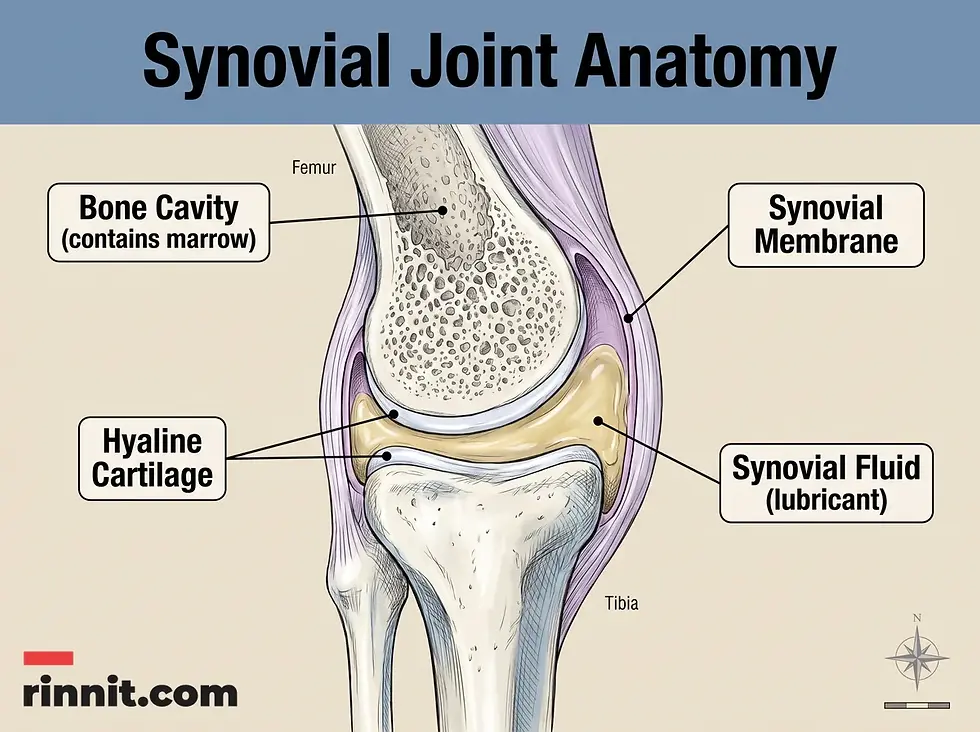
Anatomy of a synovial joint (knee): bone, hyaline cartilage, synovial membrane and lubricating synovial fluid.
What are common joint conditions and their symptoms?
Joints can be damaged by anything that harms bone or connective tissue, by autoimmune responses, and by physical trauma. Recognizing early signs of joint trouble helps with effective management [1].
Common Joint Issues
Arthritis and osteoarthritis: inflammation and wear of joint tissues, often causing pain and stiffness.
Bursitis and tendinitis: inflammation of the cushioning sacs or the tendons around a joint.
Osteoporosis: weakening of the bones that form the joints.
Autoimmune disorders: rheumatoid arthritis, psoriatic arthritis, lupus and Sjögren's syndrome can cause the body to attack its own joint tissues.
Traumatic injuries: falls, car accidents and sports injuries can cause fractures, dislocations and sprains.
Common Symptoms and Tests
Symptoms depend on the condition but often include pain (especially when moving the joint), swelling, discoloration or redness, a feeling of warmth, a grinding feeling, and a popping noise or sensation. Providers commonly use X-rays, ultrasounds, joint aspiration, CT scans and MRIs to diagnose joint problems [1].

Joint care and prevention: low-impact exercise, a nutrient-rich diet, and early attention to joint symptoms.
How can you keep your joints healthy?
The best way to take care of your joints is to maintain good overall health. Which type of exercise is best depends on your joint health and fitness level, so talk to your provider about the right plan [1].
Healthy diet: follow an eating pattern that is healthy for you.
Low-impact exercise: cycling, strength training, swimming, low-impact cardio and water aerobics give benefits without excessive joint strain.
Safety equipment: wear proper protective gear for any sport, activity or work.
Regular checkups: see a healthcare provider for routine visits and as soon as you notice changes or new pain in a joint.
Seatbelt: always wear your seatbelt to help prevent joint-damaging trauma.
What is the bottom line on joint health?
Joints are the essential connectors that let your body interact with the world through movement. From the rigid sutures of the skull to the complex mechanics of the knee, each joint has a specific role in maintaining the body's shape and function. Staying active with low-impact exercise, supporting a healthy weight, using protective gear and having regular checkups are the most practical ways to protect them.
Your next step: if you are experiencing new joint pain, swelling or stiffness, schedule a visit with a healthcare provider to evaluate your joint health and plan how to keep your mobility.
Frequently Asked Questions
How many joints are in the human body?
Experts do not agree on an exact number because they define a joint differently, but adults have around 350 joints.
What is a synovial joint?
A synovial joint is a highly mobile joint in which the bone ends are covered with slippery hyaline cartilage and the space between them is lined by a fluid-filled synovial membrane that lubricates and protects the joint.
What are the most common joint conditions?
Arthritis, osteoarthritis, bursitis, tendinitis and osteoporosis are among the conditions that commonly affect joints.
Which joints allow the most movement?
Ball and socket joints, such as those in the shoulders and hips, can rotate and turn in almost any direction.
What are fibrous joints made of?
Fibrous joints are made of thick, tightly woven connective tissue that usually contains a lot of collagen.
How does exercise help joints?
Regular movement helps keep joints flexible and strengthens the muscles that support them. For knee osteoarthritis, a Cochrane review found that exercise reduces pain and improves physical function.
What is an example of a hinge joint?
The knees and elbows are hinge joints, which open and close in one direction.
What symptoms indicate a joint problem?
Common signs include pain (especially when moving the joint), swelling, redness, warmth, and a grinding or popping feeling.
What are cartilaginous joints?
Cartilaginous joints are joints cushioned by a layer of cartilage that joins the bones and allows limited movement, such as where the ribs meet the breastbone and the pubic symphysis in the pelvis.
Can autoimmune diseases affect joints?
Yes. Autoimmune diseases such as rheumatoid arthritis, psoriatic arthritis, lupus and Sjögren's syndrome often cause symptoms in the joints.
Related Reading
What Is Arthritis? A Plain-Language Guide to the Most Common Joint Problem in the World explains the main types of arthritis and how joint pain is treated.
Cartilage: Complete Guide to Types, Function, and Joint Health describes the cartilage that cushions joints and how it wears down.
Understanding Ligaments: The Connective Bands of the Human Body covers the tough bands that hold joints together and common injuries.
Arthroplasty (Joint Replacement): Procedure, Types, and Recovery walks through joint replacement surgery, its types and recovery.
References
Cleveland Clinic. Joints. Cleveland Clinic. July 18, 2023. https://my.clevelandclinic.org/health/body/25137-joints
Fransen M, McConnell S, Harmer AR, et al. Exercise for osteoarthritis of the knee. Cochrane Database of Systematic Reviews. 2015;(1):CD004376. PMID 25569281. https://doi.org/10.1002/14651858.CD004376.pub3
Messier SP, Mihalko SL, Legault C, et al. Effects of intensive diet and exercise on knee joint loads, inflammation, and clinical outcomes among overweight and obese adults with knee osteoarthritis: the IDEA randomized clinical trial. JAMA. 2013;310(12):1263-1273. PMID 24065013. https://doi.org/10.1001/jama.2013.277669
GBD 2021 Osteoarthritis Collaborators. Global, regional, and national burden of osteoarthritis, 1990-2020 and projections to 2050: a systematic analysis for the Global Burden of Disease Study 2021. Lancet Rheumatology. 2023;5(9):e508-e522. PMID 37675071. https://doi.org/10.1016/S2665-9913(23)00163-7
Medical disclaimer
This article is for informational purposes only and is not a substitute for professional medical advice, diagnosis, or treatment. The clinical information in this guide reflects source material last reviewed in July 2023.



Comments