Brachioplasty (Arm Lift): Surgery, Recovery, Risks and Results

Updated: 6 days ago
Written and medically reviewed by Dr. Baraa Alnahhal, MD · Last reviewed: October 2026 · How we review
Quick Answer: What is brachioplasty?
Brachioplasty, also called an arm lift, is cosmetic surgery that removes loose upper-arm skin, tightens the tissue underneath and can remove stubborn fat. It suits people with a stable weight who don't smoke and accept a long scar on the inner or back of the arm. Results show right away, while swelling settles over a few weeks. [1]
What the research says
Most complications are minor and cosmetic. A review pooling 29 studies and 1,578 patients found abnormal scarring in about 9.9% of people, wound separation in 6.8%, fluid build-up (seroma) in 5.9% and infection in 3.6%. About 7.5% had a second surgery to improve appearance, while only 1.6% needed one for a medical reason. Adding liposuction lowered the rate of some complications. (Aljerian et al., Plastic and Reconstructive Surgery, 2022)
Most patients would choose the surgery again. In 66 people who had an arm lift after major weight loss, 9.1% had a medical complication and 47.0% had a cosmetic one. Still, 86.8% of those surveyed said they would have it again, and 77.4% said their quality of life improved. (de Runz et al., Plastic and Reconstructive Surgery, 2015)
The long scar doesn't spoil satisfaction for most. Among 68 patients who lost at least 30 kg after weight-loss surgery, body-image and scar-satisfaction scores rose on every scale measured, about two years after the arm lift. (Barone et al., Aesthetic Plastic Surgery, 2025)
Key takeaways
An arm lift removes loose skin; exercise builds muscle but can't tighten skin.
Good candidates have a stable weight, no smoking habit and no conditions that raise surgical risk.
The scar usually runs along the upper arm. It fades but never fully disappears.
Recovery means a compression sleeve for several weeks and no heavy lifting for a while.
Keeping your weight steady is the best way to protect your result.
What is brachioplasty?
Brachioplasty is a type of cosmetic surgery for the upper arms, often called an arm lift. [1]
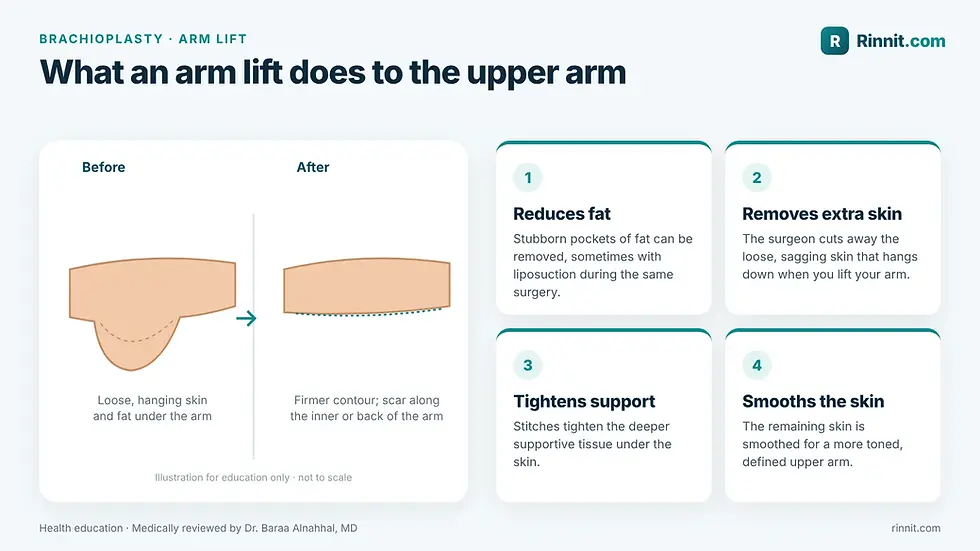
The goal is better tone and shape. The surgery does this in four ways:
What the surgeon does | What it changes |
Reduces pockets of fat | Slimmer upper arm |
Removes extra skin | Less hanging skin when you raise your arm |
Tightens supportive tissue | Firmer, more defined contour |
Smooths the remaining skin | Even, toned look |
The result is a more sculpted arm, in a way that diet and exercise alone can't achieve.
Who is an arm lift for?
An arm lift is for people whose upper arms droop or sag, sometimes described as a "bat wing" look, where a flap of skin hangs down when the arm is raised. [1]
Common reasons this happens include:
Aging. Skin loses elasticity over time.
Major weight loss. This can happen with or without weight-loss surgery.
Genetics. Some people inherit skin that sags more easily.
Lymphedema. A build-up of lymph fluid can stretch the arm tissue.
Is an arm lift right for you?
An arm lift may be right for you if you have loose upper-arm skin, a stable weight and good general health, and you can accept a scar along the upper arm. [1]
You may be a good candidate if you… | Talk with your surgeon first if you… |
Have loose skin on your upper arms | Expect to gain or lose a lot of weight |
Can accept a scar along the upper arm | Smoke |
Have kept a stable weight | Have a condition such as anemia that raises surgical risk |
Are in good general health | Want fat reduction only, with no loose skin |
Can exercise replace an arm lift?
Exercise can't replace an arm lift, because resistance training like lifting weights improves upper-arm muscle tone but can't tighten loose skin. [1]
After surgery, those same healthy habits help you keep your results for as long as possible.
What is the difference between an arm lift and liposuction?
An arm lift tightens loose skin, while liposuction removes fat that doesn't respond to diet and exercise. [1]
Arm lift | Liposuction | |
Main target | Loose, sagging skin | Stubborn fat deposits |
Tightens skin? | Yes | No |
Scar | Long scar on the inner or back of the arm | Small entry points |
Can be combined? | Yes, liposuction can be done during the same surgery for a more sculpted look | Yes |
If you have mostly fat and little loose skin, you may also want to read about liposculpture.
What happens during arm lift surgery?
During arm lift surgery, you receive anesthesia, then the surgeon makes a cut on the inside or back of the arm, removes extra skin and fat, tightens the tissue underneath and closes the incision. [1]

Here is what to expect, step by step:
Anesthesia. You get medicine to stay comfortable. This may be general anesthesia, which puts you to sleep. Or it may be a local anesthetic that numbs the area while you relax. Learn more in our anesthesia guide.
Incision. The surgeon makes a cut on the inside or back of your arm. Its size depends on how much correction you need.
Skin and fat removal. Extra skin is cut away. Extra fat may be removed with liposuction.
Tissue tightening. Stitches (sutures) tighten the supportive tissue under the skin.
Closing. The incision is closed with stitches and covered with sterile gauze to lower the risk of infection.
Does insurance cover brachioplasty?
Insurance usually doesn't cover brachioplasty, because it is mainly a cosmetic procedure. [1]
There is an exception. If sagging skin causes a medical problem, such as repeated infections, insurance may consider coverage. Approval depends on your plan and your situation.
What are the benefits of an arm lift?
An arm lift gives you a trimmer upper arm, and many people also feel more confident, especially in sleeveless tops, fitted clothes and swimwear. [1] [3]
What are the risks of brachioplasty?
Brachioplasty risks include abnormal scarring, excessive bleeding, seroma, damage to nerves, blood vessels or muscles, numbness, infection and wound separation. [1] [2]
Risk | What it means |
Abnormal or excessive scarring | Scars that are thick, wide or more visible than expected (see scar revision) |
Excessive bleeding | Bleeding more than normal during or after surgery |
Seroma | Fluid collecting under the skin |
Nerve, blood vessel or muscle damage | Injury to structures in the arm |
Numbness | Reduced feeling in the skin |
Infection | Germs entering the incision (see surgical wound infection) |
Wound separation (dehiscence) | The incision opens up (see wound dehiscence) |
What is arm lift recovery like?
Arm lift recovery involves bandages over the incision, a compression garment worn for several weeks, sometimes small drains, plenty of rest and avoiding heavy lifting for a while. [1]

Right after surgery, bandages protect the incision while it heals. You wear a snug sleeve called a compression garment to limit swelling. Small tubes (drains) may sit under the skin to remove extra fluid.
Recovery also includes:
Changing bandages as needed.
Raising your arms on pillows as advised.
Getting plenty of rest and eating a healthy diet to support healing.
Avoiding hard exercise and heavy lifting for a period of time.
Wearing the compression garment for several weeks.
When will you see results from an arm lift?
You'll see a change in the shape and tone of your arms right after an arm lift, while swelling and bruising fade over a few weeks. [1]
Timeframe | What to expect |
Right away | Visible change in arm shape and tone |
A few weeks | Swelling and bruising fade |
Long term | Scars fade somewhat but don't fully disappear |
Long term | Some looseness may return, and natural aging can cause new sagging |
Weight changes matter too. An arm lift won't stop your arms from sagging again if you gain or lose a lot of weight. That's why a steady, healthy weight is important before and after surgery. Our obesity guide covers practical ways to manage weight.
When should you call your surgeon after an arm lift?
Call your surgeon right away after an arm lift if you notice unusual arm swelling, heavy bleeding, vomiting, fever or discharge from the incision, pain medicine doesn't help, chest pain, shortness of breath, or changes in feeling or movement in your arms or hands. [1] Watch for:
Unusual swelling in your arm, which may be a sign of a blood clot
Blood-soaked dressings or heavy bleeding
Vomiting or not being able to keep fluids down, which can lead to dehydration
Fever or discharge from the incision, which may mean infection
Pain that doesn't get better with medicine
Shortness of breath or chest pain
Changes in feeling or movement in your arms or hands
Chest pain or sudden shortness of breath can be an emergency. Seek emergency care right away.
Conclusion
An arm lift can turn sagging upper arms into firmer, more defined ones when exercise alone isn't enough. It works best for people with a stable weight, no smoking habit and realistic expectations about the scar. Recovery takes several weeks of care, and keeping your weight steady helps your result last.
Thinking about an arm lift? Write down your questions, then book a consultation with a board-certified plastic surgeon to talk through your goals, health and scar expectations. For more trusted, easy-to-read health guides, explore the Rinnit.com health library.
Frequently asked questions
What is brachioplasty?
Brachioplasty, or an arm lift, is cosmetic surgery that removes loose upper-arm skin, tightens the tissue beneath it and can reduce fat for a firmer, more toned arm.
Will an arm lift leave a scar?
Yes. The scar usually runs along the length of the upper arm, on the inner or back side. It fades over time but never fully disappears.
Can I get rid of bat wings with exercise instead of surgery?
Exercise builds muscle tone in the upper arms, but it can't tighten loose skin. Surgery is the only way to remove sagging skin.
Can liposuction be done during an arm lift?
Yes. A surgeon can perform liposuction during brachioplasty to remove stubborn fat for a more sculpted result.
How long do I wear a compression garment after an arm lift?
Usually for several weeks. Your surgeon will tell you exactly how long based on your healing.
How long do arm lift results last?
Results can last a long time. However, sagging may return with aging or if your weight goes up or down a lot.
Does insurance pay for an arm lift?
Usually not, because it's mainly cosmetic. If loose skin causes a medical problem, such as repeated infections, coverage may be considered depending on your plan.
Who should not have an arm lift?
People who smoke, expect major weight changes or have conditions such as anemia that raise surgical risk should talk carefully with their doctor first.
Is an arm lift painful?
You are asleep or numbed during surgery, so you should not feel pain then. Afterward, soreness, swelling and tightness are common and are treated with medicine. Call your surgeon if your pain does not get better with medicine.
When can I go back to work after an arm lift?
It depends on your job and how you heal. Desk work usually comes sooner than jobs that involve lifting or reaching, and your surgeon will tell you when it is safe.
Related reading on Rinnit.com
External resources
References
Cleveland Clinic. Brachioplasty (Arm Lift): Surgery, Recovery & What To Expect. Cleveland Clinic. Last updated June 27, 2022. https://my.clevelandclinic.org/health/treatments/23367-brachioplasty-arm-lift
Aljerian A, Abi-Rafeh J, Ramirez-GarciaLuna J, et al. Complications in brachioplasty: a systematic review and meta-analysis. Plast Reconstr Surg. 2022;149(1):83-95. PMID: 34936607. https://doi.org/10.1097/PRS.0000000000008652
de Runz A, Colson T, Minetti C, et al. Liposuction-assisted medial brachioplasty after massive weight loss: an efficient procedure with a high functional benefit. Plast Reconstr Surg. 2015;135(1):74e-84e. PMID: 25539353. https://doi.org/10.1097/PRS.0000000000000845
Barone M, Salzillo R, Amenta A, et al. Balancing aesthetics and scarring: insights from post-bariatric brachioplasty. Aesthetic Plast Surg. 2025;49(16):4664-4670. PMID: 40481157. https://doi.org/10.1007/s00266-025-04928-3
Medical disclaimer
This article is for general education and doesn't replace advice from your doctor or surgeon.



Comments