Vaccines: How They Work, Types, Safety and Side Effects

Updated: 2 days ago
Written and medically reviewed by Dr. Baraa Alnahhal, MD · Last reviewed: November 2026 · How we review
Quick Answer
Vaccines train the immune system to recognize and fight a germ before it makes you sick. They protect you and the people around you, including babies and people who can't be vaccinated. Common side effects are a sore arm and mild fever; serious reactions are rare. Vaccines don't cause autism and can't change your DNA.
What the research says
Vaccines have saved about 154 million lives: modeling 50 years of the global immunization program, vaccines averted 154 million deaths since 1974, 101 million of them in infants, and account for 40% of the global drop in infant deaths (Shattock AJ et al., Lancet, 2024) [2]
Vaccines cut child deaths sharply: in 98 low- and middle-income countries, vaccines against 10 diseases are estimated to prevent 69 million deaths from 2000 to 2030, including a 57% cut in deaths of children under 5 (Li X et al., Lancet, 2021) [3]
Key takeaways
Vaccines teach your immune system to fight germs before they make you sick.
They protect you and others through herd immunity.
Types include live, inactivated, subunit, toxoid and mRNA vaccines.
Common side effects are a sore arm and mild fever.
Vaccines don't cause autism or change your DNA.
What is a vaccine?
The word comes from the Latin *vacca*, meaning cow, after Edward Jenner used cowpox to protect people from smallpox. Getting a vaccine is called vaccination; becoming protected is called immunization. A booster is an extra dose that tops up your protection. Sources: [1]
How vaccines work

Vaccines create immunity without causing the disease.
The vaccine shows your immune system a harmless form or piece of a germ, called an antigen.
Your B cells make antibodies against it, without you getting sick.
Memory cells remember the germ.
If you meet the real germ later, your immune system responds quickly and strongly. Sources: [1]
Some vaccines fully prevent disease, while others mainly make illness milder and lower the chance of hospital care. Protection from some vaccines fades over time, so boosters or yearly shots are needed. Sources: [1]
Why vaccines matter
They protect you from serious illness, hospital stays and death.
They protect others, such as newborns and people with weak immune systems, through herd immunity.
They've wiped out smallpox worldwide and eliminated polio and rubella in the U.S. Measles was declared eliminated in the U.S. in 2000, but large recent outbreaks have put that status at risk. Sources: [1, 2, 3]
Types of vaccines
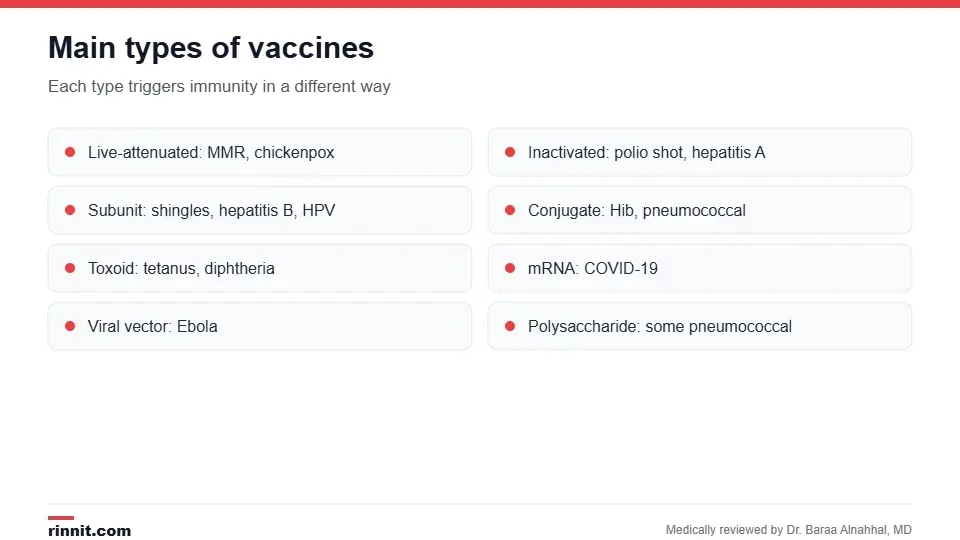
Each type triggers immunity in a different way.
Type | How it works | Examples |
Live-attenuated | A weakened whole germ; strong, long-lasting response | MMR, rotavirus, chickenpox, nasal flu |
Inactivated | A killed germ; safe for weak immune systems, may need more doses | Polio shot (IPV), hepatitis A, rabies, flu shot |
Subunit, conjugate, polysaccharide | Only part of the germ, such as a protein or sugar coat | Shingles, hepatitis B, HPV, Hib, some pneumococcal |
Toxoid | A weakened toxin made by the germ; boosters needed | Tetanus, diphtheria (Tdap) |
Nucleic acid (mRNA) | Instructions for your cells to make a harmless antigen; breaks down within days | mRNA COVID-19 vaccines |
Viral vector | A harmless virus carries the instructions | Ebola, some COVID-19 vaccines |
Sources: [1]
How vaccines are given
By injection into the arm muscle, the most common way.
Under the skin, or rarely between skin layers.
By mouth, such as oral drops.
As a nasal spray; in the U.S., only the flu vaccine. Sources: [1]
Your provider follows an immunization schedule from the CDC or your local health authority, which sets the doses and timing by age. Sources: [1]
Side effects and safety
Type | Examples |
Common | Sore arm, redness or swelling where the shot was given, mild fever |
Rare but serious | Seizures, swelling of a whole arm or leg, Guillain-Barré syndrome, severe allergic reaction |
Live vaccines may not be safe for people with weak immune systems or during pregnancy. People allergic to a vaccine ingredient, most often eggs, should talk to their provider. Sources: [1]
Common myths

Vaccines go through years of testing before approval.
Myth | Fact |
Vaccines cause autism | No. The 1990s study claiming this was discredited |
mRNA vaccines change your DNA | No. mRNA never enters the cell's nucleus and breaks down within days |
Vaccines are full of preservatives | Most U.S. vaccines are preservative-free; thimerosal is now only in multidose flu vials |
Sources: [1]
Conclusion
Vaccines are one of the most important tools in medicine, saving millions of lives every decade. Ask your provider which vaccines you and your family need and keep your records up to date.
Keep learning: read about mRNA vaccines and the COVID-19 vaccine.
Frequently asked questions
What is a vaccine?
A product that trains your immune system to fight a germ before it makes you sick.
How do vaccines work?
They trigger antibodies and memory cells without causing the disease.
What are the main types of vaccines?
Live, inactivated, subunit, toxoid, mRNA and viral vector vaccines.
What is herd immunity?
When enough people are immune that a germ can't spread easily, protecting others.
Why do I need boosters?
Protection from some vaccines fades or the germ changes.
What are common side effects?
A sore arm, redness or swelling and mild fever.
Do vaccines cause autism?
No. The study that claimed this was discredited.
Can mRNA vaccines change my DNA?
No.
Can I get vaccinated if I'm pregnant?
Some vaccines are safe; ask your provider, since live vaccines are usually avoided.
How are vaccines given?
Most are shots in the arm; some are drops by mouth or a nasal spray.
Related Reading
Biologics: What They Are, Types, Uses and Side Effects explains biologic medicines and how they're used.
mRNA Vaccines: How They Work, Benefits, Side Effects and Safety how mRNA vaccines work.
MMR Vaccine: Schedule, Effectiveness, Side Effects, and Who Should Avoid It the measles, mumps and rubella vaccine.
Tdap Vaccine: Who Needs It, When to Get It, and What to Expect the tetanus, diphtheria and whooping cough vaccine.
HPV Vaccine: Who Should Get It, the Shot Schedule, and How Well It Protects a vaccine that prevents several cancers.
Shingles Vaccine (Shingrix): Who Needs It, Doses and Side Effects the vaccine against shingles for adults.
References
Cleveland Clinic. Vaccines: Inoculation, Immunization, Safety & Schedule. Cleveland Clinic. Last updated September 7, 2022. https://my.clevelandclinic.org/health/treatments/24135-vaccines
Shattock AJ, Johnson HC, Sim SY, et al. Contribution of vaccination to improved survival and health: modelling 50 years of the Expanded Programme on Immunization. Lancet. 2024;403(10441):2307-2316. PMID 38705159. https://doi.org/10.1016/S0140-6736(24)00850-X
Li X, Mukandavire C, Cucunubá ZM, et al. Estimating the health impact of vaccination against ten pathogens in 98 low-income and middle-income countries from 2000 to 2030: a modelling study. Lancet. 2021;397(10272):398-408. PMID 33516338. https://doi.org/10.1016/S0140-6736(20)32657-X
Medical disclaimer
This article is for general education only and does not replace advice from a qualified healthcare professional. Talk to your doctor about your own diagnosis and treatment, and seek emergency care right away for severe or sudden symptoms.



Comments