Shingles Vaccine (Shingrix): Who Needs It, Doses and Side Effects

Updated: 2 days ago
Written and medically reviewed by Dr. Baraa Alnahhal, MD · Last reviewed: November 2026 · How we review
Quick Answer
The shingles vaccine lowers the risk of shingles, a painful rash caused by the chickenpox virus waking up years later, and of the long-lasting nerve pain that can follow it. In the U.S., the only one available is Shingrix. It's recommended for adults 50 and older and given as two doses, two to six months apart.
What the research says
Very high protection in adults 50 and older: in a trial of 15,411 adults, shingles developed in 6 vaccinated people versus 210 who got a placebo over about 3 years, a 97.2% efficacy that held across age groups (Lal H et al., N Engl J Med, 2015) [2]
It also works in people 70 and older: in 13,900 adults 70 and older, the vaccine was 89.8% effective against shingles, and pooled results showed 88.8% protection against postherpetic nerve pain (Cunningham AL et al., N Engl J Med, 2016) [3]
Key takeaways
The shingles vaccine protects against shingles and the nerve pain that can follow.
Shingrix is the only shingles vaccine in the U.S., and it isn't live.
It's recommended for adults 50 and older and adults 19 and older with weak immunity.
You need two doses, two to six months apart.
Protection stays high for at least seven years.
What is the shingles vaccine?
After you have chickenpox, the varicella-zoster virus stays inactive in your nerves. Decades later it can wake up and cause shingles. The shingles vaccine trains your immune system to keep the virus in check. Sources: [1]
Vaccine | Type | Status |
Shingrix (recombinant zoster vaccine) | Uses a small part of the virus; not live | The only shingles vaccine available in the U.S. |
Zostavax | Weakened live virus | No longer available in the U.S. |
Sources: [1]
Who should get it
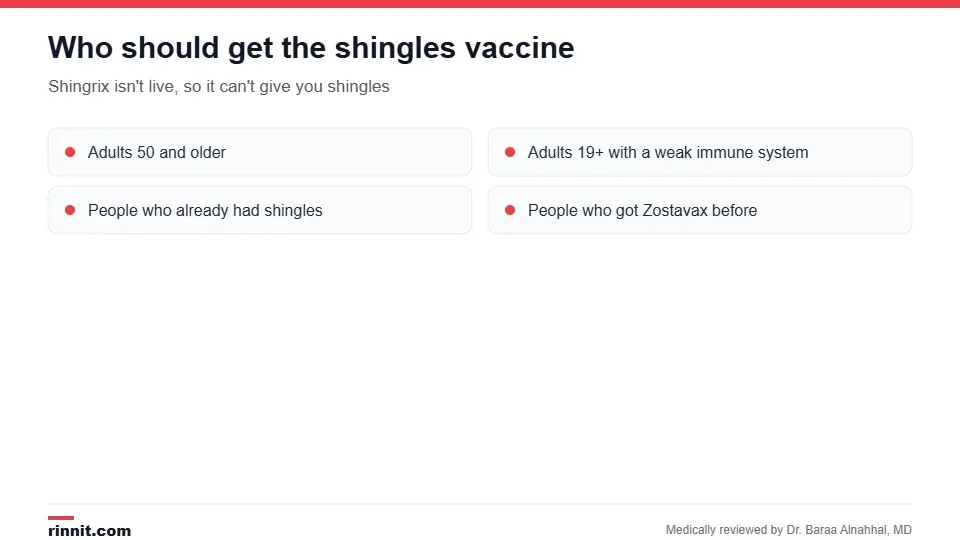
Shingrix isn't live, so it can't give you shingles.
Adults 50 and older.
Adults 19 and older with a weakened immune system.
People who already had shingles, once the rash is gone.
People who got the older Zostavax vaccine. Sources: [1]
You don't need a blood test or to remember having chickenpox. Adults 50 and older can get Shingrix either way. Sources: [1]
Who should wait or talk to a provider first
You had a severe allergic reaction to an earlier dose.
You have shingles right now.
You're sick, pregnant or breastfeeding. Sources: [1]
How you get the vaccine

Both doses are needed for full protection.
You get the first shot in your upper arm muscle.
You get the second shot two to six months later, or one to two months later if you have a weakened immune system.
No boosters are currently recommended after the two doses. Sources: [1]
Side effects
Type | Examples |
Common, short-lived | Sore arm, redness or swelling, tiredness, headache, fever, belly pain, nausea |
Extremely rare | Severe allergic reaction: hives, swelling of the face or throat, trouble breathing, fast heartbeat, dizziness |
Side effects are a sign your immune system is responding and usually pass in a few days. In trials, more vaccinated people than placebo recipients had strong side effects for a short time. Call 911 for signs of a severe allergic reaction. Sources: [1, 2]
How well it works
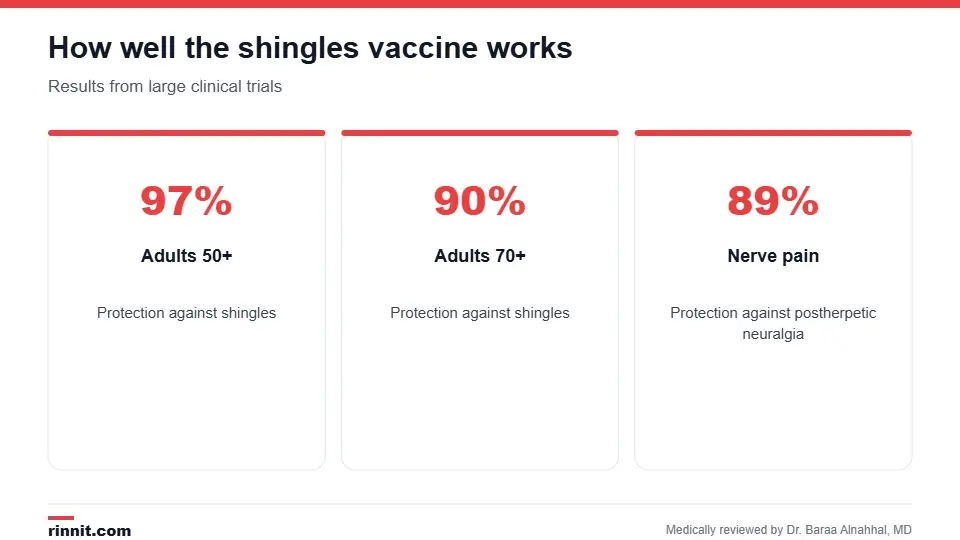
Shingles after the vaccine is usually milder and shorter.
Group | Protection in trials |
Adults 50 and older | 97.2% against shingles |
Adults 70 and older | 89.8% against shingles |
Postherpetic neuralgia | 88.8% in pooled results |
You can still get shingles after the vaccine, but it's usually milder, shorter and less likely to cause postherpetic neuralgia. You aren't contagious after getting Shingrix. Sources: [1, 2, 3]
Conclusion
The shingles vaccine is one of the most effective vaccines available for adults. Two doses give you strong, long-lasting protection against a painful rash and nerve pain that can last for months.
Keep learning: read about shingles in the eye and the chickenpox vaccine.
Frequently asked questions
What is the shingles vaccine?
A vaccine that protects against shingles and postherpetic neuralgia.
Who should get it?
Adults 50 and older, and adults 19 and older with weak immunity.
How many doses do I need?
Two doses, two to six months apart.
Is Shingrix a live vaccine?
No. It uses only part of the virus, so it can't give you shingles.
How effective is it?
About 97% in adults 50 and older and about 90% in adults 70 and older.
How long does protection last?
Protection stays high for at least seven years.
Do I need it if I already had shingles?
Yes, once the rash is gone.
What are the side effects?
Sore arm, tiredness, headache and fever for a few days.
Do I need a booster?
No boosters are currently recommended.
Can I get it if I'm pregnant?
Wait and talk to your provider first.
Related Reading
Vaccines: How They Work, Types, Safety and Side Effects explains how vaccines work and why they matter.
Shingles (Herpes Zoster): Symptoms, Causes, Treatment and Prevention Explained the infection this vaccine prevents.
Postherpetic Neuralgia: Symptoms, Causes, Diagnosis, and Treatment nerve pain that can follow shingles.
Shingles in the Eye: A Comprehensive Guide to Symptoms and Care a serious form of shingles.
Chickenpox Vaccine: Schedule, Side Effects, and Who Needs It the vaccine against the same virus in children.
Varicella-Zoster Virus (VZV): Understanding Chickenpox, Shingles, and Beyond the virus behind chickenpox and shingles.
References
Cleveland Clinic. Shingles Vaccine: What To Know. Cleveland Clinic. Last updated April 25, 2025. https://my.clevelandclinic.org/health/treatments/22996-shingles-vaccine
Lal H, Cunningham AL, Godeaux O, et al. Efficacy of an adjuvanted herpes zoster subunit vaccine in older adults. N Engl J Med. 2015;372(22):2087-2096. PMID 25916341. https://doi.org/10.1056/NEJMoa1501184
Cunningham AL, Lal H, Kovac M, et al. Efficacy of the herpes zoster subunit vaccine in adults 70 years of age or older. N Engl J Med. 2016;375(11):1019-1032. PMID 27626517. https://doi.org/10.1056/NEJMoa1603800
Medical disclaimer
This article is for general education only and does not replace advice from a qualified healthcare professional. Talk to your doctor about your own diagnosis and treatment, and seek emergency care right away for severe or sudden symptoms.



Comments