Tdap Vaccine: Who Needs It, When to Get It, and What to Expect

Updated: 6 days ago
Written and medically reviewed by Dr. Baraa Alnahhal, MD · Last reviewed: October 2026 · How we review
Quick Answer: What is the Tdap vaccine?
The Tdap vaccine is a shot that helps protect against three bacterial infections: tetanus, diphtheria and pertussis (whooping cough). It is recommended for children 7 and older, preteens, adults and during every pregnancy, with a Td or Tdap booster every 10 years. Most side effects are mild, such as a sore arm, and pass within days. [1]
What the research says
Tdap in pregnancy strongly protects newborns. A systematic review of 22 studies, including 855,546 mother–infant pairs in its effectiveness studies, found the vaccine prevented 69% to 91% of infant whooping cough cases, 91% to 94% of related hospital stays, and 95% of related deaths. (Vygen-Bonnet et al., BMC Infectious Diseases, 2020) [2]
Protection is strongest in a baby's first two months. In a study of 148,981 newborns, a mother's Tdap shot was 91.4% effective against whooping cough in the first 2 months of life and 69.0% effective across the first year. (Baxter et al., Pediatrics, 2017) [3]
No increased risk of serious pregnancy problems was found. A review of 338 studies found no evidence of increased risk of key adverse events, including stillbirth, after Tdap in pregnancy. (Gidengil et al., Vaccine, 2021) [4] One review did see more recorded diagnoses of fever and chorioamnionitis, without a rise in preterm birth or newborn intensive care admissions. (Vygen-Bonnet et al., BMC Infectious Diseases, 2020) [2]
Key takeaways
Tdap protects against tetanus, diphtheria and whooping cough. [1]
Preteens get a routine dose at ages 11 to 12. Adults need a Td or Tdap booster every 10 years. [1]
Get Tdap during every pregnancy, even if you had it before, to help protect your newborn. [1]
The vaccine contains no live bacteria, so it cannot cause these infections. [1]

What diseases does the Tdap vaccine protect against?
The Tdap vaccine protects against three bacterial infections: tetanus, diphtheria and pertussis. [1]
Letter in "Tdap" | Infection | Learn more |
T | Tetanus | |
d | Diphtheria | |
ap | Pertussis (whooping cough) |
How does the Tdap vaccine work?
The Tdap vaccine works by teaching your immune system to recognize and respond to these three infections. [1]
If you are later exposed to these bacteria, your body is ready to respond. This lowers your risk of serious illness. [1]
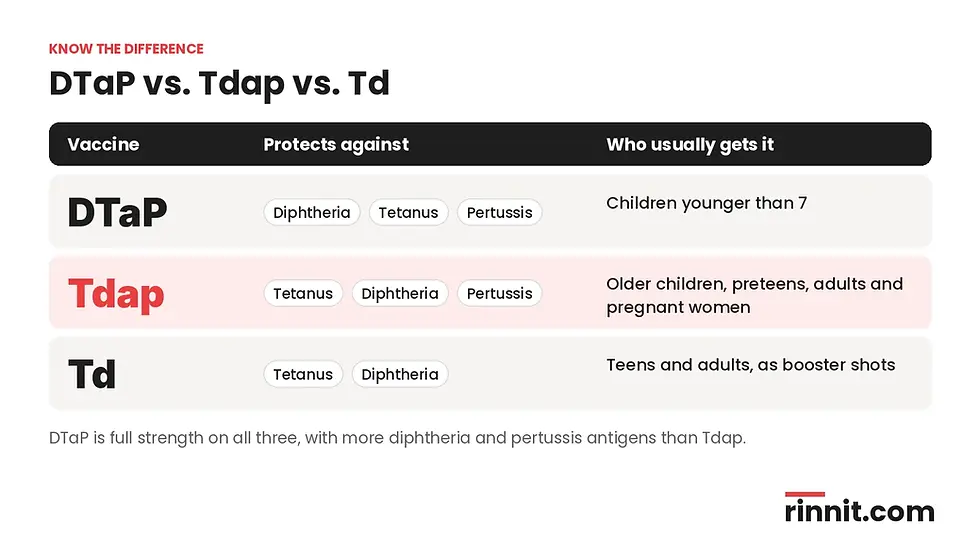
What is the difference between DTaP, Tdap, and Td?
DTaP, Tdap and Td are versions of the same vaccine family, and they differ by who usually gets them and which infections they cover. [1]
DTaP is "full strength" on all three. It has more antigens for diphtheria and pertussis than Tdap. [1]
Vaccine | Protects against | Who usually gets it |
DTaP | Diphtheria, tetanus and pertussis | Children younger than 7 |
Tdap | Tetanus, diphtheria and pertussis | Older children, preteens, adults and pregnant women |
Td | Tetanus and diphtheria | Teens and adults, as booster shots |
Many people get a Tdap booster after the DTaP shots they had as young children. [1]
Who should get the Tdap vaccine?
The Tdap vaccine is recommended for children 7 and older, preteens, adults and pregnant women. [1]
Who | Why or when |
Preteens ages 11 to 12 | Routine dose in the vaccine schedule |
Teens and adults who never had Tdap | One dose to build protection |
Adults around babies younger than 12 months | Helps protect infants from whooping cough |
People with certain injuries or wounds | Protection against tetanus |
People catching up on missed vaccines | To complete protection |
Pregnant women | During each pregnancy |
Not sure if you have had Tdap before? Your healthcare provider can help you decide. In many cases, it is fine to get Tdap even when your vaccine history is unclear or incomplete. [1]
Why should you get the Tdap vaccine during pregnancy?
Getting the Tdap vaccine during pregnancy passes immunity to your baby, helping protect your newborn from whooping cough in the first few months of life. [1]
You need it during each pregnancy, even if you received it before. Your provider may recommend getting it at the beginning of the third trimester. [1]
Research shows this protection is strongest in a baby's first two months. [3]
For more on staying protected while expecting, read our guide to flu during pregnancy.

How often do you need a Tdap booster?
Most people need one dose of Tdap in adolescence or adulthood, followed by a tetanus and diphtheria booster every 10 years. [1]
That booster can be either Td or Tdap. [1]
You may need a tetanus-containing shot sooner after certain injuries or wounds. This depends on when you last had one. [1]
Situation | What is usually needed |
Ages 11 to 12 | One routine Tdap dose |
Adults (every 10 years) | Td or Tdap booster |
Each pregnancy | One Tdap dose |
Certain injuries, burns or wounds | Tetanus-containing shot, depending on your last dose |
What happens when you get the Tdap vaccine?
The Tdap vaccine is given as a shot, usually in your upper arm, and the visit takes only a few minutes. [1]
You may get it during a routine checkup, during pregnancy, or after an injury that raises your tetanus risk, such as a severe burn or wound. [1]
How effective is the Tdap vaccine?
The Tdap vaccine is highly effective at helping protect against tetanus, diphtheria and pertussis. [1]
Protection fades over time. That is why booster shots matter. [1]
Even if a vaccinated person gets one of these infections, the vaccine helps lower the risk of severe illness. [1] In babies whose mothers got Tdap in pregnancy, it has prevented most hospital stays and deaths from whooping cough. [2]
What are the side effects of the Tdap vaccine?
Tdap vaccine side effects are usually mild and go away within a few days. [1]
Common side effect | What may help |
Sore or swollen arm | Move or gently exercise your arm; use a cool compress |
Headache or body aches | Rest; ask your provider about over-the-counter pain relievers |
Fatigue | Rest if you feel tired |
Nausea or mild fever | Drink plenty of fluids |
Ask your provider whether over-the-counter pain relievers are safe for you before taking them. [1]
When should you call a doctor after the Tdap vaccine?
Call your healthcare provider after the Tdap vaccine if symptoms worry you or last longer than a few days. [1]
Symptom | What to do |
Symptoms that worry you or last more than a few days | Call your provider |
High fever, or severe pain or swelling near the shot | Go to the emergency room |
Trouble breathing or swelling of the face | Call emergency services right away |
Severe reactions are rare, but they need immediate care. [1] Learn the warning signs of anaphylaxis.
Who should not get the Tdap vaccine?
People who had a severe allergic reaction to a previous dose should not get the Tdap vaccine. [1]
You may also need to delay or avoid it if you:
Had a severe reaction to a pertussis-containing vaccine in the past
Are currently moderately or severely ill
Tell your provider about your medical history first. This includes seizures, other nervous system problems, or a past diagnosis of Guillain-Barré syndrome. [1]
Can you get the Tdap vaccine with other vaccines?
Yes, the Tdap vaccine can be given at the same visit as other vaccines, including flu and COVID-19 vaccines. [1]
Read more about the yearly flu shot and influenza.
Conclusion
The Tdap vaccine is a quick, well-studied way to lower your risk of tetanus, diphtheria and whooping cough. [1] It matters most for babies who are too young to be fully vaccinated, which is why it is given during every pregnancy and to adults who spend time around infants. [1]
Most people need one Tdap dose, then a Td or Tdap booster every 10 years. Side effects are usually mild and short-lived. [1]
Not sure if you're due? Ask your healthcare provider to review your vaccine record at your next visit, especially if you are pregnant, planning a pregnancy, or about to spend time with a newborn. Then explore our whooping cough guide and RSV in babies guide to learn more ways to protect your family.
FAQ
Is the Tdap vaccine safe during pregnancy?
The Tdap vaccine is recommended during every pregnancy to help protect newborns from whooping cough. A review of 338 studies found no increased risk of key adverse events, including stillbirth, after Tdap in pregnancy. [1][4]
When should I get the Tdap vaccine during pregnancy?
The Tdap vaccine is often given at the beginning of the third trimester, based on your provider's advice. You need it in each pregnancy, even if you had it before. [1]
How long does the Tdap vaccine last?
Tdap protection fades over time, so adults need a Td or Tdap booster every 10 years. You may need a tetanus shot sooner after certain wounds. [1]
Can the Tdap vaccine give you whooping cough or tetanus?
The Tdap vaccine cannot cause tetanus, diphtheria or whooping cough. It does not contain live bacteria. [1]
What are the most common side effects of the Tdap vaccine?
The most common Tdap side effects are a sore or swollen arm, headache, fatigue, nausea, mild fever and body aches. These usually go away on their own within a few days. [1]
Do adults need the Tdap vaccine before being around a newborn?
Adults who spend time around babies younger than 12 months are advised to get the Tdap vaccine. This helps protect infants from whooping cough. [1]
Do I need a tetanus shot after a cut or burn?
A tetanus-containing shot may be needed sooner after certain injuries, such as a severe burn or wound. Whether you need one depends on when you last had a tetanus vaccine. [1]
Can I get the Tdap vaccine with a flu or COVID-19 shot?
The Tdap vaccine can be given at the same visit as flu and COVID-19 vaccines. [1]
What is the difference between Tdap, DTaP and Td?
All three protect against tetanus and diphtheria. DTaP is given to young children, Tdap is a booster for older children and adults that also covers whooping cough, and Td covers only tetanus and diphtheria.
Who should not get the Tdap vaccine?
People who had a severe allergic reaction to a previous dose should not get Tdap. If you have other health concerns or are feeling very ill, ask your provider whether to wait.
Related Reading
Vaccines: How They Work, Types, Safety and Side Effects explains how vaccines work and why they matter.
References
Cleveland Clinic. Tdap (Tetanus, Diphtheria, Pertussis) Vaccine. Cleveland Clinic. Last updated July 17, 2026. https://my.clevelandclinic.org/health/treatments/22654-tdap-vaccine
Vygen-Bonnet S, Hellenbrand W, Garbe E, et al. Safety and effectiveness of acellular pertussis vaccination during pregnancy: a systematic review. BMC Infect Dis. 2020;20(1):136. PMID 32054444. https://doi.org/10.1186/s12879-020-4824-3
Baxter R, Bartlett J, Fireman B, et al. Effectiveness of Vaccination During Pregnancy to Prevent Infant Pertussis. Pediatrics. 2017;139(5):e20164091. PMID 28557752. https://doi.org/10.1542/peds.2016-4091
Gidengil C, Goetz MB, Newberry S, et al. Safety of vaccines used for routine immunization in the United States: An updated systematic review and meta-analysis. Vaccine. 2021;39(28):3696-3716. PMID 34049735. https://doi.org/10.1016/j.vaccine.2021.03.079
Medical disclaimer
This article is for general educational purposes only and does not replace advice from your doctor or another qualified healthcare provider. Talk to your provider about which vaccines are right for you, your pregnancy, or your child. If you have signs of a severe allergic reaction, call emergency services right away.



Comments