Understanding the Somatic Nervous System: Your Link to the Physical World

Updated: 3 days ago
Medically reviewed by Dr. Baraa Alnahhal, MD · Last reviewed: October 2026
Quick Answer
The somatic nervous system is part of the peripheral nervous system that carries sensory information to the brain and delivers the brain’s commands to your skeletal muscles. [1] It uses cranial and spinal nerves to relay touch, taste, smell and sound, and it makes every voluntary movement possible. [1] Damage to these nerves, called peripheral neuropathy, can cause numbness, tingling and weakness.
What the research says
In type 2 diabetes, a higher triglyceride-glucose index goes with a higher risk of nerve damage. A meta-analysis of 14 observational studies (32,281 participants) found a pooled odds ratio of 2.614 (95% CI 1.788–3.821) for diabetic peripheral neuropathy. The authors note that causation still needs to be confirmed. (Gu et al., Frontiers in Endocrinology, 2026) [2]
Nearly half of people treated with chemotherapy have lasting nerve damage. Across 197 studies (72,794 patients), the pooled prevalence of chronic chemotherapy-induced peripheral neuropathy, lasting 3 months or more after treatment, was 44.50% (95% CI 40.77–48.25). It was 54.37% at 3–12 months and 40.36% at 24 months or longer. (D’Souza et al., Journal of Pain Research, 2026) [3]
A normal spinal fluid test early on does not rule out Guillain-Barré syndrome. In 12 cohorts (2,966 patients), elevated spinal fluid protein or albuminocytologic dissociation was found in 79.6% (95% CI 70.4–86.5), but only 48.1% in the first 0–1 days after symptom onset. (Lu et al., Journal of Neurology, 2026) [4]
The Role and Function of the Somatic Nervous System
The somatic nervous system has two main jobs: sensory input and movement control. [1] It is a relay network linking the central nervous system, the brain and spinal cord (see our guide to the CNS), to the rest of the body. For sensory input, it gathers information from smell, sound, taste and touch and sends it to the brain. [1] Sight is the exception, because the retina and optic nerve connect directly to the brain. [1]
Movement control is the second pillar. Every voluntary action needs a command signal to travel from the brain, through somatic nerves, to the target muscles. [1] The system also helps you notice trouble in internal organs through referred pain, such as the pain of a heart attack that you feel in your left arm, back, jaw or abdomen. [1]
Function | Description | Primary goal |
Sensory input | Relays information from smell, sound, taste and touch to the brain | Environmental awareness |
Motor control | Carries command signals from the brain to skeletal muscles | Voluntary movement |
Reflex action | Triggers automatic responses to some stimuli, such as pulling away from heat | Immediate protection |
This differs from the autonomic nervous system, which runs involuntary processes such as heart rate and digestion. Disorders of that system are covered in our article on pure autonomic failure.
Anatomy of the Somatic Network
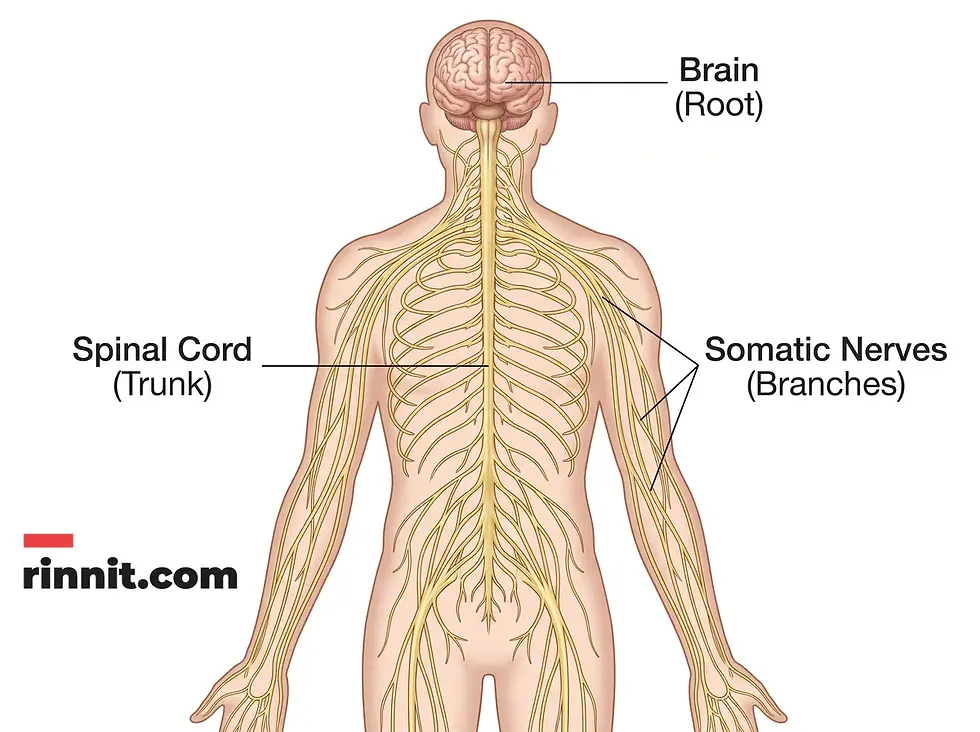
The somatic nervous system is often compared to an upside-down tree: the brain is the root, the spinal cord is the trunk, [1] and the nerves are the branches reaching every part of the body. It arises from two sources: the 12 pairs of cranial nerves (11 of which connect to the somatic system) and the 31 pairs of spinal nerves. [1]
At the cellular level, the system is built from neurons and glial cells. A neuron has a cell body, dendrites that receive signals and a long axon that sends them. Many axons are wrapped in myelin, a fatty layer that protects the nerve and speeds up signals. Glial cells support and protect neurons, and the human brain has roughly as many glial cells as neurons, not the 10 times more that was once widely quoted. [1]
Common Disorders and Impact on Health
Damage to the somatic nerves is called peripheral neuropathy and can cause loss of sensation or muscle control. Type 2 diabetes is the most common cause, because high blood sugar slowly damages the nerves in the legs and feet (see diabetic neuropathy). [1] Other causes include autoimmune disorders such as Guillain-Barré syndrome, infections such as HIV, Lyme disease and shingles, genetic conditions, toxic exposures such as lead or mercury, chemotherapy, and physical trauma. [1]
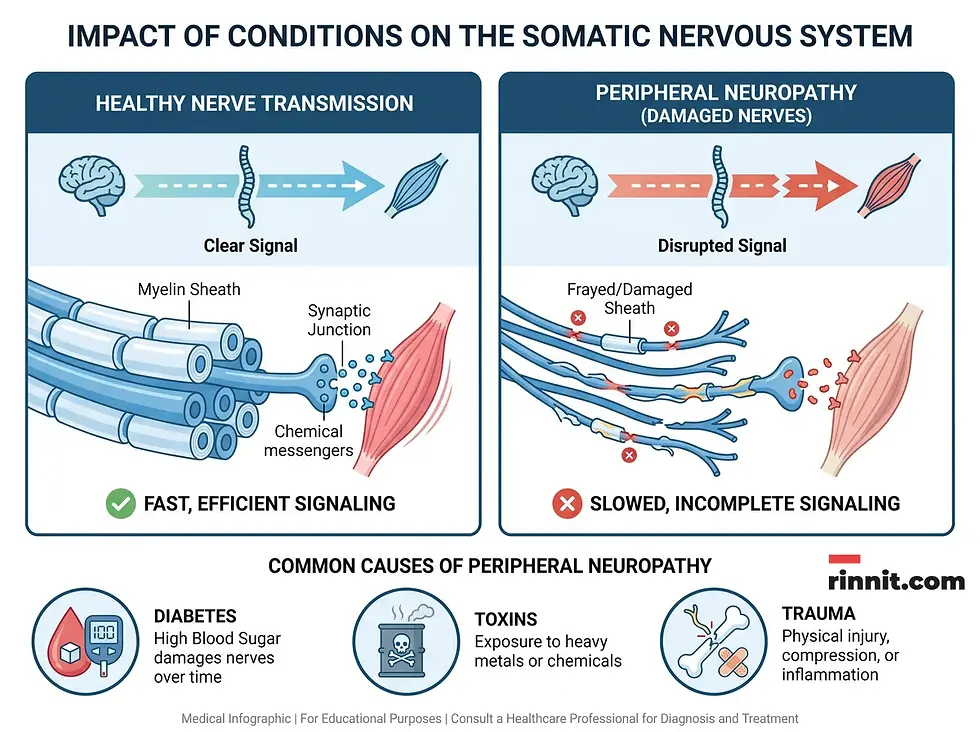
Cause | Examples | Typical impact |
Chronic disease | Gradual loss of sensation in the limbs | |
Autoimmune | Guillain-Barré syndrome | Rapid-onset muscle weakness |
Infection | Persistent nerve pain or numbness | |
Toxins and medicines | Heavy metals, alcohol, chemotherapy | Impaired motor and sensory function |
Injury and compression | Localized pain, weakness or numbness |
How Doctors Check the Somatic Nerves
Pillars of Neural Health and Maintenance
Because the somatic nervous system is closely tied to the vascular and metabolic systems, habits that protect blood vessels and blood sugar often protect nerves as well. Protecting nerves from trauma and toxins matters just as much.
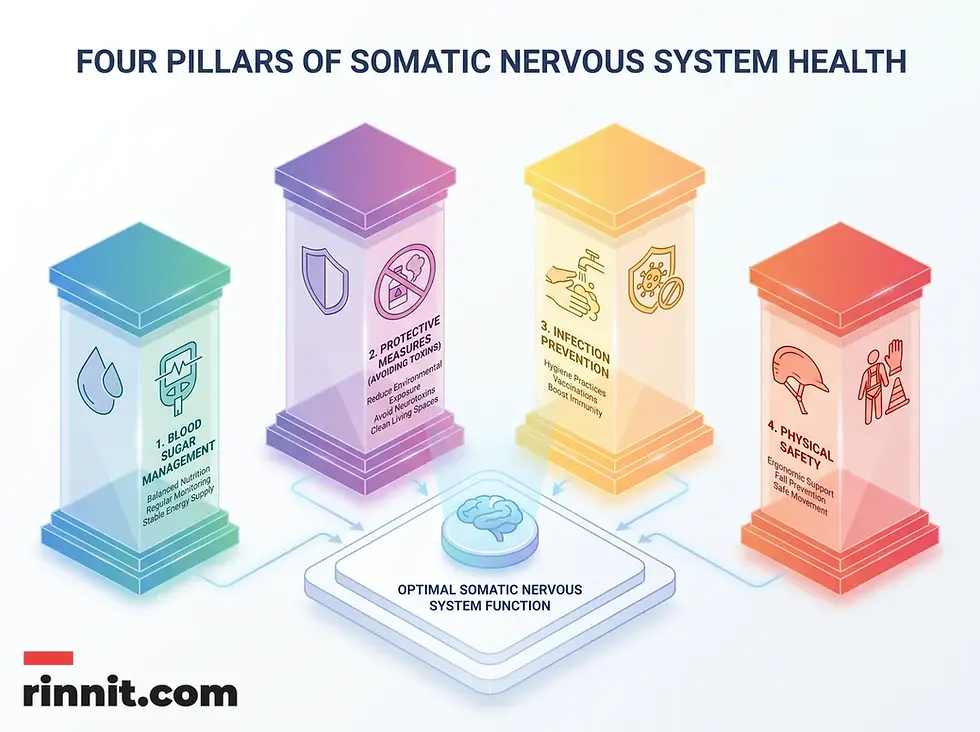
Health Care Pillars
Blood sugar management: diabetes is a leading cause of nerve damage, [1] so keeping glucose stable is among the most effective ways to prevent neuropathy.
Protective measures: avoid exposure to industrial chemicals and heavy metals, and limit alcohol (see alcohol-related neuropathy).
Infection prevention: timely vaccination and prompt treatment of infections reduce inflammation that can damage nerves.
Physical safety: wear safety equipment and use good form and ergonomic supports to lower the risk of injury and compression problems such as carpal tunnel syndrome.
General health: eat a balanced diet, stay physically active, maintain a healthy weight, and keep up with provider visits and medicines for chronic conditions. [1]
Conclusion
The somatic nervous system is the link between conscious intention and the physical world, enabling every voluntary movement and most of what you sense. Protecting it through blood sugar control, injury prevention and informed medical care helps preserve mobility, sensation and independence for life.
When to see a healthcare professional
If you have persistent numbness, tingling or unexplained muscle weakness, consult a healthcare professional. Sudden or rapidly worsening weakness needs urgent medical attention. A neurological exam and nerve testing can find problems before they cause permanent damage.
Frequently Asked Questions
1. What is the main function of the somatic nervous system?
The somatic nervous system relays sensory information from the body to the brain and carries motor commands from the brain to the muscles for voluntary movement.
2. Is the somatic nervous system part of the central nervous system?
No. It is a subdivision of the peripheral nervous system, which includes all nerves outside the brain and spinal cord.
3. Does the somatic nervous system control breathing?
Breathing is usually automatic, but the somatic system lets you take conscious control of it, for example when holding your breath.
4. Which senses are not handled by the somatic nervous system?
Sight. The retina and optic nerve connect directly to the brain.
5. What is the difference between the somatic and autonomic systems?
The somatic system handles voluntary actions and conscious sensation, while the autonomic system manages involuntary processes such as heart rate and digestion.
6. What are cranial nerves?
Twelve pairs of nerves that arise from the brain and serve mainly the head and neck. Eleven of them connect to the somatic nervous system.
7. How many spinal nerves are there?
There are 31 pairs of spinal nerves that branch from the spinal cord to the rest of the body.
8. What is myelin and why is it important?
Myelin is a fatty layer around many axons that protects the nerve and speeds up electrical signals.
9. Can the somatic nervous system feel pain from internal organs?
Yes, through referred pain, where organ pain is felt elsewhere, such as heart attack pain in the left arm, back, jaw or abdomen.
10. What is peripheral neuropathy?
A general term for damage to the peripheral nerves, often causing numbness, tingling or weakness.
11. How does diabetes affect the somatic nervous system?
High blood sugar can damage nerves over time, especially in the legs and feet, leading to loss of sensation.
12. Are glial cells the same as neurons?
No. Glial cells support and protect neurons but do not transmit signals themselves.
13. What is an axon?
A long extension of a neuron that carries electrical signals away from the cell body to other cells.
14. Can injury cause permanent somatic nerve damage?
Yes. Severe trauma or prolonged pressure can cause long-term or permanent nerve damage.
15. How can I support my somatic nervous system health?
Keep blood sugar stable, avoid toxins, prevent infections, protect yourself from injury, eat a balanced diet and stay active.
Related Reading
The Autonomic Nervous System: Understanding Your Body's Automatic Controls explains the nerve system that runs automatic body functions.
Peripheral Nervous System: Parts, Functions, Symptoms, Tests and Care covers the nerves outside the brain and spinal cord.
Understanding the Central Nervous System (CNS) describes how the brain and spinal cord control the body.
Understanding Motor Neuron Disease: Symptoms, Types, and Management explains conditions that damage the nerves controlling voluntary muscles.
References
Cleveland Clinic. Somatic Nervous System: What It Is & Function. Cleveland Clinic. Last updated June 15, 2022. https://my.clevelandclinic.org/health/body/23291-somatic-nervous-system
Gu X, Wei M, Wu C, et al. The association between the triglyceride-glucose index and diabetic peripheral neuropathy: a systematic review and meta-analysis. Front Endocrinol (Lausanne). 2026;17:1901899. PMID 42760994. https://doi.org/10.3389/fendo.2026.1901899
D’Souza RS, Whitfield S, Hussain N, et al. Prevalence and study-level predictors of chronic chemotherapy-induced peripheral neuropathy: a systematic review and meta-analysis. J Pain Res. 2026;19:643363. PMID 42713463. https://doi.org/10.2147/JPR.S643363
Lu X, Dai H, Zhao L, Huang W. Time- and threshold-dependent cerebrospinal fluid protein elevation and albuminocytologic dissociation in Guillain-Barré syndrome: a systematic review and meta-analysis. J Neurol. 2026;273(9). PMID 42616135. https://doi.org/10.1007/s00415-026-14024-4
Medical disclaimer
The information provided in this article is for educational purposes only and is not intended as medical advice. Always seek the guidance of a qualified healthcare professional regarding any medical condition or treatment.



Comments