Motor Neuron Disease: Types, Symptoms, Diagnosis and Support

Updated: 1 day ago
Medically reviewed by Dr. Baraa Alnahhal, MD · Last reviewed: October 2026
Quick Answer: What is motor neuron disease?
Motor neuron disease is a group of progressive neurological disorders that damage the nerve cells controlling walking, speaking, swallowing and breathing, causing muscle weakness, wasting or stiffness. It includes conditions such as ALS. There is no single test, so diagnosis combines examination, EMG and imaging. There is no cure, but treatment helps manage symptoms and support daily function. [1]
What the research says
Riluzole showed a survival benefit in a conventional meta-analysis of ALS trials, but network comparisons were less conclusive. A review of randomized trials including 1,601 people with ALS found a 36% higher probability of survival with riluzole than placebo (OR 1.36; P = 0.03). In the network meta-analysis, no treatment differed significantly from placebo for mortality, and the authors noted that this may preclude a strong recommendation (Prado and Adiao, Can J Neurol Sci, 2025). [2]
In ALS, expected survival in trials varied widely with how long symptoms had been present. A model-based analysis of 47 placebo-controlled trials (6,118 participants) estimated a median overall survival of 35.5 months for a disease duration of 9 months and 20.0 months for a disease duration of 36 months (Cai et al., Orphanet J Rare Dis, 2024). [3]
Riluzole offers a modest survival benefit in ALS. A Cochrane review of four randomized trials (974 riluzole-treated and 503 placebo-treated patients) found that riluzole 100 mg daily reduced the risk of death or tracheostomy (hazard ratio 0.84; 95% CI 0.698 to 0.997), which meant about a 9% gain in the chance of surviving one year (49% vs. 58%) and an increase in median survival from 11.8 to 14.8 months (Miller et al., Cochrane Database Syst Rev, 2012). [4]
ALS is uncommon and becomes more frequent with age. A meta-analysis of 124 studies estimated a worldwide ALS prevalence of 4.42 per 100,000 population and an incidence of 1.59 per 100,000 person-years, with both rising with age up to 70-79 (Xu et al., J Neurol, 2020). [5]
No cell-based therapy has proven benefit yet. A Cochrane review found only two randomized trials (112 participants); the one trial that contributed data (64 participants, 56 analyzed for function) showed a small, low-certainty improvement on a function scale (mean difference 3.38 points; 95% CI 1.22 to 5.54) and no clear difference in survival at six months (Abdul Wahid et al., Cochrane Database Syst Rev, 2019). [6]

What do motor neurons do?
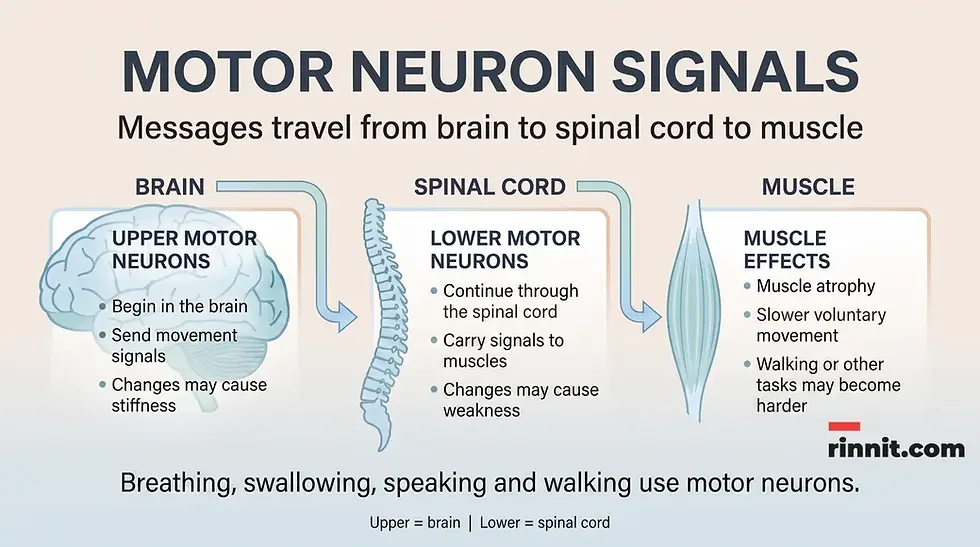
Motor neurons are nerve cells that control muscle movement. They help coordinate actions people may not consciously think about, including breathing, swallowing, chewing, talking and walking. [1]
Messages usually travel from upper motor neurons in the brain to lower motor neurons in the spinal cord. Lower motor neurons then carry those signals to muscles. [1]
When muscles cannot receive lower-motor-neuron messages, they may weaken and shrink. When upper-motor-neuron signaling is disrupted, stiffness and overactive reflexes may occur. The result can be slower, more difficult voluntary movement. [1]
What conditions are included under MND?
Healthcare providers classify motor neuron diseases by whether they affect upper motor neurons, lower motor neurons or both. The conditions can differ in age of onset, pattern of weakness, inherited features and rate of progression. [1]
MND type | Main pattern described |
Amyotrophic lateral sclerosis (ALS) | Affects both upper and lower motor neurons. It is the most common MND and causes progressive loss of muscle control that can eventually lead to paralysis. |
Progressive bulbar palsy (PBP) | Affects lower motor neurons connected to the brainstem, influencing muscles used for speaking, chewing and swallowing. It is also called progressive bulbar atrophy. |
Primary lateral sclerosis (PLS) | Affects only upper motor neurons. It often starts in the legs and may later involve the arms, hands, torso and muscles used for speaking, swallowing and chewing. |
Progressive muscular atrophy (PMA) | Affects only lower motor neurons. Hand weakness is often an early symptom, followed by weakness in the lower body; the torso and breathing can also be affected. |
Spinal muscular atrophy (SMA) | An inherited condition affecting lower motor neurons. Changes in the SMN1 gene lead to loss of SMN protein and progressive muscle wasting and weakness. |
Kennedy’s disease | Linked to a gene on the X chromosome in males. It can cause weakness in the arms and legs, often beginning around the pelvis or shoulders, along with pain or numbness in hands and feet. |
Post-polio syndrome (PPS) | Can affect polio survivors decades after the original illness, causing weakness, fatigue, pain, muscle twitches, atrophy and intolerance to cold. |
Progressive muscular atrophy mostly affects males, typically at a younger age than most other adult-onset MNDs. Spinal muscular atrophy is the most common genetic cause of infant death. [7]
How are ALS and MND related?
ALS is the most common type of MND and affects both upper and lower motor neurons. It causes progressive loss of muscle control and can eventually lead to paralysis.
Many healthcare providers use the terms ALS and motor neuron disease interchangeably in some contexts. However, MND is a broader group that includes several distinct conditions.
What are the early symptoms of motor neuron disease?
MND symptoms may develop gradually and may not be obvious at first. Early changes can affect the legs, hands, speech, swallowing or emotional expression.
Possible early sign | How it may affect daily life |
Leg or ankle weakness | Climbing stairs may become harder, or you may trip more often. |
Slurred speech | Speech may sound less clear than usual. |
Difficulty swallowing | Eating, drinking or managing saliva may become harder. |
Weakened grip | Buttoning a shirt, opening a jar or holding objects may become difficult. |
Muscle twitches or cramps | Muscles may twitch or tighten unexpectedly. |
Weight loss | Arms or legs may become thinner as muscle tissue is lost. |
Pseudobulbar affect | Laughing or crying may become difficult to stop in situations where the response feels out of place. |
One symptom alone does not establish an MND diagnosis. Progressive weakness should be evaluated because many other conditions can cause similar changes, and earlier clarification can help connect a person with appropriate care and support.
What other symptoms can occur?
As MND affects muscles involved in breathing and other functions, additional symptoms may appear. These can include breathlessness, breathing trouble when lying down, recurrent chest infections, disturbed sleep, poor concentration or memory, confusion, morning headaches and fatigue.
Breathing or swallowing changes deserve particular attention. Tell a healthcare provider about these symptoms promptly so the care team can assess what is happening and discuss supportive options.
What causes motor neuron disease?
Problems within motor neurons cause MND. In many cases, researchers do not know why these cells gradually stop functioning properly.
Some cases are inherited. A single genetic change may be passed through a biological family in several patterns. [1]
Inheritance pattern | General description |
Autosomal dominant | One changed copy of a gene from one biological parent may place a person at risk. |
Autosomal recessive | A person may need to inherit one changed copy from each biological parent to be at risk. |
X-linked | A female parent carries the change on one X chromosome and can pass it to male children. |
Non-inherited cases may involve different combinations of viral, toxic, genetic and environmental factors. A family history does not determine an individual diagnosis, but it can be important information for a clinician and genetic counselor.
Who is more likely to develop MND?
MND most commonly affects people in their 60s and 70s, but children and adults of any age can develop an MND. Risk may be higher when a close relative has MND or a related condition called frontotemporal dementia.
If you are concerned because of family history, ask a healthcare provider whether genetic counseling would be useful. A genetic counselor can help explain what a family pattern may or may not mean and discuss available testing considerations.
How is motor neuron disease diagnosed?
Diagnosis can be difficult in the early stages. There is no single test that confirms every MND. A provider may suspect MND when muscle weakness progresses without pain or loss of sensation, but the evaluation must also consider other possible explanations. [1]
The clinician may ask:
Which body parts are affected?
When did the symptoms begin?
Which symptom appeared first?
How have the symptoms changed over time?
The answers help the care team understand the pattern and decide which tests may be useful.
What tests may be used?
A provider may request several tests to examine muscles, nerves, the brain and spinal cord, or to rule out other conditions.
Test | What it may help evaluate |
Electromyography (EMG) | Electrical activity in muscles and whether the problem may involve muscle, nerves or the neuromuscular junction. |
Nerve conduction studies | How quickly nerves transmit impulses. |
MRI scan | Brain MRI, and sometimes spinal-cord MRI, can look for abnormalities that may cause similar symptoms. |
Blood tests | Other medical conditions that may mimic or contribute to symptoms. |
Urine tests | Additional information when ruling out other conditions. |
Lumbar puncture | Fluid testing when a spinal tap is considered appropriate. |
Genetic tests | Possible inherited causes when history or clinical findings raise that question. |
Over time, symptoms may become characteristic enough that the diagnosis is clearer without every test. The specific evaluation depends on the pattern of symptoms and the clinician’s judgment.
How is motor neuron disease treated?
Motor neuron disease has no specific cure, but a multidisciplinary team can help manage symptoms and preserve comfort, safety, mobility and participation for as long as possible.
Treatment is individualized. It may include physical therapy, nutrition support, medications for specific symptoms, communication support, breathing support, equipment and community resources.

Physical therapy and mobility support
Physical therapy may help maintain muscle strength and keep joints flexible. A rehabilitation team may also discuss safe movement, positioning, mobility devices and ways to adapt daily tasks as needs change. [1]
Nutrition and swallowing support
Swallowing difficulty can affect nutrition and safety. Some people may receive nutrition through a gastrostomy tube, which is inserted through the abdominal wall into the stomach. A qualified care team should guide decisions about swallowing assessment and nutrition support. [1]
Medication for symptoms
Medications may target specific symptoms rather than reverse the underlying disease.
Medication or category | Symptom focus described |
Baclofen | Muscle tightness and spasms. |
Phenytoin or quinine | Muscle cramps. |
Glycopyrrolate | Drooling. |
Antidepressants | Depression. |
Benzodiazepines | Pain as the disease progresses. |
Riluzole and edaravone | In ALS, may help prolong life and slow decline in function. |
Medication choices depend on the condition, other medicines, health history and goals of care. Quinine carries safety warnings when used for muscle cramps, so any use must be weighed carefully by the prescribing clinician. Do not start, stop or combine prescription medicines without guidance from the prescribing clinician.
Clinical trials
Many people with MND consider clinical trials. A neurology team can explain whether a trial may be relevant and what participation would involve.
What kind of support can help?
MND can affect movement, communication, swallowing, breathing, work, relationships and everyday tasks. Support should address the whole person rather than focusing only on a diagnosis.
A care team may include neurology, physical therapy, occupational therapy, speech and swallowing specialists, nutrition professionals, respiratory clinicians, mental-health professionals, social workers and palliative-care specialists. The exact team depends on needs and local resources.
Friends, loved ones and community organizations can also provide practical and emotional support. Asking for help is not a failure; it is a way to make changing tasks safer and less isolating.
What is the outlook for MND?
Motor neuron diseases are progressive, meaning they worsen over time. The pace and pattern vary by condition and person. A healthcare provider who understands the specific MND can explain the likely course more meaningfully than a general estimate. [1]
As symptoms progress, more tasks may become difficult and additional support may be needed. Planning ahead with a care team can help a person communicate preferences, prepare equipment, address swallowing or breathing changes and identify people who can help.
Does MND shorten life expectancy?
Motor neuron diseases are life-shortening and eventually lead to death, but the time it takes to reach advanced stages varies widely. Some people live for a few years, while others live for decades. [1]
An individual prognosis cannot be determined from a general article. The treating healthcare provider can explain what the diagnosis, symptom pattern and response to care may mean for that person.
When should I see a healthcare provider?
See a healthcare provider if you notice progressive muscle weakness, frequent unexplained tripping, a weakening grip, new slurred speech, swallowing difficulty or persistent muscle twitches with other changes.
You may also want an evaluation if a close relative has MND or frontotemporal dementia and you are concerned about inherited risk. A provider may refer you to a genetic counselor.
Seek urgent medical help for severe or rapidly worsening breathing difficulty, choking, inability to swallow fluids or another immediate danger. These symptoms require prompt attention regardless of the cause.
How can I prepare for an appointment?
Bring a timeline of symptoms and examples of changes in daily activities. Note which body parts were affected first, how the symptoms have changed and whether weakness occurs with pain or loss of sensation.
It can help to bring a medication list and information about close relatives with MND or frontotemporal dementia. If speech or memory is becoming difficult, ask a trusted person to attend or help record the questions you want answered.
What questions should you ask at a motor neuron disease visit?
Useful questions at a motor neuron disease visit cover the cause of weakness, needed tests, family risk, therapy options, symptom medicines, equipment, clinical trials and support.
What could be causing this pattern of weakness?
Which tests are needed, and what will each test evaluate?
Could a genetic counselor help explain family risk?
What symptoms should prompt an urgent call?
Should I work with physical, occupational or speech therapy?
How can swallowing, nutrition and breathing be monitored?
Which medicines may help with cramps, stiffness, drooling, mood or pain?
What equipment or home adaptations may make daily tasks safer?
Are clinical trials relevant to this condition?
What support is available for the person and family?
Conclusion: Evaluation, support and care planning matter
Motor neuron disease is a group of progressive conditions that damage motor neurons involved in movement, speaking, swallowing, chewing and breathing. ALS is the most common type, but MND also includes several other conditions with different patterns of motor-neuron involvement.
Progressive weakness, frequent tripping, a weaker grip, speech or swallowing changes, muscle twitches and cramps can have many causes. A healthcare provider may use an examination, symptom history, EMG, nerve studies, MRI and other tests to clarify what is happening.
There is no cure for MND, but a multidisciplinary care team can help manage symptoms and support mobility, nutrition, communication, breathing, emotional health and daily participation. Early evaluation can connect a person with care, support and planning sooner.
Frequently Asked Questions
What is MND?
Motor neuron disease is a group of neurological disorders that gradually damage motor neurons, the nerve cells controlling movement for walking, speaking, swallowing, chewing and breathing.
Is ALS the same as motor neuron disease?
ALS is the most common type of MND and affects both upper and lower motor neurons. MND is also used as a broader term for several related conditions.
What are early motor neuron disease symptoms?
Possible early signs include progressive leg or ankle weakness, frequent tripping, slurred speech, difficulty swallowing, a weak grip, dropping objects, muscle twitches, cramps, weight loss and pseudobulbar affect.
Can muscle twitching alone mean MND?
Not necessarily. Muscle twitches can have many causes. A clinician should evaluate progressive weakness or twitching accompanied by other changes rather than relying on a single symptom.
Does MND cause pain?
Progressive weakness without pain or loss of sensation may raise suspicion during evaluation, but some MND types or stages can involve pain, cramps or other discomfort. Tell a provider about any pain or sensory change.
Is there a cure for MND?
There is no specific cure for motor neuron diseases. Treatments can manage symptoms and reduce the condition’s impact. In ALS, riluzole and edaravone may help prolong life and slow decline in function.
How is MND diagnosed?
There is no single test. Evaluation may include symptom history, physical examination, EMG, nerve conduction studies, brain or spinal-cord MRI, blood tests, urine tests, lumbar puncture and genetic tests.
Is MND inherited?
Some cases are inherited through autosomal dominant, autosomal recessive or X-linked patterns. Other cases are not inherited and may involve multiple factors. A genetic counselor can help discuss family risk.
What treatments support daily life?
Care may include physical therapy, nutrition support, swallowing care, symptom-specific medicines, communication support, breathing support, adaptive equipment, community resources and emotional support.
What is the life expectancy with MND?
MND is life-shortening, but the time course varies widely. Some people live for a few years and others for decades. The treating healthcare provider is best placed to discuss an individual outlook.
When should I seek urgent help?
Seek urgent medical help for severe or rapidly worsening breathing difficulty, choking, inability to swallow fluids or another immediate danger. Seek routine professional evaluation for progressive weakness, speech or swallowing changes or family-history concerns.
How can families support someone with MND?
Families can help with appointments, daily tasks, communication, mobility, nutrition planning and emotional support. A multidisciplinary care team can connect the person and family with equipment, services and community resources.
Related guides
Related guides for people with motor neuron disease cover ALS, muscle atrophy, trouble swallowing, post-polio syndrome, and muscle spasms and cramps.
References
National Institute of Neurological Disorders and Stroke (NINDS). Motor Neuron Diseases. National Institutes of Health. Last reviewed March 13, 2026. https://www.ninds.nih.gov/health-information/disorders/motor-neuron-diseases
Prado M, Adiao KJ. Disease-modifying therapies in amyotrophic lateral sclerosis: a network meta-analysis of randomized clinical trials. Can J Neurol Sci. 2025. Epub ahead of print. PMID 40968767. https://doi.org/10.1017/cjn.2025.10429
Cai R, Yang J, Wu L, et al. Accelerating drug development for amyotrophic lateral sclerosis: construction and application of a disease course model using historical placebo group data. Orphanet J Rare Dis. 2024;19(1):40. PMID 38308282. https://doi.org/10.1186/s13023-024-03057-5
Miller RG, Mitchell JD, Moore DH. Riluzole for amyotrophic lateral sclerosis (ALS)/motor neuron disease (MND). Cochrane Database Syst Rev. 2012;2012(3):CD001447. PMID 22419278. https://doi.org/10.1002/14651858.CD001447.pub3
Xu L, Liu T, Liu L, et al. Global variation in prevalence and incidence of amyotrophic lateral sclerosis: a systematic review and meta-analysis. J Neurol. 2020;267(4):944-953. PMID 31797084. https://doi.org/10.1007/s00415-019-09652-y
Abdul Wahid SF, Law ZK, Ismail NA, et al. Cell-based therapies for amyotrophic lateral sclerosis/motor neuron disease. Cochrane Database Syst Rev. 2019;12(12):CD011742. PMID 31853962. https://doi.org/10.1002/14651858.CD011742.pub3
Cleveland Clinic. Motor Neuron Disease (MND): Symptoms & Types. Cleveland Clinic. Last updated May 6, 2025. https://my.clevelandclinic.org/health/diseases/motor-neuron-disease-mnd
Disclaimer
This article is for general educational purposes and is not a substitute for professional medical advice, diagnosis or treatment. Always seek the advice of a qualified healthcare professional with any questions about a medical condition or treatment.
This article is not a diagnosis, prognosis or personalized treatment plan. Do not start, stop or combine prescription medicines based on this article, and seek urgent medical help for severe breathing difficulty, choking or inability to swallow fluids.



Comments