Amyotrophic Lateral Sclerosis (ALS): The Complete Guide

Updated: 2 days ago
Medically reviewed by Dr. Baraa Alnahhal, MD · Last reviewed: October 2026
ALS, also known as Lou Gehrig's disease, is a nervous system disease that damages the motor neurons controlling muscle movement. Muscle weakness gradually spreads, but medicines and a full care team can slow progression and help people stay comfortable and independent for longer.
Quick Answer
Amyotrophic lateral sclerosis (ALS) is a fatal nervous system disease that attacks the motor neurons controlling muscle movement [1]. It often begins with muscle twitching and limb weakness, slurred speech or trouble swallowing, then spreads to the muscles needed to move, eat and breathe. There is no cure, but three FDA-approved medicines can slow progression and supportive therapies help [2].
What the research says
Sleep problems are common in ALS. A meta-analysis of 31 studies including 2,762 patients found that about 50% (95% CI, 45–56%) of people with ALS have a sleep disorder, and those affected were on average 3.72 years older (Xie et al., Frontiers in Neurology, 2026) [3].
Tofersen targets the SOD1 gene, and earlier may be better. A 2026 chapter reports tofersen lowers SOD1 protein and neurofilament light chain, though pivotal trials did not meet the primary functional endpoint at 28 weeks; longer-term observations suggest potential benefit with earlier initiation (Nakamura et al., Methods in Molecular Biology, 2026) [4].
Brain stimulation is safe but has not improved function. Across 30 studies, tDCS and TMS showed no significant difference from sham in ALSFRS-R at 6 months (mean difference 0.58; 95% CI, −0.16 to 1.31), with no serious adverse events reported (Alrabadi et al., Neurodegenerative Disease Management, 2026) [5].
Amyotrophic Lateral Sclerosis at a Glance
Key question | Answer |
What is it? | A nervous system disease that damages motor neurons in the brain and spinal cord, leading to progressive muscle weakness [1] |
Also called | Lou Gehrig's disease (after the baseball player diagnosed with it) [1] |
Early signs | Muscle twitching and weakness in an arm or leg, trouble swallowing, slurred speech [1] |
Cause | Unknown in most people; genetic in about 10% [1] |
Highest-risk age | 60 into the mid-80s (most common) [1] |
Diagnosis | Symptoms + exam + tests that rule out other conditions (EMG, MRI, blood/urine tests) [2] |
Treatment | No cure — medicines to slow progression, therapies to maintain independence and comfort [2] |
Outlook | Often 3 to 5 years after symptoms begin; some live 10 years or longer [1] |

What Is Amyotrophic Lateral Sclerosis?
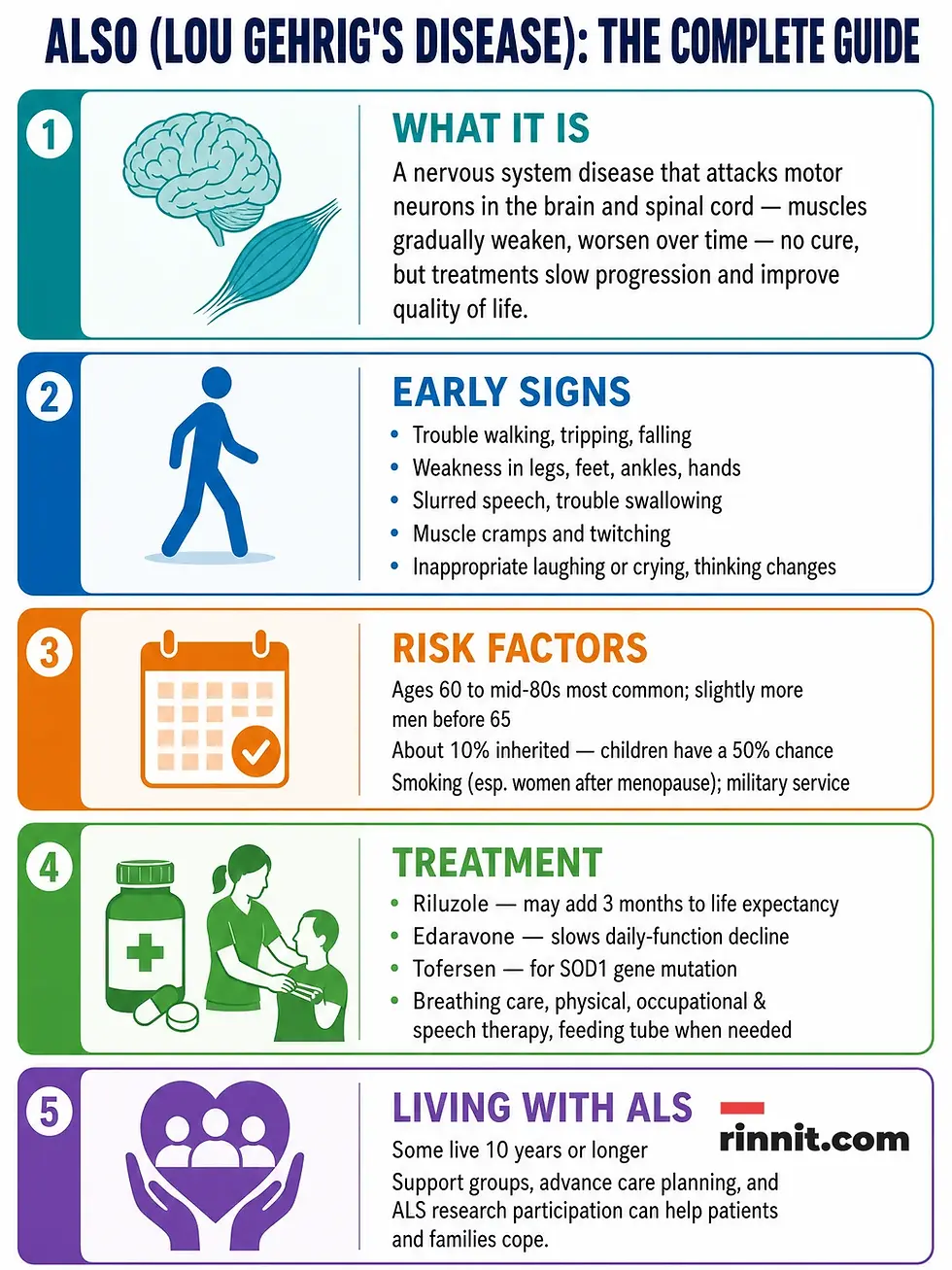
Amyotrophic lateral sclerosis (a-my-o-TROE-fik LAT-ur-ul skluh-ROE-sis) is a nervous system disease that affects nerve cells in the brain and spinal cord. Also known as ALS, it leads to muscle weakness and other symptoms that get worse over time [1].
ALS often begins with muscle twitching and weakness in an arm or leg, trouble swallowing, or slurred speech. Eventually, it affects the muscles needed to move, speak, eat, and breathe [1]. There is no cure for this fatal disease, but research into new therapies is ongoing [1].
Lou Gehrig's disease: ALS is often called Lou Gehrig's disease after the famous baseball player who was diagnosed with it [1]. The exact cause is still not known in most people, and in a small percentage of people, ALS is inherited from a parent.
What are the symptoms of amyotrophic lateral sclerosis (ALS)?
Symptoms vary from person to person, worsen over time, and depend on which nerve cells are affected. ALS generally begins with muscle weakness that spreads and intensifies.
Early Symptoms
Early sign | What it looks like |
Walking difficulty | Trouble walking or doing usual daily activities [1] |
Falls | Tripping and falling [1] |
Leg weakness | Weakness in the legs, feet, or ankles [1] |
Hand weakness | Hand weakness or clumsiness [1] |
Speech and swallowing | Slurred speech or trouble swallowing [1] |
Muscle activity | Cramps and twitching, with weakness in the arms, shoulders, or tongue [1] |
Emotional changes | Crying, laughing, or yawning at inappropriate times [1] |
Thinking changes | Changes in thinking or behavior [1] |
ALS often starts in the hands, feet, arms, or legs, then spreads to other parts of the body [1]. Muscles get weaker as more nerve cells die, eventually affecting chewing, swallowing, speaking, and breathing. Three reassuring details: there is generally no pain in the early stages, pain is not common in the later stages, and ALS does not usually affect bladder function or the senses (taste, smell, touch, and hearing) [1].
What Causes Amyotrophic Lateral Sclerosis?
The cause of amyotrophic lateral sclerosis (ALS) is not known in most people, though it may involve a mix of genetic and environmental factors. A genetic cause is found in about 10% of people with ALS [1]. The disease attacks the nerve cells that allow voluntary muscle movements such as walking and talking, called motor neurons:
ALS causes both groups of motor neurons to gradually deteriorate and then die. When motor neurons are damaged, they stop sending messages to the muscles, so the muscles can't function [1]. Researchers continue to study possible causes — it may be a mix of genetic and environmental factors.
What are the risk factors for amyotrophic lateral sclerosis (ALS)?
Risk factor | Details |
Genetics | About 10% have a gene passed down from a family member (hereditary ALS); in most hereditary cases, children have a 50% chance of inheriting the gene [1] |
Age | Risk rises with age up to 75; most common from age 60 into the mid-80s [1] |
Sex | Slightly more common in men before age 65; the difference disappears after age 70 [1] |
Smoking | Evidence supports smoking as an environmental risk factor; women who smoke are at even higher risk, particularly after menopause [1] |
Environmental toxins | Some evidence links lead or other workplace/home substances to ALS — but no single substance has been clearly linked [1] |
Military service | People who have served in the military are at higher risk, possibly due to metals or chemicals exposure, traumatic injuries, viral infections, or intense exertion [1] |
What complications can amyotrophic lateral sclerosis (ALS) cause?
As ALS progresses, four major complications develop.
Trouble Breathing
Over time, ALS leads to weakness of the muscles used to breathe. People with ALS might need a breathing device such as a ventilator to help them breathe at night, used with a mask worn over the nose, the mouth, or both [1]. Some people with advanced ALS choose a tracheostomy — a surgically created hole at the front of the neck leading to the windpipe, through which a ventilator tube is inserted.
The most common cause of death for people with ALS is breathing failure [1]. People with ALS often live 3 to 5 years after symptoms begin. However, some people live 10 years or longer [1].
Trouble Speaking
Most people with ALS develop weakness of the muscles used to form speech. It usually starts with slower speech and occasional slurring, then becomes harder to speak clearly. At that point, many people use other forms of communication and technology to get their message across [1].
Trouble Eating
Weakness of the swallowing muscles can lead to malnutrition and dehydration, plus a higher risk of breathing food, liquids, or saliva into the lungs, causing pneumonia. A feeding tube can reduce these risks and ensure proper hydration and nutrition [1].
Dementia
Some people with ALS have trouble with language and decision-making. Some are eventually diagnosed with a form of dementia called frontotemporal dementia [1].
Can amyotrophic lateral sclerosis (ALS) be prevented?
There is no way to prevent ALS [1]. Experts do not know exactly what causes the disease in most people, and researchers are actively studying the genes and other factors related to ALS.
How is amyotrophic lateral sclerosis (ALS) diagnosed?
Amyotrophic lateral sclerosis (ALS) is diagnosed based on symptoms, a physical exam, and tests that rule out other conditions [2]. The key symptoms involve the upper and lower motor nerves:
ALS can be hard to diagnose, especially in early stages, because symptoms can be similar to other diseases [2]. These tests help rule other conditions out:
Test | What it does |
Electromyogram (EMG) | A needle inserted through the skin into various muscles records electrical activity when they contract and rest — determining whether the problem lies in muscles or nerves [2] |
Nerve conduction study | Measures nerves' ability to send impulses to muscles across the body — almost always done together with EMG [2] |
MRI | Detailed images of the brain and spinal cord that reveal spinal cord tumors, herniated disks, or other conditions causing the symptoms; mainly used to rule other conditions out [2] |
Blood and urine tests | Eliminate other possible causes; the neurofilament light chain blood test may help support an early diagnosis [2] |
Spinal tap (lumbar puncture) | A small needle between two lower-back bones removes spinal fluid for lab testing — doesn't diagnose ALS but may reveal another cause [2] |
Muscle biopsy | Under local anesthesia, a small muscle piece is removed for analysis if a muscle disease is suspected [2] |
Nerve biopsy | Under local anesthesia, a small nerve piece is removed for analysis if a nerve disease is suspected [2] |
How is amyotrophic lateral sclerosis (ALS) treated?
Treatments for ALS can't reverse the damage, but they can slow the progression of symptoms, prevent complications, and make you more comfortable and independent [2]. Care typically involves a team of healthcare professionals trained in many areas, working together to improve your quality of life.
FDA-Approved Medicines
Medicine | How it works | Side effects to know |
Riluzole (Tiglutik) | Taken by mouth; can add three months to life expectancy [2] | Dizziness, gastrointestinal conditions, liver problems — liver function and blood counts are monitored [2] |
Edaravone (Radicava) | Given through a vein or by mouth as a liquid; may reduce the speed of decline in daily functioning; given daily for two weeks each month [2] | Bruising, headache, trouble walking; effect on lifespan not yet known [2] |
Tofersen (Qalsody) | Approved for people with a SOD1 gene mutation; injected into the cerebrospinal fluid during a spinal tap [2] | Headache, fatigue, joint pain, injection site pain [2] |
Your healthcare professional may also prescribe treatments to relieve other symptoms, including muscle cramps and spasms, constipation, fatigue and trouble sleeping, excessive saliva and phlegm, pain, depression, outbursts of laughing or crying, an urgent need to urinate, and leg swelling [2].
Therapies and Support
Therapy | What it provides |
Breathing care | Regular breathing tests; noninvasive ventilation (BiPAP/CPAP masks at night); tracheostomy with a ventilator tube for some; sometimes a laryngectomy to prevent food entering the lungs [2] |
Addresses pain, walking, mobility, bracing, and equipment; low-impact exercise maintains fitness, strength, and range of motion; braces, walkers, wheelchairs, and ramps | |
Occupational therapy | Adaptive equipment for dressing, grooming, eating, and bathing; home modifications for safe accessibility [2] |
Speech therapy | Adaptive techniques for clearer speech; smartphone apps, alphabet boards, pen and paper; consider recording your own voice for text-to-speech apps |
Nutritional support | Easier-to-swallow foods meeting nutritional needs; a feeding tube when swallowing becomes too difficult [2] |
Psychological and social support | Social workers for financial issues, insurance, and equipment; psychologists for emotional support for patients and families [2] |
Researchers are also conducting clinical studies on promising medicines and future treatments.
How can people and families cope with amyotrophic lateral sclerosis (ALS)?
Learning you have amyotrophic lateral sclerosis (ALS) can be devastating, and coping with it is a challenge for both you and your family. These strategies may help you and your family cope:
Coping strategy | What it means |
Take time to grieve | A period of mourning after diagnosis is natural for you and your family |
Stay hopeful | Some people live longer than expected — including 10 years or more — and an optimistic outlook improves quality of life |
Think beyond physical changes | Many people with ALS lead rewarding lives; think of ALS as one part of your life, not your entire identity |
Join a support group | Groups exist for people with ALS and for caregivers; find them through your healthcare professional or the ALS Association |
Make decisions now | With a healthcare professional, hospice nurse, or social worker, decide about life-extending procedures, where you want to spend your final days, and hospice options — planning calms anxieties and lessens the burden on loved ones |
Get involved in research | Consider joining a clinical trial, providing research samples, or joining the National ALS Registry, open to all people with ALS [2] |
How should you prepare for an ALS appointment?
Your healthcare professional may be the first to recognize the symptoms of ALS. You may be referred to a neurologist — a doctor trained in nervous system conditions — to establish a diagnosis.
What you can do: You might need several tests, so prepare. Keep a symptom diary — before seeing the neurologist, use a calendar or notebook to jot down when and how you notice symptoms related to walking, hand coordination, speech, swallowing, or other muscle movements; your notes might show a pattern that helps the diagnosis [2]. Find a neurologist and care team — an integrated care team led by your neurologist is usually most appropriate, because team members communicate with each other and know your needs.
What to expect from your doctor: The professional will review your family's medical history and your symptoms. A physical and neurological exam might test your reflexes, muscle strength, muscle size and tone, senses of touch and sight, coordination, balance, and speaking [2].
Conclusion
Early signs are easy to miss. A little tripping, a clumsy hand, or slightly slurred speech can mark the start of progressive motor neuron damage, so bring patterns of muscle weakness to a doctor promptly rather than waiting.
Diagnosis is a process of elimination. Because ALS mimics other diseases, no single test confirms it — it takes an EMG, nerve studies, MRI, and lab work together, usually led by a neurologist with an integrated care team.
Treatment means buying time and quality. No cure exists yet, but riluzole can add months to life expectancy, edaravone and tofersen slow decline, and breathing, physical, occupational, and speech therapies keep people independent and dignified — some living ten years or more.
Frequently Asked Questions
What is amyotrophic lateral sclerosis?
ALS is a nervous system disease that attacks motor neurons — the nerve cells in the brain and spinal cord that control muscle movement. It is also called Lou Gehrig's disease. Muscles gradually weaken over time as the nerve cells deteriorate and die.
What are the first signs of ALS?
ALS often begins with muscle twitching and weakness in an arm or leg, tripping and falling, hand clumsiness, slurred speech, or trouble swallowing. Symptoms usually start in the hands, feet, arms, or legs and spread over time, eventually affecting chewing, speaking, and breathing.
What causes ALS?
The cause is unknown in most people. In about 10%, a genetic cause is found — hereditary ALS — often passed from a parent, with children having a 50% chance of inheriting the gene [1]. Researchers believe the disease may result from a mix of genetic and environmental factors.
Is ALS inherited?
In about 10% of cases, ALS is hereditary, caused by a gene passed down from a family member. In most hereditary cases, each child of the affected parent has a 50% chance of inheriting the gene [1].
Can ALS be treated or cured?
There is no cure, but three FDA-approved medicines — riluzole, edaravone, and tofersen — can slow symptom progression, and therapies for breathing, mobility, speech, nutrition, and emotional support help people stay comfortable and independent for longer.
How long do people live with ALS?
People with ALS often live 3 to 5 years after symptoms begin, but some live 10 years or longer. The most common cause of death is breathing failure [1], which breathing devices and care teams work to manage.
Does ALS cause pain or affect the senses?
Generally no — there is usually no pain in the early stages, pain is not common later, and ALS typically does not affect bladder function or the senses of taste, smell, touch, and hearing.
Related Reading
EMG (Electromyography): What It Tests, What to Expect and Results explains the nerve and muscle test used to help diagnose this condition.
Deep Tendon Reflexes (DTRs): How They're Tested, Graded and What Abnormal Reflexes Mean explains how reflexes are tested and graded with a reflex hammer.
References
Mayo Clinic Staff. Amyotrophic lateral sclerosis (ALS) - Symptoms and causes. Mayo Clinic. May 06, 2026. https://www.mayoclinic.org/diseases-conditions/amyotrophic-lateral-sclerosis/symptoms-causes/syc-20354022
Mayo Clinic Staff. Amyotrophic lateral sclerosis (ALS) - Diagnosis and treatment. Mayo Clinic. May 06, 2026. https://www.mayoclinic.org/diseases-conditions/amyotrophic-lateral-sclerosis/diagnosis-treatment/drc-20354027
Xie G, Guo Y, Wang Z. Prevalence of and associated factors for sleep disorders in patients with amyotrophic lateral sclerosis: a systematic review and meta-analysis. Front Neurol. 2026;17:1889217. PMID: 42740981. https://doi.org/10.3389/fneur.2026.1889217
Nakamura Y, Moriyama H, Yokota T. Development of antisense oligonucleotide gapmers for amyotrophic lateral sclerosis. Methods Mol Biol. 2026;3065:161-170. PMID: 42814303. https://doi.org/10.1007/978-1-0716-5476-7_10
Alrabadi B, Matar HI, Bandak N, et al. Non-invasive brain stimulation in amyotrophic lateral sclerosis: a systematic review and meta-analysis of transcranial direct current stimulation and transcranial magnetic stimulation. Neurodegener Dis Manag. 2026:1-13. PMID: 42721110. https://doi.org/10.1080/17582024.2026.2731195
Medical disclaimer
This article is for general informational purposes only and is not a substitute for professional medical advice, diagnosis, or treatment. Always seek the advice of a qualified healthcare provider with any questions about a medical condition.



Comments