Tricyclic Antidepressants (TCAs): Uses, Side Effects, Risks and Safety Guide

Updated: 6 days ago
Written and medically reviewed by Dr. Baraa Alnahhal, MD · Last reviewed: October 2026 · How we review
Quick Answer: What are tricyclic antidepressants?
Tricyclic antidepressants (TCAs) are older, first-generation medicines approved to treat major depressive disorder, yet doctors now prescribe them more often for chronic nerve pain, migraine prevention, insomnia and other off-label uses. They raise norepinephrine and serotonin levels in the brain. Side effects are common, and a suspected overdose needs emergency care because it can be fatal. [1]
What the research says
TCAs work for depression, but people stop them more often. A network meta-analysis of 522 trials with 116,477 adults found every antidepressant tested beat placebo. Amitriptyline had the strongest effect (odds ratio 2.13), but amitriptyline and clomipramine were among the drugs with the highest dropout rates. (Cipriani et al., Lancet, 2018) [2]
TCAs and SSRIs work about equally well for most people. Pooling 102 randomized trials with 10,706 patients showed no overall difference in effectiveness. SSRIs were better tolerated, with fewer people quitting because of side effects (relative risk 0.73). (Anderson, J Affect Disord, 2000) [3]
Amitriptyline helps some people with nerve pain, but side effects are common. A review of 17 studies with 1,342 people found 55% of those taking amitriptyline had at least one side effect, compared with 36% on placebo. Only a minority reached satisfying pain relief. (Moore et al., Cochrane Database Syst Rev, 2015) [4]
Key takeaways
Tricyclic antidepressants are among the first antidepressants ever made, which is why they are called "first-generation" antidepressants. [1]
Doctors rarely choose them first for depression because newer options, such as SSRIs, are generally safer with fewer side effects. [1]
Today they are mostly prescribed off-label for chronic pain, nerve pain, migraine prevention, insomnia, anxiety, fibromyalgia and bedwetting. [1]
Common side effects include constipation, dry mouth and dizziness. [1]
They can be dangerous in an overdose. Take them exactly as prescribed and store them out of reach of children and pets. [1]
What are tricyclic antidepressants?
Tricyclic antidepressants are a class of medicines that help manage the symptoms of clinical depression, also called major depressive disorder. [1]
They get their name from their chemical shape. Each molecule has three rings joined to one side chain. "Tri" means three, and "cyclic" means ring. [1]
TCAs were one of the earliest types of antidepressants developed. That is why doctors call them first-generation antidepressants. [1]
What are the different types of tricyclic antidepressants?
Nine tricyclic antidepressants are approved by the U.S. Food and Drug Administration (FDA): eight for major depressive disorder and one, clomipramine, for obsessive-compulsive disorder. [1]
Generic name | Brand names | FDA-approved use |
Amitriptyline | Elavil®, Vanatrip® | Major depressive disorder |
Amoxapine | Asendin® | Major depressive disorder |
Desipramine | Norpramin® | Major depressive disorder |
Doxepin | Silenor®, Sinequan® | Major depressive disorder |
Imipramine | Tofranil®, Tofranil-PM® | Major depressive disorder |
Nortriptyline | Aventyl®, Pamelor® | Major depressive disorder |
Protriptyline | Vivactil® | Major depressive disorder |
Trimipramine | Surmontil® | Major depressive disorder |
Clomipramine | Anafranil® | Obsessive-compulsive disorder (OCD) in people aged 10 and older |
How do tricyclic antidepressants work?
Tricyclic antidepressants work by raising the levels of two brain chemicals: mainly norepinephrine, and also serotonin. [1]
These chemicals are neurotransmitters. They carry messages between nerve cells and help control mood and behavior. [1]
TCAs also block other receptors in the body. This extra action is what causes many of their side effects, such as dry mouth and trouble emptying the bladder. [1]
How TCAs may ease pain: Researchers think these medicines block pain signals in the spinal cord. They may also block pain signals in the nerves of the body through complex actions on the nervous and immune systems. [1]

What conditions do tricyclic antidepressants treat?
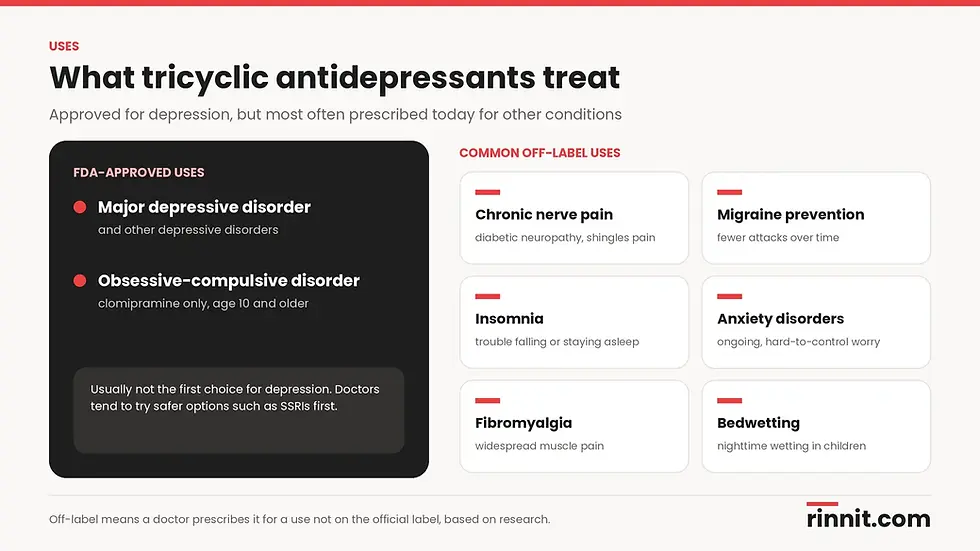
Tricyclic antidepressants are FDA-approved to treat major depressive disorder and other depressive disorders, but doctors now use them more often for off-label conditions. [1]
"Off-label" means the medicine is not officially approved for that condition, but research shows it may work. Learn more about how off-label prescribing works. [1]
FDA-approved uses
Common off-label uses
Condition | What it involves |
Chronic nerve pain | Including neuropathic pain, myofascial pain, diabetic neuropathy and postherpetic neuralgia |
Migraine prevention | Taken regularly to help prevent attacks |
Insomnia | Trouble falling or staying asleep |
Ongoing worry or fear that disrupts daily life | |
Fibromyalgia | A long-term condition with widespread pain |
Bedwetting (nocturnal enuresis) | Wetting the bed during sleep |
What is the difference between SSRIs and tricyclic antidepressants?
SSRIs and tricyclic antidepressants both improve the symptoms of major depressive disorder, but SSRIs cause fewer serious side effects and are less risky in an overdose. [1]
Feature | Tricyclic antidepressants (TCAs) | SSRIs |
Generation | First generation | Second generation |
Works for depression? | Yes | Yes |
Side effects | More significant | Generally fewer |
Overdose risk | Higher; misuse more easily leads to toxicity | Lower |
Usual role in depression | Used when other antidepressants have not worked | Commonly prescribed first |
How do you take tricyclic antidepressants?
Tricyclic antidepressants come as tablets, capsules and liquid solutions taken by mouth. [1]
Doses differ for each TCA. Because these medicines carry a high risk of side effects and toxicity, your doctor will usually start with the lowest possible dose and raise it slowly only if needed. [1]
How long do tricyclic antidepressants take to work?
Tricyclic antidepressants may take two to four weeks to reach their full effect on depression symptoms. Talk to your doctor if you notice no change after four weeks. [1]
What are the side effects of tricyclic antidepressants?
The most common side effects of tricyclic antidepressants are constipation, dry mouth and dizziness. Each TCA has its own side effect profile, so ask your doctor or pharmacist what to watch for. [1]
How often | Side effects |
Common | Constipation, dry mouth (xerostomia), dizziness |
Other possible effects | Trouble emptying the bladder (urinary retention), blurred vision, fast heartbeat (tachycardia), dizziness when standing up (orthostatic hypotension), increased appetite, weight gain |
Who should be careful with tricyclic antidepressants?
Tricyclic antidepressants may not be safe for people with heart disease or epilepsy, or for people who are pregnant or planning a pregnancy. [1]
Situation | Why it matters | What your doctor may do |
Heart disease | TCAs may cause heart complications in people with existing ischemic heart disease | Order an electrocardiogram (ECG) before you start |
Epilepsy | TCAs may raise the risk of seizures | Discuss other options |
Pregnancy or planning pregnancy | Evidence on TCAs in pregnancy is mixed; some studies have linked them to birth defects, while others have not, so the choice is made case by case | Weigh risks and benefits with you; don't stop suddenly |
Tell your doctor about any of these situations before you start. If you already take a TCA, your doctor may suggest stopping it or switching to a different antidepressant. [1]
Can tricyclic antidepressants cause suicidal thoughts?
Tricyclic antidepressants can increase suicidal thoughts or behavior in some children, teens and adults under 25, especially when starting the medicine or changing the dose. [1]
If you or your child has suicidal thoughts or behavior, call the doctor who prescribed the medicine right away. In the U.S., you can also call or text 988 to reach the Suicide and Crisis Lifeline. Elsewhere, contact your local emergency number or crisis line. [1]
Can you overdose on tricyclic antidepressants?
Yes, you can overdose on tricyclic antidepressants, and they are among the most common antidepressants involved in overdoses. An overdose can happen by accident, without realizing it, or on purpose. [1]
Overdose is very rare when the medicine is taken as prescribed. Always follow your dose and store medicines safely away from children and pets. [1]
Signs of a TCA overdose include: [1]
Heart rhythm problems
Low blood pressure
Drowsiness
Seizures
Tremors (shaking)
Confusion
Coma
A TCA overdose can be fatal if it is not treated in time. If you suspect an overdose in yourself or someone else, call your local emergency number (911 in the U.S.) and get medical help right away. [1]

When should you call a doctor about tricyclic antidepressants?
You should see your doctor regularly while taking a tricyclic antidepressant so they can check how well it is working. [1]
Situation | What to do |
Side effects that bother you | Call your doctor |
Symptoms not improving, or getting worse | Call your doctor |
You are thinking of stopping the medicine | Talk to your doctor first |
Symptoms of an overdose | Call emergency services or go to the nearest emergency room |
Suicidal thoughts | Call emergency services or go to the nearest emergency room |
For a deeper clinical look, see this detailed medical review of tricyclic antidepressants and this overview of all antidepressant classes.
Conclusion
Tricyclic antidepressants are older medicines with a long track record. They can still help with depression when newer options fall short, and they are widely used today for nerve pain, migraine prevention, sleep problems and more.
Their benefits come with real trade-offs. Side effects are common, some people should avoid them, and an overdose is a medical emergency. Starting low, taking the dose exactly as prescribed and keeping regular check-ins with your doctor make treatment safer.
Prescribed a TCA, or wondering if one could help you? Save or print this guide and bring your questions to your next appointment. Ask why this medicine was chosen for you, which side effects to watch for and how long to wait before judging results. For more plain-language guides, explore our articles on neuropathic pain, generalized anxiety disorder and how depression affects sex and libido.
FAQ
What are tricyclic antidepressants used for?
Tricyclic antidepressants are FDA-approved for major depressive disorder, and clomipramine is approved for OCD. Doctors more often prescribe them off-label for chronic nerve pain, migraine prevention, insomnia, anxiety disorders, fibromyalgia and bedwetting. [1]
Why are tricyclic antidepressants not the first choice for depression?
Tricyclic antidepressants cause more significant side effects than newer antidepressants such as SSRIs, and they are more likely to cause toxicity or overdose. Doctors usually save them for when other antidepressants have not worked. [1]
How long do tricyclic antidepressants take to work?
Tricyclic antidepressants may take two to four weeks to show their full effect on depression. If you notice no change after four weeks, talk to your doctor. [1]
What are the most common side effects of tricyclic antidepressants?
The most common side effects of tricyclic antidepressants are constipation, dry mouth and dizziness. Other possible effects include trouble emptying the bladder, blurred vision, a fast heartbeat, dizziness when standing up, increased appetite and weight gain. [1]
Are tricyclic antidepressants safe during pregnancy?
The safety of tricyclic antidepressants in pregnancy is uncertain, and the decision is made case by case. Studies link their use in pregnancy to birth defects affecting the baby's eyes, ears, face and neck, so talk to your doctor if you are pregnant or planning to be. [1]
What are the signs of a tricyclic antidepressant overdose?
Signs of a tricyclic antidepressant overdose include heart rhythm problems, low blood pressure, drowsiness, seizures, tremors, confusion and coma. An overdose can be fatal, so call emergency services right away if you suspect one. [1]
Can amitriptyline help with nerve pain?
Amitriptyline is a tricyclic antidepressant often used off-label for chronic nerve pain, such as diabetic neuropathy and postherpetic neuralgia. Research suggests only a minority of people get satisfying relief, and side effects are common. [1][4]
When should I go to the emergency room while taking a tricyclic antidepressant?
Go to the emergency room or call emergency services if you have symptoms of a TCA overdose or suicidal thoughts. For bothersome side effects or symptoms that are not improving, call your doctor instead. [1]
Can you drink alcohol while taking a tricyclic antidepressant?
It is best to avoid alcohol, since it can increase drowsiness and dizziness and raise the danger of an overdose. Talk with your provider about any alcohol use.
Can you stop taking a tricyclic antidepressant suddenly?
No. Stopping suddenly can cause discontinuation symptoms such as nausea, headache and feeling unwell. Your provider can help you lower the dose slowly.
Related Reading
SSRIs (Selective Serotonin Reuptake Inhibitors): How They Work, Uses, and Side Effects explains the antidepressants most often prescribed first for depression.
SNRIs Explained: Uses, Side Effects, and How Long They Take to Work covers SNRIs, which also treat depression and some nerve pain.
MAOIs (Monoamine Oxidase Inhibitors): Uses, Side Effects, Food Rules and Safety describes another older antidepressant class and its food interactions.
Antidepressant Discontinuation Syndrome: Symptoms, Causes, and How to Stop Safely explains symptoms that can happen when stopping antidepressants and how to taper.
References
Cleveland Clinic. Tricyclic Antidepressants. Cleveland Clinic. Last updated July 24, 2023. https://my.clevelandclinic.org/health/treatments/25146-tricyclic-antidepressants
Cipriani A, Furukawa TA, Salanti G, et al. Comparative efficacy and acceptability of 21 antidepressant drugs for the acute treatment of adults with major depressive disorder: a systematic review and network meta-analysis. Lancet. 2018;391(10128):1357-1366. PMID 29477251. https://doi.org/10.1016/S0140-6736(17)32802-7
Anderson IM. Selective serotonin reuptake inhibitors versus tricyclic antidepressants: a meta-analysis of efficacy and tolerability. J Affect Disord. 2000;58(1):19-36. PMID 10760555. https://doi.org/10.1016/s0165-0327(99)00092-0
Moore RA, Derry S, Aldington D, et al. Amitriptyline for neuropathic pain in adults. Cochrane Database Syst Rev. 2015;2015(7):CD008242. PMID 26146793. https://doi.org/10.1002/14651858.CD008242.pub3
Medical disclaimer
This article is for educational purposes only and does not replace professional medical advice, diagnosis or treatment. Do not start, stop or change any medicine without talking to your doctor or pharmacist. If you think you or someone else may have taken too much of a medicine, or if you have thoughts of harming yourself, contact your local emergency services right away.



Comments