MAOIs (Monoamine Oxidase Inhibitors): Uses, Side Effects, Food Rules and Safety

Updated: 6 days ago
Written and medically reviewed by Dr. Baraa Alnahhal, MD · Last reviewed: October 2026 · How we review
Quick Answer: What are MAOIs?
MAOIs (monoamine oxidase inhibitors) are prescription antidepressants that block the monoamine oxidase enzyme, raising brain levels of serotonin, norepinephrine and dopamine. Doctors usually reserve them for depression that has not improved with other antidepressants, because MAOIs interact dangerously with tyramine-rich foods and some medicines, which can trigger a sudden spike in blood pressure or serotonin syndrome. [1]
What the research says
Phenelzine stood out for effectiveness. A network meta-analysis of 52 double-blind trials with 6,462 participants compared 14 antidepressants; phenelzine showed the strongest evidence for efficacy of all treatments, and no drug had clearly worse dropout rates (Suchting et al., Journal of Affective Disorders, 2021). [2]
MAOIs work as well as other antidepressants. A 2024 network meta-analysis of 83 double-blind randomized trials (7,765 people on active treatment, 1,844 on placebo) found isocarboxazid, phenelzine and tranylcypromine beat placebo, with tolerability comparable to other antidepressants (Giménez-Palomo et al., Acta Psychiatrica Scandinavica, 2024). [3]
The selegiline skin patch has a wider safety margin. In trials of 2,036 patch users and 668 placebo users, no acute high-blood-pressure reactions occurred in studies without tyramine limits, and the 6 mg/24 h dose was supported without diet changes; higher doses still call for avoiding tyramine-rich foods (Robinson & Amsterdam, Journal of Affective Disorders, 2008). [4]
Key takeaways
MAOIs were the first antidepressants ever developed, but today they are a later-line choice. [1]
Four MAOIs are available in the United States: isocarboxazid, phenelzine, selegiline and tranylcypromine. [1]
High-tyramine foods such as aged cheese, salami and soy sauce can cause a dangerous rise in blood pressure while you take an MAOI. [1]
Combining an MAOI with other serotonin-raising drugs, such as SSRIs or opioids, can cause serotonin syndrome. [1]
Improvement usually starts within two to three weeks, and stopping should always be a slow, supervised taper. [1]
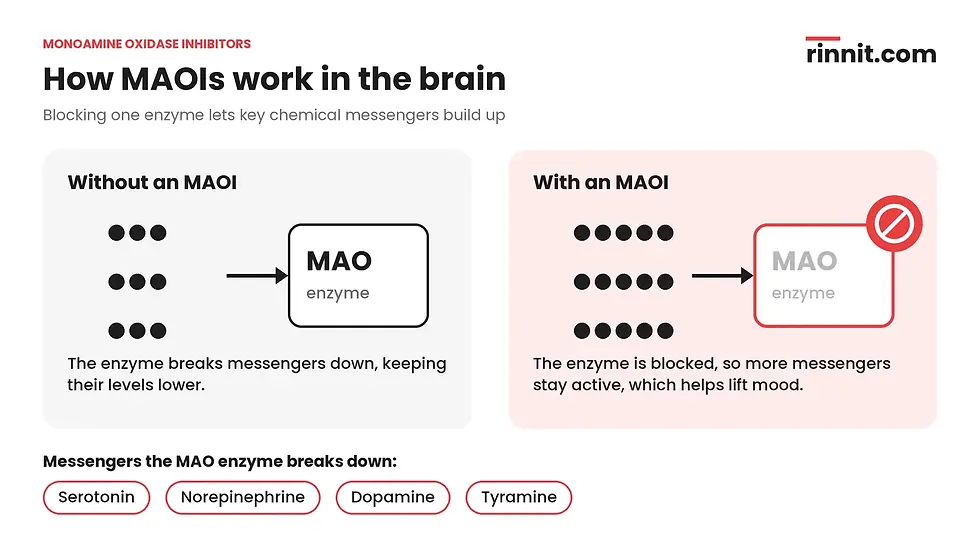
How MAOIs work: blocking the MAO enzyme lets mood-related chemical messengers stay active.
How do MAOIs work?
MAOIs work by blocking monoamine oxidase, an enzyme that breaks down chemical messengers (neurotransmitters) in the brain. [1]
When the enzyme is blocked, levels of these messengers rise. That boost helps lift mood and ease other depression symptoms. [1]
Messenger the MAO enzyme breaks down | What happens on an MAOI |
Serotonin | Levels rise, supporting mood |
Norepinephrine | Levels rise, supporting mood |
Dopamine | Levels rise, supporting mood |
Tyramine | Levels rise, which is why diet matters |
MAOIs come as tablets or capsules taken by mouth. Selegiline is also available as a skin patch. [1]
What drugs are MAOIs?
MAOI drugs available in the United States are isocarboxazid, phenelzine, selegiline and tranylcypromine. [1]
Generic name | Brand name | FDA-approved uses | Form |
Isocarboxazid | Marplan® | Major depressive disorder | Oral |
Phenelzine | Nardil® | Depression, mainly when other antidepressants have not worked | Oral |
Selegiline | Emsam® | Major depressive disorder; add-on treatment for Parkinson's disease | Skin patch (also oral) |
Tranylcypromine | Parnate® | Major depressive disorder | Oral |
What conditions do MAOIs treat?
MAOIs treat major depressive disorder and treatment-resistant depression; oral selegiline is also approved for Parkinson's disease, and some MAOIs are used off-label for panic disorder and social anxiety disorder. [1]
Doctors sometimes prescribe MAOIs off-label, meaning for a use the FDA has not approved:
MAOI | Off-label uses |
Selegiline | ADHD |
Tranylcypromine | Treatment-resistant social anxiety disorder, treatment-resistant panic disorder, atypical depression |
Why are MAOIs rarely prescribed?
MAOIs are rarely prescribed because of food interactions, side effects and safety concerns. [1]
Doctors usually turn to an MAOI only after other antidepressant classes have not helped. [1] Taking one means being extra careful with everything you eat, drink and take.
What are the side effects of MAOIs?
The most common MAOI side effects are dizziness, dry mouth, nausea, bowel changes, drowsiness and insomnia. [1] Each MAOI has its own profile, so ask your doctor or pharmacist which ones to watch for.
Common side effects | Serious complications |
Dizziness or lightheadedness (from low blood pressure) | Suicidal thoughts or behavior |
Dry mouth | Serotonin syndrome |
Nausea | Antidepressant discontinuation syndrome |
Diarrhea or constipation | High blood pressure from food interactions |
Drowsiness | |
Insomnia |

MAOI side effects at a glance, from common and mild to serious.
Can MAOIs cause suicidal thoughts?
MAOIs can increase suicidal thoughts or behavior in people younger than 25, especially when starting the medicine or changing the dose. [1]
If you or your child has suicidal thoughts, call the prescribing doctor immediately or contact your local emergency number. In the U.S., call or text 988 to reach the Suicide and Crisis Lifeline.
What is serotonin syndrome on MAOIs?
Serotonin syndrome is a potentially life-threatening reaction caused by too much serotonin in the body. [1]
It can happen when you start an MAOI or raise the dose. It is most likely when an MAOI is combined with other serotonin-raising medicines, such as SSRIs and opioids. You usually need to wait at least 2 weeks after stopping an MAOI before starting another antidepressant, and at least 5 weeks after stopping fluoxetine before starting an MAOI. [1]
Which foods should you avoid on MAOIs?
Foods to avoid on MAOIs are those high in tyramine, such as aged cheese, cured fish, salami, soy sauce and fermented beer. [1]
MAOIs stop your body from breaking down tyramine. Too much tyramine can cause a sudden rise in blood pressure, called the tyramine pressor response. In rare cases, this can trigger bleeding in the brain, which can be fatal. Get emergency care right away for a sudden severe headache, stiff neck, chest pain, a pounding or fast heartbeat, or nausea and vomiting. [1]
Avoid | Helpful note |
Aged cheese | Unaged cheeses (cottage cheese, mozzarella, ricotta) are usually low in tyramine unless stored warm |
Artisan sourdough bread | |
Cured fish | |
Fava beans | |
Fermented beers, including tap beer | |
Fermented sausages and salami | |
Liver | Fresh liver has no tyramine but spoils quickly without refrigeration |
Overripe fruit (avocados, bananas, figs) | Choose fresh, not overripe |
Soy sauce |
Tyramine increases as food ages, so choose fresh food over leftovers. [1] Your doctor may ask you to check your blood pressure at home after trying small amounts of tyramine-containing foods. A dietitian can help you build a personal list.

Foods to avoid on MAOIs: high-tyramine choices that can raise blood pressure.
How long do MAOIs take to work?
MAOIs usually take two to three weeks to improve symptoms. [1] Talk to your doctor if you do not feel better after that time.
How do you stop taking MAOIs safely?
Stopping MAOIs safely means tapering the dose slowly with your doctor, a process that usually takes at least four weeks. [1]
Stopping suddenly after six weeks or more of use can cause antidepressant discontinuation syndrome. Never stop on your own. [1]
When should you call your doctor about MAOIs?
Call your doctor about MAOIs if you have bothersome side effects, your symptoms are not improving or are worsening, or you are thinking of stopping. [1]
You should also:
Keep regular follow-up visits so your doctor can check how well the medicine works.
Tell every doctor, dentist and pharmacist you see that you take an MAOI. [1]
Conclusion
MAOIs are among the oldest antidepressants, and research shows they still work as well as newer options. Their trade-off is safety: you need to follow food rules, avoid risky drug combinations and stay in close contact with your doctor. Used carefully, an MAOI can be a valuable option when other treatments have not helped.
Want more clear, doctor-reviewed health guides? Browse our Diseases & Conditions library and check Health News for the latest research, explained simply. Living with depression or anxiety? Our guide to support groups explains how to find one near you.
FAQ
What are MAOIs used for?
MAOIs are used mainly to treat depression, especially depression that has not improved with other antidepressants. Selegiline is also approved as add-on treatment for Parkinson's disease, and some MAOIs are used off-label for panic disorder and social anxiety disorder.
What are the four MAOIs?
The four MAOIs available in the United States are isocarboxazid (Marplan), phenelzine (Nardil), selegiline (Emsam) and tranylcypromine (Parnate).
Why are MAOIs dangerous with certain foods?
MAOIs are dangerous with tyramine-rich foods because they stop the body from breaking down tyramine. High tyramine levels can cause a sudden, dangerous rise in blood pressure and, rarely, bleeding in the brain.
Can you take MAOIs with SSRIs?
MAOIs combined with SSRIs can cause serotonin syndrome, a potentially life-threatening reaction. Opioids carry the same risk, so always tell your doctor about every medicine you take.
How long does it take for MAOIs to work?
MAOIs usually take two to three weeks to improve depression symptoms. Talk to your doctor if you do not feel better after that time.
What are the most common side effects of MAOIs?
The most common side effects of MAOIs are dizziness or lightheadedness, dry mouth, nausea, diarrhea or constipation, drowsiness and insomnia.
Can you stop taking an MAOI suddenly?
An MAOI should not be stopped suddenly, because doing so after six weeks or more can cause antidepressant discontinuation syndrome. Tapering with your doctor usually takes at least four weeks.
What is a hypertensive crisis on an MAOI?
It is a sudden, dangerous rise in blood pressure that can happen when an MAOI is taken with high-tyramine foods or certain medicines. A severe headache, chest pain, a pounding heartbeat or confusion needs emergency care right away.
Why are MAOIs rarely prescribed?
MAOIs are usually used only when other antidepressants have not worked. This is because of their food and drug interactions and other safety concerns.
Can MAOIs cause suicidal thoughts?
Like other antidepressants, MAOIs can increase suicidal thoughts or behavior in people younger than 25, especially when starting or changing the dose. Call the prescribing doctor right away, or call 988 or emergency services, if this happens.
Related Reading
Serotonin Syndrome Guide: Symptoms, Causes, Diagnosis, and Treatment explains the warning signs of serotonin syndrome and its treatment.
Understanding Hypertensive Crisis: Causes, Symptoms, and Emergency Care covers dangerous blood pressure spikes and emergency care.
Atypical Depression: The Type of Depression Where Your Mood Can Still Brighten — and How It's Treated explains a depression subtype where MAOIs are sometimes used.
SSRIs (Selective Serotonin Reuptake Inhibitors): How They Work, Uses, and Side Effects explains how SSRIs work and their common side effects.
References
Cleveland Clinic. Monoamine Oxidase Inhibitors (MAOIs): What They Are & Uses. Cleveland Clinic. Last updated February 13, 2026. https://my.clevelandclinic.org/health/treatments/25220-maois-monoamine-oxidase-inhibitors
Suchting R, Tirumalajaru V, Gareeb R, et al. Revisiting monoamine oxidase inhibitors for the treatment of depressive disorders: A systematic review and network meta-analysis. J Affect Disord. 2021;282:1153-1160. PMID 33601690. https://doi.org/10.1016/j.jad.2021.01.021
Giménez-Palomo A, Chamdal AK, Gottlieb N, et al. Efficacy and tolerability of monoamine oxidase inhibitors for the treatment of depressive episodes in mood disorders: A systematic review and network meta-analysis. Acta Psychiatr Scand. 2024;150(6):500-515. PMID 39001570. https://doi.org/10.1111/acps.13728
Robinson DS, Amsterdam JD. The selegiline transdermal system in major depressive disorder: a systematic review of safety and tolerability. J Affect Disord. 2008;105(1-3):15-23. PMID 17568687. https://doi.org/10.1016/j.jad.2007.04.024
Further reading (external)
U.S. Food and Drug Administration. Depression Medicines. FDA. Last updated November 18, 2019. https://www.fda.gov/consumers/free-publications-women/depression-medicines#MAOI
Patel P, Saadabadi A. Monoamine Oxidase Inhibitors (MAOIs). StatPearls. Last updated December 13, 2025. https://www.ncbi.nlm.nih.gov/books/NBK539848/
Disclaimer
This article is for general education and does not replace advice from your doctor or pharmacist. Never start, change or stop any medicine without talking to your healthcare provider. If you have thoughts of harming yourself, contact your local emergency number right away.



Comments