Serotonin Syndrome Guide: Symptoms, Causes, Diagnosis, and Treatment

Updated: 2 days ago
Medically reviewed by Dr. Baraa Alnahhal, MD · Last reviewed: September 2026
TL;DR
Serotonin syndrome is a serious drug reaction caused by medications that build up high levels of serotonin, the natural chemical that helps nerve cells and the brain function, in the body. It most often happens when people combine certain medications, such as an antidepressant with a migraine medicine or an opioid pain medication, or when a dose is increased or a new drug is started. Symptoms usually begin within several hours and range from mild (shivering, diarrhea, agitation) to severe and life-threatening (muscle rigidity, high fever, seizures). The most common fix is simpler than you might expect: stopping the triggering medication, which clears milder forms within 24 to 72 hours, though some antidepressant-related cases take several weeks to resolve completely [1] [2].
Quick Answer
What it is: A potentially life-threatening drug reaction caused by excessive serotonin building up in the body [1].
When it starts: Symptoms usually occur within several hours of taking a new drug or increasing the dose of a serotonin-affecting medication [1].
The most common trigger: Combining two or more serotonin-raising medications, classically an antidepressant with a migraine medicine or an opioid pain medication [1].
Emergency signs: High fever, tremor, seizures, irregular heartbeat, and unconsciousness, seek emergency treatment immediately [1].
Treatment in one line: Stop the offending medication; milder forms clear within 24 to 72 hours, while severe cases need hospital treatment with benzodiazepines, cyproheptadine, oxygen, IV fluids, and blood pressure and heart rate control [2].
What This Guide Is Based On
This guide is built entirely from specialist-reviewed clinical guidance updated in September 2024, supported by the Goldman-Cecil Medicine (27th ed., 2024) toxicology and drug reaction references, the Merck Manual professional reference on serotonin syndrome, UpToDate overviews of serotonin toxicity and its management, the Critical Care Medicine serotonin syndrome treatment review, and the National Institute of Mental Health's medication information resources. These peer-reviewed and institution-backed references are cited inline throughout, with the full list at the end of this guide [1] [2].
What Is Serotonin Syndrome?
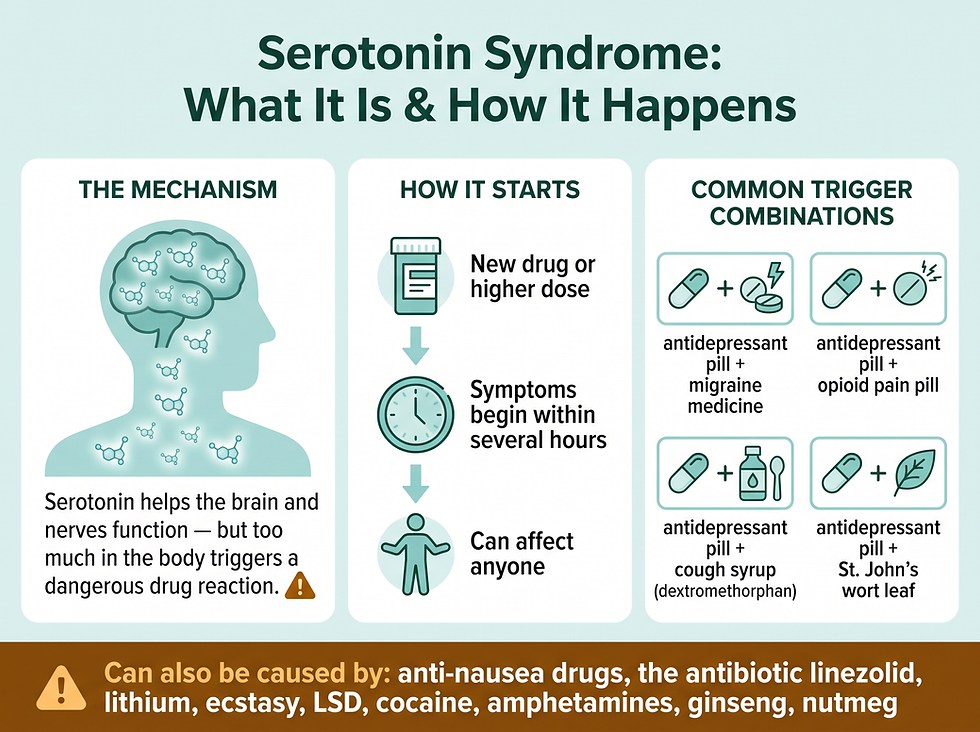
Serotonin syndrome is a serious reaction to certain medications. It happens when medications build up high levels of serotonin in your body. Serotonin is a chemical your body produces naturally. Your nerve cells in the brain and spinal cord use it to help them communicate, and it is needed for the brain to function properly. It also helps regulate attention, behavior, and body temperature, and nerve cells in your intestine produce serotonin that regulates the digestive process, blood flow, and breathing [1].
Too much serotonin causes a range of signs and symptoms that can be mild, such as shivering and diarrhea, or severe, such as muscle rigidity, fever, and seizures. Severe serotonin syndrome can cause death if it's not treated promptly [1].
It can occur when you increase the dose of certain medications or add a new drug to your regimen. It most often happens when you combine two medications that affect serotonin levels, such as a medication for depression and a medication for migraines. Some illicit drugs and dietary supplements also are associated with serotonin syndrome [1].
What Are the Symptoms?
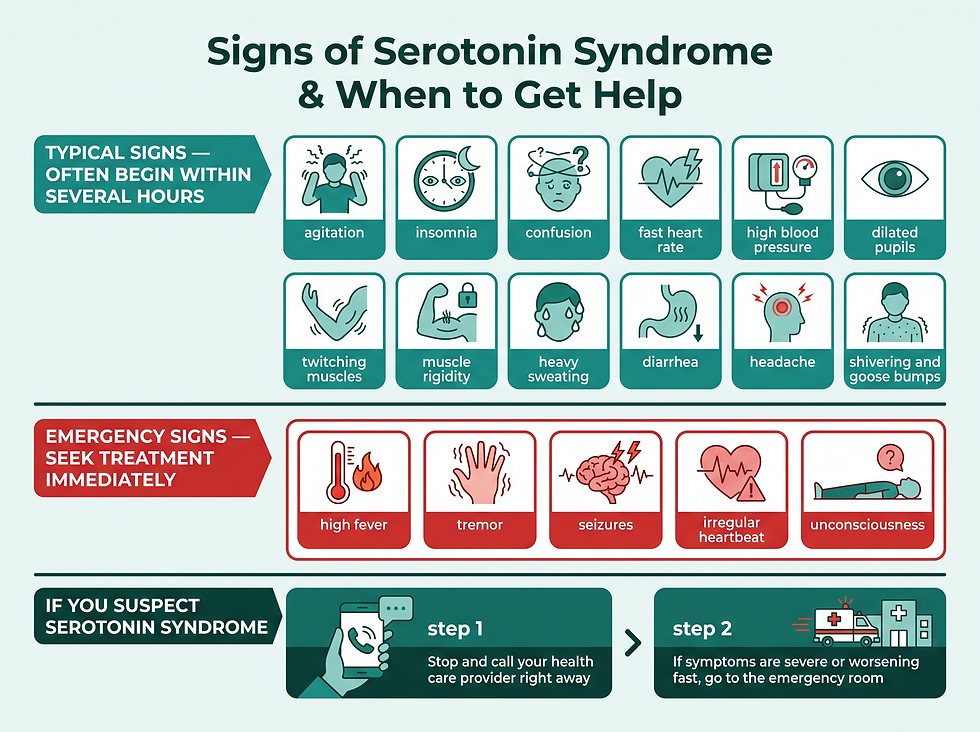
Symptoms usually occur within several hours of taking a new drug or increasing the dose of a drug, or adding a new drug to an existing regimen. They range from mild to life-threatening [1].
Symptom | What it looks like |
Agitation or restlessness | Feeling anxious, jumpy, or unable to settle [1] |
Insomnia | Trouble sleeping after starting the medication [1] |
Confusion | Mental fog, disorientation, or unclear thinking [1] |
Rapid heart rate and high blood pressure | Heart pounding, elevated blood pressure readings [1] |
Dilated pupils | Pupils noticeably larger than usual [1] |
Loss of muscle coordination or twitching | Clumsiness, jerking movements, muscle twitching [1] |
Muscle rigidity | Stiff, tight muscles [1] |
Heavy sweating | Excessive perspiration [1] |
Diarrhea | Loose stools after starting or increasing the drug [1] |
Headache | Pain or pressure in the head [1] |
Shivering | Feeling chilled or trembling [1] |
Goose bumps | Skin raised in small bumps [1] |
Severe serotonin syndrome is life-threatening. The warning signs include high fever, tremor, seizures, irregular heartbeat, and unconsciousness. If you experience these, seek emergency treatment immediately [1].
When Should You See a Doctor?
If you suspect you may have serotonin syndrome after starting a new medication or increasing a medication dose, call your health care provider right away or go to the emergency room. If you have severe or rapidly worsening symptoms, seek emergency treatment immediately [1].
What Causes Serotonin Syndrome?
Serotonin syndrome is caused by an excessive accumulation of serotonin in the body. One drug alone can cause it in some people, but most often it occurs when people combine certain medications [1].
Classic combinations include an antidepressant with a migraine medication, or an antidepressant with an opioid pain medication. Another cause is an intentional overdose of antidepressant medications [1].
The table below lists the prescription drugs, over-the-counter medicines, illicit drugs, and dietary supplements known to raise serotonin levels [1].
Category | Examples |
Selective serotonin reuptake inhibitors (SSRIs) | citalopram (Celexa), fluoxetine (Prozac), fluvoxamine (Luvox), escitalopram (Lexapro), paroxetine (Paxil), sertraline (Zoloft) [1] |
Serotonin and norepinephrine reuptake inhibitors (SNRIs) | desvenlafaxine (Pristiq), levomilnacipran (Fetzima), milnacipran (Savella), duloxetine (Cymbalta), venlafaxine (Effexor XR) [1] |
Bupropion | Zyban, Wellbutrin SR, Wellbutrin XL [1] |
Tricyclic antidepressants | amitriptyline, nortriptyline (Pamelor) [1] |
Monoamine oxidase inhibitors (MAOIs) | isocarboxazid (Marplan), phenelzine (Nardil) [1] |
Anti-migraine medications | carbamazepine (Tegretol), valproic acid, triptans such as almotriptan, naratriptan (Amerge), and sumatriptan (Imitrex) [1] |
Pain medications | codeine, fentanyl (Duragesic), hydrocodone (Hysingla ER), meperidine (Demerol), oxycodone (OxyContin), tramadol (Ultram) [1] |
Lithium | Lithobid, used as a mood stabilizer [1] |
Illicit drugs | LSD, ecstasy, cocaine, amphetamines [1] |
Herbal supplements | St. John's wort, ginseng, nutmeg [1] |
Over-the-counter cough and cold medicines | those containing dextromethorphan (Delsym) [1] |
Anti-nausea medications | granisetron (Sancuso), metoclopramide (Reglan), droperidol (Inapsine), ondansetron (Zofran) [1] |
Linezolid and ritonavir | Zyvox (an antibiotic) and Norvir (an anti-retroviral) [1] |
Who Is Most at Risk?
Anyone can develop serotonin syndrome when taking medications that raise serotonin levels, but some people are more likely than others to develop it. The risk rises with the number of serotonin-raising substances in the picture [1].
Risk factor | What it means |
Recent change to a medication | Recently starting or increasing the dose of a medication known to increase serotonin levels [1] |
Multiple serotonin-raising drugs | Taking more than one drug known to increase serotonin levels [1] |
Herbal supplements | Taking herbal supplements known to increase serotonin levels [1] |
Illicit drug use | Using an illicit drug known to increase serotonin levels [1] |
What Are the Possible Complications?
Serotonin syndrome generally doesn't cause problems once serotonin levels return to normal. If left untreated, however, severe serotonin syndrome can lead to unconsciousness and death [1].
How Is Serotonin Syndrome Diagnosed?
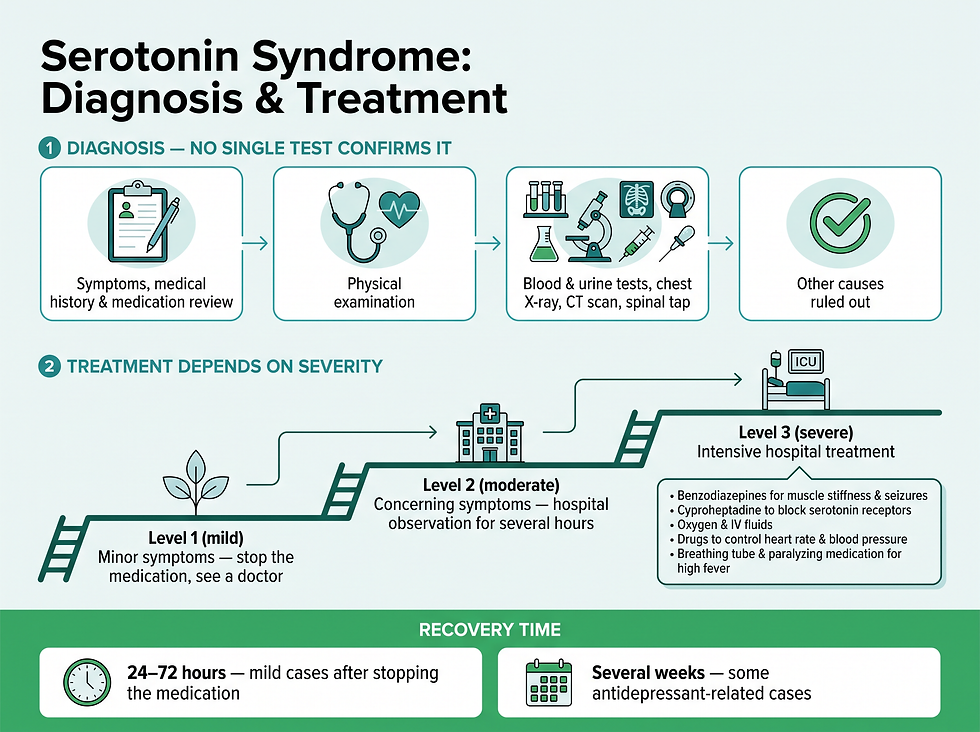
There is no single test that can confirm the diagnosis of serotonin syndrome. Your doctor will diagnose it by ruling out other possibilities. To do that, your doctor will ask about your symptoms, your medical history, and the medications you take, including over-the-counter drugs, supplements, and recreational drugs, and perform a physical examination [2].
Certain tests can help confirm that your symptoms are caused by a medication rather than by something else, such as an infection. The tests are chosen based on your symptoms. Additional tests may include blood and urine tests, a chest X-ray, a CT scan, and a spinal tap (lumbar puncture) [2].
Conditions with similar symptoms that doctors rule out in moderate to severe cases include a serious reaction to certain medications such as anesthetics and antipsychotics, overdose of illicit drugs, antidepressants, or other serotonin-raising medications, damage from illicit drug use, and severe alcohol withdrawal [2].
How Is Serotonin Syndrome Treated?
Treatment depends on how severe your symptoms are. People with minor symptoms may need only a visit to the doctor, and stopping the medication that is causing the problem may be enough. People with more concerning symptoms stay in the hospital for several hours to confirm that symptoms are improving. People with severe serotonin syndrome need intensive treatment in the hospital [2].
Treatment | What it does |
Muscle relaxants | Benzodiazepines such as diazepam (Valium) or lorazepam (Ativan) control agitation, seizures, and muscle stiffness [2] |
Serotonin-blocking medication | Cyproheptadine blocks certain serotonin receptors, lessening the activity that causes symptoms, used if other treatments are not working [2] |
Oxygen and IV fluids | Oxygen given through a mask helps maintain oxygen levels in the blood; IV fluids treat dehydration and fever [2] |
Heart rate and blood pressure control | Esmolol (Brevibloc) or nitroprusside (Nitropress) for elevated heart rate and blood pressure; phenylephrine (Vazculep) or epinephrine for blood pressure that is too low [2] |
Breathing tube and muscle-paralyzing medication | Used when fever is high, with a machine to assist breathing [2] |
Recovery time. Milder forms of serotonin syndrome usually go away within 24 to 72 hours of stopping the medications that increase serotonin and may require medications that block the effects of serotonin already in the system. Symptoms caused by some antidepressants could take several weeks to go away completely because these drugs remain in your system for a longer time [2].
How Can You Prevent It?
Preventing serotonin syndrome starts with knowing exactly what medications you take. Share a complete list of your medications, prescription, over-the-counter, and supplements, with your doctor and pharmacist. If you or a family member has experienced symptoms after taking a medication, talk to your doctor, and discuss possible risks before starting a new drug. Most importantly, do not stop taking any medications on your own; stopping antidepressants abruptly can cause withdrawal effects, so any change should be made with your doctor's guidance. Make sure every prescriber knows about all other medications you are taking, especially if more than one doctor prescribes for you. If you and your doctor decide that combining certain medications that affect serotonin levels is the right choice, stay alert to the possibility of serotonin syndrome [1].
How Should You Prepare for Your Appointment?
This is a life-threatening condition, so seek emergency treatment right away if your symptoms are worsening rapidly or are severe. If your symptoms are not severe, you can start by seeing your family doctor or general practitioner, who may refer you to a doctor trained in the brain and nervous system [2].
Before your appointment, ask whether you should stop taking your medications or supplements in advance, do not stop prescription medications without your doctor's guidance. Write down any symptoms you are experiencing, including any that seem unrelated, key personal information such as recent stresses or life changes, a complete list of all your medications, vitamins, and supplements, and your questions. Bring a family member or friend along [2].
Useful questions to ask | Why it helps |
Is serotonin syndrome the most likely cause or something else? | Clarifies the working diagnosis [2] |
What are other possible causes? | Broadens the differential [2] |
What tests do I need? | Sets diagnostic expectations [2] |
What is the best course of action? | Establishes the immediate plan [2] |
What alternatives are there? | Explores options [2] |
How do I manage this with my other conditions? | Coordinates ongoing care [2] |
Should I keep, change, or stop my medication or dose? | Drives the medication decision safely [2] |
Are there restrictions, such as avoiding certain drugs or supplements? | Prevents recurrence [2] |
Your doctor is likely to ask when your symptoms began, whether they have been continuous or occasional, how severe they are, what prescription and over-the-counter medications you take, whether you use any illicit drugs, and whether you take dietary supplements. Being ready with answers frees up time to cover what matters most to you [2].
Conclusion: A Preventable Reaction With a Fast Fix If Caught Early
Serotonin syndrome is a serious but largely avoidable drug reaction. It happens when too much serotonin builds up, most often from combining two medications that raise serotonin levels, such as an antidepressant with a migraine medicine or an opioid, but also from overlooked sources like dextromethorphan cough syrup, St. John's wort, or the antibiotic linezolid. The defining feature is speed: symptoms typically arrive within several hours of a new drug or a dose increase, which makes the connection easier to trace than many other drug reactions. Milder forms clear within 24 to 72 hours of stopping the trigger medication, while severe cases need hospital treatment, and there is no single confirmatory test, so doctors diagnose it by ruling out other causes. The single most important prevention step is keeping every prescriber and your pharmacist informed about everything you take, and calling your health care provider immediately if symptoms appear after a medication change, never stopping prescription medication on your own.
If you suspect serotonin syndrome after starting a new medication or increasing a dose, contact your health care provider right away or go to the emergency room.
This guide is for general education only and is not a substitute for professional medical advice, diagnosis, or treatment. Always seek the advice of a qualified healthcare provider with any questions about a medical condition.
Frequently Asked Questions
What is serotonin syndrome, in simple terms?
It is a potentially life-threatening reaction that happens when medications build up high levels of serotonin, the chemical that helps nerve cells and the brain function, in your body. It ranges from mild symptoms like shivering and diarrhea to severe, life-threatening ones like muscle rigidity, fever, and seizures [1].
How fast do symptoms start?
Symptoms usually occur within several hours of taking a new drug or increasing the dose of a serotonin-affecting medication, which makes the cause relatively easy to trace [1].
What is the most common cause?
Combining two medications that affect serotonin levels, classically an antidepressant with a migraine medicine or an opioid pain medication. It can also follow a dose increase, starting a new drug, or an intentional antidepressant overdose [1].
Can a single drug cause it, or only combinations?
One drug alone can cause it in some people, but it most often happens when people combine certain medications [1].
What are the emergency signs?
High fever, tremor, seizures, irregular heartbeat, and unconsciousness are signs of severe serotonin syndrome, seek emergency treatment immediately if they appear [1].
How is it diagnosed?
There is no single test that confirms it. Doctors diagnose it by ruling out other possibilities, using your symptoms, medical history, medication list, a physical examination, and targeted tests such as blood and urine tests, a chest X-ray, a CT scan, or a spinal tap [2].
How long does recovery take?
Milder forms usually go away within 24 to 72 hours of stopping the medications that increase serotonin. Symptoms caused by some antidepressants can take several weeks to clear completely because those drugs remain in the system longer [2].
How do I prevent it?
Keep a complete list of everything you take, prescription, over-the-counter, and supplements, and share it with every prescriber and your pharmacist. Talk to your doctor before combining serotonin-raising medications, and call your provider immediately if symptoms appear after a medication change. Never stop medications on your own [1].
References
Additional references consulted:
Hall AH, et al. Serotonin toxicity. In: Goldman-Cecil Medicine. 27th ed. Elsevier; 2024.
Merck Manual Professional Version: Serotonin syndrome
Boyer EW, et al. Serotonin syndrome. UpToDate.
Simon KE, et al. Serotonin toxicity: a practical approach to diagnosis and treatment. Medical Journal of Australia. 2017. doi:10.5694/mja17.00320
National Institute of Mental Health: Mental health medications
Buckley NA, et al. Serotonin toxicity: a practical approach to diagnosis and treatment. Medical Journal of Australia. 2017.
Source references:
Serotonin syndrome — Symptoms & causes (updated Sep 12, 2024)
Serotonin syndrome — Diagnosis & treatment (updated Sep 12, 2024)
Comments