Tonometry (Eye Pressure Test): Types, What to Expect and Normal Eye Pressure

Updated: 2 days ago
Written and medically reviewed by Dr. Baraa Alnahhal, MD · Last reviewed: November 2026 · How we review
Quick Answer: What is tonometry?
Tonometry is a quick eye test that measures the pressure inside the eye, called intraocular pressure (IOP). It's one of the key tests used to screen for and diagnose glaucoma. Some tonometers gently touch the eye, while others use a puff of air. Normal eye pressure for most people is 10 to 21 mmHg. The test shouldn't hurt. [1]
What the research says
Different tonometers give slightly different readings. A meta-analysis of 102 studies with 11,582 people compared eight tonometers with the standard Goldmann applanation tonometer. The air-puff (noncontact) tonometer came closest on average, yet only 66% of its readings were within 2 mmHg of the Goldmann reading. (Cook et al., Ophthalmology, 2012) [2]
Rebound tonometers agree well on average. Pooling 6 studies of 672 eyes in people with glaucoma, the IcarePRO rebound tonometer read just 0.14 mmHg lower than Goldmann applanation on average, a difference that was not significant, though results varied between studies. (Rödter et al., European Journal of Ophthalmology, 2020) [3]
High eye pressure is worth tracking over time. In the Ocular Hypertension Treatment Study, 1,636 people with high eye pressure were followed for 20 years. Glaucoma developed in 49.3% of those who were only observed and 41.9% of those treated with pressure-lowering drops, and about one in four developed vision field loss. (Kass et al., JAMA Ophthalmology, 2021) [4]
Key takeaways
Tonometry measures the pressure inside your eye and is a key test for glaucoma. [1]
Normal eye pressure for most people is 10 to 21 mmHg. [1]
Methods include applanation (the most accurate), air-puff, rebound and others; some touch the eye and some don't. [1]
The test takes seconds to a few minutes and shouldn't hurt. [1]
Very high pressure, especially with angle-closure glaucoma, can be a medical emergency. [1]
What is tonometry?
Tonometry is an eye test that measures intraocular pressure (IOP), the pressure inside your eye. Eye care specialists such as ophthalmologists and optometrists use it to screen for and diagnose glaucoma. [1]
The test measures pressure in the anterior chamber, the fluid-filled space just behind the cornea (the clear front layer of your eye). The fluid inside, called aqueous humor, creates pressure that helps your eye keep its shape. [1]
Results are reported in millimeters of mercury (mmHg), the same unit used for blood pressure. [1]
Why is tonometry done?
Your eye care specialist may check your eye pressure: [1]
As part of a routine eye exam
To screen for or diagnose glaucoma
During an exam for an eye injury or certain eye symptoms
To monitor your eye pressure if you take a medicine that can raise it (cause ocular hypertension)
To guide treatment if you have glaucoma, sometimes with frequent testing, including at home
What are the types of tonometry?

There are several ways to measure eye pressure. Some touch the surface of your eye, and others don't. All are quick and painless. [1]
Type | How it works |
Applanation | A disk-shaped tip gently flattens a small area of your eye's surface. It's the most accurate method and is often used to confirm unusual readings from other tests. |
Non-contact (air puff) | A puff or stream of air is aimed at your cornea, and the device measures how its shape changes. |
Rebound | A tiny plastic ball briefly touches your eye's surface. Some versions can be prescribed for use at home. |
Dynamic contour | A sensor tip rests on the eye without leaving a dent. |
Electronic indentation | A small probe presses the eye just enough to make a slight dent. |
Continuous monitoring | A wearable sensor that works like a contact lens tracks pressure over time. |
Sources: [1]
How do you prepare for tonometry?
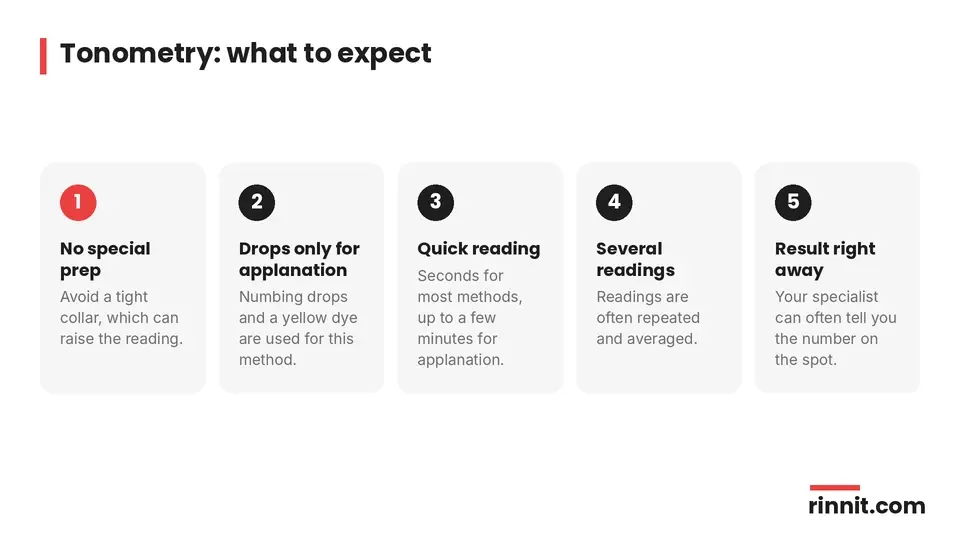
Usually, you don't need to prepare. Avoid wearing a tight collar, because pressure on your neck can raise your eye pressure reading. [1]
What happens during tonometry?
What happens depends on the type of test: [1]
Applanation: You get numbing (anesthetic) eye drops and a yellow dye called fluorescein before the tip gently touches your eye. This can take up to a few minutes.
Non-contact and most other methods: No drops are needed, and the reading takes only seconds.
Your specialist may take several readings and average them, so don't worry if you're tested more than once. They can often tell you your result right away. [1]
Does tonometry hurt?
It shouldn't, even with methods that touch your eye. The air puff or a handheld device may feel a little uncomfortable. Tell your specialist if you feel any pain. [1]
What should you do after the test?
If you had numbing drops, avoid touching or rubbing your eyes until the numbness wears off, because you might not notice an injury. Many people can drive afterward. But tonometry is often followed by eye dilation during a routine exam, which can cause light sensitivity and blurry close-up vision for several hours. Disposable sunglasses can help, and it's wise to arrange a ride if you're unsure. [1]
What do tonometry results mean?
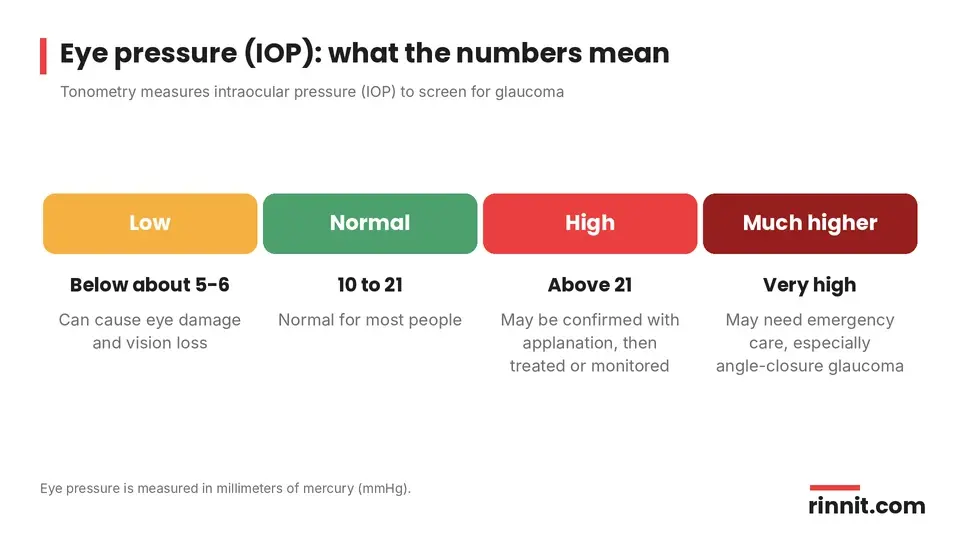
Eye pressure (mmHg) | What it may mean |
Below about 5 or 6 | Low pressure that can cause eye damage and vision loss; treatment and follow-up are typical |
10 to 21 | Normal for most people |
Above 21 | High pressure; your specialist may confirm it with applanation and recommend treatment, close monitoring or regular follow-up |
Much higher | May need emergency care, especially with angle-closure glaucoma |
Sources: [1]
If a simpler test shows high pressure, your specialist may confirm it with applanation tonometry. Depending on the result, you may need treatment, close monitoring or regular checkups, and you may be asked to test your pressure at home. [1]
When should you seek care?
High eye pressure from angle-closure glaucoma is a medical emergency that needs immediate treatment. If you test your eye pressure at home, ask your specialist what to do when a reading falls outside the normal range. [1]
Questions to ask your eye care specialist
What was my eye pressure, and is it normal for me?
Which type of tonometry did you use?
Do I need a repeat or confirmation test?
How often should my eye pressure be checked?
Would home eye pressure testing help me?
Can I drive after today's exam?
Conclusion
Tonometry is a fast, painless way to measure the pressure inside your eye, and it's one of the most important tests for catching glaucoma early. Normal pressure for most people is 10 to 21 mmHg, and readings outside that range may need confirmation, treatment or closer follow-up.
High eye pressure can often be found long before it causes symptoms or permanent damage, so regular checks with your eye care specialist help protect your sight.
Keep learning: Read our guides to glaucoma tests, the eye exam, glaucoma and ocular hypertension. For more on eye pressure, see the National Eye Institute's glaucoma page.
FAQ
What is tonometry?
Tonometry is an eye test that measures the pressure inside your eye, mainly to screen for and diagnose glaucoma. [1]
What is normal eye pressure?
For most people, normal eye pressure is 10 to 21 mmHg. [1]
Does tonometry hurt?
No. Some methods touch the eye, but none should hurt, though an air puff may feel a little uncomfortable. [1]
What is the most accurate type of tonometry?
Applanation tonometry is the most accurate and is often used to confirm unusual readings from other methods. [1]
What is the air puff eye test?
It's non-contact tonometry: a puff of air is aimed at your cornea, and the device measures how its shape changes. [1]
Do I need eye drops for tonometry?
Only for applanation tonometry, which uses numbing drops and a fluorescein dye; most other methods need no drops. [1]
How long does tonometry take?
Fast methods take seconds, and applanation can take up to a few minutes. [1]
Can I check my eye pressure at home?
Some rebound tonometers can be prescribed for home use; ask your specialist what to do if readings fall outside the normal range. [1]
Is low eye pressure a problem?
Yes. Pressure below about 5 or 6 mmHg can cause eye damage and vision loss. [1]
Can I drive after tonometry?
Many people can, but dilation during the same exam can blur near vision for several hours, so arrange a ride if you're unsure. [1]
Related Reading
Learn more in our guide to Glaucoma: The Silent Threat to Vision, and How Early Treatment Can Protect Your Sight.
Learn more in our guide to What Is Open-Angle Glaucoma? Symptoms, Causes, and Treatment.
Learn more in our guide to Angle-Closure Glaucoma: An Eye Emergency Caused by Blocked Fluid Drainage.
Learn more in our guide to What Is Ocular Hypertension? Symptoms, Causes, and Treatments.
Learn more in our guide to What Is Congenital Glaucoma? The Eye Pressure Disorder Babies Are Born With — Explained.
Gonioscopy: What It Is, What to Expect and What Open or Closed Angles Mean explains the lens exam that shows whether the eye's drainage angle is open or closed.
References
Cleveland Clinic. Tonometry: What Is It, Types, Test Procedure & Results. Cleveland Clinic. Last updated September 10, 2024. https://my.clevelandclinic.org/health/diagnostics/22859-tonometry
Cook JA, Botello AP, Elders A, et al. Systematic review of the agreement of tonometers with Goldmann applanation tonometry. Ophthalmology. 2012;119(8):1552-1557. PMID 22578443. https://doi.org/10.1016/j.ophtha.2012.02.030
Rödter TH, Knippschild S, Baulig C, et al. Meta-analysis of the concordance of IcarePRO-based rebound and Goldmann applanation tonometry in glaucoma patients. Eur J Ophthalmol. 2020;30(2):245-252. PMID 31466475. https://doi.org/10.1177/1120672119866067
Kass MA, Heuer DK, Higginbotham EJ, et al. Assessment of Cumulative Incidence and Severity of Primary Open-Angle Glaucoma Among Participants in the Ocular Hypertension Treatment Study After 20 Years of Follow-up. JAMA Ophthalmol. 2021;139(5):558-566. PMID 33856434. https://doi.org/10.1001/jamaophthalmol.2021.0341
Medical disclaimer
This article is for general education only and does not replace advice from a qualified healthcare professional. Talk to your doctor about your own diagnosis and treatment, and seek emergency care right away for severe or sudden symptoms.



Comments