Angle-Closure Glaucoma: An Eye Emergency Caused by Blocked Fluid Drainage

Updated: 2 days ago
Medically reviewed by Dr. Baraa Alnahhal, MD · Last reviewed: September 2026
Angle-closure glaucoma happens when the iris presses against the lens and blocks fluid drainage in the eye, causing pressure to build up. The acute form arrives suddenly with severe eye pain, red eye, and nausea, and it is a medical emergency that can cause permanent vision damage very quickly. About 1 in 1,000 people develop it, most often after age 40. There is no cure, but treatments including laser iridotomy control the condition effectively when applied promptly.
Quick Answer
What it is: A form of glaucoma where the iris and lens press together, blocking drainage of aqueous humor and raising intraocular pressure (IOP).
How common: About 1 in 1,000 people develop angle-closure glaucoma, most likely after age 40; roughly 17.14 million people over 40 worldwide have primary angle-closure glaucoma, with 12.3 million of them in Asia.
Emergency signs: Severe eye pain, red eye, vision loss, halos around lights, headache, nausea and vomiting — seek emergency care immediately, as permanent vision damage can happen very quickly.
Treatment: No cure exists, but eye drops, oral medication, and laser iridotomy (a hole made in the iris to restore fluid flow) control the condition; with treatment, the outlook should be good.
What Is Angle-Closure Glaucoma?
Angle-closure glaucoma is an emergency condition that happens when trapped fluid inside the eye causes pressure to build up. It is one of the two main types of glaucoma, a group of conditions defined by high pressure within the eye. That pressure is called intraocular pressure (IOP).
The condition also goes by two other names: closed-angle glaucoma and narrow-angle glaucoma. All three terms describe the same blocked-drainage problem.
Term | Meaning |
Glaucoma | A condition defined by high pressure within the eye |
Intraocular pressure (IOP) | The name for the pressure inside the eye |
Aqueous humor | The fluid inside the eye that must flow in and out freely |
Angle-closure glaucoma | When the iris blocks the eye's drainage system, raising IOP |

Why Does Eye Pressure Rise?
The body constantly makes new fluid inside the eye to replace the existing fluid. Angle-closure glaucoma happens because this aqueous humor can't flow in and out as it normally should.
When the old fluid can't leave the eye, it backs up and causes pressure. That pressure damages the optic nerve — the same damage pathway shared by all forms of glaucoma.
In angle-closure glaucoma, the reason is that your natural lens thickens over time and pushes against your iris, blocking the drainage passages.
The chain of events follows a predictable sequence: the lens thickens over time, pushes the iris forward, closes the drainage angle, and lets intraocular pressure rise.
What Are the Types of Angle-Closure Glaucoma?
Angle-closure glaucoma comes in primary forms, which develop on their own, and a secondary form, which appears alongside another medical condition.
Type | How It Behaves |
Acute angle-closure | Comes on quickly; a medical emergency because permanent vision damage can happen very quickly; symptoms include severe eye pain, blurred vision, halos, nausea, vomiting, and red eye |
Intermittent angle-closure | The drainage system changes from open to closed; symptoms may or may not appear |
Chronic angle-closure | May cause no symptoms at the beginning; symptoms develop gradually; later may trigger an acute episode or a gradual pressure increase with possible optic nerve damage |
Secondary angle-closure | Happens along with another condition |
What Are the Symptoms of Angle-Closure Glaucoma?
The symptom pattern depends sharply on which form you have. The acute form announces itself dramatically, while the chronic form can be nearly silent at first.
Form | Symptoms |
Acute | Severe eye pain, redness, vision loss, rainbow-colored rings or halos around lights, headache, nausea and vomiting |
Chronic and non-acute | Redness, blurred vision, eye discomfort, headache or brow ache — but only when symptoms are present, which doesn't always happen |
The rainbow-colored halos detail is distinctive and worth remembering. If you suddenly see colored rings around lights alongside eye pain and nausea, treat it as urgent.

What Causes Angle-Closure Glaucoma?
The root cause is mechanical. The natural lens of the eye thickens over time and pushes against the iris, blocking the drainage passages that aqueous humor uses to leave the eye.
Secondary angle-closure glaucoma develops alongside other medical conditions that affect the eye, including uveitis (eye inflammation).
Associated Condition | What It Leads To |
Poorly managed diabetes | Proliferative diabetes-related retinopathy |
Poorly managed blood pressure or vascular diseases | Conditions like ischemic central vein occlusion |
Uveitis | Eye inflammation |
Eye injury | Membranes and scars that block drainage |
Research indicates that angle-closure glaucoma also has an association with family history and certain genes, so heredity plays a role.
Who Is at Risk of Angle-Closure Glaucoma?
Three risk factors raise the likelihood of developing angle-closure glaucoma.
Risk Factor | How It Raises Risk |
Age | Risk rises with age as IOP increases and the eye changes; most likely after age 40 |
Sex | Risk is higher for females |
Ethnicity | Risk is higher for people of Asian descent |
How Common Is Angle-Closure Glaucoma?
Angle-closure glaucoma will happen to about 1 in 1,000 people. It is most likely to happen after the age of 40.
On a global scale, one estimate puts the number of people over 40 living with primary angle-closure glaucoma at 17.14 million, with a majority — 12.3 million people — in Asia.
What Are the Complications of Angle-Closure Glaucoma?
Like other forms of glaucoma, angle-closure glaucoma can damage the optic nerve and cause permanent loss of vision.
This is the exact reason the acute form is classified as a medical emergency. The damage is not cosmetic or reversible once it happens.
How Is Angle-Closure Glaucoma Diagnosed?
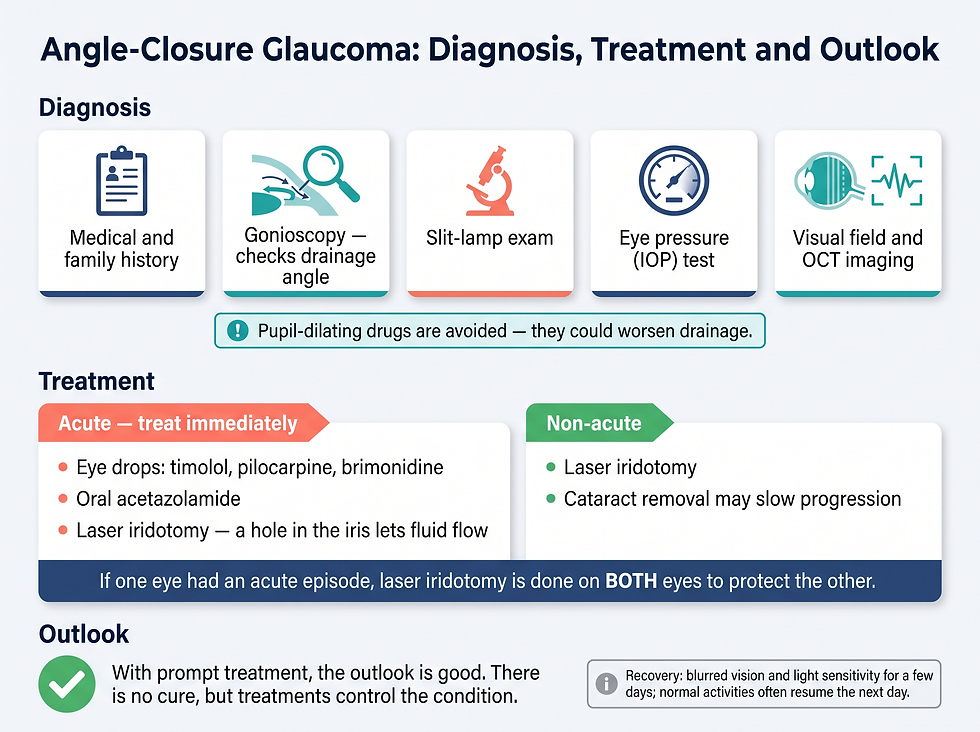
Diagnosis begins with the provider asking about symptoms and medical history, including the biological family's history. The eye care provider then gives a thorough eye exam.
Test | What It Does |
Gonioscopy | Assesses the drainage angle in the eye |
Slit-lamp exam | A special microscope that lets the provider see inside the eye |
Eye pressure (IOP) tests | Measure the pressure inside the eye |
Visual field tests | Test peripheral vision |
Optical coherence tomography or ultrasound | Imaging tests of the eye |
One important safety detail: if the provider suspects angle-closure glaucoma, they will avoid using drugs that dilate the pupils, because those medications could make drainage worse.
How Is Angle-Closure Glaucoma Treated?
There is no cure for angle-closure glaucoma, but there are effective treatments. Treatment must happen quickly in the acute form to avoid vision loss.
Treatment | Details |
Eye drops | Timolol, pilocarpine, and brimonidine eye drops |
Oral medication | Acetazolamide |
Laser iridotomy | A procedure that makes a hole in the iris to allow fluid to flow freely |
Cataract removal | May be suggested for non-acute forms; should slow the progression of chronic angle-closure glaucoma |
If you have an episode of acute angle-closure glaucoma in one eye, your provider will perform an iridotomy on both eyes. Otherwise, you remain at risk of having an episode in the other eye.
What Are the Side Effects of Treatment?
Laser iridotomy complications are generally mild and short-lived. You may experience blurred vision and sensitivity to light for a few days, along with a streak of light from the site of the laser treatment.
Most people need a driver to get home after the procedure, but normal activities can usually resume the next day.
Aspect | What to Expect |
Vision after treatment | Blurred vision for a few days |
Light sensitivity | Lasts for a few days |
Visual artifact | A streak of light from the laser treatment site |
Getting home | A driver is typically needed after the procedure |
Resuming activities | Normal activities may start the next day |
What Can I Expect If I Have Angle-Closure Glaucoma?
If you receive treatment for angle-closure glaucoma, your outlook should be good. The acute form demands immediate treatment to preserve your vision, while the non-acute forms respond well to scheduled laser and medication management.
Your provider will suggest when and how often to return for follow-up eye exams. Keeping that appointment schedule is part of the long-term plan.
Can Angle-Closure Glaucoma Be Prevented?
No, you can't prevent angle-closure glaucoma.
Screening eye exams with an eye care provider will still help. They identify whether you carry risk factors, and they can suggest preventive treatment and medications to avoid if you are at risk. If you have diabetes, managing your blood sugar is also very important.
When Should I Seek Emergency Care?
Certain events call for immediate medical help — calling your eye care provider or going to an emergency room.
Emergency Trigger | Why It Matters |
Symptoms that start suddenly, like vision loss | Signals a possible acute episode |
Severe eye pain | The hallmark symptom of acute angle-closure glaucoma |
A combination of symptoms (red eye or nausea plus eye pain) | Symptom clusters point strongly to acute angle closure |
An eye injury | Can trigger secondary angle closure |
Symptoms after any type of eye surgery | Needs immediate professional evaluation |
If you feel severe eye pain or are sick to your stomach, contact your provider or go to an emergency room. You may need immediate medical treatment to save your vision. It is best to find out what you have and how to treat it early, in any form of this condition.
Questions to Ask Your Eye Care Provider
Question | Why It Matters |
What type of glaucoma do I have? | Determines urgency: acute needs immediate care |
What treatment do you recommend? | Surfaces drops, medication, laser, or cataract surgery |
Is the type of glaucoma I have hereditary? | Relevant for family screening |
What are the side effects of treatment? | Sets recovery expectations |
What's the outlook short-term and long-term? | Frames prognosis |
Are there activities I should avoid? | Guides daily life |
How often should I schedule appointments? | Keeps follow-up on track |
Am I eligible for a clinical trial? | Opens advanced options |
Do you know of any support groups I could join? | Provides community and coping support |
Conclusion
Angle-closure glaucoma is a mechanical eye problem with urgent consequences: a thickened lens pushes the iris forward, blocks fluid drainage, and raises intraocular pressure to levels that can permanently damage the optic nerve. It affects about 1 in 1,000 people, favors women and people of Asian descent over age 40, and strikes worldwide at an estimated 17.14 million people over 40 — most of them in Asia.
Learn the six acute symptoms — severe eye pain, red eye, vision loss, halos around lights, headache, and nausea or vomiting — and treat them as an immediate emergency. Schedule regular screening eye exams after age 40, especially if you have a family history of glaucoma, and ask your eye care provider whether you are at risk before any medication that dilates your pupils is used.
FAQ
What is angle-closure glaucoma?
Angle-closure glaucoma (also called closed-angle or narrow-angle glaucoma) is when the iris and lens press together and block fluid drainage in the eye, causing intraocular pressure (IOP) to increase. It is one of the two main types of glaucoma.
How common is angle-closure glaucoma?
It affects about 1 in 1,000 people and is most likely to occur after age 40. An estimated 17.14 million people over 40 worldwide have primary angle-closure glaucoma, with 12.3 million of them in Asia.
What are the symptoms of acute angle-closure glaucoma?
Symptoms include severe eye pain, redness, vision loss, seeing rainbow-colored rings or halos around lights, headache, and nausea and vomiting. This is a medical emergency.
Is angle-closure glaucoma an emergency?
Yes. Acute angle-closure glaucoma is a medical emergency because permanent vision damage can happen very quickly. Immediate treatment is needed to preserve vision.
Who is at highest risk of angle-closure glaucoma?
Risk rises with age (especially after 40), is higher for females, and is higher for people of Asian descent. Family history and certain genes are also associated with the condition.
Is angle-closure glaucoma genetic?
Research indicates that angle-closure glaucoma has an association with family history and certain genes.
How is angle-closure glaucoma treated?
There is no cure, but treatments include timolol, pilocarpine, and brimonidine eye drops, oral acetazolamide, and laser iridotomy (a hole made in the iris to restore fluid flow). Cataract removal may slow chronic progression.
Can angle-closure glaucoma be prevented?
No, it cannot be prevented. However, screening eye exams identify risk early, and managing blood sugar is important if you have diabetes.
Why do providers avoid dilating drops in angle-closure glaucoma?
Drugs that dilate the pupils could make drainage worse if angle-closure glaucoma is suspected, so providers avoid them during examination.
Related Reading
References
Cleveland Clinic, "Angle-Closure Glaucoma," Diseases & Conditions, accessed August 2026.
American Academy of Ophthalmology, "Acute-Angle Glaucoma."
Glaucoma Research Foundation, "Types of Glaucoma."
Khazaeni B, Khazaeni L. "Acute Closed Angle Glaucoma." StatPearls [Internet]. 2023 Jan 2.
Merck Manual Professional Version, "Acute-Closure Glaucoma."
National Eye Institute (U.S.), "Types of Glaucoma."
Optometrists Network, "What is Angle Closure Glaucoma?" Updated 6/2020.
Zhang N, Wang J, Chen B, et al. "Prevalence of primary angle closure glaucoma in the last 20 years: a meta-analysis and systematic review." Front Med. 2021 Jan 18;7:624179.
Medical disclaimer: This article is for general educational purposes only and is not a substitute for professional medical advice, diagnosis, or treatment. Always seek the guidance of a qualified healthcare provider with any questions about a medical condition. Never disregard professional medical advice or delay seeking care based on information in this article. Acute angle-closure glaucoma is a medical emergency — call your eye care provider or go to an emergency room immediately if you experience severe eye pain, sudden vision changes, or nausea with eye pain.
Comments