Uveitis: Symptoms, Causes, and Treatment — What Eye Inflammation Means for Your Vision

Updated: 2 days ago
Medically reviewed by Dr. Baraa Alnahhal, MD · Last reviewed: September 2026
Editorial note: This article is for general education only and is not a substitute for professional medical advice. It was written and fact-checked from clinical sources, with prevalence data from peer-reviewed ophthalmology research. If you have significant eye pain or unexpected vision changes, seek in-person medical care today.
TL;DR
Uveitis is inflammation of the uvea, the middle layer of the eye. It causes redness, pain, light sensitivity, blurred vision, and floaters, often arriving suddenly. About half of cases have no identifiable cause. Untreated uveitis can lead to glaucoma, cataracts, retinal damage, and permanent vision loss, so same-day evaluation matters. Treatment usually involves corticosteroid drops, injections, or tablets, plus dilating drops for pain, and can take months to years.
Quick Answer
Uveitis is inflammation of the uvea, the eye's middle tissue layer, and it is one of the most treatable yet vision-threatening eye conditions. The most common form, anterior uveitis (iritis), affects roughly 40% of cases, and uveitis is linked to about 10–15% of blindness in the United States. It can strike at any age and often has no clear cause. Corticosteroids — as drops, injections, or tablets — control the swelling, and early same-day treatment is the best protection for your vision.

What Is Uveitis?
Uveitis (pronounced u-vee-I-tis) is a form of eye inflammation that affects the uvea, the middle layer of tissue in the eye wall. Inflammation in this layer produces the classic warning signs: redness, pain, blurred vision, and floaters [1].
Symptoms often arrive suddenly and worsen quickly. The condition can affect one eye or both, and it can occur at any age — even in children [1]. In U.S. adults, an estimated 121 of every 100,000 people live with noninfectious uveitis at any given time, a burden researchers now consider higher than earlier studies suggested [5].
Uveitis can be serious. Left untreated, it can cause permanent vision loss, which is why early diagnosis and treatment matter so much [1].
What Does Uveitis Feel Like?
The six warning signs of uveitis are redness, pain, light sensitivity, blurred vision, floaters, and decreased vision [1]. Floaters are dark, floating spots in your field of vision.
The pattern to know is speed. Symptoms may burst on suddenly and worsen quickly, though in some cases they develop gradually. In some people there are no symptoms at all, and the inflammation is found on a routine eye exam [1].
Warning sign | What you notice |
|---|---|
Eye redness | The white of the eye looks pink or bloodshot |
Eye pain | Aching or discomfort in or around the eye |
Light sensitivity | Bright light feels uncomfortable or painful |
Blurred vision | Details look fuzzy or out of focus |
Floaters | Dark spots drift across your field of vision |
Decreased vision | Overall vision looks dimmer or weaker |
When to seek care: contact your healthcare team promptly if you notice these warning signs. You may be referred to an ophthalmologist (eye specialist). If you have significant eye pain and unexpected vision problems, seek immediate medical attention [1].
What Are the Types of Uveitis?
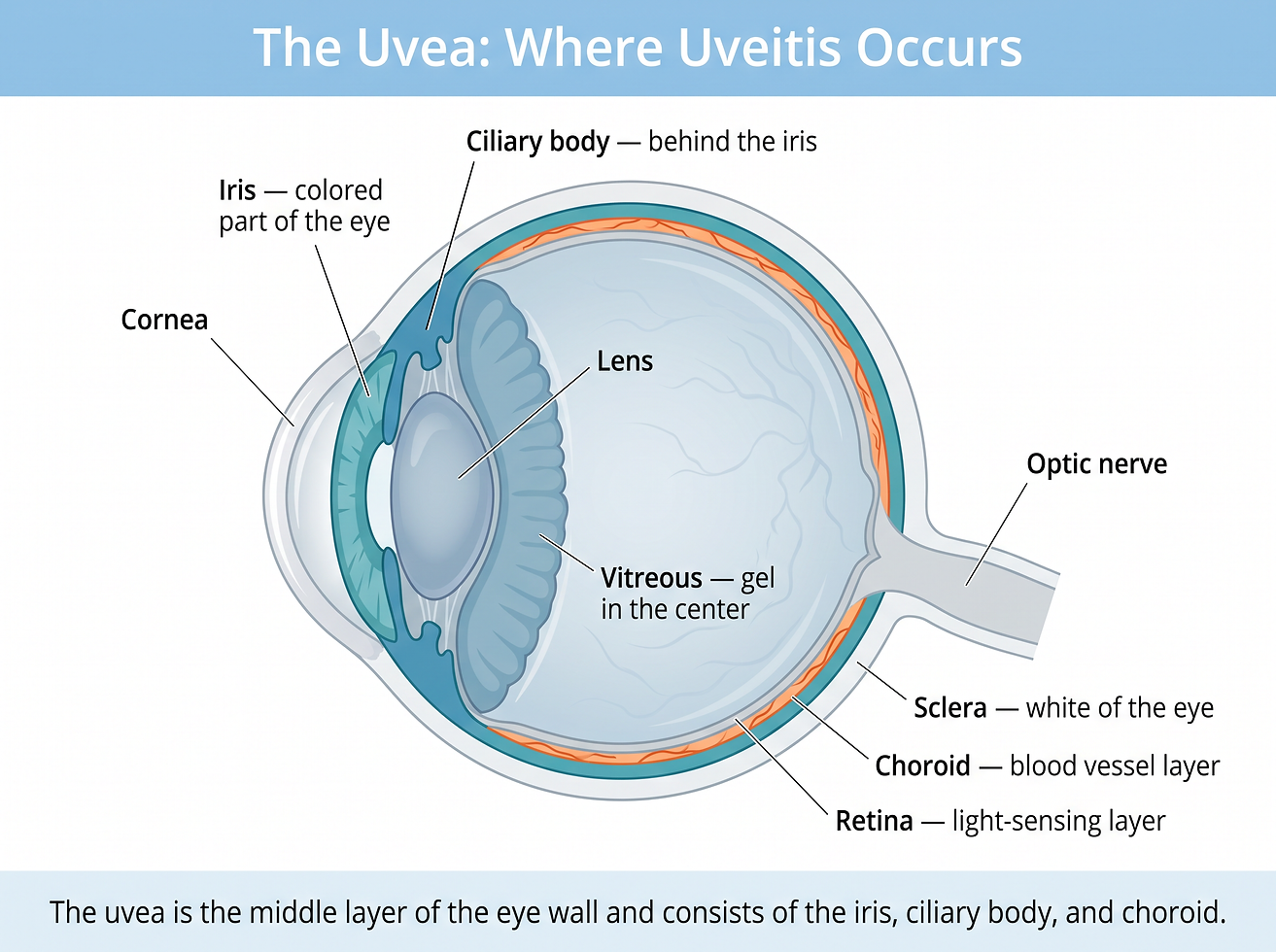
The eye has layers, and the type of uveitis depends on which part of the uvea is inflamed. The uvea has three parts: the iris (the colored part of the eye), the ciliary body (the structure behind the iris), and the choroid (the layer of blood vessels between the retina and the sclera, the white of the eye) [1].
Anterior uveitis is by far the most common form, accounting for roughly 40% of uveitis cases worldwide [7]. It is also called iritis.
Type | What is inflamed | Notes |
|---|---|---|
Anterior (iritis) | Inside front of the eye (between the cornea and iris) and the ciliary body | The most common type [1][7] |
Intermediate | Retina and blood vessels just behind the lens (pars plana), plus the vitreous gel | — |
Posterior | The retina or choroid at the inside back of the eye | — |
Panuveitis | All layers of the uvea, from front to back | — |

What Causes Uveitis?
In about half of all cases, no specific cause is ever identified, and the condition may be considered an autoimmune disease that affects only the eye or eyes [1].
When a cause can be found, it typically falls into one of these categories [1]:
Cause category | Examples |
|---|---|
Autoimmune or inflammatory disease | Sarcoidosis, systemic lupus erythematosus, Crohn's disease |
Ankylosing spondylitis | A spinal inflammatory disease where uveitis is one of the most common complications |
Infection | Cat-scratch disease, shingles, syphilis, toxoplasmosis, tuberculosis |
Medicine side effect | Drug reactions |
Eye injury or surgery | Trauma or post-surgical inflammation |
Cancer (very rare) | Eye lymphoma |
The link between uveitis and autoimmune disease is worth understanding: because uveitis often occurs without infection or injury, specialists treat it as a disorder of immune overactivity. This is why doctors may ask about arthritis, back pain, rashes, and mouth or genital sores during an exam [1][2].
Who Is at Higher Risk?
Two factors are associated with higher uveitis risk: changes in certain genes and cigarette smoking. Smoking, in particular, has been linked to uveitis that is more difficult to control [1].
Risk factor | Why it matters |
|---|---|
Genetic changes | Certain gene variants raise the likelihood of uveitis |
Cigarette smoking | Associated with uveitis that is harder to treat and control |
Autoimmune disease | Conditions like lupus, Crohn's, and sarcoidosis increase risk |
Ankylosing spondylitis | Uveitis is one of its most common complications |
Can Uveitis Cause Serious Problems?
Yes. When uveitis goes untreated, the inflammation can damage structures inside the eye. These are the recognized complications [1]:
Complication | What happens |
|---|---|
Macular edema | Swelling of the retina (the light-sensing layer) |
Retinal scarring | Scar tissue forms on the retina |
Glaucoma | Elevated eye pressure damages the optic nerve |
Cataracts | Clouding of the eye's natural lens |
Optic nerve damage | The nerve connecting eye to brain is harmed |
Retinal detachment | The retina pulls away from the back of the eye |
Permanent vision loss | Irreversible loss of sight |
The stakes are real. Uveitis accounts for an estimated 10–15% of all blindness in the United States, and roughly 30,000 new cases of legal blindness each year are connected to uveitis [8][9]. In one long-term study, about 22% of uveitis patients met the criteria for legal blindness at some point during follow-up [10]. The consistent message from ophthalmology research: cumulative damage is preventable, but only with timely treatment.
How Is Uveitis Diagnosed?
Diagnosis starts with a complete eye exam and a thorough health history, performed by an eye specialist [2].
Exam step | What it checks |
|---|---|
Vision assessment | Visual acuity and pupil response to light |
Tonometry | The pressure inside the eye (intraocular pressure); numbing drops may be used |
Slit-lamp examination | A magnifying microscope with an intense line of light reveals microscopic inflammatory cells in the front of the eye |
Ophthalmoscopy | Dilating drops widen the pupil so a bright light can examine the back of the eye |
The specialist may also order color photography of the inside of the eye, optical coherence tomography (OCT) imaging to map the retina and choroid for swelling, angiography (IV dye that photographs swollen blood vessels), fluid analysis from the eye, blood tests, and imaging such as CT or MRI [2].
Two points matter for patients. First, even if no specific cause is ever identified, uveitis can still be treated successfully. Second, finding a cause usually does not lead to a cure — treatment is still needed to control the swelling [2].
How Is Uveitis Treated?
Treatment goals are straightforward: reduce the swelling in your eye, and in other parts of the body if present. If an underlying condition is the cause, treatment may focus on that condition. Unless the cause is infectious, treatment is usually the same regardless of the cause — and it may be necessary for months to years [2].
Treatment | How it is delivered | When it is used |
|---|---|---|
Corticosteroid eye drops | Dropped into the eye | First-line for front-of-eye inflammation |
Corticosteroid injection | Into or around the eye | When drops are not enough |
Oral corticosteroid tablets | Taken by mouth | For inflammation beyond the front of the eye |
Dilating eye drops | Dropped into the eye | Control iris and ciliary body spasms, relieve pain |
Antibiotics or antivirals | By mouth, drops, or injection | When an infection is the cause |
Immunosuppressive medicines | By mouth or injection | Both eyes affected, poor steroid response, or vision threatened |
Medicine-releasing implant | Surgically implanted in the eye | Hard-to-treat posterior uveitis; releases corticosteroid for months to years |

Side effects to watch for. Some uveitis medicines can cause eye-related side effects such as glaucoma and cataracts. Oral or injected medicines can affect other parts of the body. Frequent follow-up exams and blood tests are often part of the plan [2]. The implant carries specific risks: it usually causes cataracts in people who have not had cataract surgery, and up to 30% of patients need treatment or monitoring for raised eye pressure or glaucoma [2].
Recovery speed depends on the type. Uveitis at the back of the eye — posterior uveitis or panuveitis, including retinitis or choroiditis — heals more slowly than inflammation in the front of the eye (anterior uveitis or iritis) [2].
Uveitis can come back. If any symptoms reappear or worsen, make an appointment with a healthcare professional [2].
What Should I Ask at My Appointment?
If symptoms prompt a visit to your primary care team, you may be referred to an ophthalmologist. Coming prepared helps: list your symptoms, key personal information (major illnesses, traumas, life changes), and every medicine, vitamin, or supplement you take. Bring someone who can drive you, especially if vision is affected [2].
Questions to ask | What the doctor may ask you |
|---|---|
What's the most likely cause? | When did symptoms begin? |
What tests do I need? | Continuous or occasional symptoms? |
Is uveitis temporary or long lasting? | How severe, and is it worsening? |
Will I lose my sight? | Prior uveitis? Other medical problems? |
What treatments do you recommend? | Do you have arthritis or back problems? |
What side effects can I expect? | Recent rashes, mouth or genital sores, infections? |
How can I prevent another episode? | Anything that improves or worsens symptoms? |
Conclusion and Next Steps
Uveitis is eye inflammation with real stakes — it is a leading preventable cause of blindness in the United States — but it is also one of the more responsive conditions in ophthalmology when caught early. The pattern is simple: sudden redness, pain, light sensitivity, blurred vision, or floaters, especially with fast worsening, means same-day evaluation.
Your next steps: if you have these symptoms, seek medical attention today and ask for an ophthalmology referral. Finish every prescribed course of treatment, keep follow-up appointments with eye-pressure and vision checks, and report any symptom return immediately — uveitis recurs, and each recurrence is a window to prevent cumulative damage. If you smoke, quitting is one of the few proven ways to make uveitis easier to control.
Frequently Asked Questions
What are the first signs of uveitis? The earliest signs are usually eye redness, eye pain, and light sensitivity, followed by blurred vision, floaters (dark floating spots), and decreased vision. Symptoms often come on suddenly and worsen quickly, though sometimes they develop gradually or cause no symptoms at all [1].
Is uveitis serious or dangerous? It can be. Untreated uveitis can cause macular edema, retinal scarring, glaucoma, cataracts, optic nerve damage, retinal detachment, and permanent vision loss. It accounts for an estimated 10–15% of blindness in the United States [1][8].
Can uveitis cause blindness? Yes, which is why prompt treatment matters. Research suggests uveitis is connected to roughly 30,000 new cases of legal blindness in the U.S. each year, and about 22% of patients in one long-term study met legal-blindness criteria at some point [8][10].
What's the difference between uveitis and iritis? Iritis is a type of uveitis. It is the name for anterior uveitis, inflammation of the front of the eye, and it is the most common form — roughly 40% of cases [1][7].
What causes uveitis? In about half of cases, no specific cause is found, and it is considered an autoimmune process affecting the eye. Known causes include autoimmune and inflammatory diseases (sarcoidosis, lupus, Crohn's disease, ankylosing spondylitis), infections (shingles, syphilis, tuberculosis, toxoplasmosis, cat-scratch disease), medicine side effects, and eye injury or surgery [1].
How long does uveitis treatment take? Treatment often runs for months to years. Recovery also depends on the type: back-of-eye inflammation (posterior uveitis and panuveitis) heals more slowly than front-of-eye inflammation (anterior uveitis) [2].
Does uveitis go away on its own? It should not be left to run its course. Some of the inflammation may settle, but without treatment the condition can cause lasting structural damage. Even when no cause is identified, uveitis can still be treated successfully [2].
Is uveitis related to autoimmune disease? Yes. Because about half of cases have no identifiable trigger, uveitis is often treated as an autoimmune disease of the eye. It is also a common complication of autoimmune and inflammatory conditions such as ankylosing spondylitis, sarcoidosis, lupus, and Crohn's disease [1].
References
1. Mayo Clinic — Uveitis: Symptoms and causes
2. Mayo Clinic — Uveitis: Diagnosis and treatment
3. National Eye Institute — Uveitis
4. Yanoff M, et al. — General approach to the uveitis patient and treatment strategies (Ophthalmology, 5th ed., Elsevier, 2019)
5. Gritz DC, Wong IG. — Prevalence of Noninfectious Uveitis in the United States: A Claims-Based Analysis (JAMA Ophthalmology, 2016)
6. TriNetX uveitis burden analysis via Ophthalmology Advisor (2024)
7. The Global Epidemiology of Uveitis: More Pieces of the Puzzle (Ocular Immunology and Inflammation, 2025)
8. American Academy of Ophthalmology — Preventable Blindness: Avoiding Cumulative Damage in Uveitis
9. Retina Today — Uveitis Crash Course
10. Rothova A, et al. — Degree, duration, and causes of visual loss in uveitis (British Journal of Ophthalmology)
11. Vision Loss in Uveitis (Ocular Immunology and Inflammation, 2022)
12. StatPearls — Uveitis (National Library of Medicine)
Comments