Toe Joint Replacement: Surgery, Recovery, and Risks

Updated: 6 days ago
Written and medically reviewed by Dr. Baraa Alnahhal, MD · Last reviewed: October 2026 · How we review
Quick Answer: What is toe joint replacement?
Toe joint replacement is surgery that removes a damaged toe joint, most often the big toe joint, and replaces it with an artificial joint made of metal, ceramic, or plastic. Surgeons consider it when arthritis, hallux rigidus, or injury causes lasting pain despite nonsurgical care. It aims to relieve pain while keeping the toe movable. [1][3]
What the research says
Fusion gave more pain relief and fewer revisions in pooled data. A systematic review of 33 studies (741 fusions and 555 total joint replacements) found revision surgery in 3.9% of fusions vs 11% of total joint replacements, and a larger drop in pain scores after fusion (6.56 vs 4.65 points). (Stevens et al., JBJS Reviews, 2017) [5]
Satisfaction was similar when the two surgeries were compared directly. A meta-analysis of 7 comparative studies found no significant difference between implant replacement and fusion in function scores, patient satisfaction, reoperation rate, or complication rate, although pain was lower after fusion. (Park et al., J Foot Ankle Surg, 2019) [6]
Replacement keeps the toe moving. A meta-analysis found big toe range of motion improved by 43.0° after partial (hemi) replacement and by 32.5° after total replacement. (Stibolt et al., Foot Ankle Spec, 2019) [7]
Key takeaways
Toe joint replacement swaps a damaged toe joint for an implant; the big toe joint is the one replaced most often. [1]
Surgeons offer it only after shoes, braces, medicines, physical therapy, and injections have not helped. [1]
The main alternative is joint fusion, which stops the joint moving; replacement keeps it moving. [1]
Surgery takes about two to three hours, and full weight on the toe can take up to eight weeks. [1]
Fever, pus, spreading redness, or worsening pain after surgery need a prompt call to your surgeon. [1]
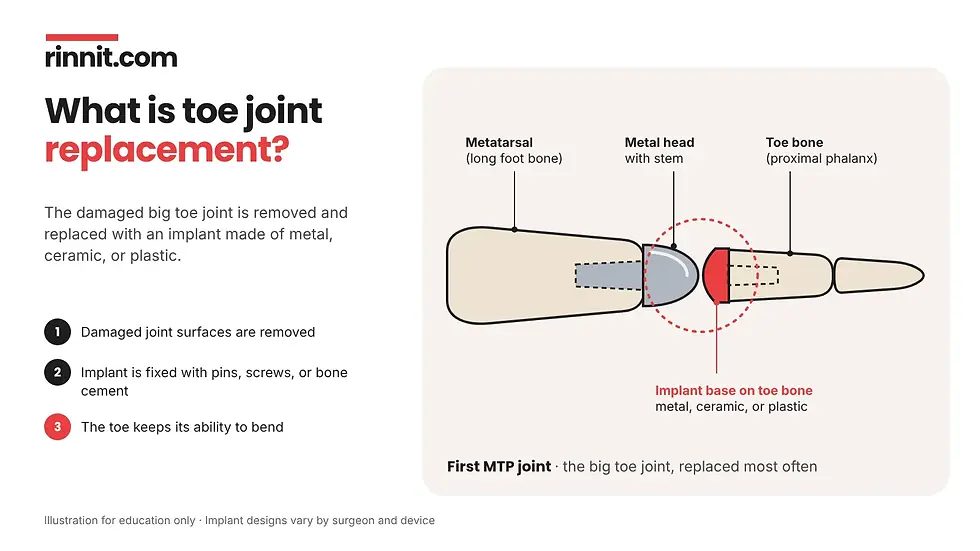
Image: rinnit.com
What is toe joint replacement?
Toe joint replacement (toe arthroplasty) is an operation that removes a worn or damaged toe joint and puts an artificial joint, called a prosthesis, in its place. [1]
The joint replaced most often is the big toe joint. Doctors call it the first metatarsophalangeal (MTP) joint, where the big toe meets the foot. [1][3]
This joint bends every time you take a step. When it is damaged or stiff, walking can become painful. [1]
Toe replacement is far less common than hip, knee, or shoulder replacement. [1]
Term you may hear | What it means |
Toe arthroplasty | Another name for toe joint replacement |
Prosthesis / implant | The artificial joint, made of metal, ceramic, or plastic |
First MTP joint | The big toe joint, at the base of the big toe |
Hallux / great toe / first toe | Other names for the big toe |
Arthrodesis | Joint fusion, the main surgical alternative |
Which conditions lead to toe joint replacement?
Toe joint replacement is used for conditions that damage the toe joint and cause lasting pain, stiffness, or swelling. [1]
Condition | What happens to the joint |
Hallux rigidus ("stiff big toe") | Arthritis that stiffens the joint at the base of the big toe [2] |
Osteoarthritis | Wear of the cartilage that cushions the joint |
The immune system attacks the joint lining | |
Bunions (hallux valgus) | The big toe joint drifts out of line |
Injury, such as a broken toe | Damage to the bone or joint surface |
Osteonecrosis | Bone dies from too little blood supply |
Hallux rigidus is the most common arthritic condition in the foot. [2] It affects about 2.5% of people over age 50. [4] If your pain started with an earlier stage of stiffness, read our guide to hallux limitus.
When is toe joint replacement recommended?
Toe joint replacement is recommended only when nonsurgical treatments have not controlled the pain. [1][2][4]
Treatments usually tried first include:
Special shoes or a brace
Changing or limiting painful activities
Pain medicines
Physical therapy
Steroid injections into the joint
The goals of surgery are to relieve pain, reduce stiffness and swelling, restore function, and improve how far the toe can bend. [1]
Not everyone is a good fit. Few people are candidates for a total toe joint replacement, and results vary from person to person. [1] The right choice depends on the state of the joint, your goals, and your surgeon's experience with the technique. [4]
How is toe joint replacement different from joint fusion?
Toe joint replacement keeps the joint moving, while joint fusion (arthrodesis) permanently joins the bones so the joint can no longer bend. [1]
Fusion makes the joint stable and reduces pain. It has long been the standard surgery for advanced hallux rigidus. [4]
Feature | Toe joint replacement | Joint fusion (arthrodesis) |
What the surgeon does | Removes the joint and inserts an implant | Joins the two bones into one solid piece |
Toe movement afterward | Kept | Lost at that joint |
Pain relief in studies | ||
Revision surgery (pooled data) | 11% after total replacement [5] | 3.9% [5] |
Patient satisfaction | Similar to fusion in comparative studies [6] | Similar to replacement in comparative studies [6] |
Who it may suit | People who want to keep the joint moving | People who want the most reliable pain relief |

Image: rinnit.com
How do you prepare for toe joint replacement?
Preparing for toe joint replacement starts with a full check by an experienced orthopaedic surgeon, ideally one who specializes in foot surgery. [1]
Your surgeon will usually:
Review your general health and other medical conditions
Ask how long you have had toe pain and how it affects daily life
Test the strength and range of motion of your toe
Order X-rays of your foot
Arrange tests, such as blood work, to confirm you are fit for surgery
It helps to write down your questions before the visit. Ask whether replacement or fusion fits your joint and your activity goals.
What happens during toe joint replacement surgery?
Toe joint replacement surgery takes about two to three hours and is done in a hospital or an outpatient surgery center. [1]
The main steps are: [1]
You receive anesthesia through an IV line in your arm.
The surgeon makes a cut on the top of the toe.
The damaged joint, cartilage, and bone are removed.
The implant is inserted.
The implant is fixed to the bones on each side with pins, screws, or bone cement.
The team checks that the implant is secure and tests how the joint moves.
Tendons and nerves are checked to make sure they are back in place.
The cut is closed, usually with stitches.
The foot is wrapped in sterile bandages and then a cast.
What happens right after toe joint replacement?
Right after toe joint replacement, you wake up in a recovery room with your foot wrapped, sometimes in a cast or boot. [1]
Staff watch for side effects of anesthesia and any complications. You stay until you can walk safely with a walker, cane, or crutches. [1]
Before you go home, your team may ask you to: [1]
Ice your toe
Keep your foot raised as much as possible
Return to have your stitches removed
Wear hard-soled shoes as often as possible
How long is recovery after toe joint replacement?
Recovery after toe joint replacement involves walking soon after surgery, and putting full weight on the toe can take up to eight weeks. [1]
Walking may hurt at first, but it should become less painful over time. Exercise is a key part of recovery, and your surgeon may recommend physical therapy. [1]
Recovery stage | What to expect |
Surgery day | About two to three hours in surgery; foot bandaged, then a cast or boot [1] |
Before going home | Walking safely with a walker, cane, or crutches [1] |
First days at home | Ice, raise the foot, wear hard-soled shoes [1] |
Follow-up visit | Stitches removed [1] |
Up to 8 weeks | Full weight on the toe [1] |

Image: rinnit.com
How can you make your home safe during recovery?
You can make your home safer during toe joint replacement recovery by planning help and removing fall risks before surgery. [1]
Arrange for someone to help at home
Remove throw rugs, cords, and other tripping hazards
Use a cane, walker, or crutches to keep weight off the toe
Add a shower bench and handrails where needed
What are the benefits and risks of toe joint replacement?
Toe joint replacement can relieve pain and improve how the toe moves, and serious complications are rare. [1]
Possible benefits | Possible risks (rare) |
Pain relief | |
Better range of motion | Infection of the wound, joint, or implant |
Better toe and foot function | Implant breaking, loosening, or dislocating |
Less stiffness and swelling | Nerve injury |
Research adds useful context. Pooled data show implant loosening is the most common complication after total toe replacement, while pain and failure of the bones to join are most common after fusion. [5]
When should you call a doctor after toe joint replacement?
You should call your doctor after toe joint replacement if you notice signs of infection or signs that the implant may be failing. [1]
Warning sign group | What to watch for |
Infection | Fever or chills; pain that persists or gets worse; pus or a bad smell from the cut; redness or swelling around the cut |
Implant problem (can appear months or years later) | Weaker or reduced joint function; the toe feels unstable or like it may give way; pain; stiffness; swelling |
Conclusion
Toe joint replacement is a joint-saving option for people whose big toe pain from arthritis, hallux rigidus, or injury has not improved with nonsurgical care. It keeps the toe moving, while fusion tends to give stronger pain relief with fewer repeat surgeries. Recovery means early walking, careful home setup, and up to eight weeks before full weight on the toe.
If big toe pain is limiting your walking, bring this guide to your orthopaedic foot surgeon and ask whether replacement or fusion fits your joint and your goals. For more foot health guides, explore our articles on foot and ankle arthritis and hallux rigidus, and follow Rinnit on Instagram for weekly health explainers.
FAQ
Is toe joint replacement a common surgery?
Toe joint replacement is much less common than hip, knee, or shoulder replacement. The big toe joint is the toe joint replaced most often.
How long does toe joint replacement surgery take?
Toe joint replacement surgery takes about two to three hours. It is done in a hospital or an outpatient surgery center, and you go home once you can walk safely with a walker, cane, or crutches.
How long until I can put full weight on my toe after replacement?
Full weight-bearing on the toe can take up to eight weeks after toe joint replacement. Walking starts soon after surgery and usually becomes less painful over time.
Is toe joint replacement better than toe joint fusion?
Toe joint replacement keeps the joint moving, while fusion stops it moving but tends to give greater pain relief. In pooled studies, revision surgery was needed after 11% of total replacements and 3.9% of fusions, but patient satisfaction was similar.
What are the risks of toe joint replacement?
Toe joint replacement risks are rare and include blood clots, infection, implant breaking, loosening, or dislocating, and nerve injury. Signs of implant failure can appear long after surgery.
What are signs of infection after toe joint replacement?
Signs of infection after toe joint replacement include fever or chills, pain that persists or worsens, pus or a bad smell from the cut, and redness or swelling around the cut. Call your surgeon promptly if you notice any of these.
Who is a good candidate for toe joint replacement?
A good candidate for toe joint replacement has lasting toe pain that has not improved with shoes, braces, medicines, physical therapy, or injections. Few people are candidates for a total toe replacement, so an orthopaedic foot surgeon decides after an exam and X-rays.
What kind of doctor does toe joint replacement?
Toe joint replacement is done by an orthopaedic surgeon, ideally one who specializes in foot surgery. Experience with the technique matters when choosing between replacement and fusion.
How long does a toe joint replacement last?
Many toe implants last for years, but they can loosen or wear out over time. If that happens, another surgery, often a joint fusion, may be needed.
Will I need a special shoe after toe joint replacement?
Yes. Most people wear a stiff-soled surgical shoe or boot for several weeks to protect the toe while it heals. Your surgeon will tell you when you can switch back to regular shoes.
Related Reading
Hallux Rigidus (Big Toe Arthritis) explains big toe arthritis, a common reason for joint replacement.
Cheilectomy: Surgery, Recovery, and Risks describes removing bone spurs from the big toe joint.
Arthrodesis (Joint Fusion): Procedure, Recovery, and Long-Term Benefits covers joint fusion, the main alternative to toe joint replacement.
Bunion Surgery (Bunionectomy): Types, Procedure, Recovery and Risks explains surgery to correct a bunion at the base of the big toe.
References
Cleveland Clinic. Toe Joint Replacement: Procedure Details & Recovery. Cleveland Clinic. Last updated April 6, 2023. https://my.clevelandclinic.org/health/treatments/24891-toe-joint-replacement
American Academy of Orthopaedic Surgeons. Hallux Rigidus (Stiff Big Toe). OrthoInfo. Accessed October 31, 2026. https://www.orthoinfo.org/diseases--conditions/stiff-big-toe-hallux-rigidus/
American Orthopaedic Foot & Ankle Society. What is a First MTP Joint Replacement? FootCareMD. Accessed October 31, 2026. https://www.footcaremd.org/conditions-treatments/toes/first-mtp-joint-replacement
Lam A, Chan JJ, Surace MF, et al. Hallux rigidus: How do I approach it? World J Orthop. 2017;8(5):364-371. PMID 28567339. https://doi.org/10.5312/wjo.v8.i5.364
Stevens J, de Bot RTAL, Hermus JPS, et al. Clinical Outcome Following Total Joint Replacement and Arthrodesis for Hallux Rigidus: A Systematic Review. JBJS Rev. 2017;5(11):e2. PMID 29135720. https://doi.org/10.2106/JBJS.RVW.17.00032
Park YH, Jung JH, Kang SH, et al. Implant Arthroplasty versus Arthrodesis for the Treatment of Advanced Hallux Rigidus: A Meta-analysis of Comparative Studies. J Foot Ankle Surg. 2019;58(1):137-143. PMID 30583775. https://doi.org/10.1053/j.jfas.2018.08.045
Stibolt RD, Patel HA, Lehtonen EJ, et al. Hemiarthroplasty Versus Total Joint Arthroplasty for Hallux Rigidus: A Systematic Review and Meta-analysis. Foot Ankle Spec. 2019;12(2):181-193. PMID 30132693. https://doi.org/10.1177/1938640018791017
Medical disclaimer
This article is for general education and does not replace advice from your own doctor. Talk with a qualified orthopaedic surgeon about your symptoms and treatment options before making decisions about surgery.



Comments