Hallux Rigidus (Big Toe Arthritis)

Updated: 3 days ago
Medically reviewed by Dr. Baraa Alnahhal, MD · Last reviewed: October 2026
Quick Answer
Hallux rigidus is the medical term for arthritis of the big toe, a type of osteoarthritis caused by gradual wear and tear of the joint where the big toe meets the foot [1]. The name means stiff big toe, its main symptom [1]. Around 1 in 40 adults over 50 have it, and it is the most common type of foot arthritis [1].
Key takeaways
Joint affected: The metatarsophalangeal (MTP) joint of the big toe [1].
Core symptom: Stiffness and a reduced range of motion in the big toe [1].
Main cause: Gradual wear and tear of the joint cartilage [1].
More common in: Adults over 50, females, athletes, and people on their feet all day [1].
Diagnosis: A physical exam and foot X-rays [1].
Primary treatment: Shoes with room for the toes and stiff soles, supportive pads, and anti-inflammatory medicine. Surgery is needed only for some people [1].
What the research says
X-ray changes are common, but fewer people have symptoms. In a Japanese study of 604 adults aged 50 and older (mean age 67.1), 26.7% (161 people) had radiographic hallux rigidus, but only 8.1% overall had symptoms. Knee osteoarthritis (odds ratio 1.73), hallux valgus or bunion (3.98), and a history of gout attacks (3.86) were independently linked to hallux rigidus, and knee osteoarthritis was associated with more severe disease (Senga et al., BMC Musculoskelet Disord, 2021) [2].
Spacer surgery improves function, but complications are not rare. A systematic review of 16 studies with 428 patients who had interpositional arthroplasty for advanced hallux rigidus found that the average foot score (AOFAS-HMI) improved from 51.6 before surgery to 86.0 afterward, and total toe motion improved from 39.3 degrees to 61.5 degrees. The complication rate was 21.5%, with metatarsalgia the most common, and the evidence was low in level and quality (Butler et al., J Foot Ankle Surg, 2022) [3].
Newer implants have not clearly beaten established surgery. A review of 18 studies, including 1,349 patients treated with a polyvinyl alcohol hydrogel implant, found complication rates of 27.9% for the implant, 11.8% for cheilectomy, and 24.1% for fusion, with failure rates of 14.8%, 0.3%, and 9.0%. All three approaches produced comparable improvements in patient-reported outcomes (Butler et al., Eur J Orthop Surg Traumatol, 2024) [4].
Understanding the Causes

Hallux rigidus usually develops gradually as the cartilage that cushions the MTP joint thins and breaks down [1]. This joint is under constant stress: every step you take places a force equal to about twice your body weight on it [1]. Over time, that mechanical stress can lead to the "bone-on-bone" friction typical of osteoarthritis.
Most cases develop naturally with age and have no single obvious cause [1], but other contributors include:
Overuse: Repeated stress on the joint from sports, hobbies, or jobs that keep you on your feet [1].
Injury: Stubbing the toe or a sprain such as turf toe can damage the joint [1].
Foot anatomy: Longer-than-usual bones in the feet and toes can place extra strain on the big toe joint [1].
Underlying conditions: Rheumatoid arthritis, gout, autoimmune disorders that cause inflammation, and osteochondritis dissecans can raise the risk [1].
Recognizing the Signs
Stiffness: The toe becomes harder to bend [1], which can change how you walk.
Pain: Usually felt on top of the toe joint, though it can feel deeper inside the toe. It can get worse with standing or moving, in cold, damp weather, and in shoes that are too tight [1].
Swelling: Inflammation around the MTP joint is common [1], especially during flare-ups.
Bone spur: A hard bump on top of the joint, resembling a bunion or callus [1], can rub against shoes and cause more discomfort.

Stages of Hallux Rigidus
Providers may grade hallux rigidus from 0 to 4 based on how much movement the toe has lost compared with the other big toe [1]:
Grade 0: 10% to 20% less movement.
Grade 1: 20% to 50% less movement.
Grade 2: 50% to 75% less movement.
Grade 3: 75% to 100% less movement.
Grade 4: 75% to 100% less movement along with more severe pain when moving the toe.
Management and Treatment Strategies
The goals of treatment are to reduce pain and inflammation [1] and to keep as much joint movement as possible.
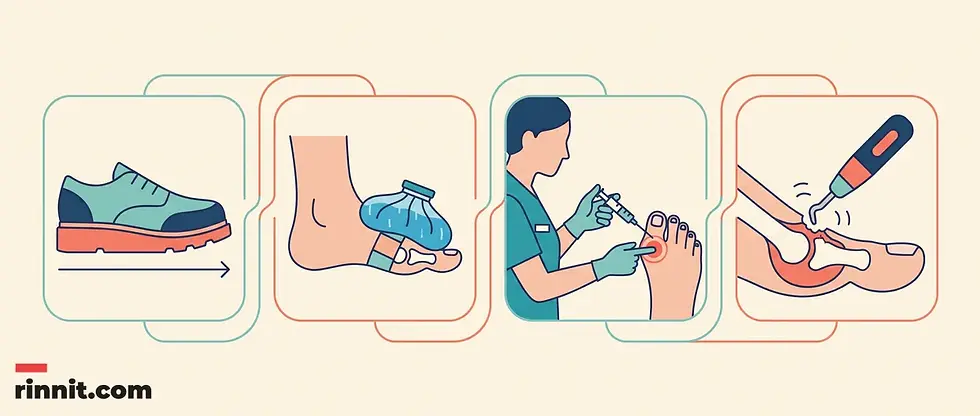
Nonsurgical Treatments
Most people manage hallux rigidus without surgery [1]:
Footwear changes: Wear shoes with plenty of room for the toes and a stiff sole to relieve pressure on the joint [1]. Avoid high heels and shoes with a small toe box [1].
Limiting toe movement: Over-the-counter pads or inserts can support the big toe and limit painful motion [1]. You may need to avoid activities that stress the joint, such as running or sports [1].
Pain relievers: Over-the-counter NSAIDs can ease pain and swelling. Don't take them for more than 10 days in a row without talking to your provider [1].
Icing: Cold packs wrapped in a thin towel can relieve symptoms [1].
Contrast soaks: Switching between hot and cold water, about 30 seconds each [1], may help relieve inflammation.
Corticosteroid injections: Cortisone shots into the big toe joint [1] may be used for inflammation that doesn't improve with other treatments.
Surgical Options
A provider may suggest surgery if other treatments don't relieve your symptoms or if the condition makes daily activities hard or impossible [1]:
Cheilectomy: Shaving down bone spurs to give the toe more room to bend and to relieve pain [1].
Osteotomy: Cutting the toe bones to realign or shorten the big toe [1].
Arthroplasty: Joint replacement in which the damaged bone is removed and a "spacer" of donor tissue is placed between the joint ends [1].
Arthrodesis (fusion): Joining the bones of the joint permanently. This offers a lasting solution but may restrict how much the big toe can move [1].
Complications are rare but can include infection, joint stiffness, worsening arthritis, a misshapen toe returning, and long-term swelling [1].
Recovery and Long-Term Outlook
Recovery depends on the treatment. Switching shoes and using toe pads may be all you need, and you can usually return to your routine as soon as your provider says it is safe. After surgery:
Cheilectomy and arthroplasty: A special shoe for about two weeks before returning to regular footwear. Swelling may last a few months [1].
Osteotomy: Swelling should go down in six to eight weeks, and complete healing can take up to three months [1].
Joint fusion: A cast or boot for three to six weeks, then crutches for a few weeks. Some swelling and stiffness can last a few months [1].
Surgery is usually the only way to get rid of hallux rigidus permanently [1], but most people control their symptoms with nonsurgical care [1]. You probably can't prevent hallux rigidus [1], but you may slow its progression by keeping the toe joint mobile with exercise, resting after intense activity, never playing through pain, and wearing well-fitting shoes with room for your toes [1].
Conclusion
Hallux rigidus is a manageable condition that doesn't have to end an active lifestyle. By choosing the right footwear and seeking help early, you can protect your joint and stay on your feet. If you have persistent big toe pain, see a podiatrist or other healthcare provider [1] to find the best path forward.
Frequently Asked Questions
What is hallux rigidus?
It is arthritis of the big toe joint that causes stiffness and pain.
What does "hallux rigidus" mean?
It literally means "stiff big toe."
Is it the same as a bunion?
No. A bunion (hallux valgus) involves a misalignment of the big toe, while hallux rigidus is arthritis of the joint. The two can occur together.
Who is most likely to get it?
Adults over 50, females, athletes, and people who are on their feet all day at work.
Does it affect hearing?
No. It is strictly a foot condition.
Can I still run with hallux rigidus?
You may need to switch to lower-impact activities or wear stiff-soled shoes, and it is best to avoid playing through pain.
What is the MTP joint?
The metatarsophalangeal joint, where the big toe meets the foot.
Why does it hurt more in the cold?
Cold, damp weather is a known trigger that can make joint pain and stiffness worse.
Can shoes cause hallux rigidus?
Tight shoes and high heels aren't known to cause it, but they can make symptoms worse.
What are bone spurs?
Extra bone growths that form in response to joint damage.
How is it diagnosed?
With a physical exam that tests how far your big toe moves, and usually a foot X-ray to look for bone spurs and joint changes.
What is a Grade 4 stage?
The most advanced grade, with 75% to 100% less toe movement and more severe pain when you move the toe.
Are there exercises for it?
Exercises that keep the big toe joint mobile may help slow progression, but check with your provider or a podiatrist first.
What are stiff-soled shoes?
Shoes that don't bend easily at the toe, which reduces stress on the big toe joint.
Can I use an ice pack?
Yes. Wrap a cold pack in a thin towel rather than placing it on bare skin, and ask your provider how often and for how long to ice.
What is a contrast bath?
A foot soak that alternates between hot and cold water, such as 30 seconds in hot water followed right away by 30 seconds in cold water, to help relieve inflammation.
Do I need a podiatrist?
A podiatrist, a healthcare provider who specializes in the feet, can help with diagnosis and treatment, especially if you have new or lasting big toe pain.
Is surgery always necessary?
No. Most people manage hallux rigidus without surgery.
What is a cheilectomy?
A surgery that shaves down bone spurs on the toe joint to give the toe more room to bend.
Does joint fusion stop the pain?
Fusion (arthrodesis) is a permanent solution that often relieves pain, but the joint can no longer bend as freely.
How long is recovery after surgery?
It depends on the procedure. After a cheilectomy or joint replacement with a spacer, you wear a special shoe for about two weeks. After an osteotomy, swelling goes down in six to eight weeks and healing can take up to three months. After a fusion, you wear a cast or boot for three to six weeks and then use crutches for a few weeks.
Can gout cause hallux rigidus?
Gout is a known risk factor, because it causes joint inflammation that can contribute to joint damage.
Is it hereditary?
Foot shape, such as having longer-than-usual foot bones, can raise your risk, but a clear inherited pattern isn't established.
Can I wear high heels again?
It is generally best to avoid high heels, because they push the toe upward and put extra stress on the joint.
What are NSAIDs?
Nonsteroidal anti-inflammatory drugs such as ibuprofen or naproxen. Don't take them for more than 10 days in a row without talking to your provider.
Are there natural remedies?
Well-fitting shoes with room for your toes, icing, rest after intense activity, and gentle joint mobility are the simplest self-care steps.
Can a stubbed toe lead to arthritis?
Yes. An injury such as a badly stubbed toe can damage the joint and contribute to hallux rigidus.
What is turf toe?
A sprain of the big toe joint that is common in athletes.
Does it affect both feet?
It can, and having it in one foot may make you more likely to develop it in the other, although it often starts or is worse in one foot.
What is an osteotomy?
A surgery that cuts and realigns, or shortens, the bones of the toe.
Can children get it?
It is uncommon in children and is usually linked to an injury or an underlying condition.
What is cartilage?
The smooth tissue that cushions the ends of bones in a joint.
Why does walking hurt?
Every step places a force equal to about twice your body weight on the big toe joint.
Can I use toe spacers or pads?
Over-the-counter pads or inserts can support the big toe and limit painful movement. Ask your provider which type suits you.
What is arthroplasty?
A joint replacement surgery in which the damaged bone is removed and replaced with a "spacer" of donor tissue between the joint ends.
Is hallux rigidus permanent?
The arthritis doesn't go away on its own, and surgery is usually the only way to get rid of it permanently, but most people control their symptoms with nonsurgical treatment.
Can it cause other joint pain?
If it changes how you walk, it may strain other joints. Having hallux rigidus doesn't, by itself, raise your risk of arthritis in other joints.
What kind of shoes should I look for?
Shoes with a wide toe box and a stiff sole. Avoid high heels and shoes that squeeze your toes.
Are cortisone shots painful?
There is some discomfort during the injection, and the relief may not last, so your provider will weigh whether it is right for you.
How many grades are there?
There are five grades, numbered 0 through 4, based on how much movement the toe has lost and how much pain you have.
Can I use a heating pad?
Heat may help relax a stiff joint, while ice is better for swelling. Ask your provider what suits you.
Does weight loss help?
Carrying less weight lowers the load on your foot joints, which may ease symptoms.
What is "wear and tear"?
The gradual breakdown of joint tissue from normal use over many years.
Is it a sign of old age?
It is more common with age, but it can also affect active younger adults, especially athletes.
Can I swim with hallux rigidus?
Yes. Swimming is a low-impact exercise that is easy on the big toe joint.
What is a "spacer" in surgery?
A piece of donor tissue placed between the ends of the joint after the damaged bone is removed.
Does the bump on top go away?
Not on its own. A cheilectomy can remove the bone spurs.
Is it related to rheumatoid arthritis?
Rheumatoid arthritis is a different type of arthritis, but it is a risk factor for hallux rigidus.
Can I wear flip-flops?
Most flip-flops bend easily and lack support, so they usually aren't recommended.
Where can I find more information?
Talk to your healthcare provider or podiatrist, or see the references below.
Related Reading
Bunion Surgery (Bunionectomy): Types, Procedure, Recovery and Risks explains the four bunionectomy techniques, what happens on the day, the recovery timeline and risks.
References
Cleveland Clinic. Hallux rigidus. Cleveland Clinic. Medically reviewed; last updated May 23, 2023. https://my.clevelandclinic.org/health/diseases/14665-hallux-rigidus
Senga Y, Nishimura A, Ito N, et al. Prevalence of and risk factors for hallux rigidus: a cross-sectional study in Japan. BMC Musculoskelet Disord. 2021;22(1):786. PMID: 34517874. https://doi.org/10.1186/s12891-021-04666-y
Butler JJ, Shimozono Y, Gianakos AL, et al. Interpositional arthroplasty in the treatment of hallux rigidus: a systematic review. J Foot Ankle Surg. 2022;61(3):657-662. PMID: 35033445. https://doi.org/10.1053/j.jfas.2021.11.024
Butler JJ, Dhillon R, Wingo T, et al. Polyvinyl alcohol hydrogel implant for the treatment of hallux rigidus is associated with a high complication rate and moderate failure rate at short-term follow-up: a systematic review. Eur J Orthop Surg Traumatol. 2024;34(4):1765-1778. PMID: 38554163. https://doi.org/10.1007/s00590-024-03895-w
Medical disclaimer
This article is for informational purposes only and is not a substitute for professional medical advice, diagnosis, or treatment. Always seek the advice of a qualified healthcare provider with any questions about a medical condition or before making decisions about treatment. Never disregard professional medical advice or delay seeking it because of something you have read here.



Comments