Bunion Surgery (Bunionectomy): Types, Procedure, Recovery and Risks

Updated: 3 days ago
Written and medically reviewed by Dr. Baraa Alnahhal, MD · Last reviewed: November 2026 · How we review
Quick Answer: What is bunion surgery?
Bunion surgery, or bunionectomy, is an operation that removes a bunion from the big toe joint and realigns the toe. It usually takes an hour or less and is typically outpatient. Bones heal in about six to 12 weeks, most activities resume after about three months, and swelling can last six to nine months.
What the research says
Minimally invasive and open bunion surgery give similar results. A meta-analysis of 7 studies (395 feet) found no clinically important difference in function scores, pain or toe angle correction between minimally invasive and open hallux valgus surgery, and complications did not differ. (Alimy et al., Clinical Orthopaedics and Related Research, 2023) [2]
Surgery reliably reduces bunion pain. Across 9 comparative studies, both distal and proximal first metatarsal osteotomies cut pain scores from about 7 to about 2 out of 10 and raised foot function scores by about 25 to 35 points, with low, similar complication rates. (Harahap et al., Orthopedic Reviews, 2026) [3]
Some angle recurrence is common over the long term. In studies following scarf osteotomies for 8 to 14 years, 40% of feet had a big toe angle above 15° again, but only 2% had an angle above 25°. (Lalevee et al., EFORT Open Reviews, 2024) [4]
Key takeaways
A bunionectomy is the only way to permanently remove the bony growth and realign the foot. [1]
Surgery is usually considered when walking is very painful and other treatments haven't helped. [1]
There are four main techniques, and the right one depends on the cause and severity of the bunion. [1]
Most bunion surgeries take an hour or less and you go home the same day. [1]
Full recovery takes a few months, and putting weight on the foot too early can undo some procedures. [1]
What is bunion surgery?
A bunion is a bony bump at the base of the big toe. A bunionectomy removes it from the big toe joint and realigns the toe. The same operation can also treat a bunionette (tailor's bunion), which forms on the pinky toe joint. [1] Read our guide to bunions: symptoms, causes and treatment for background on the condition itself.
Who needs bunion surgery?
Surgery is typically considered when walking is very painful and other treatments haven't helped. A bunionectomy is the only way to permanently remove the bony growth and realign the foot. [1]
What are the types of bunion surgery?
Surgeons use one of four techniques. [1]
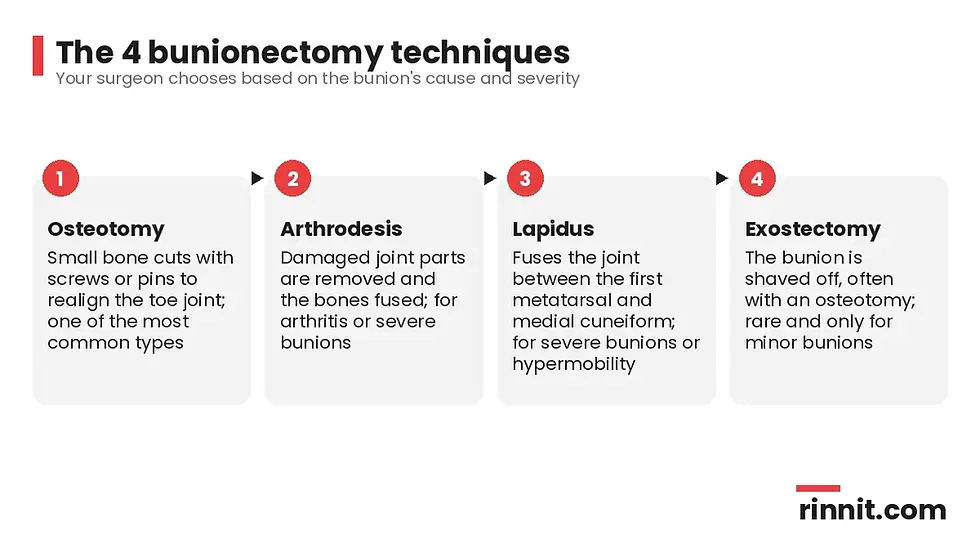
The four main bunionectomy techniques.
Technique | What the surgeon does | When it's used |
Osteotomy | Makes small bone cuts and uses screws or pins to realign the toe joint | One of the most common types; minimally invasive versions with smaller cuts are becoming more common |
Arthrodesis (joint fusion) | Removes the damaged parts of the joint and fuses the bones | When arthritis caused the bunion or the bunion is severe |
Lapidus procedure | Removes the bunion and fuses the joint between the first metatarsal and the medial cuneiform | Severe bunions or foot hypermobility |
Exostectomy | Shaves the bunion off, often together with an osteotomy | Rare; only for minor bunions |
Sources: [1]
How do you prepare for bunion surgery?
Before surgery you will have a foot X-ray, blood tests and a physical exam. Your surgeon will tell you which medicines and supplements to stop and how long to fast beforehand. [1]
What happens during bunion surgery?
You receive anesthesia so you feel no pain. General anesthesia is usually unnecessary; regional anesthesia can numb you from the waist down or just the foot. The procedure usually takes an hour or less. [1]

What to expect on the day of bunion surgery.
Item | Typical detail |
Anesthesia | Regional (waist down or foot only); general is usually not needed |
Length of surgery | An hour or less |
Recovery room | A few hours of monitoring |
Going home | Usually the same day, with a driver |
Sources: [1]
What happens after bunion surgery?
You are monitored in a recovery room for a few hours while the care team watches for anesthesia effects and checks your vital signs and pain. Most bunion surgeries are outpatient, so you can go home the same day, but you'll need a ride because you can't drive afterward. [1]
How long is recovery from bunion surgery?
Full recovery takes a few months. [1]

A typical bunion surgery recovery timeline.
Non-absorbable stitches are removed about two weeks after surgery. [1]
Bones take about six to 12 weeks to heal, and you'll likely wear a protective shoe or boot. [1]
Physical therapy may help restore strength and range of motion. [1]
Most usual physical activities can resume after about three months, though swelling may last six to nine months. [1]
Your surgeon will tell you whether you can bear weight right away. You may need crutches or a knee roller (scooter) for a few weeks, and putting too much weight on the foot too early can undo some procedures. [1]
What are the benefits and risks of bunion surgery?
Most people get significant pain relief, better big toe alignment, easier walking and more comfortable shoe wear. [1]
Risks are rare but include: [1]
Risk | What it means |
Blood clots | Clots that can form after surgery |
Infection | Germs entering the surgical site |
Nerve damage or numbness | Injury to small nerves in the foot |
Scarring | Visible or thickened scar tissue |
Blood vessel damage | Damage that can cause long-term swelling |
Bunion recurrence | The bunion comes back |
Nonunion | The bones don't heal together |
Sources: [1]
Bunion correction is considered safe and effective, and most people have meaningful symptom relief once they recover. Keeping follow-up appointments and keeping the toe supported and stable during healing are important. [1]
When should you call your surgeon after bunion surgery?
Contact your surgeon or podiatrist right away if you have: [1]
A loose, fallen or wet surgical dressing
A fever above 101°F
Bleeding
Signs of infection, such as leaking, odor, discoloration, swelling or warmth at the site
New or worsening pain
Conclusion
A bunionectomy removes a painful bunion and realigns the big toe using one of four techniques chosen for your foot. Most operations take an hour or less and are done as outpatient surgery, but full recovery takes a few months and careful weight-bearing matters. [1]
If a bunion makes walking painful even after changing shoes and trying other treatments, ask your provider whether bunion surgery is right for you.
Keep learning: If your big toe joint is stiff rather than angled, read our guide to hallux rigidus (big toe arthritis).
FAQ
What is a bunionectomy?
A bunionectomy is surgery that removes a bunion from the big toe joint and realigns the toe.
When is bunion surgery needed?
Surgery is usually considered when walking is very painful and other treatments have not helped.
What are the types of bunion surgery?
The four main techniques are osteotomy, arthrodesis (joint fusion), the Lapidus procedure and exostectomy.
Can a bunionectomy treat a tailor's bunion?
Yes. A bunionectomy can also treat bunionettes (tailor's bunions) on the pinky toe joint.
Are you put to sleep for bunion surgery?
General anesthesia is usually not needed; regional anesthesia numbs you from the waist down or just the foot.
How long does bunion surgery take?
Bunion surgery usually takes an hour or less.
Is bunion surgery outpatient?
Yes. Most bunion surgeries are outpatient, so you go home the same day with someone driving you.
How long is recovery from bunion surgery?
Full recovery takes a few months; bones heal in about six to 12 weeks and most activities resume after about three months.
How long does swelling last after bunion surgery?
Swelling may last six to nine months after surgery.
Can a bunion come back after surgery?
Yes. Bunion recurrence is one of the possible, though uncommon, risks of surgery.
How do I prepare for bunion surgery?
Before surgery you'll have a foot X-ray, blood tests and a physical exam [1]. Your surgeon will tell you which medicines and supplements to stop and how long to fast beforehand [1].
When should I call my doctor after bunion surgery?
Contact your surgeon or podiatrist right away for a loose, fallen or wet dressing, a fever above 101°F, bleeding, signs of infection such as leaking, odor, discoloration, swelling or warmth at the site, or new or worsening pain [1].
Related Reading
Bunions: Symptoms, Causes, and Treatment explains what causes a bunion and the nonsurgical treatments to try first.
Tailor’s Bunion (Bunionette): Symptoms, Causes and Treatment covers the smaller bunion on the pinky toe that a bunionectomy can also treat.
Hallux Rigidus (Big Toe Arthritis) describes big toe arthritis, one of the reasons a surgeon may choose joint fusion.
References
Cleveland Clinic. Bunion & Bunionette Surgery: Procedure, Risks & Recovery. Cleveland Clinic. Last updated June 22, 2026. https://my.clevelandclinic.org/health/procedures/bunion-surgery-bunionectomy
Alimy AR, Polzer H, Ocokoljic A, et al. Does Minimally Invasive Surgery Provide Better Clinical or Radiographic Outcomes Than Open Surgery in the Treatment of Hallux Valgus Deformity? A Systematic Review and Meta-analysis. Clin Orthop Relat Res. 2023;481(6):1143-1155. PMID 36332131. https://doi.org/10.1097/CORR.0000000000002471
Harahap R, Utomo P, Dirgahayu P, et al. Performance of Distal and Proximal First Metatarsal Osteotomy in Hallux Valgus Surgery: A Systematic Review and Meta-Analysis. Orthop Rev (Pavia). 2026;18:158949. PMID 41878342. https://doi.org/10.52965/001c.158949
Lalevee M, Saffarini M, van Rooij F, et al. Recurrence rates with long-term follow-up after hallux valgus surgical treatment using shaft metatarsal osteotomies: a systematic review and meta-analysis. EFORT Open Rev. 2024;9(10):933-940. PMID 39360793. https://doi.org/10.1530/EOR-23-0093
Medical disclaimer
This article is for general education only and does not replace advice from a qualified healthcare professional. Talk to your doctor about your own diagnosis and treatment, and seek emergency care right away for severe or sudden symptoms.



Comments