Bunions: Symptoms, Causes, and Treatment

Updated: 3 days ago
Medically reviewed by Dr. Baraa Alnahhal, MD · Last reviewed: October 2026

Quick answer
A bunion is a bony bump on the joint at the base of the big toe, caused by bones in the front of the foot moving out of position. It causes swelling, soreness and stiffness that can make walking hard. Treatment starts with roomy shoes, padding, pain medicines, inserts and ice, with surgery only when pain limits daily activities.
What the research says
According to PubMed:
Surgery reduced pain and improved function compared with no treatment, with low-certainty evidence. A Cochrane review of 25 randomized trials (1,597 adults) included one trial of 140 participants comparing surgery with no treatment. At 12 months, mean pain was 21 versus 39 points on a 0 to 100 scale (mean difference -18.00, 95% CI -26.14 to -9.86), and function scores were 9 points higher with surgery (95% CI 5.16 to 12.84). (Dias et al., DOI)
Bunions can come back after surgery. A systematic review and meta-analysis of 23 studies (2,914 people) found a pooled recurrence prevalence after bunion surgery of 24.86% (95% CI 19.15 to 30.57). Higher preoperative and postoperative hallux valgus angles were linked with recurrence. (Ezzatvar et al., DOI)
Bunions are linked with falls in older people. A meta-analysis of studies in community-dwelling older adults found that people who fell were more likely to have hallux valgus (pooled OR 1.89, 95% CI 1.19 to 3.00) as well as foot pain (pooled OR 1.95, 95% CI 1.38 to 2.76). (Menz et al., DOI)
Study details are from PubMed abstracts.
What is a bunion?
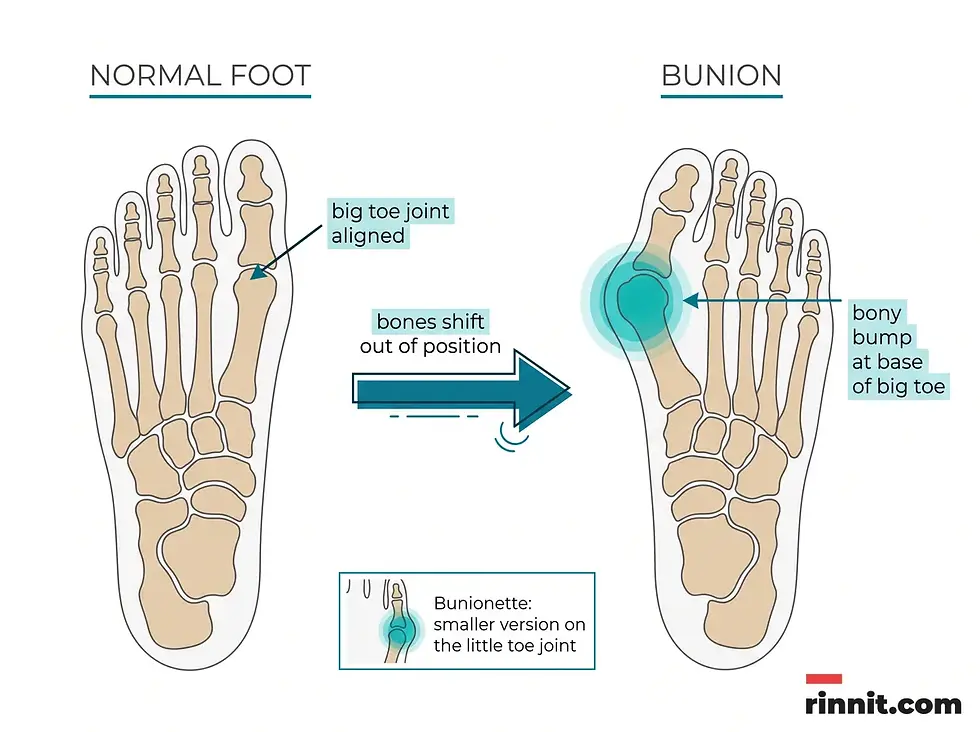
A bunion is a bony bump that forms on the joint at the base of the big toe. It happens when some of the bones in the front part of the foot move out of their regular position. This shift causes the big toe to get pulled toward the smaller toes. It also forces the joint at the base of the big toe to stick out. [1]
The skin over the bunion might change in color and feel sore. Wearing tight, narrow shoes might cause bunions or make them worse. Bunions can also form because of the shape of the foot, a foot defect, or a condition such as arthritis.
A smaller bunion, called a bunionette, can form on the joint of the little toe.
Key facts at a glance
Question | Answer |
What is it? | A bony bump on the joint at the base of the big toe |
What causes it? | Bones in the front of the foot shift out of position; exact cause unclear |
Where does it form? | Outside of the base of the big toe (bunionette on the little toe) |
Does it need treatment? | Often no; bunions frequently cause little or no pain |
First steps at home | Roomy shoes, padding, pain medicines, shoe inserts, ice |
When is surgery used? | Only for frequent pain or limits on daily activities, not for looks |
Full recovery after surgery | Often up to six months |
What are the symptoms of bunions?
The symptoms of a bunion develop around the joint at the base of the big toe. The hallmarks are a visible bump, changes in the skin over the bump, and pain that may be constant or come and go.
The most common signs include:
A bulging bump on the outside of the base of the big toe
Swelling, a change in color, or soreness around the big toe joint
Corns or calluses, which often form where the first and second toes rub against each other
Ongoing pain or pain that comes and goes
Stiffness or limited movement of the big toe, which could lead to trouble walking
Hard skin on the sole of the foot
Symptom signs table
Sign | Where it appears | What it means |
Bulging bump | Outside of the base of the big toe | The joint has shifted out of position |
Swelling or color change | Around the big toe joint | Skin over the bunion is irritated and sore |
Corns or calluses | Where the first and second toes rub | Toes are crowding each other |
Ongoing or on-and-off pain | Big toe joint | The bump rubs against shoes |
Stiffness | Big toe | Limited movement can make walking hard |
Hard skin | Sole of the foot | Pressure is shifting as the foot changes shape |
When should you see a doctor about bunions?
Bunions often do not need medical treatment. But some symptoms should be checked by a member of your health care team. You could also see a doctor who treats foot conditions, called a podiatrist, or an orthopedic foot specialist.
Get a checkup if you have:
Ongoing pain in the big toe or foot
A bump on the big toe joint
Less movement in the big toe or foot
Trouble finding shoes that fit properly because of a bunion
What causes bunions to form?
Many theories exist about how bunions form, but the exact cause is not clear. Factors that likely play a role include an inherited foot type, foot stress or injuries, and defects present at birth.
Experts disagree on the role that shoes play. Some say tight, high-heeled, or narrow shoes cause bunions. Others say that footwear simply contributes to bunions forming.
Bunions might also be linked with some types of arthritis. The link is especially strong with types of arthritis that involve painful swelling caused by a problem with the immune system. These conditions include rheumatoid arthritis.
Cause and risk factor table
Factor | How it contributes |
Inherited foot type | The foot's structure and anatomy make shifting more likely |
Foot stress or injuries | Stress on the front of the foot pushes bones out of position |
Defects present at birth | Foot structure differences exist from birth |
Rheumatoid arthritis | Immune-system inflammation raises the risk |
High heels | Force the toes into the front of the shoes and crowd them |
Tight, narrow, or pointed shoes | Poorly fitting shoes add pressure on the joint |
What complications of bunions should you watch for?
Bunions can lead to health problems beyond the bump itself. Three complications are most common.
Bursitis happens when the small fluid-filled pads that cushion the bones near the joints become inflamed. This leads to pain around the joint.
Hammertoe is an irregular bend that happens in the middle joint of a toe. It usually affects the toe next to the big toe and can cause pain and pressure.
Metatarsalgia causes pain and swelling in the ball of the foot as pressure shifts forward.
Complications at a glance
Complication | What it is | Where the pain is |
Bursitis | Inflammation of the fluid-filled pads cushioning the bones | Around the big toe joint |
Hammertoe | Irregular bend in the middle joint of a toe | Usually the toe next to the big toe |
Metatarsalgia | Pain and swelling in the ball of the foot | Ball of the foot |
How are bunions diagnosed?
To find out if you have a bunion, your health care professional asks you about your symptoms and checks your foot. The diagnosis starts with a physical exam.
After the exam, an X-ray of the foot can help determine the best way to treat the bunion. The image shows how far the bones have shifted and guides the treatment plan.
Diagnostic step | What it involves | What it shows |
Symptom review | Questions about pain, stiffness, and shoe fit | History of the problem |
Physical exam | Checking the foot and the big toe joint | The bump, skin changes, and movement limits |
X-ray | Image of the foot bones | How far the bones have shifted, to guide treatment |
How can you ease bunion pain without surgery?
Treatment choices for a bunion vary. They depend on how severe the bunion is and how much pain it causes.

Often, surgery is not needed to relieve the pain and pressure of a bunion. The first steps are simple changes and medicines.
Different shoes. Wear roomy, comfortable shoes that give your toes plenty of space. This is usually the single most helpful change.
Padding. Bunion pads or cushions that are not medicated may help ease pain. They act as a buffer between your foot and your shoe. You can buy bunion pads or cushions without a doctor's prescription.
Medicines. Acetaminophen, ibuprofen, or naproxen sodium can help control the pain of a bunion. Cortisone shots also might help.
Shoe inserts. Padded shoe inserts help spread out pressure evenly when you move your feet. This eases symptoms and may slow the bunion from progressing. Supports sold at the store without a prescription relieve some people's symptoms. Other people need prescription shoe inserts called orthotic devices.
Ice. You can ice your bunion after you have been on your feet a long time or if the bunion becomes inflamed. The cold helps relieve soreness and swelling. Do not place ice directly on the skin. Wrap it in a towel first, then use it for 15 to 20 minutes at a time. If you have reduced feeling or blood flow problems with your feet, check with your health care team before using ice.
Nonsurgical treatment options
Option | How it helps | Do you need a prescription? |
Roomy, comfortable shoes | Gives toes space; removes the pressure that worsens the bump | No |
Bunion pads or cushions | Buffers the foot from the shoe | No |
Pain medicines (acetaminophen, ibuprofen, naproxen) | Controls pain and soreness | No |
Cortisone shots | May reduce inflammation around the joint | Yes |
Padded shoe inserts | Spreads pressure evenly; may slow progression | Over-the-counter for some; prescription orthotic devices for others |
Ice | Relieves soreness and swelling | No |
When is surgery needed for bunions?
You might need surgery if simpler treatments do not ease your symptoms. Surgery is recommended only when a bunion causes frequent pain or limits your daily activities. It is usually not done to improve how the foot looks.
There are many surgeries for bunions, and no one technique is best for every problem. Surgeries can be done as single procedures or in combination. They might involve:
Removing the swollen tissue from around the big toe joint
Straightening the big toe by removing part of the bone
Realigning one or more bones in the forefoot to correct the irregular angle in the big toe joint
Joining the bones of the affected joint for good
Depending on the surgery done, you might be able to walk on your foot right after the procedure. But a full recovery often takes up to six months.
To keep another bunion from forming, you will need to wear proper shoes. Most people should not expect to wear narrower shoes after surgery. Talk to a member of your health care team about what to expect after bunion surgery.
Surgery summary
Surgery approach | What is done |
Tissue removal | Swollen tissue around the big toe joint is removed |
Bone removal | Part of the bone is removed to straighten the big toe |
Bone realignment | One or more forefoot bones are realigned to correct the angle |
Joint fusion | The bones of the affected joint are joined for good |
How can you prevent bunions?
To help prevent bunions, choose shoes carefully. They should be supportive and have a wide toe box with no pointy toes. There should also be space between the tip of your longest toe and the end of the shoe.
Your shoes should match the shape of your feet without squeezing or pressing any part of your foot.
How should you prepare for a bunion appointment?
You will likely start by seeing your primary care doctor. Or you might see a foot doctor called a podiatrist or an orthopedic foot specialist.
What you can do. Prepare a list of questions before your appointment. This helps you make the most of your time with your health care team. Your questions might include: What is causing my foot problems? Is this condition likely to last a short time or a long time? What treatment do you recommend? Is surgery right for me, and why or why not? Are there other self-care steps that might help? What are the potential benefits, risks, and complications of bunion surgery?
Feel free to ask any other questions during your visit.
What to expect from your doctor. Some questions your health care professional might ask include: When did your foot problems start? How much pain do you have in your foot? Where is the pain? What, if anything, seems to improve your symptoms? What, if anything, appears to make your symptoms worse? What type of shoes do you wear? If surgery is considered, what are your expectations?
Conclusion
A bunion is a common problem with the joint at the base of the big toe, and it usually forms when bones in the front of the foot shift out of position. The good news is that most bunions do not need medical treatment. Roomy shoes with a wide toe box, cushioned padding, over-the-counter pain medicine, shoe inserts, and ice are enough for most people.
Surgery is reserved for bunions that cause frequent pain or limit daily activities, and it is not done to change how the foot looks. If your bunion hurts, is growing, or is making it hard to find shoes that fit, a podiatrist or orthopedic foot specialist can confirm the diagnosis with a physical exam and an X-ray and map out the right plan.
Next steps: See a podiatrist or orthopedic foot specialist if your bunion causes ongoing pain or makes it hard to find shoes that fit, and start with roomy, supportive shoes in the meantime.
Frequently asked questions
Do bunions go away on their own?
No. A bunion is a change in the position of the bones in the foot, so it does not disappear without treatment. However, many bunions never need medical treatment because they cause little pain, and symptoms can be managed with shoes, padding, and pain relief.
Can tight shoes cause bunions?
Tight, narrow, or high-heeled shoes might cause bunions or make them worse, though experts disagree on how big a role footwear plays. Some say tight shoes cause bunions; others say shoes only contribute. Inherited foot type, foot stress or injuries, and defects present at birth are also likely factors.
How long does bunion surgery recovery take?
Depending on the surgery, you might be able to walk on your foot right after the procedure. But a full recovery often takes up to six months. Wearing proper shoes afterward helps keep another bunion from forming.
Is bunion surgery done to make the foot look better?
No. Surgery is recommended only when a bunion causes frequent pain or limits daily activities. It is usually not done to improve how the foot looks.
What is a bunionette?
A bunionette is a smaller bunion that forms on the joint of the little toe instead of the big toe. It works the same way as a bunion, with the joint sticking out at the base of the toe.
This article is for general education and is not a substitute for professional medical advice, diagnosis, or treatment. Always consult a qualified healthcare professional about your individual situation.
Trusted external resources
Related Reading
Orthotics: Types, Uses and How Custom Shoe Inserts Work explains how orthotics support the feet and ankles.
Bunion Surgery (Bunionectomy): Types, Procedure, Recovery and Risks explains the four bunionectomy techniques, what happens on the day, the recovery timeline and risks.
Foot X-Ray: What It Shows, Why It's Done, What to Expect and Results explains the imaging test commonly used to diagnose this condition in the foot and ankle.
References
American Academy of Orthopaedic Surgeons. Bunions. OrthoInfo. Accessed October 14, 2026. https://www.orthoinfo.org/diseases--conditions/bunions
American Podiatric Medical Association. Bunions. APMA. Accessed October 14, 2026. https://www.apma.org/patients-and-the-public/conditions-affecting-the-foot-and-ankle/bunions/
Perler A, Dixon M, Alvi F. Hallux Valgus. In: StatPearls [Internet]. Treasure Island (FL): StatPearls Publishing; 2026 Jan-. Updated February 22, 2026. PMID 31971732. https://www.ncbi.nlm.nih.gov/books/NBK553092/
Cleveland Clinic. Bunions (hallux valgus). Cleveland Clinic. September 18, 2023. https://my.clevelandclinic.org/health/diseases/14386-bunions-hallux-valgus
Mayo Clinic Staff. Bunions - Symptoms and causes. Mayo Clinic. May 8, 2025. https://www.mayoclinic.org/diseases-conditions/bunions/symptoms-causes/syc-20354799
American Academy of Orthopaedic Surgeons. Bunion surgery. OrthoInfo. Accessed October 14, 2026. https://www.orthoinfo.org/treatment/bunion-surgery
Connors JC. Bunion. Merck Manual Professional Version. October 2025. https://www.merckmanuals.com/professional/musculoskeletal-and-connective-tissue-disorders/foot-and-ankle-disorders/bunion
Dias CG, Godoy-Santos AL, Ferrari J, et al. Surgical interventions for treating hallux valgus and bunions. Cochrane Database Syst Rev. 2024;7(7):CD013726. PMID 39051477. https://doi.org/10.1002/14651858.CD013726.pub2
Ezzatvar Y, López-Bueno L, Fuentes-Aparicio L, et al. Prevalence and predisposing factors for recurrence after hallux valgus surgery: a systematic review and meta-analysis. J Clin Med. 2021;10(24):5753. PMID 34945049. https://doi.org/10.3390/jcm10245753
Menz HB, Auhl M, Spink MJ. Foot problems as a risk factor for falls in community-dwelling older people: a systematic review and meta-analysis. Maturitas. 2018;118:7-14. PMID 30415759. https://doi.org/10.1016/j.maturitas.2018.10.001
Review date: May 8, 2025.



Comments