Thrombectomy: How Doctors Remove a Blood Clot, Risks, and Recovery

Updated: 6 days ago
Written and medically reviewed by Dr. Baraa Alnahhal, MD · Last reviewed: October 2026 · How we review
Quick Answer: What is a thrombectomy?
Thrombectomy is a procedure that removes a blood clot from an artery or vein to restore blood flow to the brain, lungs, heart, limbs, intestines or kidneys. It is done through open surgery or a thin catheter, often as an emergency within hours. Prompt treatment can greatly lower the risk of death or permanent disability. [1]
What the research says
Removing a stroke clot cuts disability for most patients. In a pooled analysis of 1,287 patients from five randomized trials, thrombectomy for large-artery stroke markedly reduced disability at 90 days (common odds ratio 2.49). Only about 2.6 patients needed treatment for one to have less disability, with benefit even in people aged 80 or older and no rise in deaths or brain bleeding. (Goyal et al., Lancet, 2016) [2]
Most stroke clots can be cleared, but outcomes still vary. A review of 35 randomized trials found that blood flow was largely restored in 75.5% of stroke thrombectomies. At three months, 43.5% of patients were living independently, 5.4% had a symptomatic brain bleed and 18.4% had died. (De Rubeis et al., Rev Neurol (Paris), 2026) [3]
Catheter clot removal for lung clots has low complication rates. Across 13 studies of 1,001 people with intermediate-to-high-risk pulmonary embolism, mechanical thrombectomy without clot-dissolving drugs had a major bleeding rate of 2.39% and a 30-day death rate of 0.72%, with an average hospital stay of about 5.4 days. (Schuster et al., Cardiovasc Intervent Radiol, 2026) [4]
Key takeaways
A thrombectomy removes a blood clot (thrombus) that blocks an artery or vein.
It is used when medicines alone cannot clear a dangerous clot.
There are two main types: open surgery and minimally invasive catheter procedures.
Timing matters. Some thrombectomies must happen within hours to save a limb, organ or life.
Most people take blood thinners afterward to prevent a new clot.
Call your doctor for bleeding, chest pain, fever, confusion, or new pain or swelling after the procedure.
Thrombectomy at a glance
Feature | Details |
What it is | Removal of a blood clot from an artery or vein |
Main goal | Restore blood flow and prevent tissue or organ damage |
Types | Surgical (open) or percutaneous (minimally invasive) |
Anesthesia | General anesthesia or sedation through a vein |
Length | About one hour to several hours |
Hospital stay | Same day to several days |
After care | Blood thinners, sometimes compression stockings |
What is a thrombectomy?
A thrombectomy is a surgical or interventional treatment that removes a blood clot from inside a blood vessel. [1]
A blood clot, also called a thrombus, can block blood flow to your arms, legs or organs. Clots most often form in the legs, arms, intestines, brain, lungs and heart. [1]
When a clot cuts off blood supply, tissue starts to suffer quickly. That is why some thrombectomies must be done within hours to prevent life- or limb-threatening damage. [1]

Who needs a thrombectomy?
A thrombectomy is for people with a blood clot that cannot be treated with blood thinners (anticoagulants) or clot-dissolving drugs (thrombolytics) alone. [1]
Your care team may recommend it when a clot blocks blood flow and puts you at risk of: [1]
Death.
An embolus, when a clot breaks loose and travels to another part of the body.
Permanent tissue or organ damage.
Learn more about how clots form in our guide to blood clotting disorders.
What conditions does a thrombectomy treat?
A thrombectomy treats clots that block major blood vessels in many parts of the body. [1]
Condition | Where the clot is | Related guide |
Deep vein thrombosis (DVT) | Deep veins, usually the legs | |
Pulmonary embolism | Arteries of the lungs | |
Stroke | Arteries of the brain | |
Acute limb ischemia | Arteries of the arms or legs | |
Acute mesenteric ischemia | Arteries of the intestines | |
Renal artery occlusion | Artery to a kidney | — |
Heart attack | Coronary arteries of the heart |
Who should not have a thrombectomy?
A thrombectomy may not be the right choice when the risks outweigh the benefits or the clot cannot be safely reached. [1]
You may not be a candidate if you have: [1]
A clot that is too hard to reach.
A clot in a very small blood vessel.
A clot that medicine can treat.
A preexisting blood disorder.
Bleeding in the brain (intracranial hemorrhage). See our guide to hemorrhagic stroke.
Very high blood pressure that cannot be controlled.
A chronic clot that has been present for more than 30 days.
Do all blood clots need a thrombectomy?
Not all blood clots need a thrombectomy, because many can be treated with medicine alone. [1]
Treatment | How it works | Typical use |
Anticoagulants (blood thinners) | Stop new clots forming and give the body time to dissolve the clot | Non-emergency clots |
Thrombolytics (clot-busting drugs) | Dissolve sudden (acute) clots | Acute clots |
Thrombectomy | Physically removes the clot | Dangerous clots medicine cannot clear |
Your healthcare provider decides which option fits based on several factors, including the clot's size and location. [1]
What are the types of thrombectomy?
The two main types of thrombectomy are surgical (open) thrombectomy and percutaneous (minimally invasive) thrombectomy. [1]
Surgical (open) thrombectomy
The surgeon makes an incision to reach the blocked vessel, opens it, removes the clot with a balloon, and then repairs the vessel. [1]
Percutaneous (minimally invasive) thrombectomy
The doctor passes special devices through catheters to break up or suction out the clot from inside the vessel. If some clot remains, clot-dissolving medicine may be delivered to that spot. [1]
Common catheter techniques include: [1]
Catheter-directed mechanical thrombectomy, with or without thrombolysis.
Catheter-directed aspiration (suction) thrombectomy.
Catheter-directed thrombolysis.

A thrombectomy is closely related to an embolectomy, which removes a clot that has traveled from elsewhere. Read our embolectomy guide to compare the two.
How do you prepare for a thrombectomy?
Preparation for a thrombectomy depends on whether it is planned or done as an emergency. In an emergency, there may be no time to prepare. [1]
For a planned procedure, your provider may ask you to: [1]
Have imaging tests. Ultrasound, MRI or CT scans show the size and location of the clot.
Stop smoking. Smoking raises the risk of complications during and after surgery.
Review your medicines. Tell your provider about all medicines, vitamins, herbal supplements and over-the-counter drugs such as aspirin. You may need to stop blood thinners beforehand.
What happens during a thrombectomy?
A thrombectomy usually takes from about one hour to several hours, depending on the clot's location and size. [1]
Here is what generally happens: [1]
Anesthesia or sedation. You receive general anesthesia or sedation through a vein in your arm.
Access. For open surgery, the surgeon cuts the skin above or below the blocked vessel. For a catheter procedure, the doctor punctures a vessel, usually in the leg or arm, and threads wires and catheters inside.
Guidance. Continuous imaging guides the catheter and devices to the clot.
Clot removal. A balloon catheter pulls the clot out (open surgery), or devices break up, dissolve or suction the clot (mechanical thrombectomy).
Closure. The surgeon repairs the vessel, or the doctor removes the catheter and closes the puncture with pressure or a closure device.
What happens after a thrombectomy?
After a thrombectomy, the care team monitors your vital signs as you wake from anesthesia or sedation. [1]
Some people go home the same day. Others stay overnight or for several days, depending on the clot's location, the procedure and the need for ongoing blood thinners. [1]
Before you leave, you will get instructions on: [1]
How to care for your incision at home.
Which medicines to take and avoid.
When to return to normal activities.
What are the benefits of a thrombectomy?
The main benefit of a thrombectomy is lowering the risk of severe disability, limb loss or death by restoring blood flow as quickly as possible. [1]
Faster blood flow limits tissue damage and helps protect body functions. [1]
What are the risks of a thrombectomy?
The risks of a thrombectomy include bleeding, infection and damage to the blood vessel. [1]
Risk | What it means |
Vessel damage or stenosis | Injury or narrowing of the treated blood vessel |
Bleeding | Blood loss at the access site or inside the body |
Hematoma | A large, severe bruise |
Infection | Germs entering at the incision or puncture site |
Pulmonary embolism | A clot breaking loose and traveling to the lungs |
Anesthesia reaction | A reaction to the medicines used for sleep or sedation |
Clot recurrence | A new clot forming in the same place |
What is recovery like after a thrombectomy?
Recovery after a thrombectomy depends on the type of procedure and other factors, such as your overall health. [1]
Blood thinners: Most people take them to prevent another clot. [1]
Compression stockings: Your provider may recommend them to prevent clots in the legs. [1] Some hospitals also use intermittent pneumatic compression devices.
Clot prevention: Ask your provider about other ways to lower your risk of future clots. [1]
What is the outlook after a thrombectomy?
The outlook after a thrombectomy depends on many factors, including your overall health and where the clot was. [1]
When should you call a doctor after a thrombectomy?
Call your healthcare provider after a thrombectomy if you notice any of these symptoms: [1]
Bleeding.
Chest pain.
Confusion or disorientation.
Dizziness or balance problems.
Fever.
Pain, swelling or numbness in your arms or legs.
Pus or drainage from the incision site.
Shortness of breath.
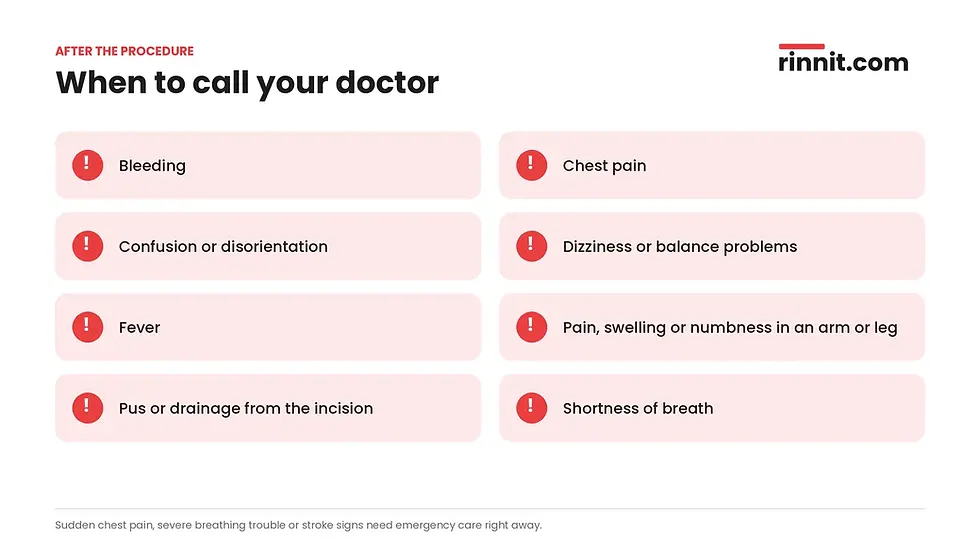
If symptoms are sudden or severe, such as crushing chest pain, severe trouble breathing or signs of stroke, call your local emergency number right away.
Conclusion
A thrombectomy removes a blood clot that blocks blood flow, and it can be life-saving when performed quickly. It can be done through open surgery or a thin catheter, and the choice depends on where the clot is and how much damage it threatens. Recovery usually involves blood thinners and close follow-up, and knowing the warning signs helps you act fast if something goes wrong.
Want to understand clots and blood flow better? Explore our guides to deep vein thrombosis, ischemia and cerebrovascular disease, and share this article with someone who is preparing for a procedure. For background reading, see the open-access clinical overview of thrombectomy.
FAQ
What is a thrombectomy?
A thrombectomy is a procedure that removes a blood clot from an artery or vein to restore blood flow. It can be done through open surgery or with catheters inserted through a small puncture.
Is a thrombectomy major surgery?
A thrombectomy can be major or minimally invasive, depending on the type. An open thrombectomy involves an incision and vessel repair, while a percutaneous thrombectomy uses catheters through a needle puncture, usually in the leg or arm.
How long does a thrombectomy take?
A thrombectomy usually takes from about one hour to several hours. The length depends on the location and size of the blood clot.
Are you awake during a thrombectomy?
A thrombectomy is done under general anesthesia or sedation given through a vein in your arm. Sedation helps you feel relaxed during the procedure.
What conditions does a thrombectomy treat?
A thrombectomy treats deep vein thrombosis, pulmonary embolism, stroke, heart attack, acute limb ischemia, acute mesenteric ischemia and renal artery occlusion. It is used when a clot threatens tissue or organs and medicine alone is not enough.
What are the risks of a thrombectomy?
The risks of a thrombectomy include bleeding, hematoma, infection, blood vessel damage or narrowing, pulmonary embolism, a reaction to anesthesia and recurrence of the clot. Your care team weighs these risks against the danger of the clot.
How long is the hospital stay after a thrombectomy?
The hospital stay after a thrombectomy ranges from the same day to several days. It depends on the clot's location, the type of procedure and whether you need ongoing blood thinners.
When should you seek help after a thrombectomy?
Call your doctor after a thrombectomy if you have bleeding, chest pain, confusion, dizziness, fever, pain or swelling in a limb, drainage from the incision or shortness of breath. Sudden or severe symptoms need emergency care.
What is the difference between thrombectomy and thrombolysis?
Thrombectomy physically removes a clot with a catheter or surgery, while thrombolysis uses clot-dissolving medicine. Some people receive both, depending on where the clot is and how long ago symptoms started.
Will I need blood thinners after a thrombectomy?
Many people need blood thinners or antiplatelet medicine after a thrombectomy to help prevent new clots. Take them exactly as prescribed, and ask your provider before stopping.
Related Reading
Venogram (Venography): Why It's Done, What to Expect and Risks explains the contrast X-ray test that shows blood flow in your veins.
References
Cleveland Clinic. Thrombectomy: What It Is and Procedure Details. Cleveland Clinic. Last updated May 2, 2022. https://my.clevelandclinic.org/health/treatments/22897-thrombectomy
Goyal M, Menon BK, van Zwam WH, et al. Endovascular thrombectomy after large-vessel ischaemic stroke: a meta-analysis of individual patient data from five randomised trials. Lancet. 2016;387(10029):1723-1731. PMID 26898852. https://doi.org/10.1016/S0140-6736(16)00163-X
De Rubeis G, Fabiano S, Bertaccini L, et al. Setting benchmark for ischemic stroke treated endovascularly: A systematic review and meta-analysis. Rev Neurol (Paris). 2026;182(3):165-174. PMID 41651771. https://doi.org/10.1016/j.neurol.2025.12.009
Schuster GR, Maciel RC, Merighi MC, et al. Catheter-Directed Mechanical Thrombectomy without Thrombolysis for Intermediate-to-High-Risk Acute Pulmonary Embolism: A Systematic Review and Meta-Analysis. Cardiovasc Intervent Radiol. 2026;49(8):1452-1466. PMID 41920339. https://doi.org/10.1007/s00270-026-04416-4
Mathews S, De Jesus O. Thrombectomy. In: StatPearls. Treasure Island (FL): StatPearls Publishing. Last updated August 23, 2023. PMID 32965825. https://www.ncbi.nlm.nih.gov/books/NBK562154/
Medical disclaimer
This article is for educational purposes only and does not replace professional medical advice, diagnosis or treatment. Always talk to a qualified healthcare provider about your symptoms and treatment options. If you think you are having a medical emergency, call your local emergency number immediately.



Comments