Embolectomy: How Doctors Remove a Dangerous Blood Clot, Risks, and Recovery

Updated: 6 days ago
Written and medically reviewed by Dr. Baraa Alnahhal, MD · Last reviewed: October 2026 · How we review
Quick Answer: What is an embolectomy?
An embolectomy is a procedure that removes a blood clot blocking blood flow in a blood vessel. Doctors reach the clot with a thin catheter through a small cut in the neck or groin, or through open surgery. It is often urgent and is used when clot-dissolving medicines cannot be used or have not worked. [1]
What the research says
Surgery to remove lung clots has become much safer over time. A meta-analysis of 78 studies (6,859 patients) found in-hospital death after surgical pulmonary embolectomy fell from 42.86% in 1965 to 20.56% in 2024; many patients were critically ill, with a median of 27.6% having cardiac arrest before surgery. (Rahouma et al., J Clin Med, 2024) [2]
Catheter-based treatment was linked to the lowest in-hospital death rate. A network meta-analysis of 53 studies (157,454 patients with intermediate- to high-risk pulmonary embolism) found catheter-directed therapy was associated with lower in-hospital death than surgical embolectomy (odds ratio 0.61), clot-busting drugs (0.41), or blood thinners alone (0.33), without significant added bleeding. Most included studies were observational. (Ishisaka et al., Catheter Cardiovasc Interv, 2023) [3]
In the sickest patients, removing the clot mechanically helped survival. Among 327 patients on heart-lung support (ECMO) across 17 studies, death occurred in 22.6% of those whose clot was removed mechanically — mostly by surgical embolectomy — versus 42.8% with other strategies. (Chopard et al., Eur Respir J, 2022) [4]
Key takeaways
An embolectomy physically removes a clot; medicines dissolve or stop clots instead.
Most people with a clot are treated with medicine, not surgery. [1]
The two main methods are a catheter procedure (small cut in the neck or groin) and open surgery (through the chest for lung clots). [1]
After the procedure, most people take blood thinners, and some get a vena cava filter. [1]
Survival after pulmonary embolectomy has improved sharply since the 2000s. [1]

Embolectomy at a glance
Question | Short answer |
What it removes | A blood clot that blocks normal blood flow |
Other name | Thrombectomy (when the clot formed in place) |
Main methods | Catheter procedure or open surgery |
Anesthesia | Yes, for both methods |
Is it urgent? | Often, depending on the clot's size and location |
Hospital stay | At least a day or two for pulmonary embolectomy |
After care | Blood thinners; sometimes a vena cava filter |
What is an embolectomy?
An embolectomy is a procedure that takes out a blood clot that is blocking normal blood flow in a blood vessel. [1] When a clot blocks a vessel, the tissue on the other side stops getting the blood and oxygen it needs.
The procedure is also called a thrombectomy. The two names describe where the clot came from. [1]
Depending on the clot's size and location, an embolectomy can be an emergency. [1]
What is the difference between an embolus and a thrombus?
An embolus is a clot that formed in one part of the body and then traveled to another part, such as the lungs, while a thrombus is a clot that causes problems in the same place where it formed. [1]
Term | Where the clot formed | Where it causes the problem | Procedure name |
Embolus | One part of the body (often a leg vein) | Somewhere else (for example, the lungs) | Embolectomy |
Thrombus | The same place | The same place | Thrombectomy |
A common example is a clot from a deep leg vein — called deep vein thrombosis — that breaks off and travels to the lungs. This is a pulmonary embolism. [1]
Who needs an embolectomy?
People need an embolectomy when a clot is dangerous and medicine alone cannot safely clear it. Most people with a blood clot are treated with medicine rather than surgery. [1]
Doctors may consider an embolectomy for a pulmonary embolism or a clot in the right side of the heart when: [1]
Blood thinners or clot-busting drugs cannot be used
Those medicines have been tried and failed
There is a risk the clot could pass through a heart defect and reach the brain or other organs (see embolic stroke)
The person is not improving with IV medicine and supportive care
Symptoms are severe
Conditions that raise the risk of blood clots include heart disease, obesity, pregnancy, cancer, and certain clotting disorders. [1]
How is an embolectomy done?
An embolectomy is done either with a thin tube (catheter) passed through a blood vessel, or through open surgery, and both methods use anesthesia. [1]
Before the procedure
For surgery, doctors may use a heart ultrasound passed down the food pipe (transesophageal echocardiogram) during the operation. [1]
For a catheter procedure, doctors use ultrasound and X-ray dye imaging (angiography) to guide the catheter. [1]
Catheter embolectomy
The doctor makes a small cut, usually in the neck or groin. [1]
A catheter is guided through the blood vessel to the clot, using X-ray images. [1]
Suction pulls the clot out. This step is repeated as needed. [1]
Surgical pulmonary embolectomy
The surgeon makes a cut down the middle of the chest. [1]
The sac around the heart is opened. [1]
A heart-lung bypass machine (cardiopulmonary bypass) takes over pumping. [1]
The surgeon opens the main lung artery and removes the clots. [1]
The artery is repaired. [1]
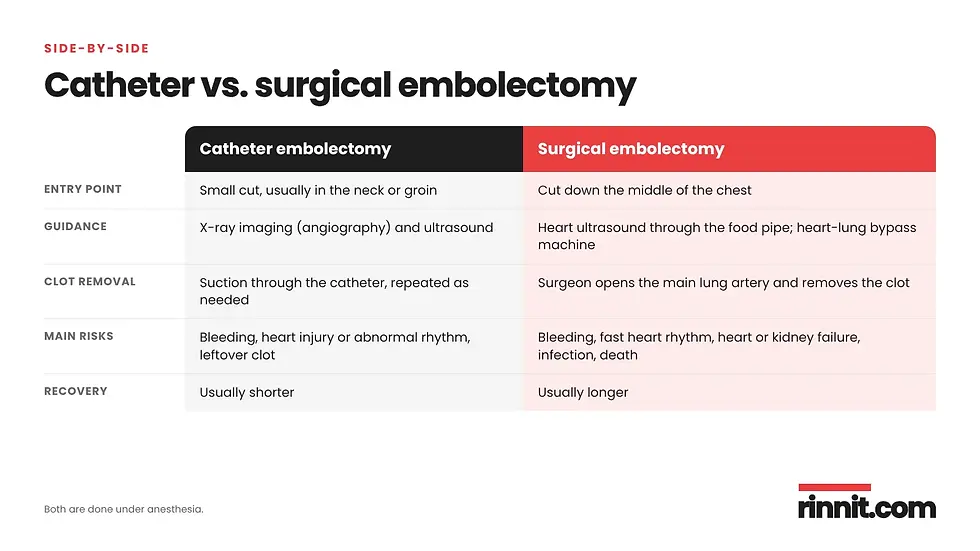
Catheter embolectomy | Surgical embolectomy | |
Entry point | Small cut, usually neck or groin | Cut down the middle of the chest |
Guidance | X-ray (angiography) and ultrasound | Heart ultrasound via the food pipe; heart-lung bypass |
How the clot comes out | Suction through the catheter | Surgeon opens the lung artery and removes it |
Recovery | Usually shorter | Usually longer |
What are the benefits of an embolectomy?
The main benefit of an embolectomy is that it clears a dangerous clot when medicines are not an option or are not working. [1] Doctors may prefer a catheter procedure or surgery when: [1]
Blood thinners or clot-busters are not safe for the person
The person is not getting better with IV medicine and supportive care
Symptoms are severe
What are the risks of an embolectomy?
The risks of an embolectomy depend on the method: a catheter procedure can cause bleeding, heart injury, or leftover clot, while open surgery carries larger risks, including heart or kidney failure. [1]
Catheter embolectomy risks | Surgical embolectomy risks |
Bleeding from damage to a blood vessel | Bleeding |
Heart injury or abnormal heart rhythm (arrhythmia) | A fast heart rhythm (supraventricular tachycardia) |
Some clot left behind | Heart failure |
Kidney failure | |
Infection | |
Death |
What is recovery like after an embolectomy?
Recovery after an embolectomy usually means at least a day or two in the hospital for a pulmonary embolectomy, and recovery from surgery generally takes longer than recovery from a catheter procedure. [1]
After the procedure, your care team may: [1]
Start blood thinners (anticoagulants) to prevent new clots
Check your heart with an ultrasound through the chest wall (transthoracic echocardiogram)
Place a vena cava filter to catch future clots before they reach the lungs
Monitor you in intensive care, which some catheter patients need

What is the outlook after an embolectomy?
The outlook after a pulmonary embolectomy has improved a lot: experienced centers report death rates of about 5% to 16% since the 2000s, though a 2024 pooled analysis of 6,859 patients put in-hospital deaths at about 22%, down from about 43% in 1965. [1]
Period | Share of patients who did not survive pulmonary embolectomy |
Historically | About 25% to 50% |
Since the 2000s | About 5% to 16% |
In one study, 73% of people were alive five years after surgery. [1]
Some people with lung clots develop long-term scarring in the lung arteries. Learn more in our guide to chronic thromboembolic pulmonary hypertension (CTEPH).
When should you call a doctor after an embolectomy?
You should call your doctor after an embolectomy if you have trouble breathing, chest pain, heart palpitations, bleeding, or signs of infection. [1]
Warning sign | What it may mean |
Trouble breathing | A breathing or clot problem needs checking |
Chest pain | A heart or lung problem needs checking |
Heart palpitations | A possible heart rhythm problem |
Bleeding | A possible side effect of the procedure or blood thinners |
Fever, redness, or pus at the cut | A possible infection |
If breathing trouble or chest pain is sudden or severe, get emergency care right away. Review the emergency signs of pulmonary embolism.
How is an embolectomy different from a thrombectomy, endarterectomy, or thrombolytic therapy?
An embolectomy removes a clot that traveled from somewhere else, while a thrombectomy removes a clot where it formed, an endarterectomy removes plaque, and thrombolytic therapy dissolves clots with medicine. [1]
Treatment | What it does | Key point |
Embolectomy | Removes a clot that traveled | Physical removal |
Thrombectomy | Removes a clot where it formed | Physical removal |
Endarterectomy | Removes plaque, not a clot | Treats narrowed arteries |
Thrombolytic therapy | Dissolves clots with medicine | Can cause bleeding, including in the brain |
Conclusion
An embolectomy is a procedure that removes a clot when medicine alone is not safe or not enough. It can be done with a catheter through a small cut or with open surgery. Both carry real risks, but outcomes after pulmonary embolectomy have improved a great deal. After the procedure, blood thinners, follow-up checks, and knowing the warning signs are the keys to a safe recovery.
Facing this decision for yourself or a family member? Save or print this page and bring it to your next appointment, so you can ask your care team which method fits your situation and why. To understand where these clots come from, read our full pulmonary embolism guide and our guide to DVT and venous thromboembolism. For clear, verified health updates, follow us on Instagram and YouTube.
For more background, see the U.S. National Library of Medicine's pulmonary embolism overview and the National Heart, Lung, and Blood Institute's venous thromboembolism page.
FAQ
What is an embolectomy?
An embolectomy is a procedure that removes a blood clot blocking normal blood flow in a blood vessel. It can be done with a catheter or with open surgery.
Is an embolectomy the same as a thrombectomy?
They are closely related, and the terms are often used for the same procedure. A thrombectomy removes a clot where it formed, while an embolectomy removes a clot that traveled from somewhere else.
Why would someone need an embolectomy instead of medicine?
An embolectomy may be needed when blood thinners or clot-busting drugs cannot be used or have failed. It may also be used when symptoms are severe or the clot could travel to the brain through a heart defect.
How is a catheter embolectomy done?
A doctor makes a small cut, usually in the neck or groin, and guides a catheter to the clot using X-ray images. Suction then pulls the clot out, repeated as needed.
Is an embolectomy major surgery?
A surgical pulmonary embolectomy is major surgery through the chest, using a heart-lung bypass machine. A catheter embolectomy is less invasive and usually has a shorter recovery.
What are the risks of an embolectomy?
Catheter embolectomy risks include bleeding, heart injury or abnormal rhythm, and leftover clot. Surgical risks include bleeding, fast heart rhythm, heart failure, kidney failure, infection, and death.
How long is recovery after an embolectomy?
People usually stay in the hospital at least a day or two after a pulmonary embolectomy. Recovery from surgery generally takes longer than recovery from a catheter procedure.
When should I seek help after an embolectomy?
Call your doctor if you have trouble breathing, chest pain, heart palpitations, bleeding, or signs of infection. Get emergency care right away if breathing trouble or chest pain is sudden or severe.
What symptoms can mean a clot needs urgent treatment?
A clot in the lungs can cause sudden shortness of breath, chest pain or coughing up blood. A clot in an arm or leg can make it cold, pale, numb, weak or very painful. Call 911 right away for any of these symptoms.
Will I need blood thinners after an embolectomy?
Most people take blood thinners after an embolectomy to help prevent new clots. Your doctor will tell you which medicine to take and for how long. Do not stop it on your own.
Related Reading
Thrombectomy: How Doctors Remove a Blood Clot, Risks, and Recovery explains how surgeons remove a clot that formed in place.
Pulmonary Embolism Guide: Symptoms, Causes, Diagnosis, and Treatment covers the symptoms, diagnosis and treatment of lung blood clots.
Acute Limb Ischemia: When a Sudden Blood Clot Cuts Off a Limb's Blood Supply — Symptoms, Treatment, and the 6-Hour Window describes the emergency when a clot suddenly blocks blood to a limb.
Vena Cava Filters: Preventing Pulmonary Embolism explains how a vein filter helps stop clots reaching the lungs.
References
Cleveland Clinic. Embolectomy: Purpose & Procedure Details. Cleveland Clinic. Last updated June 17, 2022. https://my.clevelandclinic.org/health/treatments/23340-embolectomy
Rahouma M, Al-Thani S, Salem H, et al. The outcomes of surgical pulmonary embolectomy for pulmonary embolism: a meta-analysis. J Clin Med. 2024;13(14):4076. PMID: 39064116. https://doi.org/10.3390/jcm13144076
Ishisaka Y, Watanabe A, Fujisaki T, et al. Comparison of interventions for intermediate to high-risk pulmonary embolism: a network meta-analysis. Catheter Cardiovasc Interv. 2023;102(2):249-265. PMID: 37269229. https://doi.org/10.1002/ccd.30745
Chopard R, Nielsen P, Ius F, et al. Optimal reperfusion strategy in acute high-risk pulmonary embolism requiring extracorporeal membrane oxygenation support: a systematic review and meta-analysis. Eur Respir J. 2022;60(5):2102977. PMID: 35487534. https://doi.org/10.1183/13993003.02977-2021
Medical disclaimer
This article is for general education only and does not replace professional medical advice, diagnosis, or treatment. Always talk with a qualified healthcare provider about your own condition. If you have sudden trouble breathing or chest pain, seek emergency care immediately.



Comments