What Is Chronic Thromboembolic Pulmonary Hypertension (CTEPH)? Symptoms, Causes, Diagnosis, and Treatment Options

Updated: 3 days ago
Medically reviewed by Dr. Baraa Alnahhal, MD · Last reviewed: October 2026
Quick Answer: What is chronic thromboembolic pulmonary hypertension (CTEPH)?
Chronic thromboembolic pulmonary hypertension (CTEPH) is a rare form of pulmonary hypertension in which lung blood clots fail to dissolve, leaving scar-like tissue that narrows vessels and strains the right side of the heart. [1] It causes shortness of breath during activity, fatigue and swollen legs. [1] Treatment centers on pulmonary endarterectomy or balloon angioplasty, plus lifelong blood thinners. [1] [2]
Key takeaways
CTEPH is the form of pulmonary hypertension that may be cured, not just managed. [1]
It develops from old clots that never dissolved and turned into scar-like tissue that narrows the lung vessels and strains the right side of the heart. [1]
It is caused by blood clots in the lungs, though about 1 in 4 people with CTEPH never had a diagnosed pulmonary embolism, and most people who have had a pulmonary embolism never develop it. [1] [4]
The hallmark symptom is shortness of breath with activity, often with fatigue, chest tightness, dizziness, fainting, or swollen legs. [1]
Pulmonary endarterectomy and pulmonary balloon angioplasty can potentially cure CTEPH; riociguat helps people who cannot have a procedure or who still have high pressure after surgery. [1] [2]
What the research says
Riociguat improved exercise capacity in people who could not have surgery or still had high lung pressure after it. In the CHEST-1 randomized trial of 261 patients with inoperable CTEPH or persistent or recurrent pulmonary hypertension after pulmonary endarterectomy, the six-minute walk distance rose by a mean of 39 m with riociguat and fell by 6 m with placebo at week 16 (difference 46 m; 95% CI 25 to 67). Pulmonary vascular resistance fell by 226 dyn·sec·cm⁻⁵ with riociguat and rose by 23 with placebo. Right ventricular failure was the most common serious adverse event (3% in each group). The trial compared riociguat with placebo over 16 weeks and did not evaluate surgery or balloon angioplasty (Ghofrani et al., N Engl J Med, 2013). [3]
About 3 in 100 people develop CTEPH after an acute pulmonary embolism, and some clot histories carry more risk. A meta-analysis of 22 cohort studies including 5,834 acute pulmonary embolism patients found an overall CTEPH incidence of 2.82% (95% CI 2.11 to 3.53%). Incidence was higher in Asian cohorts than European cohorts (5.08% vs. 1.96%), and a previous venous thromboembolic event and an unprovoked pulmonary embolism were each linked to higher risk (OR 2.57 and 2.71). Rates were also higher in retrospective and smaller studies, so the true figure varies by population (Pang et al., Front Med, 2021). [4]
Lifelong anticoagulation is the recommended management, but the best blood thinner is still being studied. A meta-analysis of 7 studies (1 randomized trial and 6 observational studies; 2,969 patients) comparing direct oral anticoagulants with vitamin K antagonists found no difference in major bleeding (RR 0.59, 95% CI 0.34 to 1.02) and lower mortality with direct oral anticoagulants (RR 0.54, 95% CI 0.37 to 0.79), but a higher risk of recurrent pulmonary embolism (RR 3.80, 95% CI 1.93 to 7.50). Most of the data were observational, so confounding is likely, and no one should change a blood thinner without their specialist (Ishisaka et al., Thromb Res, 2023). [5]
What Is Chronic Thromboembolic Pulmonary Hypertension (CTEPH)?

CTEPH is a rare form of pulmonary hypertension. It occurs when pressure in the small blood vessels of the lungs becomes abnormally high because of old blood clots and the scarring they leave behind. [1]
The word "thromboembolic" refers to blood clots (thrombi) that travel and lodge in the lung's blood vessels (embolism). When those clots do not dissolve as they normally would, scar-like tissue develops in the vessels. That scar tissue narrows the vessels, and the narrower the vessels, the higher the pressure climbs. [1]
One point matters more than any other for understanding this condition: CTEPH is caused by blood clots in the lungs (pulmonary embolism). About 1 in 4 people with CTEPH have no known history of pulmonary embolism because the original clot caused no clear symptoms, so CTEPH is confirmed by imaging that shows old clots, not by history alone. [1]
Who Gets CTEPH?
CTEPH can happen to anyone. There is no single profile that predicts it. It follows blood clots in the lungs, although about 1 in 4 people never had a diagnosed pulmonary embolism, and most people who have had one will not develop CTEPH. [1] [4]
How Common Is CTEPH?
There are approximately 5,000 new CTEPH cases per year in the U.S. [1] This number might actually be underestimated, since the condition is not always correctly diagnosed. [1]
How Can CTEPH Affect Your Health?
With pulmonary hypertension and CTEPH, pressure becomes too high on the right side of the heart. That pressure leads to a backup of oxygen-poor blood. The heart then has to work harder to push blood out to the lungs. At the same time, blood takes longer to travel through the narrowed vessels of the lungs, causing a drop in oxygen levels. [1] Over time, that combination of strain and low oxygen drives the symptoms described below.
CTEPH Symptoms
CTEPH symptoms develop gradually and can look like ordinary breathlessness at first. The key is that they persist and typically worsen, especially with physical activity.
Symptom | What It Feels Like |
Shortness of breath | Especially noticeable during physical activity; the hallmark symptom |
Fatigue | Ongoing tiredness from low oxygen and a heart working overtime |
Chest pain or tightness | Discomfort or pressure in the chest |
Dizziness | Lightheadedness, particularly with exertion |
Fainting (syncope) | Brief loss of consciousness |
Heart palpitations | Pounding in the chest |
Swollen legs | Fluid retention (edema) causing swelling in the legs |
Cyanosis | Fingers and toes with a bluish tint from low oxygen |
Coughing up blood | Rare, but possible |

Sudden chest pain or fainting can be signs of a pulmonary embolism, so call 911 or your local emergency number if they happen. [7] Leg swelling in particular is often caused by fluid retention; see our guide to edema for other causes.
What Causes CTEPH?
The condition occurs when tiny blood clots in the lung blood vessels do not dissolve. This causes scar-like tissue to develop, leading to blood vessel narrowing. The more severe the narrowing, the higher the pressure. [1]
In other words, CTEPH is not caused by a new clot, but by the aftermath of old clots that never cleared. Instead of dissolving, they organize into scar-like tissue that permanently narrows the vessels, forcing the right side of the heart to push harder against the resistance.
CTEPH Risk Factors
Not everyone with a pulmonary embolism develops CTEPH, and having a risk factor does not mean CTEPH is inevitable. The following factors have been associated with a higher risk of the condition developing after a pulmonary embolism:
Risk Factor | Why It Matters |
Personal or family history of blood clots or clotting disorders | Includes conditions like antiphospholipid syndrome; more clots mean more chances for some not to dissolve |
Blood type other than Type O | Blood type influences clotting behavior |
Being female | Women appear to be at somewhat higher risk |
Prior spleen removal (splenectomy) | Changing how blood and platelets circulate |
Certain cancers | Cancer affects blood clotting mechanisms |
Bone infection (osteomyelitis) | Chronic infection influences clotting |
Chronic gastrointestinal diseases | Such as inflammatory bowel disease, which involves inflammation and clotting changes |
Infected heart tissue due to a pacemaker | Infection around the heart tissue can contribute |
Thyroid hormone replacement therapy | Associated with higher risk in studies |
How Is CTEPH Diagnosed?
Diagnosing CTEPH matters because it is the form of pulmonary hypertension that can be cured, so it should not be mistaken for other types. [1] Care usually starts with tests that check for signs of CTEPH, followed by additional studies that confirm the diagnosis and its severity.
Initial Tests
Test | What It Does |
Lung ventilation-perfusion scan (V/Q scan) | Shows how well air and blood flow through different parts of the lungs |
Pulmonary angiogram | Shows whether there are blood clots or narrow blood vessels |
Pulmonary function tests | Measure how well the lungs move air |
Transthoracic echocardiogram (TTE) | An ultrasound that looks at the heart's structure and pressure estimates |
Additional Studies
These tests typically help confirm the diagnosis and its severity:
Test | What It Does |
Right heart catheterization | Measures pressures directly inside the heart and lung vessels |
CT pulmonary or digital subtraction angiography | Advanced imaging techniques that examine the pulmonary arteries in detail |
MRI | Detailed imaging of the heart and lung blood flow |
Exercise stress test | Shows how well the heart and lungs perform under exertion |
How Is CTEPH Treated?
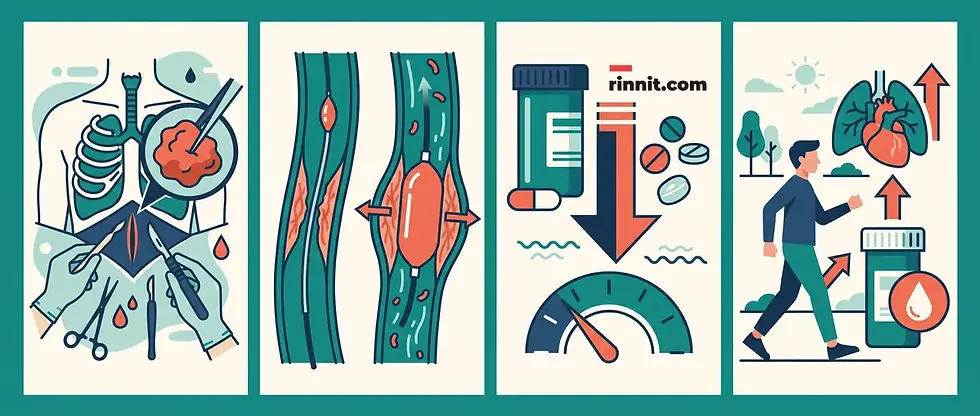
A procedure is typically necessary, and there are two main options. [1] Both aim to physically remove the blockage, which is why CTEPH can be cured rather than only managed. A related article explains pulmonary thromboendarterectomy, the surgical approach, in more detail.
Treatment | What It Is and Who It Is For |
Pulmonary endarterectomy | An open surgical procedure that removes blood clots from the lung arteries. The standard curative option for many patients. |
Pulmonary balloon angioplasty | A procedure using tiny balloons at the tip of long tubes (catheters) that push aside scar tissue to open up narrowed arteries. An alternative way to open the vessels. |
Riociguat tablets | A pulmonary hypertension medication that can bring symptom relief. Used for people who cannot have a procedure, or patients whose pulmonary hypertension continues after surgery. |
Which Treatment Is Right for You?
The decision depends on where the scar tissue sits, how severe the narrowing is, and your overall health. Some people are candidates for surgery, some are better suited to the balloon procedure, and some will rely on medication. A specialized care team makes this determination case by case.
What Is the Outlook for Patients With CTEPH?
This is one of the most encouraging aspects of CTEPH: pulmonary endarterectomy and pulmonary balloon angioplasty can potentially cure CTEPH. [1] People who have one of these procedures typically have an excellent prognosis. [1]
Despite this positive outlook, many patients struggle with anxiety and depression. This is especially true for people who are not eligible for curative treatment. [1] If you experience these issues, let your healthcare provider know. They can address your concerns and recommend therapies to help you feel better.
Is CTEPH Preventable?
CTEPH is a complication of many health conditions, some of which are out of your control. You can lower your risk by taking good care of your lungs. This includes avoiding tobacco or quitting smoking. [1]
Beyond that, people who have had a pulmonary embolism should follow their provider's guidance closely, stay on prescribed treatment, and report new breathing symptoms early.
Living With CTEPH
Living with CTEPH after treatment involves a few lasting habits that protect your heart, lungs, and blood.
Blood thinners for life. You will be on blood thinners for the rest of your life. [1] [2] If you take warfarin, you might have to avoid certain foods. [1] These include foods high in vitamin K, like soy and broccoli, because vitamin K can have a serious interaction with the medication. [1] [8] Keep your diet consistent and discuss changes with your provider or pharmacist.
Keep moving. Light exercise, like walking, helps many people gain strength and feel their best. [1] Your healthcare provider may recommend a medically supervised exercise program called pulmonary rehabilitation, which builds safe, structured exercise habits for people with lung conditions. [1]
When to Call a Healthcare Provider
Contact your provider right away if you have a history of pulmonary embolism and notice new or worsening shortness of breath, chest pain or tightness, dizziness, unusual fatigue, or swelling in your legs. [6]
Call 911 or your local emergency number if you experience fainting, sharp chest pain, or coughing up blood, since these can be signs of a pulmonary embolism. [7]
Questions to Ask Your Doctor
Bringing specific questions to your appointment helps you get clear answers:
Could my symptoms be related to my past pulmonary embolism?
Do I need a V/Q scan to check for CTEPH?
Am I a candidate for pulmonary endarterectomy or balloon angioplasty?
If I cannot have a procedure, is medication like riociguat appropriate for me?
What diet guidance applies if I take warfarin?
Would pulmonary rehabilitation be safe and helpful for me?
How will we monitor my heart and lungs long term?
Conclusion
Chronic thromboembolic pulmonary hypertension is a rare condition, but it stands out among lung blood pressure disorders for a powerful reason: it can often be cured. It begins with old blood clots in the lungs that never dissolved, leaving scar tissue that narrows the vessels and forces the right side of the heart to work against rising pressure. That process produces the telltale symptoms of breathlessness during activity, fatigue, chest tightness, dizziness, and swollen legs. If you have ever had a pulmonary embolism, treat those symptoms as a signal worth investigating. Diagnosis leads to procedures that can physically open the vessels and restore normal pressure, and most people who undergo treatment have an excellent outlook.
Frequently Asked Questions
What is chronic thromboembolic pulmonary hypertension (CTEPH)?
CTEPH is a rare form of pulmonary hypertension, which is high blood pressure in the small blood vessels of the lungs. It is caused by old blood clots that did not dissolve and left scar-like tissue that narrows the vessels.
What does CTEPH stand for?
CTEPH stands for chronic thromboembolic pulmonary hypertension. "Chronic" means long-lasting, "thromboembolic" refers to blood clots that traveled and lodged in the lungs, and "pulmonary hypertension" means high blood pressure in the lung vessels.
Is CTEPH the same as pulmonary hypertension?
No. CTEPH is one specific type of pulmonary hypertension caused by old blood clots. Other forms of pulmonary hypertension have different causes and are not treated the same way.
How is CTEPH different from other types of pulmonary hypertension?
CTEPH is the only form of pulmonary hypertension that can often be cured with a procedure that physically removes the clot-related blockage. Most other forms are managed rather than cured.
How common is CTEPH?
There are approximately 5,000 new CTEPH cases per year in the U.S., though the true number may be higher because the condition is not always correctly diagnosed.
Can anyone get CTEPH?
CTEPH can happen to anyone who has had blood clots in the lungs, even if the clot was never diagnosed; about 1 in 4 people with CTEPH have no known history of pulmonary embolism.
Do all people with pulmonary embolism develop CTEPH?
No. Most people who have had a pulmonary embolism will never develop CTEPH. A minority develop it when some clots fail to dissolve.
How long after a pulmonary embolism can CTEPH develop?
CTEPH develops when old clots do not dissolve over time, which can take months or longer. Persistent or new breathing symptoms after an embolism should always be evaluated.
What happens in the body when you have CTEPH?
Undissolved clots form scar-like tissue that narrows the lung blood vessels. The right side of the heart then has to push harder against that resistance, oxygen-poor blood backs up, and blood moves more slowly through the lungs, dropping oxygen levels.
What is the most common CTEPH symptom?
Shortness of breath, especially during physical activity, is the hallmark symptom. Fatigue is also very common.
Can CTEPH cause chest pain?
Yes. Chest pain or tightness is a recognized symptom of CTEPH.
Is coughing up blood a symptom of CTEPH?
It can be, but coughing up blood is rare in CTEPH. When it happens, it should be reported to a healthcare provider.
What is cyanosis, and can CTEPH cause it?
Cyanosis is a bluish tint in the fingers and toes caused by low oxygen levels. It is a recognized symptom of CTEPH.
Does CTEPH cause dizziness?
Yes. Dizziness is a recognized symptom, and more severe lightheadedness can progress to fainting.
Can CTEPH cause fainting?
Yes. Fainting (syncope) is a recognized symptom of CTEPH, and sudden fainting can be a sign of a pulmonary embolism, a medical emergency.
Why does CTEPH cause fatigue?
Low oxygen levels and a heart that is working harder than normal leave the body under constant strain, which produces ongoing fatigue.
Can CTEPH cause heart palpitations?
Yes. Pounding in the chest, known as heart palpitations, is a recognized symptom of CTEPH.
Why do legs swell with CTEPH?
When the right side of the heart struggles against high lung pressures, fluid backs up and collects in the legs, causing swelling called edema.
What are the main risk factors for CTEPH?
Risk factors include a personal or family history of blood clots or clotting disorders (including antiphospholipid syndrome), blood type other than Type O, being female, prior spleen removal, certain cancers, bone infection (osteomyelitis), chronic gastrointestinal diseases like inflammatory bowel disease, infected heart tissue due to a pacemaker, and thyroid hormone replacement therapy.
Does blood type affect CTEPH risk?
Yes. Blood type other than Type O is a recognized risk factor for developing CTEPH after a pulmonary embolism.
Are women at higher risk of CTEPH?
Yes. Being female is listed as a risk factor for CTEPH.
Can spleen removal increase CTEPH risk?
Yes. Prior spleen removal (splenectomy) is a recognized risk factor.
Can cancer increase CTEPH risk?
Yes. Certain cancers are listed as risk factors for CTEPH.
Can bone infection increase CTEPH risk?
Yes. Bone infection (osteomyelitis) is a recognized risk factor.
Can inflammatory bowel disease increase CTEPH risk?
Yes. Chronic gastrointestinal diseases such as inflammatory bowel disease are listed as risk factors.
Can a pacemaker infection affect CTEPH risk?
Yes. Infected heart tissue due to a pacemaker is a recognized risk factor.
Can thyroid hormone replacement increase CTEPH risk?
Yes. Thyroid hormone replacement therapy is listed as a risk factor for CTEPH.
What is antiphospholipid syndrome, and does it relate to CTEPH?
Antiphospholipid syndrome is a blood clotting disorder. A personal or family history of blood clots or clotting disorders like it is a major CTEPH risk factor.
How is CTEPH diagnosed?
Diagnosis begins with screening tests such as a ventilation-perfusion (V/Q) scan, pulmonary angiogram, pulmonary function tests, and a transthoracic echocardiogram (TTE). Additional studies like right heart catheterization, CT or digital subtraction angiography, MRI, and an exercise stress test confirm the diagnosis and its severity.
What is a V/Q scan?
A ventilation-perfusion scan measures both airflow (ventilation) and blood flow (perfusion) through the lungs to detect areas where blood flow is blocked, which is characteristic of CTEPH.
What does a pulmonary angiogram show?
A pulmonary angiogram shows whether there are blood clots or narrowed blood vessels in the lung arteries.
What is a transthoracic echocardiogram (TTE)?
TTE is an ultrasound of the heart that estimates the pressure in the lung vessels and assesses how hard the right side of the heart is working.
What is right heart catheterization?
Right heart catheterization is a procedure that measures pressures directly inside the heart and the pulmonary arteries. It is a key test for confirming pulmonary hypertension and its severity.
Can CTEPH be cured?
Yes, potentially. Pulmonary endarterectomy and pulmonary balloon angioplasty can potentially cure CTEPH, and people who undergo one of these procedures typically have an excellent prognosis.
What is pulmonary endarterectomy?
Pulmonary endarterectomy is an open surgical procedure that removes blood clots and scar tissue from the lung arteries.
What is pulmonary balloon angioplasty?
Pulmonary balloon angioplasty uses tiny balloons at the tip of long tubes (catheters) that are inflated inside narrowed arteries to push aside scar tissue and open the vessels.
When is medication used for CTEPH?
Medication such as riociguat is used for people who cannot have a procedure, or for patients whose pulmonary hypertension continues after surgery.
What is riociguat?
Riociguat is a pulmonary hypertension medication in tablet form that can bring symptom relief for people who cannot have a procedure or whose pulmonary hypertension persists after surgery.
What is the outlook after CTEPH surgery?
People who undergo pulmonary endarterectomy or pulmonary balloon angioplasty typically have an excellent prognosis, and the condition can potentially be cured.
Do I need blood thinners forever after CTEPH treatment?
Yes. People with CTEPH are on blood thinners for the rest of their life, even after curative treatment.
Can I eat broccoli and soy with CTEPH?
If you take warfarin, you might have to limit or be consistent with foods high in vitamin K, such as soy and broccoli, because vitamin K can have a serious interaction with the medication. Discuss diet specifics with your provider or pharmacist.
Can I exercise with CTEPH?
Yes. Light exercise like walking helps many people gain strength and feel their best, and providers may recommend a medically supervised exercise program called pulmonary rehabilitation.
What is pulmonary rehabilitation?
Pulmonary rehabilitation is a medically supervised exercise program that helps people with lung conditions build strength and improve how they feel.
Does CTEPH affect mental health?
Many patients struggle with anxiety and depression, especially those who are not eligible for curative treatment. These issues are common and treatable, and you should let your healthcare provider know if you experience them.
Is CTEPH preventable?
CTEPH is a complication of many health conditions, some out of your control, so it cannot be fully prevented. You can lower your risk by taking good care of your lungs, including avoiding tobacco and quitting smoking.
Does smoking affect CTEPH risk?
Avoiding tobacco and quitting smoking helps you take good care of your lungs and lowers risk factors related to lung health.
When should I see a doctor about possible CTEPH?
If you have a history of pulmonary embolism and experience new or worsening shortness of breath, fatigue, chest pain or tightness, dizziness, or leg swelling, contact your provider right away.
When is CTEPH an emergency?
Fainting, sharp chest pain, or coughing up blood can be signs of a pulmonary embolism. Call 911 or your local emergency number right away.
Can children get CTEPH?
CTEPH is associated with conditions that develop after a pulmonary embolism, which is rare in children but not impossible. Any child with a clot history and new breathing symptoms should be evaluated.
Is CTEPH contagious?
No. CTEPH is caused by blood clots and scar tissue in the lung vessels. It cannot be passed from person to person.
Is CTEPH genetic?
No direct genetic cause is described, though a family history of blood clots or clotting disorders is a risk factor.
How long can you live with CTEPH?
CTEPH is potentially curable with surgery or balloon angioplasty, and most treated patients have an excellent prognosis. Untreated, the condition progresses and strains the heart, which is why prompt treatment matters.
What happens if CTEPH is left untreated?
Untreated CTEPH progressively narrows the lung vessels, increases pressure on the right side of the heart, and lowers oxygen levels, leading to worsening symptoms and serious complications including right heart failure.
Does CTEPH come back after surgery?
CTEPH can potentially be cured by the procedures, but lifelong blood thinners and ongoing medical follow-up are required to protect the lungs and heart.
What should I ask my doctor about CTEPH?
Ask whether your symptoms could relate to a past pulmonary embolism, whether you need a V/Q scan, whether you are a candidate for endarterectomy or angioplasty, whether medication is appropriate, what diet guidance applies to your blood thinner, and whether pulmonary rehabilitation is right for you.
Related Reading
Pulmonary Embolism Guide: Symptoms, Causes, Diagnosis, and Treatment
Pulmonary Hypertension: Complete Guide to Symptoms, Causes, Diagnosis, and Treatment
Blood Clots Explained: Symptoms, Emergency Signs, and Treatment Options
Pulmonary Thromboendarterectomy (PTE): A Curative Solution for Chronic Blood Clots
Antiphospholipid Syndrome: Symptoms, Causes, Treatment & Complete Guide
Pulmonary Rehabilitation: Managing Chronic Lung Disease Through Exercise and Education
References
Cleveland Clinic. Chronic Thromboembolic Pulmonary Hypertension (CTEPH). Cleveland Clinic health library. Accessed October 15, 2026. https://my.clevelandclinic.org/health/diseases/17635-chronic-thromboembolic-pulmonary-hypertension-cteph
Kim NH, Delcroix M, Jais X, et al. Chronic thromboembolic pulmonary hypertension. Eur Respir J. 2019;53(1):1801915. PMID: 30545969. https://doi.org/10.1183/13993003.01915-2018
Ghofrani HA, D'Armini AM, Grimminger F, et al. Riociguat for the treatment of chronic thromboembolic pulmonary hypertension. N Engl J Med. 2013;369(4):319-329. PMID: 23883377. https://doi.org/10.1056/NEJMoa1209657
Pang W, Zhang Z, Wang Z, et al. Higher incidence of chronic thromboembolic pulmonary hypertension after acute pulmonary embolism in Asians than in Europeans: a meta-analysis. Front Med (Lausanne). 2021;8:721294. PMID: 34765615. https://doi.org/10.3389/fmed.2021.721294
Ishisaka Y, Watanabe A, Takagi H, et al. Anticoagulation in chronic thromboembolic pulmonary hypertension: a systematic review and meta-analysis. Thromb Res. 2023;231:91-98. PMID: 37839150. https://doi.org/10.1016/j.thromres.2023.10.003
National Library of Medicine. Pulmonary hypertension. MedlinePlus Medical Encyclopedia. Last reviewed May 4, 2026. https://medlineplus.gov/ency/article/000112.htm
Cleveland Clinic. Pulmonary Embolism (PE): Signs, Symptoms & Treatment. Cleveland Clinic health library. Last updated April 20, 2026. https://my.clevelandclinic.org/health/diseases/17400-pulmonary-embolism
NIH Office of Dietary Supplements. Vitamin K: Fact Sheet for Consumers. Office of Dietary Supplements. Last updated March 22, 2021. https://ods.od.nih.gov/factsheets/VitaminK-Consumer/
Medical disclaimer
This article is for informational purposes only and is not a substitute for professional medical advice, diagnosis, or treatment. Always seek the advice of a qualified healthcare provider with any questions about a medical condition or before making decisions about treatment. Never disregard professional medical advice or delay seeking it because of something you have read here.



Comments