Thoracotomy: Purpose, Procedure, Risks and Recovery

Updated: 6 days ago
Written and medically reviewed by Dr. Baraa Alnahhal, MD · Last reviewed: October 2026 · How we review
Quick Answer: What is a thoracotomy?
A thoracotomy is open chest surgery in which a surgeon makes a cut between two ribs to reach the heart, lungs, aorta, esophagus, diaphragm or trachea. It is done under general anesthesia, usually takes two to four hours, and is often used for lung cancer. Most people stay about a week in hospital. [1]
What the research says
Smaller-incision surgery can mean fewer complications than open surgery for some lung cancers. A meta-analysis of 9 studies (943 video-assisted vs 2,827 open lobectomies after induction therapy) found fewer complications, shorter chest-tube drainage and shorter hospital stays with the video-assisted approach, with no difference in 3-year survival. (Hireche et al., J Surg Res, 2022) [2]
A nerve block beside the spine relieves pain as well as an epidural, with fewer side effects. A review of 14 randomized trials (698 patients) found similar pain control after thoracotomy, with less low blood pressure (risk ratio 0.16), nausea and vomiting, itching and urinary retention with the paravertebral block. (Yeung et al., Cochrane Database Syst Rev, 2016) [3]
Starting epidural pain relief before the incision may reduce lasting pain. Across 19 trials (1,062 adults), pre-emptive epidural analgesia lowered pain at rest in the first 72 hours, and fewer patients had pain 1 to 6 months later (6 trials, 276 patients); evidence quality was low to moderate. (Park et al., Reg Anesth Pain Med, 2020) [4]
Key takeaways
A thoracotomy opens the chest through a cut between two ribs, usually on the left or right side.
It can diagnose a problem (biopsy) or treat one, most often lung cancer.
Surgery takes about two to four hours; the hospital stay is about one week.
Expect about two months off work, with tiredness during that time.
Pain lasting more than two months is called post-thoracotomy pain syndrome. [1]
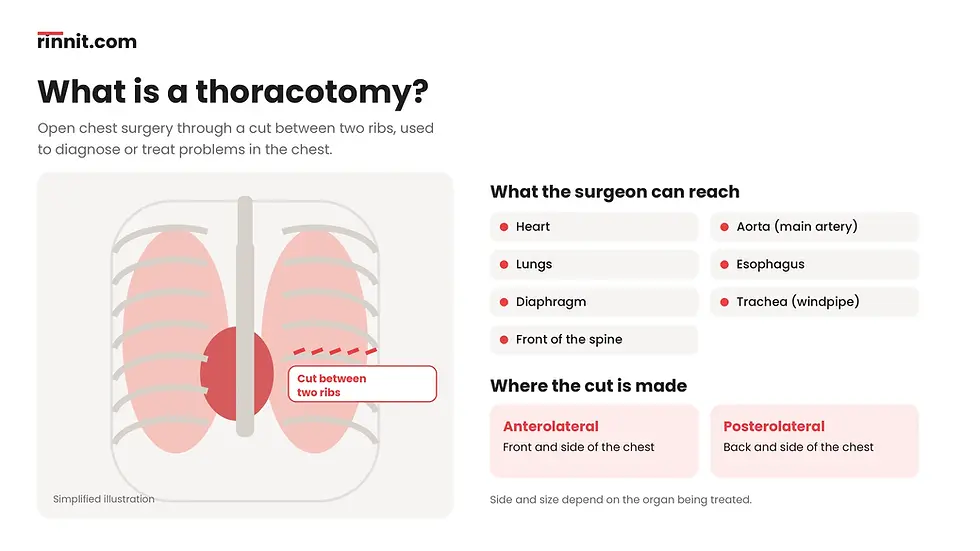
What is a thoracotomy and how does it work?
A thoracotomy is a procedure in which a surgeon makes a cut between your ribs to see or reach the organs inside your chest. [1]
Through this opening, the surgeon can reach your:
Heart
Aorta (the body's main blood vessel)
Lungs and trachea (windpipe)
Esophagus
Diaphragm
Front of the spine
Surgeons call it an open thoracotomy because it is not a minimally invasive approach. The cut is usually made on the left or right side of the chest, depending on which organ needs care. Sometimes a small section of rib must be removed. [1]
What are the types of thoracotomy?
The types of thoracotomy are named for where the surgeon makes the cut. The size and exact location depend on the surgery you need. [1]
Type | Where the cut is made |
Anterolateral thoracotomy | Front and side of the chest |
Posterolateral thoracotomy | Back and side of the chest |
Clamshell thoracotomy | Combines part of a thoracotomy with part of a sternotomy to see both the front and side of the chest; can be on the right or left |
Why is a thoracotomy done?
A thoracotomy is done to diagnose a chest condition by removing tissue (biopsy) or to treat a problem inside the chest. [1]
Conditions it may treat include:
Heart and blood vessel conditions or chest trauma
Diaphragm problems
Collapsed lung (pneumothorax)
Excess fluid around the heart (cardiac tamponade)
Esophageal diseases, including cancer
Excess fluid around the lungs (pleural effusion)
A surgeon may also switch to a thoracotomy during a planned minimally invasive operation if scar tissue or other findings make the smaller approach impossible. [1]
How do you prepare for a thoracotomy?
Preparing for a thoracotomy means getting healthy enough for general anesthesia and following your surgical team's instructions on medicines, food and drink. [1]
Stop smoking. You may need to quit before surgery so your body can handle general anesthesia.
Share your full medicine list. Include vitamins, supplements and over-the-counter products, since some raise bleeding risk.
Stop medicines only when told. Your provider will tell you when, often about a week before surgery. Don't stop on your own.
Follow fasting instructions. Your team will tell you when to stop eating and drinking. [1]
What happens during a thoracotomy?
During a thoracotomy, which usually lasts two to four hours under general anesthesia, the surgical team follows seven main steps. [1]
You are positioned on your side with one arm over your head.
One lung is ventilated: a machine breathes for the lung on the side not being operated on.
The surgeon makes a cut between two ribs.
A small piece of rib is removed if needed.
Instruments are used to see and treat the organs that need care.
A chest tube is placed to drain extra fluid and let air escape.
The cut is closed. [1]

What are the risks of a thoracotomy?
The main risks of a thoracotomy are problems with anesthesia, infection, bleeding, pain and fluid around the lungs, with some complications appearing later. [1]
Timing | Possible complication |
Early | Problems with general anesthesia |
Early | Infection |
Early | Bleeding |
Early | Pain |
Early | Pleural effusion (fluid around the lungs) |
Later | |
Later | Collapse of one or more areas of the lung (atelectasis) |
Later | Post-thoracotomy pain syndrome (pain lasting more than two months) |
How is pain managed after a thoracotomy?
Pain after a thoracotomy is managed with medicines given by mouth, through an IV, or through a thin catheter placed in the back. Pain usually fades over days to weeks. [1]
What happens after a thoracotomy?
After a thoracotomy, the chest tube or tubes stay in for at least two days and are removed once your lung has fully expanded and no longer needs air or fluid drainage. [1]
While in hospital, your team will ask you to:
Cough to clear your lungs
Use a breathing aid called an incentive spirometer
Take short walks
Manage pain with the medicines prescribed
If the surgery was done to diagnose a condition, your provider will explain the findings and the next steps. [1]
How long is thoracotomy recovery?
Thoracotomy recovery usually involves about one week in hospital and about two months off work, and feeling tired during this period is common. [1]
Recovery milestone | Typical timing |
Surgery | 2 to 4 hours |
Chest tube removal | After at least 2 days |
Hospital stay | About 1 week |
Time off work | About 2 months |
Pain that needs follow-up | Lasting more than 2 months |
What helps recovery at home?
Recovery at home is helped by daily walking, breathing exercises and following your surgical team's activity instructions. [1]
Eating: You can return to your normal diet. A daily fiber supplement may help prevent constipation.
Fluids: Drink freely unless your provider tells you to limit fluids.
Walking: A little every day improves blood flow and may help prevent pneumonia.
Breathing: Keep working on your breathing exercises.
Arms and shoulders: Your provider may suggest specific exercises.
Pain medicine: Take it as directed.
Activity limits: Ask your surgical team when you can resume sex, heavy lifting and sports. [1]
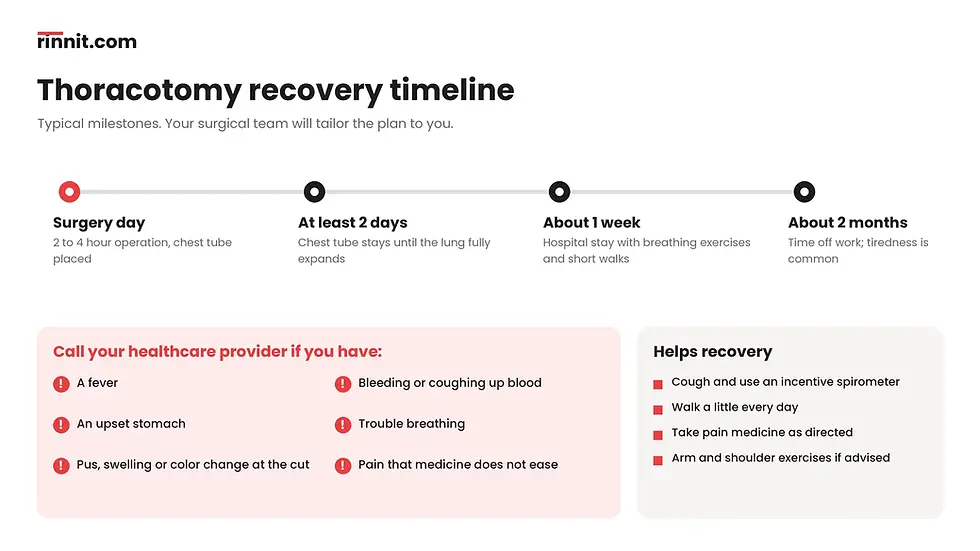
When should you call your doctor after a thoracotomy?
You should call your healthcare provider after a thoracotomy if you notice signs of infection, bleeding, breathing trouble or pain that medicine does not control. [1]
Call your provider if you have:
A fever
Bleeding, or you cough up blood
An upset stomach
Trouble breathing
Pus, swelling or skin color changes at the incision
Pain that doesn't improve with medicine
Keep all follow-up visits your provider schedules. [1]
How is a thoracotomy different from a sternotomy, thoracostomy or clamshell thoracotomy?
A thoracotomy differs from these procedures mainly in where the cut is made and how large it is. [1]
Procedure | Where the cut is | Main purpose |
Thoracotomy | Between two ribs | Open access to chest organs |
Sternotomy | Through the breastbone (sternum), which is divided and later rejoined | Open access through the front of the chest |
Thoracostomy | A much smaller cut for a tube into the pleural space (between the lung and chest wall) | Give medicines or drain fluid |
Clamshell thoracotomy | Combines part of a thoracotomy and a sternotomy | Better view of both the front and side of the chest |
Conclusion
A thoracotomy is a major but well-established operation that gives surgeons direct access to the heart, lungs, esophagus and other chest organs through a cut between the ribs. Knowing what happens before, during and after surgery can make it feel less frightening. Recovery takes time, usually about two months, and steady habits such as deep breathing, daily walks and good pain control help you heal. Ask your surgical team every question you have before a planned operation, and call them promptly if a warning sign appears.
Next step: If you or a loved one is facing chest surgery, read our related guides on lung resection and lung cancer, and save this page to bring your questions to your next appointment.
FAQ
What is a thoracotomy?
A thoracotomy is open chest surgery in which a surgeon makes a cut between two ribs to see or reach organs in the chest. It can be used to diagnose a condition or to treat one, such as lung cancer.
How long does thoracotomy surgery take?
Thoracotomy surgery usually takes two to four hours. It is done under general anesthesia, so you are asleep and feel no pain during the operation.
How long is the hospital stay after a thoracotomy?
The hospital stay after a thoracotomy is about one week. The chest tube stays in for at least two days and is removed once the lung has fully expanded.
How long does it take to recover from a thoracotomy?
Recovery from a thoracotomy usually means about two months off work. Feeling tired during this time is common, and daily walking and breathing exercises help recovery.
Is a thoracotomy a major surgery?
A thoracotomy is a major open surgery that requires general anesthesia and a hospital stay of about one week. Risks include infection, bleeding, pain, pleural effusion, pneumonia and partial lung collapse.
What is post-thoracotomy pain syndrome?
Post-thoracotomy pain syndrome is pain that lasts more than two months after a thoracotomy. Contact your provider if your pain does not improve with medicine.
What is the difference between a thoracotomy and a sternotomy?
A thoracotomy uses a cut between the ribs, while a sternotomy uses a cut through the breastbone. In a sternotomy, the surgeon divides the breastbone and then puts it back together.
When should I call my doctor after a thoracotomy?
Call your doctor after a thoracotomy if you have a fever, bleeding or coughing up blood, trouble breathing, an upset stomach, pus or swelling at the incision, or pain that medicine does not ease.
Will I have a chest tube after a thoracotomy?
Yes. Most people have one or more chest tubes after a thoracotomy to drain air, blood and fluid. They usually come out after a few days, once drainage slows and the lung has re-expanded.
When can I drive after a thoracotomy?
Do not drive while taking opioid pain medicine or until you can turn and move comfortably. Your surgeon will tell you when it is safe, which is often after a few weeks.
Related Reading
Video-Assisted Thoracic Surgery (VATS): Procedure and Benefits explains the minimally invasive alternative to open chest surgery.
Lobectomy: Lung Surgery, Recovery, Risks and Outlook describes removing a lobe of the lung, a common reason for thoracotomy.
Sternotomy: Procedure, Recovery Timeline, Wires and Warning Signs explains opening the chest through the breastbone and how it differs.
Intercostal Nerve Block: Uses, Procedure and Side Effects covers a nerve block used to ease pain between the ribs after surgery.
References
Cleveland Clinic. Thoracotomy: Purpose, Procedure, Risks & Recovery. Cleveland Clinic. Last updated February 12, 2026. https://my.clevelandclinic.org/health/treatments/22981-thoracotomy
Hireche K, Canaud L, Lounes Y, et al. Thoracoscopic Versus Open Lobectomy After Induction Therapy for Nonsmall Cell Lung Cancer: New Study Results and Meta-analysis. J Surg Res. 2022;276:416-432. PMID 35465975. https://doi.org/10.1016/j.jss.2022.04.002
Yeung JH, Gates S, Naidu BV, et al. Paravertebral block versus thoracic epidural for patients undergoing thoracotomy. Cochrane Database Syst Rev. 2016;2(2):CD009121. PMID 26897642. https://doi.org/10.1002/14651858.CD009121.pub2
Park SK, Yoon S, Kim BR, et al. Pre-emptive epidural analgesia for acute and chronic post-thoracotomy pain in adults: a systematic review and meta-analysis. Reg Anesth Pain Med. 2020;45(12):1006-1016. PMID 33055105. https://doi.org/10.1136/rapm-2020-101708
Further reading (external)
American Lung Association. Thoracotomy. American Lung Association. Last updated November 20, 2024. https://www.lung.org/lung-health-diseases/lung-procedures-and-tests/thoracotomy
Chang B, Tucker WD, Burns B. Thoracotomy. StatPearls. Last updated July 24, 2023. https://www.ncbi.nlm.nih.gov/books/NBK557600/
Alberta Health Services. Thoracotomy: What to Expect at Home. MyHealth.Alberta.ca. Last updated July 31, 2024. https://myhealth.alberta.ca/Health/aftercareinformation/pages/conditions.aspx?hwid=ud2451
Medical disclaimer
This article is for general education only and does not replace advice from your doctor or surgical team. Always talk with a qualified healthcare provider about your own diagnosis, surgery and recovery. If you have trouble breathing, cough up blood or have severe chest pain, seek emergency care right away.



Comments