Lung Resection: Types, Surgery, Recovery, Risks and Outlook

Updated: 3 days ago
Medically reviewed by Dr. Baraa Alnahhal, MD · Last reviewed: October 2026
Quick Answer: What is lung resection?
Lung resection, also called pulmonary resection, is surgery to remove part or all of a lung to treat cancer, infection, emphysema and other conditions or to obtain tissue for diagnosis. It may be minimally invasive or open. Recovery takes weeks to months. Seek emergency care for coughing up blood, sudden trouble breathing or sudden chest pain. [6]
What the research says
VATS lobectomy was linked to better overall survival than open lobectomy in an analysis of randomized trials. In an individual patient data meta-analysis of three randomized trials in early-stage non-small-cell lung cancer (1,185 patients; 586 VATS and 599 open), VATS lobectomy was associated with a 21% lower risk of death (pooled HR 0.79, 95% CI 0.65–0.96), while disease-free survival was similar (pooled HR 0.91, 95% CI 0.75–1.12) (Harris et al., Lancet, 2026). [3]
Segmentectomy was non-inferior to lobectomy for small peripheral cancers, with a trade-off in local relapse. In the JCOG0802 trial (1,106 patients with clinical stage IA non-small-cell lung cancer, tumor ≤2 cm), 5-year overall survival was 94.3% after segmentectomy versus 91.1% after lobectomy (HR 0.663, 95% CI 0.474–0.927). Local relapse was more common after segmentectomy (10.5% versus 5.4%), and grade 2 or worse complications occurred at similar rates (27% versus 26%) (Saji et al., Lancet, 2022). [4]
Several postoperative complications are linked to hospital readmission. In a meta-analysis of 11 studies (386,012 participants) of people who had pulmonary resection for lung cancer, those who developed postoperative empyema, pneumonia, air leak or arrhythmia had higher odds of readmission (Liu et al., Technol Cancer Res Treat, 2022). [5]

What is lung resection?
Lung resection is surgery to remove diseased, damaged or injured lung tissue. It may remove a small part of a lobe, an entire lobe or an entire lung. The procedure is major surgery, but people can live with part of a lung removed or with one lung. The effect on breathing and daily life depends on the amount removed, the health of the remaining lung and other conditions. [6]
A resection may also provide tissue for a biopsy. Examining that tissue can help diagnose cancer, infection such as tuberculosis, a lung nodule or an inflammatory lung disease such as pulmonary fibrosis. [6]
The lungs are divided into lobes. The left lung has two lobes and the right lung has three. This anatomy helps explain why the operation name matters: a wedge, segment, lobe and entire lung represent different amounts of tissue. [6]
What are the types of lung resection?
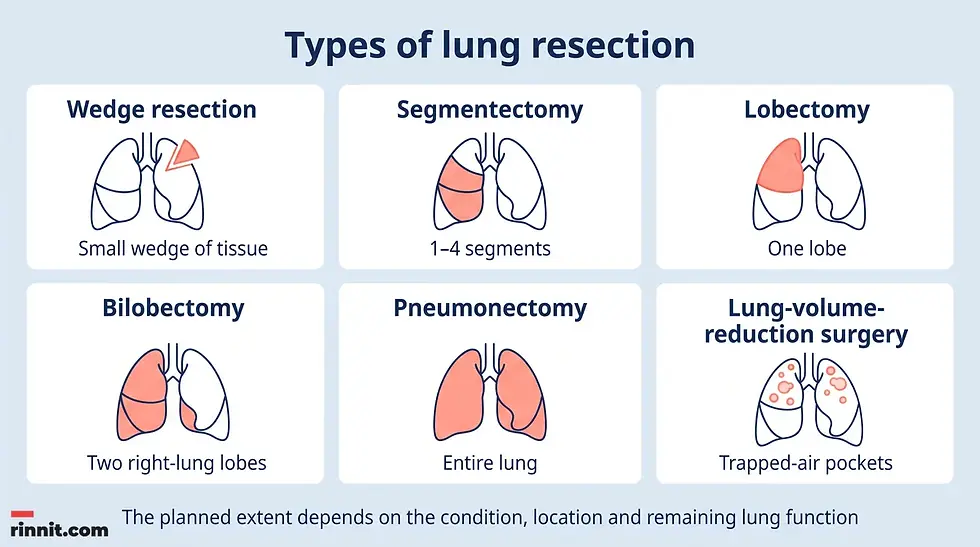
The type of lung resection planned depends on the condition being treated, its location and extent, the function of the remaining lung and the surgeon's assessment.
Type | What the surgeon removes | Main distinction |
Wedge resection | A wedge-shaped section of lung tissue | Removes a small area while preserving most of the lobe. |
Segmentectomy | One to four segments of a lobe | Preserves the remaining segments of that lobe. |
Lobectomy | One lobe | Removes a complete lobe; a sleeve resection may also involve part of the main bronchus. |
Bilobectomy | Two lobes of the right lung | Removes two of the right lung’s three lobes. |
Pneumonectomy | An entire lung | Removes all lung tissue on one side. |
Lung-volume-reduction surgery | Selected pockets containing trapped air | Used in selected cases of emphysema rather than to remove a tumor. |
The planned operation depends on the condition being treated, its location and extent, the function of the remaining lung and the surgeon’s assessment.
Why is lung resection performed?
A lung resection may be recommended to treat a disease, remove damaged tissue or obtain a tissue sample. Conditions mentioned in patient care discussions include lung cancer, cancer that has spread to the lung from another organ, benign tumors, lung nodules, bronchiectasis, emphysema, abscesses and blunt-force or penetrating injuries.
Some resections are also part of diagnosis. A tissue sample can help clarify whether a nodule is cancerous, whether an infection is present or whether inflammation has changed the lung. [6]
For cancer, surgery is most effective in some early-stage non-small-cell lung cancers that have not spread outside the lung and in some carcinoid tumors. Surgery cannot guarantee a complete cure. Chemotherapy or radiation may be needed afterward, depending on the diagnosis and treatment plan. [6]
How does lung resection surgery work?
Lung resection surgery is done through one of two broad routes, minimally invasive thoracoscopic surgery or open surgery. The surgeon chooses the approach based on the location and size of the area being removed, the condition being treated, the amount of tissue involved, overall health and technical considerations. [6]
Minimally invasive VATS or robotic VATS
Video-assisted thoracoscopic surgery, or VATS, uses a thoracoscope—a narrow tube with a light and camera—through small chest incisions. Robotic VATS uses robotic instruments controlled by the surgeon. These approaches can allow the surgeon to work through smaller incisions. [6]
People who have VATS or robotic VATS rather than thoracotomy tend to have less pain, fewer complications, a shorter recovery and a faster return to activities. These are general tendencies, not guarantees. Some operations require open access for safety or technical reasons.
Open thoracotomy
A thoracotomy uses an incision on the side of the chest. The surgeon spreads the ribs to reach the lung. Open surgery is more involved than thoracoscopic surgery and may require a longer activity limitation during recovery. [6]
How should someone prepare for lung resection?
The surgical team provides the preparation plan. Tell the team about every medicine, supplement and non-prescription product, and mention implanted devices such as a joint replacement, artificial heart valve or pacemaker.
Preparation may include not eating or drinking for a specified period, changing a medicine schedule only under professional direction, stopping smoking, planning several days in the hospital and arranging transportation home. Do not stop a medicine without instructions from the prescribing or surgical team.
Smoking can affect healing and lung function. If you smoke, ask the care team for support rather than trying to manage the timing alone.
Preparation area | Questions to discuss with the team |
Medicines | Which medicines, supplements or blood thinners need a specific plan? |
Implanted devices | Does a pacemaker, valve or joint replacement change the preparation? |
Food and drink | When should fasting begin, and which medicines can be taken with water? |
Smoking | What support is available to stop or reduce smoking before surgery? |
Hospital stay | How many nights are expected, and what should a support person know? |
Transportation | When will it be safe to travel home, and who should drive? |
Recovery at home | What equipment, help or follow-up appointments should be arranged? |
What tests may be needed before surgery?
The tests depend on the reason for surgery and the person’s health. Possible evaluations include blood tests, pulmonary-function tests, a chest X-ray, CT, heart tests such as an electrocardiogram or exercise stress test, MRI, PET scanning and bronchoscopy. [6]
These tests can help the team understand the condition, locate the area to be treated, assess breathing capacity and plan anesthesia or surgery. Not every person needs every test.
Test or evaluation | What it may help the team understand |
Blood tests | General health and readiness for surgery. |
Pulmonary-function tests | How well the lungs move air and exchange gases. |
Chest X-ray or CT | The location and appearance of a lung problem. |
ECG or exercise stress test | Aspects of heart rhythm or exercise response. |
MRI | Details of selected tissues when indicated. |
PET scan | Activity and distribution of certain diseases. |
Bronchoscopy | The airways and selected tissue areas. |
What happens during lung resection?
The patient is under general anesthesia and asleep. The provider makes one or more incisions in the chest or side. With thoracotomy or sternotomy, the surgeon may separate ribs to access the lung. With VATS or robotic VATS, a thoracoscope and long instruments enter through smaller incisions. [6]
The surgeon removes the planned diseased or damaged tissue. A chest drain is placed to remove excess fluid and air. The incision is closed, and the patient is taken to a recovery area to wake up under observation. [6]
The details vary according to the resection type, surgical route, condition, technique and amount removed. A lung resection may take about three to six hours, but the individual operating time can differ.
What happens after lung resection?
After surgery, the patient usually spends time in a recovery room and may stay in the hospital for about two to three days. The stay depends on the operation and how recovery is progressing. [6]
Many people have chest tubes for about 24 to 48 hours, although a tube may remain longer. The team watches breathing, pain, drainage, heart rhythm and other signs of recovery. [6]
Shortness of breath can occur after surgery. The care team may teach coughing or deep-breathing exercises to help keep the lungs clear. Temporary supplemental oxygen may be needed. Leg swelling can occur; worsening swelling after going home should be reported. [6]
What are the benefits of minimally invasive lung surgery?
When VATS or robotic VATS is appropriate, people tend to experience less pain, fewer complications, a shorter recovery and a faster return to activities than people who have thoracotomy. The best approach depends on the patient and the operation, so a smaller incision is not automatically the right choice.
The purpose of surgery may be to remove a cancer or other disease, improve symptoms, remove damaged tissue or obtain a diagnosis. The expected benefit depends on the condition and cannot be promised from the procedure name alone.
What are the risks and possible complications?
Like other major operations, lung resection carries risks. Possible complications include air leak, irregular heartbeat, bronchopleural fistula, bleeding in the chest, pneumonia, infection at the incision, pulmonary embolism and a reaction to anesthesia. [6]
A bronchopleural fistula is an abnormal passageway involving the lung and the space around it. A hemothorax is bleeding into the chest. A pulmonary embolism is a blood clot that travels to the lungs. These terms describe possible complications; they do not diagnose a person’s symptoms.
The amount of lung removed, the surgical route, the condition being treated, general health and other medical problems all affect risk. Ask the surgical team which complications are most relevant to the planned procedure and how they are monitored.
Possible complication | What it can involve |
Air leak | Air escaping from the lung after surgery and potentially prolonging chest-tube use. |
Arrhythmia | An irregular heartbeat that may require monitoring or treatment. |
Bronchopleural fistula | An abnormal passageway between an airway and the space around the lung. |
Hemothorax | Bleeding into the chest. |
Pneumonia | A lung infection during the recovery period. |
Incision infection | Infection around a surgical wound. |
Pulmonary embolism | A blood clot affecting blood flow in the lungs. |
Anesthesia reaction | A reaction to medicines used to keep the patient asleep. |
How long does lung-resection recovery take?
Recovery can take weeks to months. After thoracotomy, activity may be limited for about a month. After VATS or robotic VATS, some people return to regular activities in about two weeks. These are broad descriptions, not personal clearance to drive, work, exercise or lift. [6]
Recovery speed depends on the type of resection, the surgical approach, overall health and other medical conditions. The treating team decides when activities can resume.
Breathing may feel different at first. Coughing or deep-breathing exercises may help keep the lungs clear, and supplemental oxygen may be used for a short time. Give yourself time to regain stamina and ask for help with daily tasks if needed.

How can someone care for themselves after surgery?
Follow the provider’s instructions for keeping the lungs clear, caring for the incision, taking medicines and returning to activity. Do not use a general timeline as permission to change the plan.
Drink enough fluids to help keep bowel movements regular if the care team says fluids are appropriate. If constipation occurs, ask the provider whether fiber or another option is suitable. Report worsening leg swelling after going home.
Support from family or friends can be useful while stamina returns. Keep follow-up appointments and ask who to contact when a symptom is unexpected or difficult to manage.
Can people live with one lung or part of a lung removed?
People can live with part of a lung removed or with one lung, but the effect varies. Lung tissue heals after resection but does not grow back. Breathing capacity, activity tolerance and recovery depend on the remaining lung, the amount removed, overall health and other conditions. [6]
A surgical team can explain what the planned resection may mean for breathing and daily activities. Avoid comparing your recovery with another person’s experience.
What is the outlook after lung resection?
The outlook depends on why the surgery was performed, how much tissue was removed, the surgical approach, overall health and the course of recovery.
For cancer, surgery may be one part of a broader plan. Chemotherapy or radiation may be needed afterward. Even when surgery is intended to treat a cancer, no clinician can promise a complete cure in an individual case. [6]
Mortality risk varies by the type of resection, the condition treated, general health and other factors. Larger resections generally carry higher risk. Published estimates are population-level information and cannot predict one person’s outcome; ask the surgical team for individualized counseling.
When should someone call the surgical team?
Contact the healthcare provider promptly for blood that soaks through the incision bandage, excessive or discolored mucus, discolored or foul-smelling fluid around the incisions, fever, nausea or vomiting, or pain that prescribed medicine does not control.
Seek emergency care for coughing up blood, unexpected difficulty breathing, sudden chest pain with shortness of breath or loss of consciousness.
Symptom after surgery | Recommended response |
Blood soaking through the bandage | Contact the surgical team promptly. |
Excessive or discolored mucus | Contact the surgical team promptly. |
Discolored or foul-smelling incision fluid | Contact the surgical team promptly. |
Fever | Contact the surgical team promptly. |
Nausea or vomiting | Contact the surgical team promptly. |
Pain not controlled by prescribed medicine | Contact the surgical team promptly. |
Coughing up blood | Seek emergency care. |
Unexpected difficulty breathing | Seek emergency care. |
Sudden chest pain with shortness of breath | Seek emergency care. |
Loss of consciousness | Seek emergency care. |
What questions should you ask before lung resection?
Topic | Questions to discuss |
Purpose | What condition is the operation treating or diagnosing? |
Extent | How much lung or airway tissue is expected to be removed? |
Approach | Is VATS, robotic VATS or thoracotomy planned, and why? |
Testing | Which pulmonary, heart or imaging tests are needed? |
Anesthesia | What should be expected before and after general anesthesia? |
Chest tube | How long might a chest tube remain, and who explains its care? |
Breathing | Will breathing exercises or temporary oxygen be part of recovery? |
Activity | When can driving, work, lifting and exercise be reconsidered? |
Cancer care | Will additional chemotherapy, radiation or another treatment be discussed? |
Support | What help should be arranged for the first days at home? |
Warning signs | Which symptoms require a call, urgent evaluation or emergency care? |
Conclusion
Lung resection removes part or all of a lung to treat disease, injury or damage, or to provide tissue for diagnosis. The operation may be a wedge resection, segmentectomy, lobectomy, bilobectomy, pneumonectomy or selected lung-volume-reduction procedure. [6]
Surgeons may use VATS, robotic VATS or open thoracotomy. Preparation can include medication review, smoking support, fasting, pulmonary and heart testing, imaging, a hospital plan and transportation. After surgery, chest tubes, shortness of breath, breathing exercises, temporary oxygen and gradual activity may be part of recovery. [6]
Recovery can take weeks to months, and complications can include air leak, arrhythmia, fistula, bleeding, pneumonia, infection, blood clots and anesthesia reactions. Follow the surgical team’s instructions and seek prompt or emergency care for the warning signs described above. [6]
Frequently Asked Questions
What is lung resection?
Lung resection, or pulmonary resection, is surgery to remove part or all of a lung. It may treat disease or injury and can also provide tissue for diagnosis.
Why would someone need a lung resection?
Reasons can include lung cancer, cancer that spread to the lung, benign tumors, nodules, bronchiectasis, emphysema, abscesses, inflammation or lung injury.
What is the smallest type of lung resection?
A wedge resection removes a wedge-shaped section of lung tissue. The appropriate operation depends on the condition, location and surgical plan.
What is a segmentectomy?
A segmentectomy removes one to four portions, or segments, of a lung lobe while preserving the rest of that lobe.
What is a lobectomy?
A lobectomy removes one lobe of a lung. A sleeve resection is a form of lobectomy that can also remove part of a main bronchus and reconnect it to remaining healthy lung.
What is a pneumonectomy?
A pneumonectomy removes an entire lung. It is a larger resection than a wedge resection, segmentectomy or lobectomy.
Is lung resection always open surgery?
No. Surgeons may use VATS or robotic VATS through smaller incisions, or open thoracotomy. The approach depends on the operation and the person’s clinical situation.
How long does lung-resection surgery take?
A lung resection may take about three to six hours, but the time varies according to the resection, condition, approach and other circumstances.
How long is the hospital stay?
A stay of about two to three days is a common description, but the actual stay depends on the operation and recovery.
How long do chest tubes stay in?
Many people have chest tubes for about 24 to 48 hours, though a tube may stay longer depending on drainage and recovery.
How long does it take to recover from lung resection?
Recovery can take weeks to months. Some people return to regular activities in about two weeks after VATS or robotic VATS, while activity after thoracotomy may be limited for about a month. The surgical team decides what is safe for an individual.
Is shortness of breath normal after lung surgery?
Shortness of breath can occur after surgery. The care team may teach coughing or deep-breathing exercises, and temporary supplemental oxygen may be used. New or unexpected breathing difficulty needs prompt assessment.
Do lungs grow back after resection?
No. Lung tissue heals but does not grow back. People can live with part of a lung removed or with one lung, but the effect varies.
What are the risks of lung resection?
Risks can include air leak, irregular heartbeat, bronchopleural fistula, bleeding in the chest, pneumonia, incision infection, pulmonary embolism and anesthesia reactions.
Can lung resection cure cancer?
It can be an important treatment for some cancers, especially certain early-stage non-small-cell lung cancers and carcinoid tumors, but a complete cure cannot be promised. Additional chemotherapy or radiation may be needed.
Will someone need chemotherapy or radiation after surgery?
Some people do and some do not. The decision depends on the diagnosis, staging, tissue findings and overall treatment plan.
What tests are done before lung resection?
Possible tests include blood tests, pulmonary-function tests, chest X-ray, CT, heart testing, MRI, PET scan and bronchoscopy. The team selects tests based on the person and the planned operation.
Can someone smoke before lung resection?
Smoking can affect healing and lung function. Ask the surgical team for individualized support and instructions about stopping or reducing smoking.
What should someone tell the surgical team before surgery?
Tell the team about all medicines, supplements, non-prescription products, implanted devices, smoking and other health conditions. Do not stop any medicine without instructions.
What should someone do about constipation after surgery?
Follow the care team’s plan. Fluids may help keep bowel movements regular when appropriate, and a provider can advise whether fiber or another option is suitable.
When should someone call after lung resection?
Call promptly for blood soaking the incision bandage, excessive or discolored mucus, foul-smelling incision fluid, fever, nausea or vomiting, or pain not controlled by prescribed medicine.
When is lung-resection recovery an emergency?
Seek emergency care for coughing up blood, unexpected difficulty breathing, sudden chest pain with shortness of breath or loss of consciousness.
Related Reading
Lobectomy: Lung Surgery, Recovery, Risks and Outlook explains surgery to remove one lobe of a lung.
Pneumonectomy: Complete Guide to Lung Removal Surgery covers surgery to remove an entire lung and the recovery afterward.
Video-Assisted Thoracic Surgery (VATS): Procedure and Benefits describes the minimally invasive approach often used for lung surgery.
Lung Cancer: Symptoms, Causes, Diagnosis, and Treatment Explained explains lung cancer types, symptoms and treatment options.
References
American Lung Association. Lung Cancer Surgery. American Lung Association. Last updated June 22, 2026. https://www.lung.org/lung-health-diseases/lung-disease-lookup/lung-cancer/treatment/types-of-treatment/lung-cancer-surgery
NHS. Treatment for lung cancer. NHS website. Last reviewed August 20, 2026. https://www.nhs.uk/conditions/lung-cancer/treatment/
Harris RA, Law JJ, Hao L, et al. Survival outcome of VATS compared with open lobectomy for lung cancer: an individual patient data meta-analysis of randomised trials. Lancet. 2026;407(10534):1182-1190. PMID 41864749. https://doi.org/10.1016/S0140-6736(26)00031-0
Saji H, Okada M, Tsuboi M, et al. Segmentectomy versus lobectomy in small-sized peripheral non-small-cell lung cancer (JCOG0802/WJOG4607L): a multicentre, open-label, phase 3, randomised, controlled, non-inferiority trial. Lancet. 2022;399(10335):1607-1617. PMID 35461558. https://doi.org/10.1016/S0140-6736(21)02333-3
Liu J, Yang X, Liu X, et al. Predictors of readmission after pulmonary resection in patients with lung cancer: a systematic review and meta-analysis. Technol Cancer Res Treat. 2022;21:15330338221144512. PMID 36583561. https://doi.org/10.1177/15330338221144512
Cleveland Clinic. Lung Resection: Procedure, Types, Risks & Recovery. Cleveland Clinic. Last updated January 15, 2025. https://my.clevelandclinic.org/health/treatments/21868-lung-resection
Disclaimer
This article is for general educational purposes and is not a substitute for professional medical advice, diagnosis or treatment. Always seek the advice of a qualified healthcare professional with any questions about a medical condition or treatment.
The treating team must tailor diagnosis, surgical choice, medicines, testing, activity, breathing support, follow-up and urgent-care guidance to the person’s health, goals and risks. Do not use this article to self-diagnose or to decide whether surgery is appropriate.



Comments