Pneumonectomy: Complete Guide to Lung Removal Surgery

Updated: 1 day ago
Medically reviewed by Dr. Baraa Alnahhal, MD · Last reviewed: October 2026
Pneumonectomy is the surgical removal of an entire lung, typically to treat lung cancer or severe lung damage. Procedures range from standard removal to extrapleural surgery involving the surrounding linings. Full healing takes several months and involves significant lifestyle adjustments, and major risks include infection, heart rhythm problems, and respiratory failure.
Quick Answer
A pneumonectomy is a major surgical procedure that removes either the entire right or left lung. It is most often performed for lung cancer when a tumor cannot be removed by taking only part of the lung. It can be life-saving but carries a high risk of complications, and recovery takes several months as the body adjusts to one lung. [1]
What the research says
In a study of 406 pneumonectomy patients with lung cancer, about 1 in 3 were alive at 5 years, and left-sided surgery fared better. Thirty- and 90-day mortality were 3.2% and 6.2%, and 36.7% of patients developed complications, mainly arrhythmia, pulmonary infection, bronchopleural fistula, and acute respiratory distress syndrome. Overall survival was 82.7% at 1 year, 50.9% at 3 years, and 32.5% at 5 years, and patients who had a left pneumonectomy had a better prognosis than those who had a right pneumonectomy (Gu et al., J Cancer, 2017).
When lung removal was used for a lung destroyed by tuberculosis, long-term survival was high. In 73 patients, operative mortality was 6.8% and 39.7% had complications, yet 5- and 10-year survival were 88.9% and 76.2%. Four of the five bronchopleural fistulas occurred after right-sided surgery (Byun et al., Korean J Thorac Cardiovasc Surg, 2012).
Post-pneumonectomy syndrome is rare, and a prosthetic implant is the preferred fix. A systematic review of 41 studies covering 104 patients found that 87 were treated by repositioning the mediastinum with a prosthetic implant, which the authors call the treatment of choice. The main implant complications were leakage (8.9%) and over- or under-filling (8.5%) (Christodoulides et al., J Cardiothorac Surg, 2023).
Saving part of the lung, when possible, may be safer. Across 19 studies with 3,878 patients with lung cancer, sleeve lobectomy had lower postoperative mortality than pneumonectomy (odds ratio 0.50) and better long-term survival (hazard ratio 0.63) (Shi et al., World Journal of Surgical Oncology, 2012).
Pneumonia is a key risk after lung removal. In 17 studies with 21,104 patients having lung cancer surgery, pneumonectomy raised the odds of postoperative pneumonia (odds ratio 1.75), and pneumonia was linked to much higher mortality (odds ratio 12.12) (Sheervalilou et al., Lung India, 2026).
Research summaries are based on article abstracts retrieved from PubMed.
What is a pneumonectomy?
A pneumonectomy is the most extensive form of lung resection surgery. Unlike a lobectomy or wedge resection, which only removes a specific portion of the lung, a pneumonectomy involves the total removal of the entire organ. This procedure is generally reserved for cases where less invasive surgeries are insufficient to address the underlying condition. [1]
The surgery is classified based on which side is operated upon: a right-sided pneumonectomy removes the right lung, while a left-sided pneumonectomy removes the left. Because of anatomical differences, right-sided pneumonectomies carry a higher risk of complications than left-sided ones. [1]

What are the types of pneumonectomy procedures?
The two main types of pneumonectomy are a standard pneumonectomy and an extrapleural pneumonectomy, chosen based on the extent of disease and overall health. There are two primary categories of this surgery:
Standard Pneumonectomy: The surgeon removes the entire lung and, in some cases, nearby nerves or tissue that may be affected by disease.
Extrapleural Pneumonectomy: This is a more complex procedure often used for mesothelioma. It involves removing the lung along with the pleura (chest lining), the pericardium (heart lining), and parts of the diaphragm. [1]
Feature | Standard Pneumonectomy | Extrapleural Pneumonectomy |
Organs Removed | Entire lung only | Lung, pleura, pericardium, diaphragm |
Common Use | Lung cancer | Pleural mesothelioma |
Complexity | High | Very High |
Recovery Time | Several months | Extended recovery |
Who needs a pneumonectomy, and who is a good candidate?
The most common reason for a pneumonectomy is to treat lung cancer that has not spread to other parts of the body but is positioned such that partial removal is not possible. Other indications include severe lung injuries, chronic infections like tuberculosis, or fungal infections such as aspergillosis. [1]
It is also used for pleural mesothelioma, lung carcinoid tumors and disseminated thymoma, and for bronchiectasis. [1]
Before surgery, patients must undergo extensive testing to ensure they can survive with only one lung. These tests evaluate heart function and the respiratory capacity of the remaining lung. Individuals with severe heart valve disease, severe pulmonary hypertension, or inadequate lung function are typically not candidates for this major procedure. [1]
These tests include a VQ scan, pulmonary function tests and an echocardiogram, and people who smoke are advised to stop. [1]
What happens during a pneumonectomy?
A pneumonectomy can be performed using a traditional thoracotomy, which involves a large incision in the side and back, or via video-assisted thoracic surgery (VATS), which is less invasive but not always an option. During the procedure, the patient is placed under general anesthesia. The surgeon separates the ribs to access the lung, deflates it, and removes it through the incision. [1]
You lie on your side during the operation, which can take several hours; an extrapleural pneumonectomy takes longer. Most of the time, surgeons do not put in a drain. [1]

What is recovery and long-term outlook after a pneumonectomy?
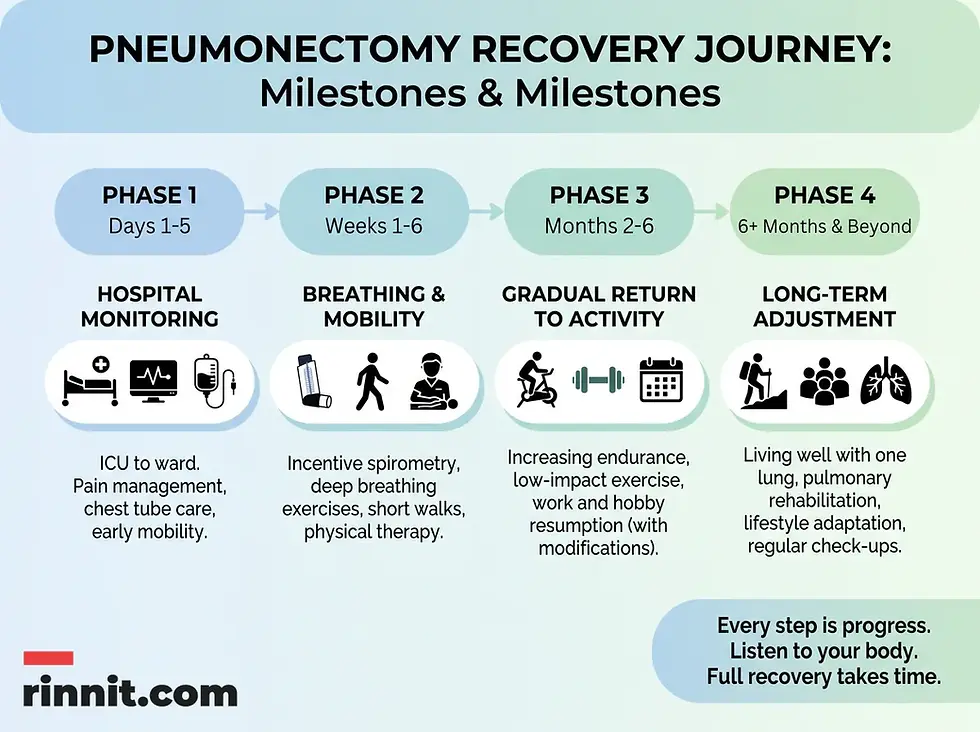
Recovery from a pneumonectomy is a gradual process that begins with several days in the hospital for close monitoring. Right after surgery, air fills the empty space where the lung used to be, and over time fluid replaces the air. The remaining lung may expand slightly, and the heart, diaphragm, and other structures shift toward the new space. [1]
In the hospital, the care team monitors oxygen levels, heart rate and blood pressure, gives pain medicine and guides breathing exercises each day. You may need oxygen through a tube under the nose at first, and you may feel more tired than usual and need to take frequent breaks. [1]
Patients often face activity restrictions, including limits on driving and heavy lifting, and full recovery takes several months. Physical therapy is frequently recommended to help the body adapt to its new “normal” and to improve breathing efficiency. [1]
What are the potential risks and complications of a pneumonectomy?
As a major surgery, pneumonectomy carries significant risks. Complications can occur immediately after the operation or develop months later. Common risks include pneumonia, heart rhythm abnormalities (arrhythmias), and infections in the chest cavity (empyema). [1]
Other risks include cardiac arrest and bronchopleural fistula. [1]
One rare but serious complication is postpneumonectomy syndrome, where the shifting of internal organs blocks the remaining airways. This can happen years after the initial surgery and requires medical intervention. [1]
Conclusion
Pneumonectomy is a significant medical intervention that offers a chance at recovery for those with advanced lung disease or cancer. While the procedure is complex and the recovery demanding, it can be a life-saving measure when other treatments are not viable. Patients should work closely with their surgical team to prepare for the lifestyle changes that come with living with a single lung. If you or a loved one are preparing for lung surgery, consult with a thoracic specialist to understand the best path forward.
Frequently Asked Questions
What is the main reason for a pneumonectomy?
The most frequent reason is to treat lung cancer that cannot be removed by taking only a portion of the lung.
Can you live a normal life with only one lung?
Yes, many people lead active lives with one lung, though they may experience shortness of breath during intense physical activity.
How long does the surgery take?
A pneumonectomy typically takes several hours, depending on the complexity and the specific type of procedure performed.
What fills the empty space after the lung is removed?
The space first fills with air, which is gradually replaced by fluid, while the heart, diaphragm, and other structures shift toward it.
Is a right-sided pneumonectomy more dangerous than a left-sided one?
Generally, yes. Because of anatomical differences, right-sided pneumonectomies carry a higher risk of complications than left-sided ones.
What are the most common complications?
Common risks include pneumonia, infection, heart rhythm issues, and fluid buildup in the chest.
How long is the hospital stay?
Patients usually remain in the hospital for several days for close monitoring of their vital signs and oxygen levels.
When can I return to work after surgery?
Recovery varies, but most patients require several months before they can return to full-time work or school.
Will I need oxygen after surgery?
Some patients may need supplemental oxygen temporarily during their recovery period as the remaining lung adjusts.
What tests are needed before surgery?
Pre-operative tests usually include CT scans, pulmonary function tests, and heart evaluations like an echocardiogram.
Related Reading
Lobectomy: Lung Surgery, Recovery, Risks and Outlook describes surgery to remove a single lung lobe instead.
Lung Cancer: Symptoms, Causes, Diagnosis, and Treatment Explained covers lung cancer, the most common reason for pneumonectomy.
Pulmonary Rehabilitation: Managing Chronic Lung Disease Through Exercise and Education explains a program that rebuilds breathing and fitness after lung surgery.
References
Cleveland Clinic. Pneumonectomy. Cleveland Clinic Health Library. Last updated May 20, 2023. https://my.clevelandclinic.org/health/treatments/25003-pneumonectomy
Gu C, Wang R, Pan X, et al. Comprehensive study of prognostic risk factors of patients underwent pneumonectomy. J Cancer. 2017;8(11):2097-2103. PMID: 28819411. https://doi.org/10.7150/jca.19454
Byun CS, Chung KY, Narm KS, et al. Early and Long-term Outcomes of Pneumonectomy for Treating Sequelae of Pulmonary Tuberculosis. Korean J Thorac Cardiovasc Surg. 2012;45(2):110-115. PMID: 22500281. https://doi.org/10.5090/kjtcs.2012.45.2.110
Christodoulides N, Fitzmaurice GJ, Bukowska I, et al. Post-pneumonectomy syndrome: a systematic review of the current evidence and treatment options. J Cardiothorac Surg. 2023;18(1):119. PMID: 37038182. https://doi.org/10.1186/s13019-023-02278-2
Shi W, Zhang W, Sun H, et al. Sleeve lobectomy versus pneumonectomy for non-small cell lung cancer: a meta-analysis. World J Surg Oncol. 2012;10:265. PMID: 23231962. https://doi.org/10.1186/1477-7819-10-265
Sheervalilou M, Ghanei M, Arabfard M. Clinical predictors and mortality of postoperative pneumonia following pulmonary resection in patients with lung cancer: A systematic review and meta-analysis. Lung India. 2026;43(1):67-77. PMID: 41474431. https://doi.org/10.4103/lungindia.lungindia_253_25
Medical disclaimer
This article is for informational purposes only and is not a substitute for professional medical advice, diagnosis, or treatment. Always seek the advice of your physician or other qualified health provider with any questions you may have about a medical condition.



Comments