Intercostal Nerve Block: Uses, Procedure and Side Effects

Updated: 2 days ago
Written and medically reviewed by Dr. Baraa Alnahhal, MD · Last reviewed: November 2026 · How we review
Quick Answer
An intercostal nerve block is an injection under a rib that relieves pain in the chest or upper abdomen. The shot contains a local anesthetic and usually a steroid. It's used for pain from rib fractures, shingles and surgery. It takes only minutes, and the steroid's relief starts in two to three days and can last several months.
What the research says
The block eased pain after chest surgery: in a review of 66 studies with 5,184 people, intercostal nerve blocks lowered resting pain by about 1.3 to 1.4 points on a 10-point scale in the first day after chest surgery and reduced opioid use at 48 hours (Guerra-Londono CE et al., JAMA Network Open, 2021) [2]
It gave strong but short relief for broken ribs: in a trial of adults with up to six rib fractures, an intercostal block gave more pain relief in the first 4 hours than another type of chest block, but it wore off sooner and 43.3% needed extra pain medicine; neither group had complications (Zengin M et al., BMC Anesthesiology, 2025) [3]
Key takeaways
An intercostal nerve block numbs a nerve under a rib.
It treats chest and upper belly pain.
It helps with rib fractures, shingles and surgery pain.
Steroid relief starts in two to three days.
Serious complications are rare.
What is an intercostal nerve block?
It's a type of nerve block. The intercostal nerves sit alongside the intercostal muscles between your ribs, and they're easier to reach than many other nerve block sites. Sources: [1]
What it's used for
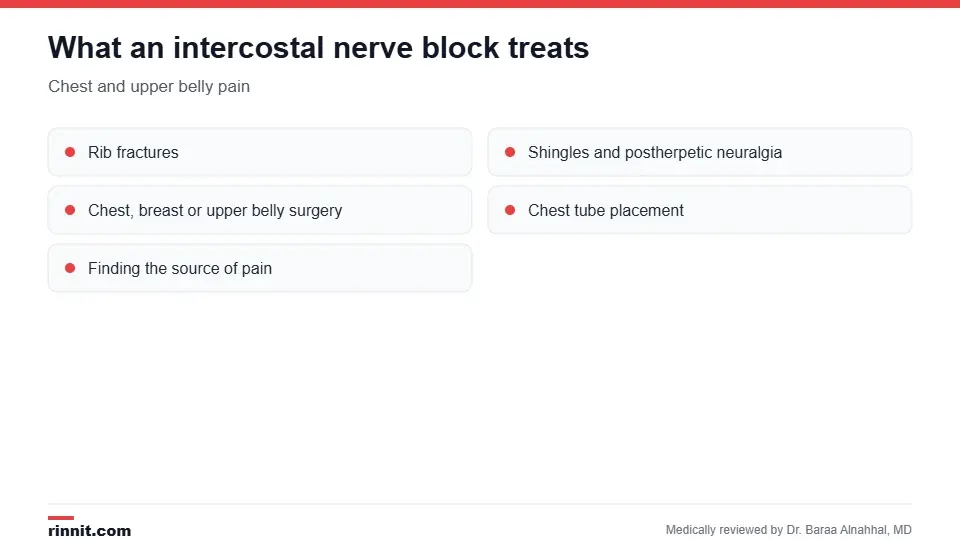
It can give temporary relief and let nerves heal.
Acute or chronic chest or upper belly pain.
Pain control for chest surgery, chest tube placement, breast surgery or upper belly surgery.
Finding out whether pain comes from organs or from muscles, skin or joints. Sources: [1]
How to prepare
Usually no special preparation is needed.
Tell your provider if you take blood thinners, but don't stop them without your prescriber's OK.
If you'll get sedation, fast for six to eight hours and arrange a ride home. Sources: [1]
What happens during the block

It's a quick outpatient procedure.
You lie on your side (the pain-free side) or on your stomach.
You may get a mild sedative through an IV.
The skin is cleaned and numbed; you may feel a pinch.
Ultrasound or X-ray may guide the needle.
Medicine is injected as close to the nerve as possible.
You rest 15 to 30 minutes while a nurse watches you. Sources: [1]
Risks
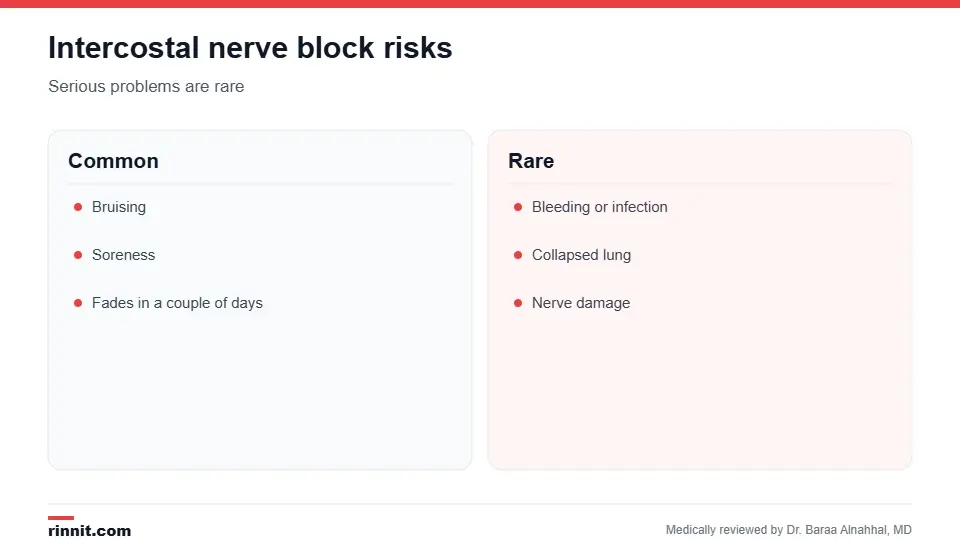
Serious complications are rare.
Type | Examples |
Common | Bruising or soreness at the injection site, fading in a couple of days |
Rare | Bleeding, infection, collapsed lung, nerve damage |
Sources: [1, 3]
Recovery and results
Some people feel relief right away.
Pain may return a few hours later as the numbing medicine wears off.
Longer relief usually starts in two to three days as the steroid works.
Relief may last several months for some people.
Repeat injections may be an option if it helps. Sources: [1]
Some people get no relief and may need other treatments. Sources: [1, 2]
When to call your provider
Fever, redness or pus at the injection site.
Weakness or tingling. Get emergency care for new shortness of breath or chest pain, which can signal a collapsed lung.
Any new symptoms. Sources: [1]
Conclusion
An intercostal nerve block can quiet painful rib nerves and ease chest or upper belly pain from injury, shingles or surgery. Talk with your provider about whether repeat blocks could help you.
Keep learning: read about nerve blocks and rib fractures.
Frequently asked questions
What is an intercostal nerve block?
An injection under a rib that numbs a painful nerve.
What does it treat?
Chest or upper belly pain from injury, shingles or surgery.
What's in the injection?
A local anesthetic and usually a steroid.
Does it hurt?
You may feel a pinch; the skin is numbed first.
How long does it take?
A few minutes, plus 15 to 30 minutes of rest.
When will I feel relief?
Numbing works fast; steroid relief starts in two to three days.
How long does relief last?
It varies; for some, several months.
Can it help broken ribs?
Yes. It's used for rib fracture pain.
What are the risks?
Soreness and bruising; rarely, a collapsed lung or infection.
Should I stop my blood thinner?
Not without talking to your prescriber.
Related Reading
Understanding Nerve Blocks: A Comprehensive Guide to Targeted Pain Relief an overview of nerve blocks.
Rib Fracture: Symptoms, Causes, and Recovery Guide a common reason for the block.
Postherpetic Neuralgia: Symptoms, Causes, Diagnosis, and Treatment nerve pain after shingles.
Intercostal Muscles: Anatomy, Function, and Common Conditions the muscles between the ribs.
Thoracic Surgery: Types, Risks and Recovery Explained chest surgery.
References
Cleveland Clinic. Intercostal Nerve Block: What It Is, Procedure, & Side Effects. Cleveland Clinic. Last updated March 1, 2023. https://my.clevelandclinic.org/health/treatments/17134-intercostal-nerve-block
Guerra-Londono CE, Privorotskiy A, Cozowicz C, et al. Assessment of intercostal nerve block analgesia for thoracic surgery: a systematic review and meta-analysis. JAMA Network Open. 2021;4(11):e2133394. PMID 34779845. https://doi.org/10.1001/jamanetworkopen.2021.33394
Zengin M, Küçük O, Aslan M, et al. Comparison of the analgesic efficacy of ultrasound-guided superficial serratus anterior plane block and intercostal nerve block for rib fractures: a randomized controlled trial. BMC Anesthesiology. 2025;25(1):122. PMID 40082780. https://doi.org/10.1186/s12871-025-03000-6
Medical disclaimer
This article is for general education only and does not replace advice from a qualified healthcare professional. Talk to your doctor about your own diagnosis and treatment, and seek emergency care right away for severe or sudden symptoms.



Comments