Rib Fracture: Symptoms, Causes, and Recovery Guide

Updated: 2 days ago
Medically reviewed by Dr. Baraa Alnahhal, MD · Last reviewed: October 2026
Quick Answer: What is a rib fracture?
A rib fracture, or broken rib, is a crack or break in a rib bone, usually from a direct impact such as an accident, fall or sports [1]. It causes localized pain, especially with deep breaths or coughing [1] [2]. Most heal at home with rest, ice and pain relievers, but complications like pneumonia or a collapsed lung can occur [1] [2].
Emergency warning
Go to the emergency room right away after any serious trauma [1], or if you have any of the following:
What the research says
Breathing exercises matter, especially for older adults. A joint practice guideline and meta-analysis of 151 studies on older adults with multiple rib fractures found that poor performance on incentive spirometry (a device that trains deep breathing) was linked with longer hospital stays, lung complications, and unplanned ICU admission, and it recommended using the device to help decide who needs intensive care (Mukherjee et al., J Trauma Acute Care Surg, 2023) [3].
Surgery helps some serious injuries, but not every outcome. In a meta-analysis of 8 randomized trials in adults (752 patients, 372 assigned to rib fixation), surgery reduced time on a ventilator, ICU and hospital stays, pneumonia, and tracheostomy, but it did not improve quality of life at 6 months (Sharma et al., Injury, 2024) [4].
The benefit of surgery is less clear at very advanced ages. Across 10 studies of 98,004 patients aged 60 or older (2,478 had surgery), surgery was linked with lower mortality (risk ratio 0.61) but longer hospital stays, and there was no significant mortality difference in patients aged 80 or older (Jiang et al., J Thorac Dis, 2026) [5].
What Is a Rib Fracture?
A rib fracture occurs when one or more of the bones in the rib cage are broken. Ribs are sturdy bones, so breaking one without a major trauma such as a car accident or fall is uncommon [1]. About 30% of people who have a trauma to the chest break at least one rib [1]. However, in people with weakened bones, even a minor event such as a severe cough can cause a break [1].
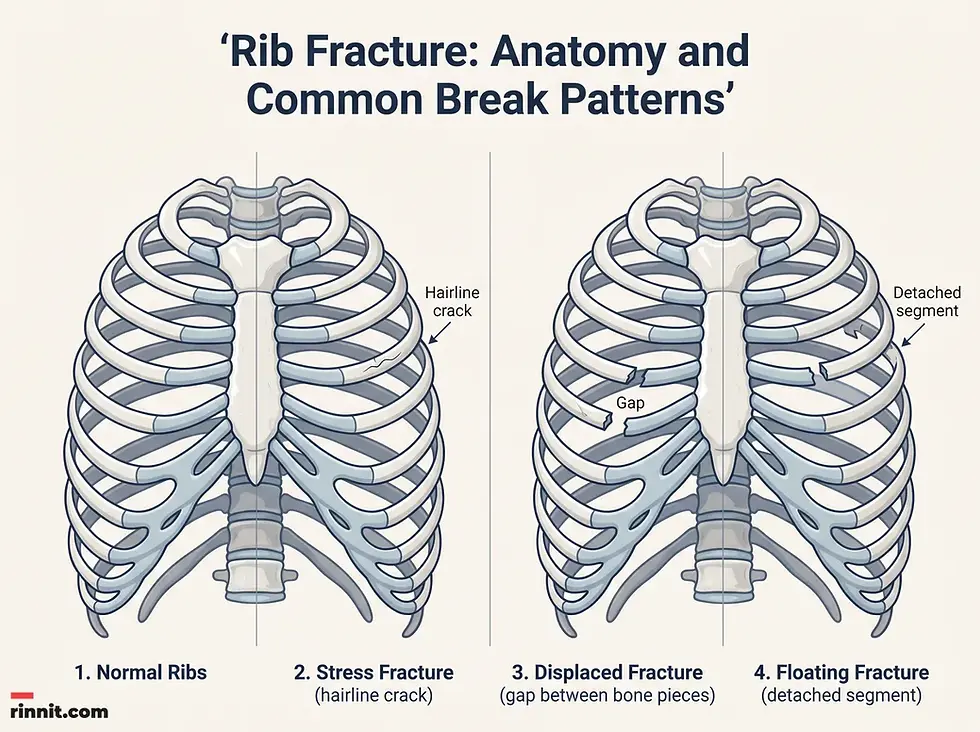
Healthcare providers classify these fractures by the pattern of the break:
Stress fracture [1]: A small crack caused by repetitive stress.
Avulsion fracture [1]: A small piece of bone is pulled away by a ligament or tendon.
Comminuted fracture [1]: The bone breaks into several pieces.
Floating fracture [1]: A segment of the rib cage breaks and becomes detached from the rest of the chest wall (see our guide to flail chest).
Fractures are also described as displaced (the bone pieces have moved far enough that a gap forms) or non-displaced (the bone is broken but stays in its original position) [1]. Displaced fractures are much more likely to need surgery [1].
What are the symptoms and complications of a rib fracture?
The most common sign of a rib fracture is pain that gets worse when you breathe, cough, or move your chest and upper body [1] [2]. Tenderness and bruising or discoloration are also common [1]. Pain can lead to a dangerous cycle: people avoid deep breathing to reduce the pain, which raises the risk of lung infection [1] [2]. The muscles between the ribs (see our guide to the intercostal muscles) move with every breath, which is why breathing hurts so much. Chest wall pain can also come from other problems, such as costochondritis, so it is important to have it checked.
Potential complications
To learn more about this lung infection, see our complete guide to pneumonia.
What causes rib fractures, and who is at risk?
Osteoporosis and fall risk raise the chance of rib fractures, but the leading cause is a direct impact to the chest [1]. This often happens in:
Atraumatic causes (breaks not caused by a specific injury) include severe or persistent coughing, cancers that have spread to the bone, and osteoporosis [1]. Osteoporosis is a major risk factor because weakened bones are more likely to break, even during everyday activities. Being at risk of falls also raises your chances of a rib fracture [1]. Children break ribs less often than adults because their bones are much more flexible [1].
How is a rib fracture diagnosed?
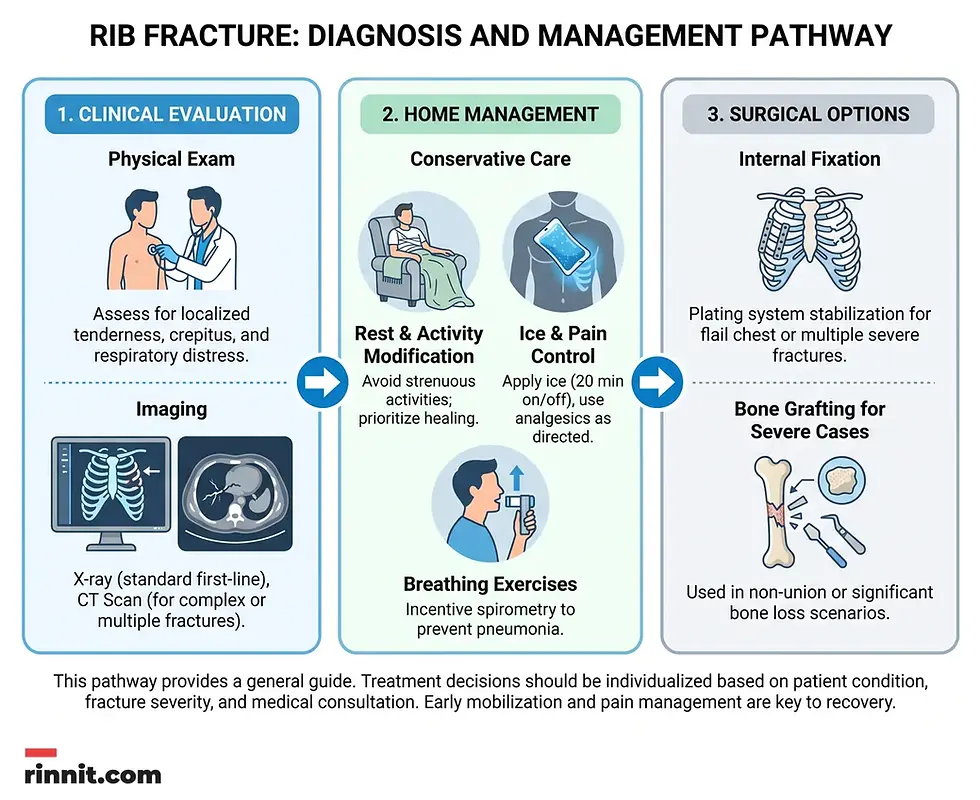
A rib fracture is diagnosed starting with a physical exam to check for tenderness and to listen to the lungs. Imaging tests may then be used to confirm the fracture and check for internal damage [1]:
X-rays: Confirm the break and show how damaged the bones are [1]. Small breaks do not always show up on X-rays.
CT scan: Gives a more detailed picture than an X-ray. It is used if X-rays are inconclusive or to plan surgery [1].
MRI: Shows damage to the soft tissues, muscles, and organs around the ribs [1].
How is a rib fracture treated, and what is recovery like?
Most rib fractures do not need surgery and can be managed at home [1] [2]. The goals of treatment are to control pain so you can breathe deeply and to prevent lung complications [2].
Home management
Rest and icing: Apply ice for about 20 minutes at a time, a few times a day [1]. Wrap the ice pack in a cloth first [2].
Pain relief: Over-the-counter anti-inflammatory medicines such as ibuprofen or aspirin are usually recommended [1] [2] (see our guide to NSAIDs). Check with your provider first if you have heart, kidney, or liver disease, high blood pressure, or a history of stomach ulcers or bleeding [2].
Breathing exercises: You may be asked to take slow deep breaths and cough on purpose every few hours, or to use a breathing device, to keep your lungs clear [1] [2]. Pressing a pillow against the injury can reduce the pain during these exercises [1] [2].
Stay active: Avoid intense workouts and sports, but keep moving and breathing as normally as you can [1]. Do not rest in bed all day [2].
Do not wrap or tape your chest. A tight wrap keeps the ribs from moving when you breathe or cough, which raises the risk of pneumonia [2].
Surgical options
Surgery is rare. It is usually reserved for serious internal injuries or for bones that fail to heal properly (nonunion or malunion) [1].
How long does recovery take?
Most people need at least a month to recover [1], and healing often takes about six weeks or longer [2]. Recovery can take longer if other organs were injured [1]. You should expect to make a full recovery [1]. Talk to your provider before returning to sports or other physical activity [1].
When to call your healthcare provider
Contact your provider if you have pain that prevents deep breathing or coughing despite pain relievers, a fever, a cough that brings up more mucus or blood, or shortness of breath [2].
How can rib fractures be prevented?
Rib fractures cannot always be prevented, but seatbelts, protective gear, a clutter-free home, bone-healthy habits and walking aids can lower your risk.
Always wearing a seatbelt [1].
Wearing the right protective gear for sports and other activities [1].
Keeping your home and workspace free of clutter that could cause a trip, and never standing on chairs, tables, or countertops to reach things [1].
Following a diet and exercise plan that supports bone health [1], including enough calcium and vitamin D.
Using a cane or walker if you have trouble walking or a higher risk of falls [1].
Talking to your doctor about a bone density test if you are over 50 or have a family history of osteoporosis [1].

Conclusion
A rib fracture is a painful injury that needs careful attention, even when you recover at home. By focusing on pain control and breathing exercises, most people with an isolated rib fracture make a full recovery. If you suspect a broken rib, get medically evaluated to rule out serious internal injuries.
What are the next steps if you have a rib fracture?
If you have had a chest injury, see a healthcare provider for an exam and, if needed, imaging. Rest, follow your breathing exercise instructions to help prevent pneumonia [1] [2], and stay as active as your provider allows. If you have osteoporosis, ask your doctor about a long-term bone health plan to help prevent future fractures.
Trusted resources: Cleveland Clinic: Rib Fracture, MedlinePlus: Rib fracture - aftercare.
Frequently Asked Questions
How long does it take for a broken rib to heal?
Most people need at least a month, and healing often takes about six weeks or longer. Severe injuries or complications can take longer.
Can I sleep on my side with a broken rib?
Sleep in whatever position is most comfortable and lets you breathe deeply. If you are unsure, ask your provider which position is best for your injury.
Should I wrap my chest if I have a broken rib?
No. Wrapping or taping the chest keeps the ribs from moving when you breathe, which can limit deep breathing and raise the risk of pneumonia.
Can a cough really break a rib?
Yes. Severe or persistent coughing can cause a rib fracture, especially in people with weakened bones or osteoporosis.
When can I return to sports after a rib fracture?
Talk to your provider first. Avoid intense workouts and sports until your provider says the bone has healed, which usually takes at least a month.
Is a “cracked” rib the same as a “broken” rib?
Yes. In medical terms, any crack or break in a bone is a fracture.
Why does it hurt so much to breathe?
Your ribs move every time you breathe, cough, or move your upper body, and the muscles used for breathing attach to the ribs. A fracture makes each of these movements painful.
Can a broken rib puncture a lung?
Yes. A broken rib can injure the lung and cause a collapsed lung (pneumothorax).
Do I need an X-ray for a suspected broken rib?
A provider can diagnose a rib fracture with a physical exam and will often order imaging, such as an X-ray or CT scan, to check for other injuries. Small breaks do not always show up on X-rays.
Can I drive with a broken rib?
Ask your provider. In general, avoid driving until you can move comfortably, pain does not limit your reactions, and you are not taking medicines that cause drowsiness.
What is a “floating” rib fracture?
A “floating” rib fracture happens when a segment of the rib cage breaks in more than one place and becomes detached from the rest of the chest wall.
Does smoking affect rib healing?
Yes. Smoking can slow bone healing and raise the risk of lung complications such as pneumonia.
How can I tell if my lung has collapsed?
Signs include sudden sharp chest pain and increasing difficulty breathing. This is a medical emergency, so go to the emergency room right away.
What are breathing exercises for rib fractures?
Breathing exercises for rib fractures usually involve slow, deep breaths and gentle coughing every couple of hours to keep the lungs clear. Holding a pillow against the injured area can make them less painful, and your provider may add a breathing device called an incentive spirometer.
Can children break ribs easily?
No. Children’s bones are more flexible than adults’, so they break ribs less often.
Related Reading
Intercostal Nerve Block: Uses, Procedure and Side Effects explains intercostal nerve blocks.
Chest X-Ray (CXR): What It Shows, How It's Done and What Results Mean explains how a chest X-ray is used to check for broken ribs after a chest injury.
References
Cleveland Clinic. Rib Fracture. Cleveland Clinic. December 9, 2022. https://my.clevelandclinic.org/health/diseases/17434-rib-fracture-broken-rib
MedlinePlus. Rib fracture - aftercare. National Library of Medicine. April 13, 2026. https://medlineplus.gov/ency/patientinstructions/000539.htm
Mukherjee K, Schubl SD, Tominaga G, et al. Non-surgical management and analgesia strategies for older adults with multiple rib fractures: a systematic review, meta-analysis, and joint practice management guideline from the Eastern Association for the Surgery of Trauma and the Chest Wall Injury Society. J Trauma Acute Care Surg. 2023;94(3):398-407. PMID 36730672. https://doi.org/10.1097/TA.0000000000003830
Sharma VJ, Summerhayes R, Wang Y, et al. Surgical stabilisation of rib fractures: a meta-analysis of randomised controlled trials. Injury. 2024;55(8):111705. PMID 38945079. https://doi.org/10.1016/j.injury.2024.111705
Jiang H, Xie Y, Luo J, et al. Clinical value of surgical intervention and decision-making dilemmas for elderly patients of rib fractures: a systematic review and meta-analysis. J Thorac Dis. 2026;18(2):148. PMID 41816451. https://doi.org/10.21037/jtd-2025-1-2480
Medical disclaimer
This article is for informational purposes only and does not constitute medical advice. Rib fractures can have life-threatening complications. Always seek the advice of your physician or other qualified health provider with any questions you may have regarding a medical condition. Never disregard professional medical advice or delay in seeking it because of something you have read in this article.



Comments