Flail Chest: Symptoms, Causes, Diagnosis, Treatment and Outlook — What You Need to Know

Updated: 2 days ago
Medically reviewed by Dr. Baraa Alnahhal, MD · Last reviewed: September 2026
TL;DR
Flail chest is a life-threatening medical emergency that occurs when a segment of the rib cage breaks under extreme stress and becomes detached from the rest of the chest wall. This condition is defined by three or more adjacent ribs breaking in at least two places, creating a "flail" segment that moves independently. The hallmark sign is paradoxical breathing, where the injured section moves inward during inhalation and outward during exhalation—the opposite of normal chest movement. Typically caused by high-impact blunt force trauma such as car accidents or falls, flail chest requires immediate hospitalization, often involving intensive care, mechanical ventilation, and sometimes surgical rib fixation. While recovery is a long process that can take months, rapid medical intervention significantly improves the outlook for a complete recovery.
MEDICAL EMERGENCY WARNING Flail chest is a life-threatening condition. Call 911 or go to the nearest emergency room (ER) immediately if you have experienced a chest injury and have any of the following symptoms:
Severe chest pain that makes breathing difficult
Shortness of breath or gasping for air
Cyanosis (blue tint to the skin, lips, or fingernails)
Visible deformity or uneven movement of the chest wall
Coughing up blood or excessive mucus
Extreme weakness, dizziness, or confusion
Quick Answer: What is Flail Chest?
Flail chest is a severe thoracic injury where a portion of the rib cage breaks and separates from the chest wall, becoming unstable. It occurs when three or more neighboring ribs are fractured in two or more places each. This creates a free-floating segment of bone that no longer moves in sync with the rest of the chest. Instead, it exhibits "paradoxical movement," sinking in when you breathe in and bulging out when you breathe out. This instability makes it extremely difficult and painful to breathe effectively, often leading to serious complications like lung bruising (pulmonary contusion) or respiratory failure. Because it is almost always caused by significant blunt force trauma, it is considered a major medical emergency requiring urgent professional treatment.
What Is Flail Chest?
Flail chest is a critical medical condition characterized by extreme instability in the chest wall. Under normal circumstances, the entire rib cage moves outward as a single unit to allow the lungs to expand with air. In a flail chest injury, the structural integrity of this cage is compromised because a specific section of ribs has been broken in multiple locations. This detached segment is referred to as a "flail segment."
The most distinctive feature of this condition is paradoxical chest movement. Because the flail segment is no longer attached to the rest of the rib cage, it responds to the pressure changes inside the chest rather than the movement of the respiratory muscles. When a person with flail chest inhales, the negative pressure pulls the unstable segment inward while the rest of the chest expands. When they exhale, the segment is pushed outward while the rest of the chest contracts. This inefficient movement, combined with intense pain, significantly impairs the body's ability to take in oxygen and release carbon dioxide.
Key Characteristic | Description |
Alternative Names | Chest wall instability, Chest wall deformity |
Medical Definition | 3+ adjacent ribs broken in 2+ places |
Hallmark Sign | Paradoxical chest movement (opposite of normal breathing) |
Primary Cause | Blunt force trauma (high-impact accidents) |
Urgency Level | Life-threatening medical emergency |

How Common is Flail Chest?
Flail chest is a relatively rare but highly serious consequence of major trauma. It is estimated to occur in about 5% to 13% of patients who are hospitalized with significant chest injuries. Because it requires a massive amount of force to break multiple ribs in multiple places, it is most frequently seen in high-speed motor vehicle accidents and falls from significant heights. While it can affect anyone, the severity and outcomes are often influenced by the presence of underlying conditions like osteoporosis, which can make the ribs more susceptible to multiple fractures even with less extreme force.
Symptoms of Flail Chest
The symptoms of flail chest are immediate and severe, reflecting the traumatic nature of the injury. Beyond the visible paradoxical movement of the chest wall, patients experience intense physical distress. The pain associated with multiple rib fractures is often described as excruciating and is significantly worsened by any attempt to take a deep breath or cough.
Category | Specific Symptoms |
Respiratory Signs | Shortness of breath, rapid/shallow breathing, gasping for air |
Physical Pain | Severe chest pain, extreme tenderness over the rib cage |
Visible Indicators | Paradoxical chest movement, bruising, swelling, chest wall deformity |
Oxygen Depletion | Cyanosis (blue-ish skin, lips, or nails), confusion, dizziness |
Internal Signs | Coughing up blood or mucus, rapid heart rate |
Causes and Risk Factors
Blunt force trauma is the overwhelming cause of flail chest. The ribs are remarkably resilient, so a significant amount of energy must be transferred to the chest to cause the specific pattern of fractures required for a flail segment. While accidents are the primary cause, certain individual factors can increase the likelihood of the ribs failing under pressure.
Primary Causes | Common Scenarios |
Motor Vehicle Crashes | High-speed collisions, especially those without seatbelts. |
Significant Falls | Falling from ladders, roofs, or heights onto hard surfaces. |
High-Impact Sports | Hockey, football, lacrosse, wrestling, or mixed martial arts. |
Crushing Injuries | Heavy objects falling on the chest or industrial accidents. |
Medical Procedures | In rare cases, vigorous CPR can cause multiple rib fractures. |
Risk Factors for Severe Injury
Lack of Seatbelt Use: Increases the force of impact against the steering wheel or dashboard.
Bone Density Issues: Conditions like osteoporosis or brittle bone disease (osteogenesis imperfecta) make ribs easier to break.
Advanced Age: Older adults often have thinner bones and are at higher risk for falls.
High-Risk Occupations: Working at heights or in construction without proper safety gear.

Potential Complications
Flail chest is rarely an isolated injury; the force required to cause it often damages the underlying organs as well. Complications can arise both immediately after the trauma and during the long recovery process. The most dangerous complication is often not the broken bones themselves, but the damage to the lungs.
Complication Type | Specific Issues |
Lung Injuries | Pulmonary contusion (lung bruising), collapsed lung (pneumothorax), hemothorax (blood in chest). |
Respiratory Issues | Pneumonia, respiratory failure, Acute Respiratory Distress Syndrome (ARDS). |
Structural Changes | Long-term chest wall deformity, chronic pain, restricted lung capacity. |
Systemic Effects | Internal bleeding, extreme fatigue, loss of physical stamina. |
The Danger of Pulmonary Contusion
A pulmonary contusion, or bruising of the lung tissue, occurs in the majority of flail chest cases. This bruising causes fluid and blood to leak into the lung's air sacs, preventing oxygen from entering the bloodstream. If not treated quickly, this can lead to sudden and fatal respiratory failure.
Diagnosis of Flail Chest
Diagnosing flail chest begins with a rapid physical assessment in an emergency setting. Healthcare providers look for the characteristic uneven movement of the chest wall while the patient breathes. Because flail chest is a trauma-related emergency, the diagnostic process is streamlined to identify life-threatening issues as quickly as possible.
Physical Examination and Observation
A provider will observe the patient's breathing pattern, looking for the inward collapse of a chest segment during inhalation. They may also gently palpate (touch) the ribs to feel for "crepitus"—a crunchy or grinding sensation caused by broken bone ends rubbing together.
Imaging and Monitoring
Advanced imaging is essential to determine the exact number of fractures and to check for internal damage to the lungs, heart, and blood vessels.
Test Type | Purpose |
Chest X-ray | To identify the location and number of rib fractures. |
CT Scan | Provides a detailed 3D view of the chest wall and internal organs to detect bruising or bleeding. |
Pulse Oximetry | Continuously monitors the level of oxygen in the blood. |
Arterial Blood Gas (ABG) | Measures the exact levels of oxygen and carbon dioxide in the blood to assess lung function. |
Treatment and Management
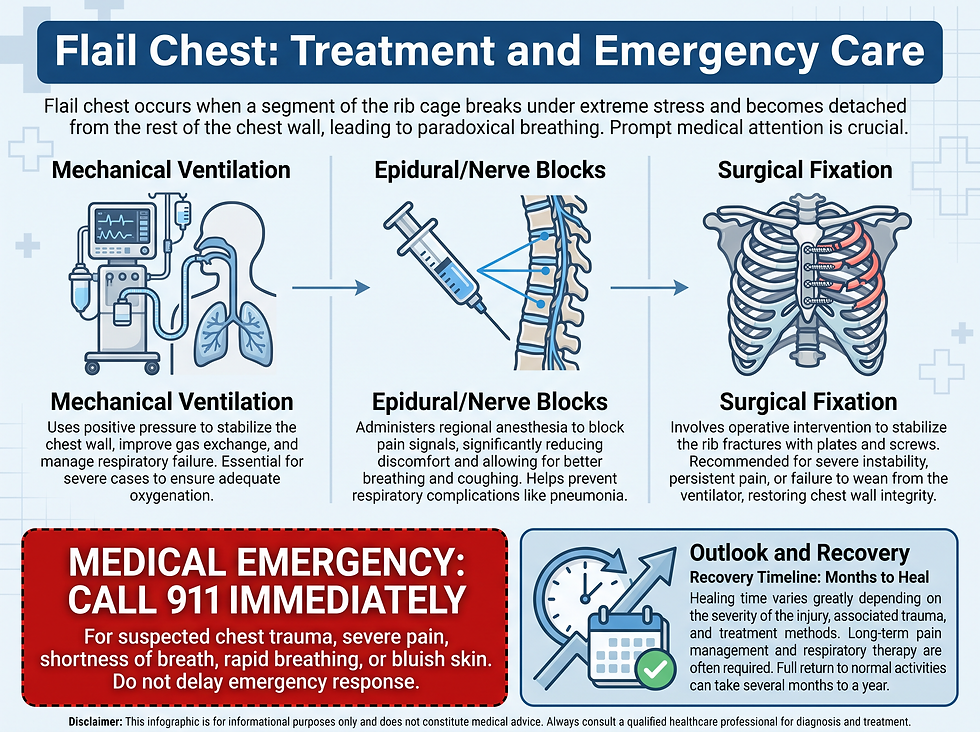
The treatment of flail chest is multi-staged, focusing first on stabilizing the patient's breathing and then on managing pain and preventing infection. Most patients require a stay in the Intensive Care Unit (ICU).
Respiratory Support
Ensuring the body gets enough oxygen is the highest priority. Depending on the severity, this may involve:
Supplemental Oxygen: Delivered via a mask or nasal prongs.
CPAP or BiPAP: Non-invasive machines that provide continuous air pressure to keep the lungs expanded.
Mechanical Ventilation: In severe cases, a breathing tube and ventilator are used to breathe for the patient until the chest wall stabilizes.
Pain Management
Effective pain control is critical because if it hurts too much to breathe, the patient will take shallow breaths, which leads to lung collapse and pneumonia.
IV Medications: Strong pain relievers delivered directly into the bloodstream.
Epidural Analgesia: A catheter placed in the back to deliver numbing medication to the nerves of the chest wall.
Intercostal Nerve Blocks: Injections of local anesthetic near the broken ribs to block pain signals.
Surgical Rib Fixation
In some cases, surgeons perform a procedure called "internal fixation." They use specialized metal plates and screws to bridge the fractures and hold the ribs in their correct position. This can help the chest wall stabilize faster, reduce the time spent on a ventilator, and decrease long-term deformity.
Treatment Goal | Methods Used |
Oxygenation | Oxygen therapy, CPAP, mechanical ventilation. |
Pain Control | Epidurals, nerve blocks, IV pain medication. |
Infection Prevention | "Pulmonary toilet" (clearing mucus), early mobilization. |
Structural Repair | Surgical rib fixation with metal plates. |
Outlook and Prognosis
The prognosis for flail chest is generally good if the patient receives rapid medical treatment. The speed of intervention is the most significant factor in preventing fatal respiratory failure. However, the road to full recovery is long. Patients typically spend one to two weeks in the hospital, with at least several days in the ICU. A full return to normal activities and strength often takes several months. Long-term, some individuals may experience persistent chest wall pain or a slight decrease in their ability to perform strenuous exercise.
Prevention Strategies
While accidents cannot always be avoided, the risk of sustaining a flail chest injury can be significantly reduced through safety measures and health maintenance.
Seatbelt Safety: Always wear a seatbelt properly; it is the most effective defense against chest trauma in a vehicle.
Fall Prevention: Use ladders safely, install grab bars in bathrooms for those at risk, and remove tripping hazards from the home.
Protective Gear: Athletes in high-impact sports should always wear recommended chest protectors and safety equipment.
Bone Health: Maintain strong bones through adequate calcium and vitamin D intake, and follow medical advice for managing osteoporosis.
When to See a Healthcare Provider
Any significant blow to the chest warrants a medical evaluation. However, certain signs indicate a life-threatening emergency that requires immediate intervention.
Seek Immediate Emergency Care (Call 911) If: | Contact a Provider for Follow-up If: |
You have severe chest pain after an injury. | You have a persistent cough after your injury. |
You are struggling to catch your breath. | You feel unusually tired during physical activity. |
Your chest moves unevenly when you breathe. | You have lingering pain that doesn't improve. |
Your skin, lips, or nails look blue or gray. | You have concerns about your chest's shape. |
You feel dizzy, faint, or extremely weak. | You need guidance on returning to exercise. |
A Note from the Care Team
"Flail chest is a serious and possibly life-threatening condition. It’s normal for your stress hormones to race after a major accident and prevent you from realizing how hurt you are. But if you experience chest trauma, pause for a moment. If you’re having a hard time breathing or every breath causes intense pain, you need immediate help. You’ll need plenty of time to recover. And even after you start to heal, you must keep up with breathing exercises to prevent any problems. If you have any issues in the aftermath of the injury, ask your providers for help."
Frequently Asked Questions
What exactly defines a flail chest?
Flail chest is defined as having three or more adjacent ribs broken in at least two places each, creating a segment of the chest wall that is no longer structurally attached to the rest of the rib cage.
What is paradoxical breathing?
Paradoxical breathing is the hallmark sign of flail chest. It occurs when the detached "flail segment" of the chest moves in the opposite direction of the rest of the chest wall during the breathing cycle—moving in during inhalation and out during exhalation.
Is flail chest always a medical emergency?
Yes. Flail chest is considered a life-threatening medical emergency because it severely impairs breathing and is often accompanied by dangerous internal injuries like lung bruising or a collapsed lung.
What is the most common cause of flail chest?
The most common cause is high-impact blunt force trauma, which most frequently occurs during motor vehicle accidents, significant falls, or high-impact sports collisions.
Can you die from flail chest?
Yes, if left untreated, flail chest can lead to respiratory failure, internal bleeding, and death. However, with rapid medical intervention, the prognosis for recovery is generally good.
How is the pain from flail chest managed in the hospital?
Pain is typically managed through a combination of IV medications, epidural catheters to numb the chest wall, and intercostal nerve blocks near the site of the fractures.
Will I need a ventilator if I have flail chest?
Many patients with flail chest require mechanical ventilation to help them breathe and to provide internal stabilization for the chest wall while the ribs begin to heal.
What is "surgical rib fixation"?
It is a surgical procedure where metal plates and screws are used to bridge the rib fractures, holding the bones in place so they can heal properly and stabilizing the chest wall.
How long does it take to recover from flail chest?
Initial hospital recovery often takes one to two weeks, but a full recovery to normal activities and physical strength can take several months.
What is a pulmonary contusion?
A pulmonary contusion is a bruise of the lung tissue. It frequently occurs alongside flail chest and is dangerous because it prevents the lungs from properly exchanging oxygen.
Can osteoporosis increase the risk of flail chest?
Yes. Weakened bones from osteoporosis make the ribs more fragile, meaning they can break in multiple places even with less extreme force than would be required for healthy bones.
What should I do if I see someone with uneven chest movement after an accident?
Call 911 immediately. Do not attempt to move the person unless they are in immediate danger, and keep them as calm and still as possible until emergency responders arrive.
Can flail chest cause a collapsed lung?
Yes, a collapsed lung (pneumothorax) is a common complication of flail chest, occurring when air leaks into the space between the lung and the chest wall.
What is "pulmonary toilet"?
Pulmonary toilet refers to a set of techniques used to clear mucus and secretions from the lungs, which is vital for preventing pneumonia during the recovery from a chest injury.
Will my chest look different after a flail chest injury?
In some cases, a permanent change in the shape or structure of the chest wall can occur, though surgical fixation helps to minimize this deformity.
References
Barlotta KS, et al. - Flail Chest, The Atlas of Emergency Medicine (2021)
Medical Disclaimer: The information provided in this article is for educational purposes only and should not be considered medical advice. Flail chest is a life-threatening emergency. If you suspect a chest injury, seek immediate emergency medical care or call 911.
Comments