Thoracic Aortic Aneurysm Surgery: Open Repair vs. TEVAR, Risks and Recovery

Updated: 6 days ago
Written and medically reviewed by Dr. Baraa Alnahhal, MD · Last reviewed: October 2026 · How we review
Quick Answer: What is thoracic aortic aneurysm surgery?
Thoracic aortic aneurysm surgery is a procedure that repairs a bulge in the chest section of the aorta to lower the risk of a life-threatening rupture. Surgeons use either open repair, which replaces the weak section with a synthetic graft, or TEVAR, a minimally invasive stent graft placed through the groin. Surgery may be recommended above 5.5 centimeters. [1]
What the research says
TEVAR carries lower early risk, while open repair holds up better over time. A 2025 meta-analysis of 29 studies covering 49,972 patients found that endovascular repair had lower postoperative mortality (odds ratio 0.57). Open repair showed better all-cause survival beyond 16 months and fewer repeat aortic procedures. (Liu et al., International Journal of Surgery, 2025) [2]
TEVAR shortens time in intensive care and in hospital. Pooled data from 13 studies (14,580 patients) showed an average ICU stay of 4.5 days after endovascular repair vs. 8.5 days after open repair, and a hospital stay of 5.7 vs. 9.5 days. Paraplegia, kidney failure and heart complications were more frequent after open repair; vascular complications were more frequent after TEVAR (5.29% vs. 1.17%). (Harky et al., Annals of Vascular Surgery, 2019) [3]
Spinal cord injury is uncommon after TEVAR but remains a key risk. A systematic review of 41 studies reported spinal cord ischemia in 0% to 10.6% of patients after endovascular repair of the descending thoracic aorta, with permanent symptoms in 0% to 5.1%. (Lella et al., Journal of Vascular Surgery, 2022) [4]
Key takeaways
Thoracic aortic aneurysms are rare, affecting about 1 in every 10,000 people. [1]
Not every thoracic aortic aneurysm needs surgery; the decision depends on size, symptoms and overall health. [1]
Surgery may be recommended when the aneurysm is 5.5 cm or larger, or grows 0.5 cm or more in a year; lower thresholds apply for some genetic conditions. [1]
The two main options are open repair through the chest and TEVAR through a blood vessel in the groin. [1]
Hospital stay is about three days after TEVAR and up to 10 days after open repair. [1]
Most people return to their usual routine within two to three months. [1]
Thoracic aortic aneurysm surgery at a glance
Feature | Open repair | TEVAR |
Approach | Long incision along the side of the chest | Small incision in the groin; catheter guided to the chest |
What the surgeon does | Removes the damaged section and sews in a synthetic graft | Places a mesh stent graft inside the diseased section |
First recovery stop | Intensive care unit (ICU) for a day or two | Hospital stay; mild bruising and pain are possible |
Hospital stay | Up to 10 days | About 3 days |
Activity limits | Limit physical activity for 4–6 weeks | Daily activities within a couple of weeks; no strenuous activity for about 4 weeks |
Source: [1]
What is a thoracic aortic aneurysm?
A thoracic aortic aneurysm is a bulge that forms at a weak spot in the part of the aorta that runs through the chest. [1] The aorta is the large artery that carries blood from the heart to the rest of the body. It starts at the heart, travels through the chest and abdomen, and ends at the pelvis. [1]
When the artery wall weakens, that section can balloon outward. [1] These aneurysms do not always rupture, but a rupture is life-threatening. [1]
For a full look at symptoms, causes and screening, read our thoracic aortic aneurysm guide. Aneurysms can also form lower down, in the belly; see our abdominal aortic aneurysm guide and our overview of aortic aneurysm types.
Who needs thoracic aortic aneurysm surgery?
Thoracic aortic aneurysm surgery is recommended for people whose rupture risk is higher than the risk of the operation itself. [1] Not everyone with this type of aneurysm needs surgery. [1]
Your care team weighs three main factors: [1]
The aneurysm's size and growth, tracked with imaging scans
Your symptoms
Your overall health
What size thoracic aortic aneurysm needs surgery?
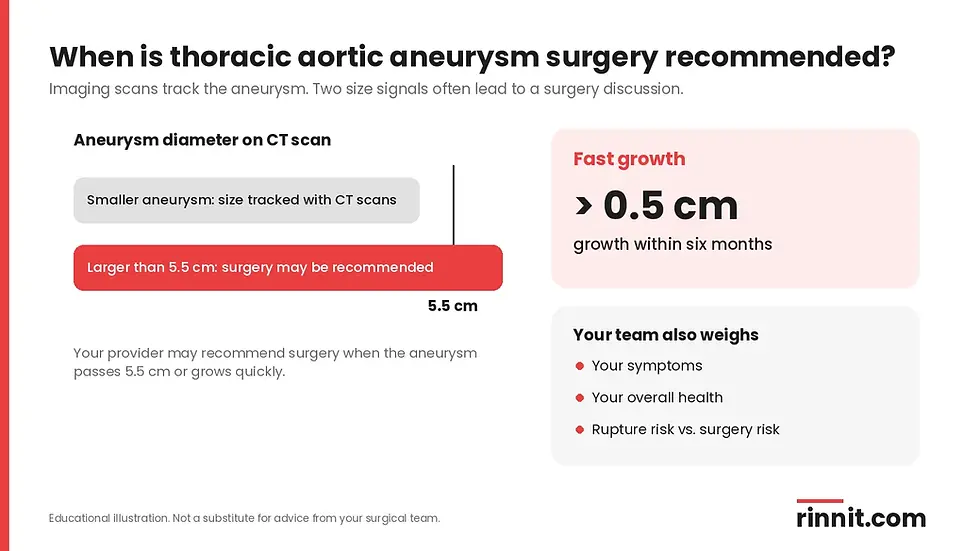
A thoracic aortic aneurysm larger than 5.5 centimeters may need surgery. [1] Your provider may also recommend surgery if the aneurysm has grown 0.5 centimeters or more in a year, or at a smaller size if you have certain genetic conditions. [1]
CT scans are the usual tool for monitoring aneurysm size over time. [1]
Imaging finding | What it may mean |
Aneurysm below 5.5 cm and stable | Size is usually monitored with repeat scans |
Aneurysm larger than 5.5 cm | Surgery may be recommended |
Growth of 0.5 cm or more in a year | Surgery may be recommended |
Source: [1]
What are the types of thoracic aortic aneurysm surgery?
The two types of thoracic aortic aneurysm surgery are open thoracic aneurysm repair and thoracic endovascular aortic repair (TEVAR). [1]
Open thoracic aneurysm repair is open surgery through a long incision along the side of the chest. The surgeon removes the damaged portion of the aorta and replaces it with a synthetic tube called a graft. [1]
TEVAR is a minimally invasive procedure. The surgeon threads a thin, hollow tube (catheter) through a blood vessel in the groin up to the aorta, then places a small mesh device (stent) that repairs the diseased section and restores normal blood flow. [1]
The right choice depends on several factors, including the size of the aneurysm and your overall health. [1]

How do you prepare for thoracic aortic aneurysm surgery?
Preparing for thoracic aortic aneurysm surgery starts with imaging scans that confirm surgery is needed, followed by specific instructions from your provider. [1]
Never stop a blood thinner on your own. Follow the exact plan your surgical team gives you.
If high blood pressure is part of your picture, our guide to high blood pressure explains how it is measured and managed.
What happens during open thoracic aortic aneurysm repair?
Open thoracic aortic aneurysm repair replaces the weakened section of the aorta with a synthetic graft through a chest incision. [1] The surgeon: [1]
Makes a large incision along the side of the chest.
Uses special tools to stop blood flow temporarily in the affected segment of the aorta.
Replaces the damaged section with a synthetic graft.
Closes the incision with stitches.
What happens during TEVAR?
TEVAR repairs a thoracic aortic aneurysm from inside the blood vessel using a stent placed through the groin. [1] The provider: [1]
Inserts a catheter and special wires through an artery in the groin.
Guides the catheter up to the thoracic aorta.
Injects contrast dye through the catheter to see the aorta clearly.
Uses CT or X-ray guidance to position the stent accurately.
Removes the catheter and wires and places a bandage over the groin incision.
For more detail on the endovascular option, see the TEVAR patient page from the Society for Vascular Surgery.
What happens after thoracic aortic aneurysm surgery?
What happens after thoracic aortic aneurysm surgery depends on the type of repair. [1]
After open repair | After TEVAR | |
Immediately after | Move to the intensive care unit (ICU), then to another hospital area after a day or two | Mild bruising and pain are possible |
Total hospital stay | Up to 10 days | About 3 days |
Pain control | Medicines as needed | Medicines as needed |
Source: [1]
What are the risks of thoracic aortic aneurysm surgery?
Thoracic aortic aneurysm repair can save a life, but it is major surgery with real risks. [1] Possible complications include: [1]
Bleeding
Disrupted blood flow to the spinal cord
Heart attack
Infection
Loss of kidney function
Pneumonia or other breathing problems
Stroke
Weakness in the legs
Studies comparing the two approaches show a trade-off. Paraplegia, kidney failure and heart complications are more common after open repair, while vascular complications are more common after TEVAR. [3] Spinal cord ischemia after endovascular repair of the descending thoracic aorta has been reported in up to 10.6% of patients, with permanent symptoms in up to 5.1%. [4]
What are the benefits of thoracic aortic aneurysm surgery?
The main benefit of thoracic aortic aneurysm surgery is a significantly lower risk of aneurysm rupture, which is a life-threatening emergency. [1] This is why surgery is usually advised only when the risk of rupture outweighs the risk of the operation. [1]
How long is recovery after thoracic aortic aneurysm surgery?
Recovery after thoracic aortic aneurysm surgery takes most people two to three months before they are back to their usual routine. [1]
Recovery milestone | Open repair | TEVAR |
Hospital stay | ICU, then up to 10 days total | About 3 days |
Activity limits | Limit physical activity for 4–6 weeks | Daily activities within a couple of weeks; avoid strenuous activity for about 4 weeks |
Back to usual routine | Within 2–3 months | Within 2–3 months |
Source: [1]

How successful is thoracic aortic aneurysm surgery?
Thoracic aortic aneurysm surgery is highly successful with either approach. [1] In TEVAR, the stent is placed successfully in as many as 99% of procedures, and open surgery is also a highly successful operation. [1]
Long-term results differ between the two. A large pooled analysis shows lower early mortality after TEVAR, but better all-cause survival beyond 16 months and fewer repeat aortic procedures after open repair. [2] Your surgeon will weigh these trade-offs against your age, health and aneurysm anatomy.
When should you call a doctor after thoracic aortic aneurysm surgery?
You should call your healthcare provider after thoracic aortic aneurysm surgery if you notice any sign of a complication or infection, including: [1]
A bulge around the incision site
Excessive redness around the incision site
A fever of 100.4°F (38°C) or higher
Pain that does not go away
Swelling
Conclusion
Thoracic aortic aneurysm surgery is a lifesaving option for many people with a large or fast-growing aneurysm in the chest. [1] Open repair replaces the damaged section through the chest, while TEVAR lines it from the inside through a small groin incision. [1] TEVAR offers a shorter hospital stay and lower early risk, while open repair tends to hold up better over the long term. [2] [3]
The best choice is personal. It depends on your aneurysm's size and growth, your symptoms and your overall health. [1]
Your next step: If you or a loved one has a thoracic aortic aneurysm, bring this guide to your next appointment and ask your vascular surgeon which repair fits your case, and what your recovery plan will look like. To understand the condition itself, read our complete thoracic aortic aneurysm guide, and learn the warning signs of a related emergency in our aortic dissection guide.
Related reading: Marfan syndrome · Ehlers-Danlos syndrome · Aortopathy explained · Aortic valve replacement
FAQ
Is thoracic aortic aneurysm surgery major surgery?
Thoracic aortic aneurysm surgery is major surgery, even though it can be lifesaving. Risks include bleeding, infection, stroke, heart attack, kidney problems and reduced blood flow to the spinal cord. [1]
What size thoracic aortic aneurysm needs surgery?
A thoracic aortic aneurysm larger than 5.5 centimeters may need surgery. Surgery may also be recommended if the aneurysm grows 0.5 centimeters or more in a year. [1]
Does every thoracic aortic aneurysm need surgery?
Not every thoracic aortic aneurysm needs surgery. The decision depends on the aneurysm's size, your symptoms and your overall health, and smaller aneurysms are often monitored with CT scans. [1]
Which is better, open repair or TEVAR?
Neither open repair nor TEVAR is best for everyone; the choice depends on the aneurysm's size and your overall health. The largest pooled analysis shows TEVAR has lower early mortality and shorter hospital stays, while open repair shows better long-term survival and fewer repeat procedures. [1] [2] [3]
How long do you stay in the hospital after thoracic aortic aneurysm surgery?
The hospital stay after TEVAR is usually about three days. After open repair, patients spend a day or two in intensive care and stay in hospital for up to 10 days. [1]
How long does recovery take after thoracic aortic aneurysm surgery?
Most people are back to their usual routine within two to three months after thoracic aortic aneurysm surgery. Activity is limited for four to six weeks after open repair, and strenuous activity is avoided for about four weeks after TEVAR. [1]
What is the success rate of TEVAR?
The stent is placed successfully in as many as 99% of TEVAR procedures. Open thoracic aortic aneurysm surgery is also highly successful. [1]
When should I call my doctor after thoracic aortic aneurysm surgery?
Call your doctor after thoracic aortic aneurysm surgery if you have a bulge or excessive redness at the incision, a fever of 100.4°F (38°C) or higher, swelling, or pain that does not go away. [1]
Will I need scans after TEVAR?
Yes. People who have TEVAR need regular imaging, often CT scans, for the long term to check that the stent graft stays in place and does not leak. Your surgeon will set the schedule.
Can thoracic aortic aneurysm surgery cause paralysis?
Rarely, surgery on the chest aorta can reduce blood flow to the spinal cord and cause leg weakness or paralysis. Surgeons take steps to protect the spinal cord, and any new leg weakness or numbness after surgery needs emergency care.
Related Reading
Open Aneurysm Surgery: Procedure, Recovery and Outlook explains open aneurysm surgery.
References
Cleveland Clinic. Thoracic Aortic Aneurysm Surgery. Cleveland Clinic. Last updated May 25, 2022. https://my.clevelandclinic.org/health/treatments/17527-thoracic-aortic-aneurysm-surgery
Liu J, Gou D, Xu K, et al. Comparison of short- and long-term outcomes between endovascular and open repair for descending thoracic aortic aneurysm: a systematic review and meta-analysis. Int J Surg. 2025;111(3):2662-2674. PMID 39869368. https://doi.org/10.1097/JS9.0000000000002230
Harky A, Kai Chan JS, Ming Wong CH, et al. Open versus Endovascular Repair of Descending Thoracic Aortic Aneurysm Disease: A Systematic Review and Meta-analysis. Ann Vasc Surg. 2019;54:304-315.e5. PMID 30081163. https://doi.org/10.1016/j.avsg.2018.05.043
Lella SK, Waller HD, Pendleton A, et al. A systematic review of spinal cord ischemia prevention and management after open and endovascular aortic repair. J Vasc Surg. 2022;75(3):1091-1106. PMID 34740806. https://doi.org/10.1016/j.jvs.2021.10.039
Medical disclaimer
This article is for general education only and does not replace professional medical advice, diagnosis or treatment. Decisions about aneurysm monitoring or surgery should be made with a qualified vascular or cardiothoracic surgeon who knows your full medical history. If you have sudden, severe chest, back or belly pain, call your local emergency number right away.



Comments