Testosterone Replacement Therapy (TRT): Benefits, Side Effects, and Who It's For

Updated: 6 days ago
Written and medically reviewed by Dr. Baraa Alnahhal, MD · Last reviewed: October 2026 · How we review
Quick Answer: What is testosterone replacement therapy?
Testosterone replacement therapy (TRT) is a long-term treatment that uses manufactured testosterone to raise low levels in men with male hypogonadism, a medical condition affecting the testicles, pituitary gland or hypothalamus. It can improve sex drive, energy, mood and bone density, but it does not cure the cause and needs regular blood tests. [1]
What the research says
Heart safety held up in a large trial. Among 5,246 men aged 45 to 80 with low testosterone and existing or high-risk heart disease, major heart events (heart-related death, heart attack or stroke) occurred in 7.0% of men using testosterone gel versus 7.3% on placebo over about 33 months of follow-up. Atrial fibrillation, acute kidney injury and pulmonary embolism were more common with testosterone. (Lincoff et al., N Engl J Med, 2023) [5]
Erections improved by a meaningful margin. Pooling data from 17 trials and 3,431 men, testosterone raised the erectile function score by 2.14 points over placebo, enough to count as a real improvement for mild erectile dysfunction, regardless of age, weight, diabetes or starting testosterone level. It did not significantly improve depressive symptoms. (Hudson et al., Lancet Healthy Longev, 2023) [6]
No rise in heart or stroke events in the short to medium term. Across 35 placebo-controlled trials (5,601 men), heart and stroke events (reported in 13 trials) affected 7.5% of men on testosterone and 7.2% on placebo, with no meaningful difference. Treatment also improved quality of life and sexual function. (Cruickshank et al., Health Technol Assess, 2024) [7]
Key takeaways
TRT is approved for men with confirmed low testosterone linked to a medical condition (hypogonadism). [1][4]
Diagnosis needs two morning blood tests showing low testosterone, plus other checks to make sure treatment is safe. [1][3]
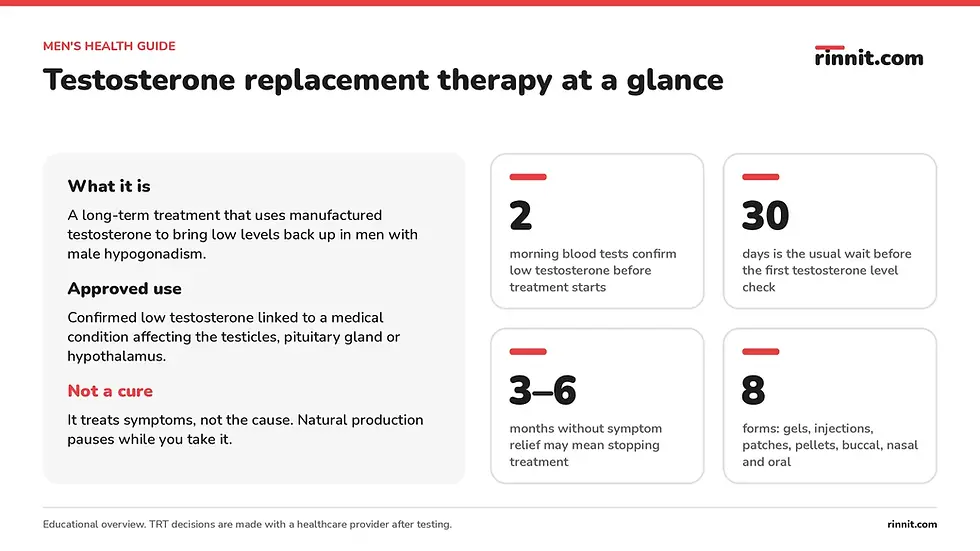
TRT comes in 8 forms, from daily gels to pellets placed every 3 to 6 months. [1]
Benefits include better sexual function, mood, energy, lean body mass and bone density. [1]
TRT lowers sperm count and can cause infertility, so it is not a good fit if you are planning biological children. [1]
If symptoms don't improve after 3 to 6 months, your provider may recommend stopping. [1]
What is testosterone replacement therapy?
Testosterone replacement therapy is a treatment in which you take a manufactured form of testosterone to bring low levels of this hormone back to a normal range. [1]
It is used for men with male hypogonadism, a condition in which the body doesn't make enough testosterone. [1]
TRT helps with symptoms such as low sex drive and lack of energy. It is a decision you and your healthcare provider make together after weighing the benefits and risks. [1]
Who is testosterone replacement therapy for?
Testosterone replacement therapy is approved for males whose low testosterone comes from a known medical condition called hypogonadism. [1]
Hypogonadism develops when one of the organs that controls testosterone production is damaged or doesn't work properly. [1]
Organ involved | Its role in testosterone | Example of what can go wrong |
Testicles | Make testosterone | Damage from chemotherapy or radiation therapy |
Signals the testicles to make testosterone | Damage from treatment or a genetic condition | |
Hypothalamus | Signals the pituitary gland | Damage from treatment or a genetic condition |
No testosterone product is approved for men with low testosterone who have no associated medical condition. [4]
Product labels have also said that safety and effectiveness were not established for low testosterone related to aging. In June 2026, the U.S. Food and Drug Administration asked manufacturers to remove that statement from the labels. [4] Your provider will still confirm the diagnosis with testing before recommending treatment. [1]
What tests happen before starting testosterone replacement therapy?
Before starting testosterone replacement therapy, your provider confirms the diagnosis and checks that treatment is safe for you through a medical history, a physical exam and blood tests. [1]
Blood test | What it checks |
Two morning testosterone tests | Confirm that testosterone is truly low [3] |
Hemoglobin and hematocrit | Starting red blood cell levels, since TRT can raise them |
Liver function tests | How well your liver is working |
Luteinizing hormone (LH) | Your level of this hormone |
PSA (prostate-specific antigen) | A starting PSA level, since TRT can raise it |
Prolactin | Your level of this hormone |
Treatment should start only after two separate morning tests both show a low testosterone level. [3]
How does testosterone replacement therapy work?
Testosterone replacement therapy works by supplying testosterone from outside the body, which raises your blood level and eases the symptoms of low testosterone. [1]
TRT does not fix the underlying cause. While you take it, your testicles stop making their own testosterone, so you need to keep taking the medication to maintain a normal level. [1]
If you stop, your body needs time to restart its own production. [1]
What are the different forms of testosterone replacement therapy?
Testosterone replacement therapy comes in eight forms that differ mainly in how they enter the body and how often you use them. [1][2]

Form | How often | What to know |
Skin gel | Daily | Applied to clean, dry skin; wash your hands and cover the area, because gel passed to children or women can cause serious effects. One of the most common forms. |
Intramuscular injection | Every 1 to 2 weeks | Some long-acting types are given every 10 weeks, but only in a medical office. |
Subcutaneous injection | Weekly | Given under the skin. |
Skin patch | Daily | Change the location to avoid skin reactions. |
Pellets | Every 3 to 6 months | Implanted under the skin by a provider; gives steady, long-term dosing. |
Buccal tablet | Twice a day | A sticky tablet placed on the gums; absorbs quickly into the blood. |
Nasal gel | 3 times a day | Applied into each nostril. |
Oral pill | Twice a day | Swallowed by mouth. |
Your provider helps you choose the best option. Whichever form you use, follow-up blood tests check your testosterone level and make sure treatment isn't harming your health. [1]
What are the benefits of testosterone replacement therapy?
Testosterone replacement therapy can improve many symptoms of low testosterone in men with hypogonadism. [1]
TRT may improve:
Sexual function, including symptoms of erectile dysfunction linked to low testosterone
Lean body mass
Bone mineral density, which matters for osteoporosis risk
Mood
Energy levels
Sense of well-being
What are the side effects of testosterone replacement therapy?
Testosterone replacement therapy can cause side effects that range from skin changes to lower fertility, along with changes on blood tests. [1]

Side effect | What it means |
Acne or oily skin | Skin changes from higher testosterone |
Ankle swelling | Caused by mild fluid retention |
Prostate stimulation | Can lead to urinary symptoms |
Breast enlargement (gynecomastia) or tenderness | Growth or soreness of breast tissue |
Worse sleep apnea | Existing obstructive sleep apnea can get worse |
Smaller testicles | Because the testicles stop making testosterone |
Skin irritation | With gels or patches applied to the skin |
Lower sperm count | Can lead to male infertility |
Blood tests during treatment may also show:
A higher PSA level
A higher red blood cell count, which thickens the blood
Who should not use testosterone replacement therapy?
Testosterone replacement therapy should be avoided by people with certain health conditions because it can make those conditions worse. [1]
You shouldn't use TRT if you have:
Untreated heart failure
Untreated obstructive sleep apnea
Had a heart attack or stroke within the past six months
A history of high red blood cell counts
Untreated prostate cancer
A prostate lump that hasn't been checked
Planning to have children? TRT can lower sperm count and cause fertility problems. Restoring fertility after TRT can be expensive and take a long time, so it is best avoided if you want biological children. [1]
TRT is meant for medical use only. Using testosterone for bodybuilding or to try to prevent aging isn't worth the health risks. [1]
Is testosterone replacement therapy safe for your heart?
Testosterone replacement therapy is generally safe for people without the conditions listed above, though long-term evidence over decades is limited and some studies have mixed results. [1]
Here is how the evidence has shifted:
Year | What happened |
2015 | The U.S. Food and Drug Administration warned that testosterone use may be linked to higher cardiovascular risk, based on two studies. [1] |
2023 | A large randomized trial of 5,246 men found testosterone gel did not raise major heart events compared with placebo over a medium-length period. [5] |
2024 | A review of 35 trials found no difference in heart and stroke events in the short to medium term. [7] |
2026 | After reviewing the 2023 trial, the U.S. Food and Drug Administration found no new safety signal for serious heart outcomes. [4] |
Some studies suggest TRT lowers heart attack risk over time, while others suggest it raises it. Research on venous thromboembolism (blood clots) also shows mixed results. [1]
Because of this, your provider weighs your personal health history before deciding whether TRT is safe for you. Testosterone can also raise blood pressure, so your provider should check it regularly during treatment. [1]
How long does testosterone replacement therapy take to work?
Testosterone replacement therapy usually takes a few weeks before you notice changes in your body and mood, though timing varies from person to person. [1]
Time on TRT | What to expect |
First few weeks | Early changes in body and mood may begin |
About 30 days | First testosterone level check, once therapy has had time to take effect |
3 to 6 months | If symptoms haven't improved, your provider may suggest stopping, since low testosterone may not be the cause |
Long term | Continue as long as it helps and doesn't cause health problems, with regular blood tests |
Can you stop testosterone replacement therapy?
Yes, you can stop testosterone replacement therapy once you've started, and your testosterone will return to its starting level. [1]
People stop TRT when:
Side effects are bothersome
Treatment isn't improving symptoms
A new health condition makes TRT unsafe
After stopping, your body takes some time to restart its natural testosterone production. Talk with your provider before you stop. [1]
When should you see a healthcare provider about testosterone replacement therapy?
You should see your healthcare provider about testosterone replacement therapy for regular check-ups and blood tests, and any time treatment isn't working as expected. [1]
Book an appointment if:
Your symptoms haven't improved
Side effects are causing you distress
You want to try a different form of testosterone
You're thinking about stopping TRT
You develop a health condition that could make TRT unsafe
Conclusion
Testosterone replacement therapy can ease the symptoms of low testosterone caused by hypogonadism, improving sexual function, energy, mood and bone health for many men. It is a long-term treatment, not a cure, and it requires careful testing before you start and regular monitoring after.
The most important steps are confirming the diagnosis with morning blood tests, choosing a form that fits your routine, and reviewing your progress at 3 to 6 months. If you are planning a family or have heart, prostate or sleep conditions, these need to be part of the conversation from day one.
Living with symptoms of low testosterone? You don't have to put up with them. Write down your symptoms and questions, and book a visit with your healthcare provider to ask whether testing and TRT are right for you. To learn more about the condition behind TRT, read our guide to male hypogonadism, and explore more men's health guides on our site.
FAQ
What is testosterone replacement therapy (TRT)?
Testosterone replacement therapy (TRT) is a treatment that uses manufactured testosterone to raise low testosterone levels in men with male hypogonadism. TRT eases symptoms such as low sex drive and low energy, but it does not cure the underlying cause.
Who is a good candidate for testosterone replacement therapy?
Testosterone replacement therapy is meant for men with confirmed low testosterone linked to a medical condition affecting the testicles, pituitary gland or hypothalamus. A provider confirms the diagnosis with two morning blood tests before recommending it.
How long does testosterone replacement therapy take to work?
Testosterone replacement therapy usually takes a few weeks before you notice changes in your body and mood. Providers typically check your testosterone level about 30 days after you start, and may suggest stopping if symptoms haven't improved after 3 to 6 months.
Is testosterone replacement therapy safe for the heart?
Testosterone replacement therapy did not increase major heart events compared with placebo in a large randomized trial of 5,246 men over a medium-length period. Long-term evidence over decades is still limited, so your provider reviews your heart health before you start.
Does testosterone replacement therapy affect fertility?
Testosterone replacement therapy lowers sperm count and can cause infertility. Restoring fertility after TRT can be expensive and take a long time, so TRT is usually avoided if you plan to have biological children.
Can you stop testosterone replacement therapy once you start?
Testosterone replacement therapy can be stopped at any time with your provider's guidance, and testosterone returns to its starting level. Your body needs some time to restart its own production after you stop.
When should you see a healthcare provider about testosterone replacement therapy?
A healthcare provider should be seen for regular blood tests during TRT and whenever symptoms don't improve, side effects are distressing, or a new health condition develops. Also book a visit if you want to switch forms or stop treatment.
What tests are needed before starting TRT?
Your provider confirms low testosterone with two separate morning blood tests. Other blood tests usually check red blood cell levels, liver function, PSA and certain hormones before treatment starts.
What forms of testosterone replacement therapy are there?
TRT comes as skin gels, patches, injections, pellets placed under the skin, nasal gel, tablets that stick to the gums and pills. Your provider helps you pick a form that fits your health and routine.
What are the common side effects of TRT?
Common side effects include acne or oily skin, mild ankle swelling and changes on blood tests, such as a higher red blood cell count. TRT can also lower sperm production, which is why regular follow-up tests matter.
Related Reading
Bioidentical Hormones: Uses, Safety and Side Effects explains bioidentical hormone therapy.
References
Cleveland Clinic. Testosterone Replacement Therapy (TRT): What It Is. Cleveland Clinic. Last updated January 16, 2025. https://my.clevelandclinic.org/health/treatments/testosterone-replacement-therapy-trt
Barbonetti A, D'Andrea S, Francavilla S. Testosterone replacement therapy. Andrology. 2020;8(6):1551-1566. PMID 32068334. https://doi.org/10.1111/andr.12774
Petering RC, Brooks NA. Testosterone Therapy: Review of Clinical Applications. Am Fam Physician. 2017;96(7):441-449. PMID 29094914. https://pubmed.ncbi.nlm.nih.gov/29094914/
U.S. Food and Drug Administration. Testosterone Information. FDA. Last updated June 23, 2026. https://www.fda.gov/drugs/postmarket-drug-safety-information-patients-and-providers/testosterone-information
Lincoff AM, Bhasin S, Flevaris P, et al. Cardiovascular Safety of Testosterone-Replacement Therapy. N Engl J Med. 2023;389(2):107-117. PMID 37326322. https://doi.org/10.1056/NEJMoa2215025
Hudson J, Cruickshank M, Quinton R, et al. Symptomatic benefits of testosterone treatment in patient subgroups: a systematic review, individual participant data meta-analysis, and aggregate data meta-analysis. Lancet Healthy Longev. 2023;4(10):e561-e572. PMID 37804846. https://doi.org/10.1016/S2666-7568(23)00169-1
Cruickshank M, Hudson J, Hernández R, et al. The effects and safety of testosterone replacement therapy for men with hypogonadism: the TestES evidence synthesis and economic evaluation. Health Technol Assess. 2024;28(43):1-210. PMID 39248210. https://doi.org/10.3310/JRYT3981
Medical disclaimer
This article is for educational purposes only and does not replace professional medical advice, diagnosis or treatment. Always talk with a qualified healthcare provider before starting, changing or stopping testosterone replacement therapy or any other treatment.



Comments