Bioidentical Hormones: Uses, Safety and Side Effects

Updated: 2 days ago
Written and medically reviewed by Dr. Baraa Alnahhal, MD · Last reviewed: November 2026 · How we review
Quick Answer
Bioidentical hormones are plant-derived, processed hormones designed to match the hormones your body makes, mainly used to ease menopause and perimenopause symptoms. Some are FDA-approved; compounded versions aren't FDA-approved or tested for safety. Claims that they're safer than traditional hormone therapy aren't backed by large studies. They can raise the risk of blood clots, stroke and gallbladder disease.
What the research says
Evidence on compounded hormones is limited: 29 mostly short-term trials of 1,808 women found compounded bioidentical hormones didn't worsen cholesterol or blood sugar and vaginal androgens eased vaginal atrophy, but no trials measured breast cancer, endometrial cancer or heart disease risk (Liu Y et al., Menopause, 2022) [2]
Many users don't know compounded products aren't approved: two U.S. surveys estimated 1 to 2.5 million women aged 40 and older use compounded hormones, and 86% of women didn't know these products aren't FDA-approved (Pinkerton JV et al., Menopause, 2015) [3]
Key takeaways
Bioidentical hormones are designed to match your body's own hormones.
They're mainly used for menopause symptoms.
Compounded versions aren't FDA-approved or tested.
They carry risks similar to other hormone therapy.
Full effects usually take about three months.
What are bioidentical hormones?
Hormones are chemical messengers made by your endocrine glands. Bioidentical hormone therapy (BHRT) uses processed hormones from plants to replace low or missing hormones. Evidence that they work as well as conventional hormone therapy is limited. Sources: [1]
What they're used for

They may not be safe with clotting disorders, heart disease, breast cancer or stroke.
Hot flashes and night sweats.
Vaginal dryness, low sex drive or painful sex.
Sleep problems and fatigue.
Weight gain.
Mood changes, memory loss or confusion. Sources: [1]
They may not be safe if you have a blood clotting disorder, heart disease, breast cancer or a history of stroke. Sources: [1]
FDA-approved vs. compounded

Many major medical groups don't support compounded hormones.
Feature | FDA-approved | Compounded |
Who makes it | Drug companies | A pharmacist, custom-mixed |
FDA approval | Yes, for certain types | No |
Tested for safety and effectiveness | Yes | No |
Side effect reporting | Required | Not required |
Many major medical groups don't support compounded hormones. Sources: [1, 2, 3]
Forms
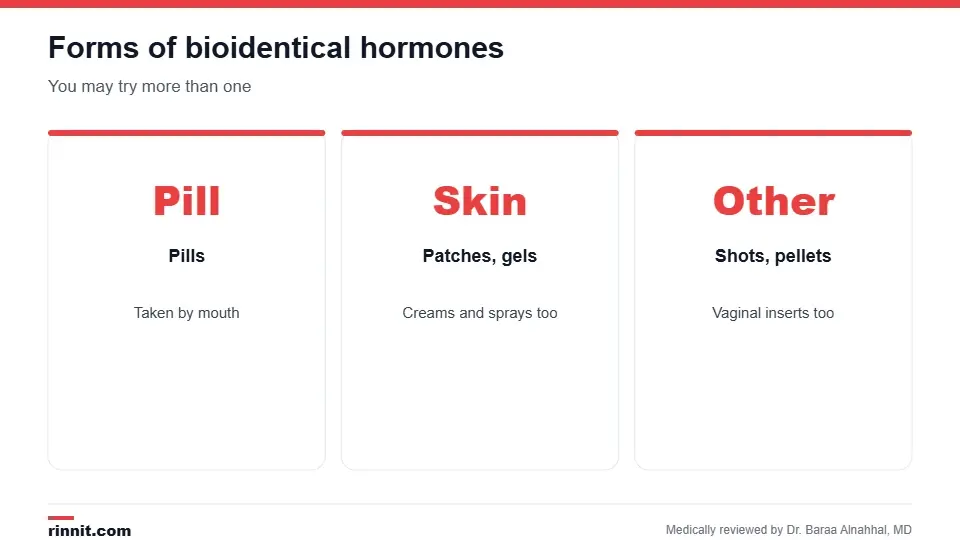
You may try more than one form.
Pills.
Patches.
Creams, gels or sprays.
Shots.
Vaginal inserts.
Implanted pellets. Sources: [1]
How treatment works
The goal is symptom relief at the lowest dose for the shortest time. Some providers use blood, urine or saliva tests, but the FDA recommends against using hormone levels to guide dosing in women because levels change daily. Sources: [1]
Risks and side effects
Higher risk of blood clots, stroke and gallbladder disease.
Heart disease and breast cancer risk may rise with age or long-term use.
Weight gain, acne, headaches or blurred vision.
Breast tenderness, spotting, cramping or bloating.
Mood swings or tiredness.
Itching or redness with patches, creams or gels. Sources: [1]
Side effects often improve as your body adjusts, but your dose may need to change. Sources: [1]
Results
Bioidentical hormones work for some people, and results vary. Some feel mild relief within a few weeks, but most take about three months to feel the full effect. Your provider may recommend traditional hormone therapy instead. Sources: [1]
When to call your provider
Contact your provider about any side effect that's hard to manage or doesn't go away quickly, which may mean your hormone levels are too high. Sources: [1]
Conclusion
Bioidentical hormones can ease menopause symptoms for some people, but compounded versions aren't tested or approved. Talk with your provider about FDA-approved options and the lowest effective dose.
Keep learning: read about menopause hormone therapy and menopause.
Frequently asked questions
What are bioidentical hormones?
Plant-derived hormones designed to match the body's own hormones.
What are they used for?
Mainly to ease menopause and perimenopause symptoms.
Which hormones are used?
Estrogen, progesterone and testosterone.
Are bioidentical hormones FDA-approved?
Some are; compounded versions aren't.
Are they safer than regular hormone therapy?
Large studies don't support that claim.
What are the risks?
Blood clots, stroke and gallbladder disease, among others.
How long until they work?
Some feel relief in weeks; most take about three months.
Can saliva tests guide my dose?
The FDA recommends against using hormone levels to guide dosing in women.
What forms are available?
Pills, patches, creams, gels, sprays, shots, inserts and pellets.
Who shouldn't use them?
People with clotting disorders, heart disease, breast cancer or past stroke may not be able to.
Related Reading
Hormone Therapy for Menopause: Benefits, Risks and Types traditional menopause hormone therapy.
Understanding Menopause: Stages, Symptoms, and Management an overview of menopause.
Perimenopause: Symptoms, Causes, and Treatments Explained the transition to menopause.
Testosterone Replacement Therapy (TRT): Benefits, Side Effects, and Who It's For testosterone treatment.
HRT and Blood Clots: Menopause Hormone Pills vs Patches in a Major 2026 Study clot risk by hormone form.
References
Cleveland Clinic. Bioidentical Hormones: Therapy, Uses, Safety & Side Effects. Cleveland Clinic. Last updated April 15, 2022. https://my.clevelandclinic.org/health/treatments/15660-bioidentical-hormones
Liu Y, Yuan Y, Day AJ, et al. Safety and efficacy of compounded bioidentical hormone therapy (cBHT) in perimenopausal and postmenopausal women: a systematic review and meta-analysis of randomized controlled trials. Menopause. 2022;29(4):465-482. PMID 35357369. https://doi.org/10.1097/GME.0000000000001937
Pinkerton JV, Santoro N. Compounded bioidentical hormone therapy: identifying use trends and knowledge gaps among US women. Menopause. 2015;22(9):926-936. PMID 25692877. https://doi.org/10.1097/GME.0000000000000420
Medical disclaimer
This article is for general education only and does not replace advice from a qualified healthcare professional. Talk to your doctor about your own diagnosis and treatment, and seek emergency care right away for severe or sudden symptoms.



Comments