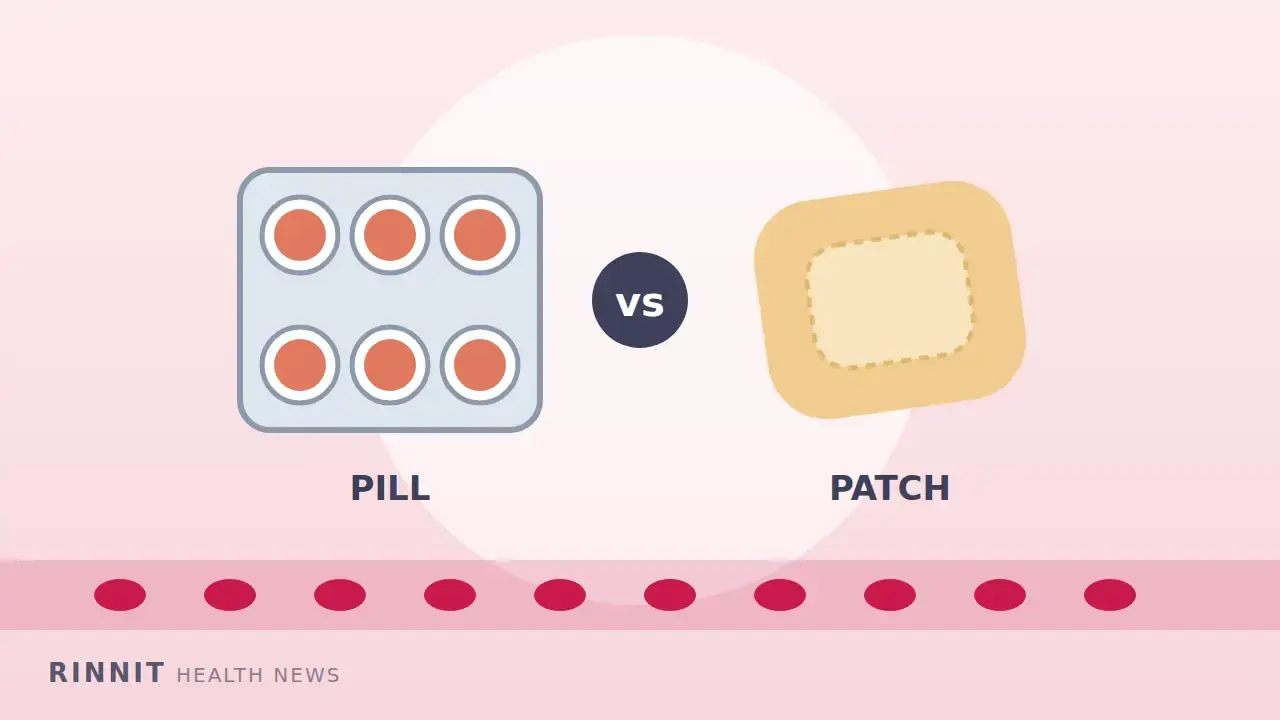
HRT and Blood Clots: Menopause Hormone Pills vs Patches in a Major 2026 Study

Updated: 2 days ago
Written and medically reviewed by Dr. Baraa Alnahhal, MD · Last reviewed: September 2026
Menopausal hormone therapy taken as a pill was linked to higher rates of blood clots, stroke and heart attack in a nationwide Danish study published in The BMJ on 23 September 2026 — while the same hormones delivered through the skin as patches or gels showed no overall increase. The absolute risks were small. The difference between swallowing the hormone and absorbing it through skin was not. Here is what the new data on HRT and blood clots means for women using or considering hormone therapy.

Key takeaways
Women currently taking oral estrogen had about a 60% higher rate of venous blood clots, a 30% higher rate of ischaemic stroke and a 20% higher rate of heart attack than women not using hormone therapy.
In absolute terms, that worked out to roughly one extra clot per 1,055 women per year of use, one extra stroke per 1,642, and one extra heart attack per 3,846.
Transdermal therapy — patches and gels — showed no overall increase in any of the three outcomes, with one exception noted below.
Stroke and heart attack risk was concentrated in women taking higher-dose oral estradiol (above 1 mg a day) for more than a year.
This is an observational study. It shows a strong, consistent association; it cannot prove that the pills caused the events.
What did the study actually find?
Researchers led by Julie Berggreen used Denmark's national health registries to compare women aged 50–69 who had a first blood clot, stroke or heart attack between 2003 and 2021 against matched women who did not. Compared with women not currently using any hormone therapy, current users of oral estrogen — alone or combined with a progestin — had higher rates of all three.
The reported risk estimates were 1.6 (95% confidence interval 1.5 to 1.8) for venous thromboembolism, 1.3 (1.2 to 1.4) for ischaemic stroke, and 1.2 (1.1 to 1.3) for heart attack.
Venous thromboembolism means a blood clot that forms in a vein — usually a deep vein in the leg (deep vein thrombosis), which can break loose and travel to the lungs (pulmonary embolism). Ischaemic stroke means a stroke caused by a blocked blood vessel in the brain, as opposed to a bleed.
How big is the risk in real numbers?
Small. Among women not using hormone therapy, the background rates were 15.8 venous clots, 20.3 ischaemic strokes and 13.0 heart attacks per 10,000 women per year. Oral therapy raised those by 0.09%, 0.06% and 0.03% per year respectively.
Researchers express this as "number needed to harm" — how many women would have to take the treatment for one year for one extra event to occur. Here it was 1,055 women for one extra blood clot, 1,642 for one extra stroke, and 3,846 for one extra heart attack.
Outcome | Oral hormone therapy | Transdermal (patch/gel) |
|---|---|---|
Venous blood clot | Risk estimate 1.6 (1.5–1.8) | No overall increase |
Ischaemic stroke | 1.3 (1.2–1.4) | No overall increase |
Heart attack | 1.2 (1.1–1.3) | No overall increase, except combined cyclic patches: 2.1 (1.1–4.1) |
Dose/duration pattern | Clot risk present at all doses and durations; stroke and heart attack risk concentrated at >1 mg/day oral estradiol used >1 year | — |
Source: BMJ 2026;394:e100688. Figures in brackets are 95% confidence intervals.
HRT and blood clots: why would a pill behave differently from a patch?
Because of where the hormone goes first. Swallowed estrogen is absorbed from the gut and passes through the liver before reaching the rest of the body — the "first-pass effect." The liver responds by producing more of the proteins involved in clotting.
Estrogen absorbed through the skin enters the bloodstream directly and largely bypasses that step. Commenting on the study for the Science Media Centre, Professor Robert F. Storey described this as a well-established mechanism that the new data confirm.
Does this mean women should stop taking hormone therapy?
No — and no one involved in the study says that. Hormone therapy remains the most effective treatment for hot flushes and night sweats, as both Mayo Clinic and Cleveland Clinic set out in their patient guidance. What this study adds is a reason to discuss route of delivery and dose, not whether to treat at all.
Stopping hormone therapy abruptly can bring symptoms back sharply. Any change belongs in a conversation with the prescribing clinician.
What should a woman ask her doctor?
Four practical questions follow directly from the findings: Am I on an oral or transdermal form? If oral, what is my daily estradiol dose, and is it above 1 mg? How long have I been on it, and is that duration still justified by my symptoms? Given my personal clot and cardiovascular risk — smoking, weight, family history, previous clots — would a patch or gel be reasonable for me?
What are the limits of this study?
Considerable, and they matter. This was an observational study, so it can show association but not prove cause. The researchers had no data on age at menopause, body mass index, or smoking status — all of which affect both cardiovascular risk and the likelihood of being prescribed hormone therapy.
Professor Storey raised a further point: women with unrecognised cardiac symptoms might stay on treatment longer, which could skew the results. The cohort was Danish, so the findings may not transfer cleanly to more ethnically diverse populations. And the one transdermal signal that did appear — a higher heart attack estimate with combined cyclic patches — came with a wide confidence interval (1.1 to 4.1), meaning that particular number is uncertain.
How does this fit with what was already known?
It sharpens a picture rather than overturning one. Concerns about clot risk with oral estrogen are long-standing, and the oral-versus-transdermal distinction has been part of specialist practice for years. What was missing was contemporary, nationwide data covering current formulations and doses, with enough cases to separate dose and duration. The British Menopause Society characterised the study as reaffirming known benefits and risks by route of administration.
Frequently asked questions
Is the patch safer than the pill for menopause symptoms?
In this study, transdermal therapy showed no overall increase in blood clots, stroke or heart attack, while oral therapy did. That points toward the patch carrying lower thrombotic risk. It is one observational study, and "safer for clots" is not the same as "safer overall" — individual suitability still depends on your full medical history.
What dose of oral estradiol was linked to stroke and heart attack?
Doses above 1 mg per day, taken for more than one year. Risk rose with duration: for women on more than five years of high-dose oral estradiol, the estimates were 1.8 for ischaemic stroke (95% CI 1.4–2.2) and 1.8 for heart attack (1.4–2.4), compared with no current use.
Should I stop my HRT after reading this?
No. Do not stop or change hormone therapy on the basis of a news article. The absolute risks found here were small, the study cannot prove cause and effect, and stopping abruptly can cause symptoms to return. Raise it at your next appointment instead.
Does this apply to vaginal estrogen?
This study examined systemic oral and transdermal therapy. Low-dose vaginal estrogen used for local symptoms was not the focus of these findings, and results should not be assumed to transfer to it. Ask your clinician about your specific product.
How many women were in the study?
The analysis covered 9,807 women with venous thromboembolism, 18,460 with ischaemic stroke and 11,974 with heart attack, each matched to five controls of the same birth year — 49,035, 92,300 and 59,870 respectively.
Health information, not medical advice. This article summarises published research for general information. It is not a substitute for personalised medical advice, diagnosis or treatment. Do not start, stop or change any medication — including menopausal hormone therapy — based on this article. Speak to a qualified healthcare professional about your own circumstances. If you have symptoms of a blood clot (swelling, pain or warmth in one leg; sudden breathlessness or chest pain) or of a stroke (sudden facial droop, arm weakness or speech difficulty), seek emergency care immediately.
Primary source: Berggreen J, Pourhadi N, Wood-Kurland H, Løkkegaard E, Torp-Pedersen C, Meaidi A. Contemporary menopausal hormone therapy and thrombotic disease: nationwide nested case-control study. BMJ 2026;394:e100688. https://doi.org/10.1136/bmj-2026-100688
About the author: Dr. Baraa Alnahhal, MD, is a medical doctor and the founder of Rinnit. Dr. Baraa Alnahhal reviews new medical research and translates it into clear, evidence-based health information for everyday readers.

Comments