FDA Chlorthalidone Dissolution Testing Recall: What to Know

Written and medically reviewed by Dr. Baraa Alnahhal, MD · Last reviewed: September 30, 2026
The FDA chlorthalidone dissolution testing recall covers 13,567 bottles of chlorthalidone 25 mg tablets, a common blood pressure pill, because they failed dissolution specifications. The recalled lot is RISA24002 (NDC 64980-599-01, expiring April 2027). The FDA classified it as a Class II recall on September 17, 2026. It is the second recall of this product for the same problem in 2026 (FDA Enforcement Report; openFDA).
If you take chlorthalidone, do not stop it on your own. Check your lot number with your pharmacist and ask for a replacement if yours is affected.
Key takeaways
What: Chlorthalidone Tablets USP, 25 mg, in 100-tablet bottles, lot RISA24002, NDC 64980-599-01, expiring 04/2027.
Why: "Failed dissolution specifications." The tablets may not release their medicine as expected.
Who: Manufactured by Inventia Healthcare Limited (India) and distributed by Rising Pharma Holdings, Inc. (East Brunswick, New Jersey).
How big: 13,567 bottles, distributed nationwide in the United States.
Risk level: Class II, meaning possible temporary or medically reversible effects, with a remote chance of serious harm.
Repeat problem: In June 2026, 11,460 bottles from two other lots were recalled for the same reason.
What to do: Keep taking your medicine, check your lot with your pharmacist, and watch your blood pressure at home.
Which chlorthalidone is being recalled?
Two recalls of the same chlorthalidone product appear in the FDA's Enforcement Report in 2026. Both are voluntary, started by the company, and still listed as ongoing (openFDA, September recall; openFDA, June recall).
Detail | September 2026 recall | June 2026 recall |
|---|---|---|
FDA recall number | D-0852-2026 | D-0610-2026 |
Product | Chlorthalidone Tablets USP, 25 mg | Chlorthalidone Tablets USP, 25 mg |
Bottle size | 100 tablets | 100 tablets and 1,000 tablets |
NDC | 64980-599-01 | 64980-599-01 (100) and 64980-599-10 (1,000) |
Lot (batch) number | RISA24002 | RISA24001 (100) and RISB24002 (1,000) |
Expiration date | 04/2027 | 04/2027 |
Bottles recalled | 13,567 | 11,460 |
Recall started | September 3, 2026 | June 5, 2026 |
FDA classified | September 17, 2026 (Class II) | June 22, 2026 (Class II) |
Reason | Failed dissolution specifications | Failed dissolution specifications |
Distribution | Nationwide (U.S.) | Nationwide (U.S.) |
Only these lots are part of the recall. Chlorthalidone made by other companies, and other lots from this company, are not included.
What is dissolution testing, and what does "failed" mean?
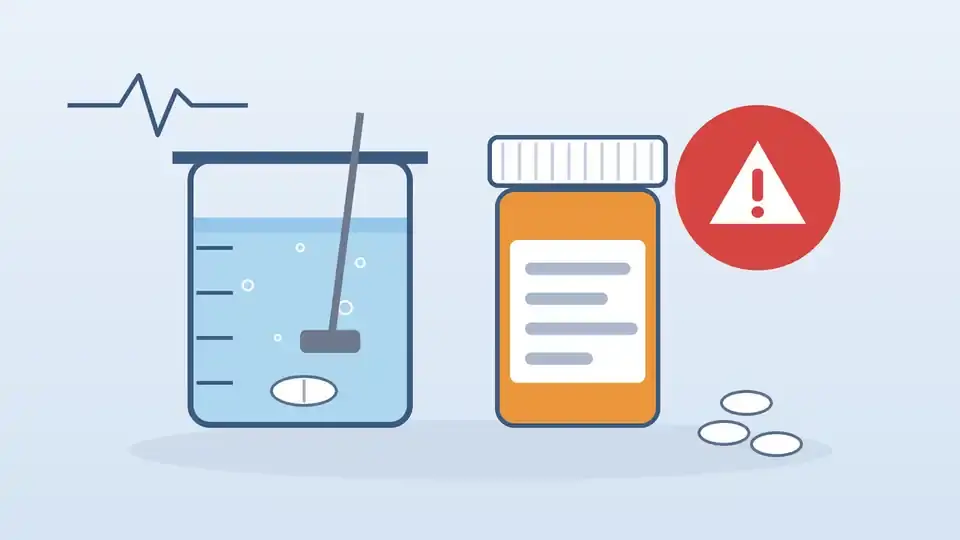
Before a tablet can work, it has to break apart and dissolve in your gut so the medicine can be absorbed into your blood. Dissolution testing checks this in the lab. Tablets are placed in a special liquid at body temperature and stirred, and technicians measure how much of the active ingredient dissolves over a set time.
Each medicine has a target, called a specification. A batch "fails dissolution" when too little of the drug dissolves in the expected time. In simple terms:
Too little medicine may be absorbed, so the dose may be weaker than intended.
The medicine may be absorbed too slowly, so its effect may be delayed or uneven.
It is a quality problem, not a contamination problem. The recall notice does not report a harmful impurity or a wrong ingredient.
For a blood pressure pill, the practical concern is that it might lower blood pressure less than expected.
How serious is a Class II recall?
The FDA sorts recalls into three classes by level of risk (FDA):
Class I: a reasonable probability of serious health problems or death.
Class II: may cause temporary or medically reversible health problems, or the chance of serious harm is remote.
Class III: not likely to cause health problems.
Both chlorthalidone recalls are Class II. Some online reports have called this a Class I recall. The FDA Enforcement Report lists it as Class II.
How to check if your chlorthalidone is affected
Look at your bottle label. Find the drug name and strength: chlorthalidone 25 mg.
Find the NDC and lot number. The recalled product has NDC 64980-599-01 or 64980-599-10 and lot RISA24001, RISA24002 or RISB24002.
Call your pharmacist if you cannot find them. Pharmacies often pour tablets into their own bottles, so your label may not show the maker's lot number. Your pharmacist can look it up.
Check the maker. The recalled tablets are made by Inventia Healthcare and distributed by Rising Pharma. If your pharmacy uses a different maker, your tablets are not part of this recall.
What to do if you have a recalled bottle
Keep taking your medicine until you talk to a professional. Stopping suddenly can make your blood pressure rise.
Call your pharmacy. Ask them to replace your supply with tablets from an unaffected lot or another manufacturer.
Tell your doctor, especially if your blood pressure has been harder to control recently.
Check your blood pressure at home for a few days if you have a home monitor, and share readings that are higher than usual with your doctor. Here is a guide to what your blood pressure numbers mean.
Get emergency help if your reading is higher than 180/120 mm Hg and you have chest pain, shortness of breath, back pain, numbness, weakness, vision changes or trouble speaking. Call 911 or your local emergency number (American Heart Association).
Report problems. You or your doctor can report side effects or quality problems to the FDA MedWatch program.
What is chlorthalidone?
Chlorthalidone is a diuretic, or "water pill." It helps the kidneys remove extra salt and water from the body. Doctors prescribe it for high blood pressure and for fluid build-up (edema). It controls high blood pressure but does not cure it, so people usually take it every day, even when they feel well (MedlinePlus).
Chlorthalidone is often part of treatment for people whose blood pressure is hard to control. Learn more about resistant hypertension and renal hypertension.
Why this recall matters
This is the second dissolution failure for the same product, from the same maker, in about three months. Recalls like this are part of routine quality control, and they show the system catching a problem. For patients, the lesson is simple: know the name, strength and maker of your medicines, and ask your pharmacist whenever you hear about a recall.
Planning to talk to your doctor about it? Our printable list of questions to ask your doctor can help. For the bigger picture, read our plain-language guide to heart health.
Frequently asked questions
Why was chlorthalidone recalled?
Chlorthalidone 25 mg tablets from Inventia Healthcare Limited, distributed by Rising Pharma Holdings, Inc., were recalled because they failed dissolution specifications. That means lab tests showed the tablets may not dissolve and release their medicine as expected.
Which chlorthalidone lot numbers are recalled?
The September 2026 recall covers lot RISA24002 (100-tablet bottles, NDC 64980-599-01, expiring 04/2027). An earlier June 2026 recall covered lot RISA24001 (100-tablet bottles) and lot RISB24002 (1,000-tablet bottles, NDC 64980-599-10), also expiring 04/2027.
Is the chlorthalidone recall a Class I or Class II recall?
Both chlorthalidone recalls are Class II. The FDA uses Class II when a product may cause temporary or medically reversible health effects, or when the chance of serious harm is remote.
Should I stop taking chlorthalidone because of the recall?
No. Do not stop taking chlorthalidone on your own. Stopping a blood pressure medicine suddenly can let your blood pressure rise. Call your pharmacist or doctor, who can check your lot number and arrange a replacement.
What does failed dissolution mean for a tablet?
Dissolution testing measures how fast and how completely a tablet releases its active ingredient in liquid under set lab conditions. A tablet that fails may release too little medicine, or release it too slowly, so it may not work as well as intended.
How do I know if my chlorthalidone is part of the recall?
Look at your pharmacy bottle label or ask your pharmacist. The recalled product is chlorthalidone tablets USP 25 mg with NDC 64980-599-01 or 64980-599-10 and lot RISA24001, RISA24002 or RISB24002. Many pharmacies repackage tablets, so your pharmacist can check the source lot for you.
Health information, not medical advice
This article explains a public FDA recall for general education. It does not replace advice from your own doctor or pharmacist. Never start, stop or change a medicine without talking to a qualified health professional.
Sources
U.S. Food and Drug Administration. Enforcement Report. Recall D-0852-2026, report date September 23, 2026, and recall D-0610-2026, report date June 24, 2026.
openFDA. Drug enforcement record D-0852-2026 and record D-0610-2026.
U.S. Food and Drug Administration. Recalls background and definitions.
MedlinePlus, U.S. National Library of Medicine. Chlorthalidone.
American Heart Association. Hypertensive crisis: when you should call 911 for high blood pressure.
U.S. Food and Drug Administration. MedWatch: the FDA safety information and adverse event reporting program.
About the author: Dr. Baraa Alnahhal, MD, is a medical doctor and the founder of Rinnit. Dr. Baraa Alnahhal reviews new medical research and health news and translates it into clear, evidence-based health information for everyday readers.

Comments